Jenisch Haus and the Ernst Barlach Haus: two museums in the Jenischpark
A neoclassical country house of 1834 and a museum building of 1962 in the same park above the Elbe. A walk through the rooms, architecture and collections of both.
In the Jenischpark above the Elbe stand two museums built almost 130 years apart. Jenisch Haus, built between 1831 and 1834, preserves the domestic world of a Hamburg senator. The Ernst Barlach Haus, opened in October 1962, is devoted to the work of a single sculptor. How both houses fit into the history of the country estates along the river is told in the article on the Elbchaussee. This article goes inside: into the rooms, the architecture and the collections.
Jenisch Haus and the Ernst Barlach Haus: one park, two eras
The Ernst Barlach Haus describes its relationship with its neighbour with some precision. The architect Werner Kallmorgen, it says, designed it as a modern counterpart to the neoclassical Jenisch Haus, a restrained building that settles into the wide parkland on the bank of the Elbe. The museum refers to the older house by its subtitle: “Museum für Kunst und Kultur an der Elbe”, a museum of art and culture on the Elbe.
The contrast is deliberate. On one side stands a country house whose rooms survive largely in their original state and which speaks of guests, servants and celebrations. On the other stands a building made for one purpose only: looking at art.
Jenisch Haus: a white cube above the Elbe
The Stiftung Historische Museen Hamburg describes Jenisch Haus as a three-storey white cube with a Doric portico set in front of it on the side facing the Elbe. Martin Johan Jenisch (1793 to 1857) commissioned the plans from Franz Gustav Forsmann, then had them revised by Karl Friedrich Schinkel. The SHMH counts the house among the significant monuments of neoclassical architecture.
The layout follows the society of its day. The ground floor holds the reception rooms, with rich stucco, parquet floors, furniture, paintings and sculpture from the Empire and Biedermeier periods. The family lived on the first floor, the staff on the lower second floor. From the rooms on the south side the view opens onto the river and its ships.
Today the upper floors are used for temporary exhibitions. They usually deal with art or architecture of the early 19th century, or with the relationship between designed landscape and architecture. Since 2008 Jenisch Haus has been part of the Stiftung Historische Museen Hamburg as a branch of the Altonaer Museum.
The White Hall and the Elbe Salon: the ground floor
To the left of the vestibule lies the White Hall, originally a festive dining room. Its walls and ceiling are entirely stuccoed, and three floor-length windows open eastwards onto the park. The parquet dates from the time the house was built, as does the plain stove in the corner. The chandelier, designed by Schinkel, came to the house from a manor in East Holstein.
In the Jenisch Room, probably conceived as a tea or reading salon, it is worth looking down. The parquet was laid to a design by Forsmann: square panels of oak frame a central field inlaid with a circle of palmettes, wreaths and ribbons, made from partly stained woods and decorative nails.
The Lower Elbe Salon opens through three almost full-height windows onto the portico. From here one stepped out onto the terrace and down stone steps into the park, which is why the SHMH also calls it a garden room. Most of its furnishings date from the French Empire. The seating group in black lacquered and gilded wood originally stood in Georg Friedrich Baur’s house on the Palmaille in Altona. Its chairs, with sphinxes on the armrests, go back to a design by Percier & Fontaine, the leading architects and interior designers of the Empire in Paris.
Music Salon and Upper Elbe Salon: porcelain, wallpaper, sound
The Music Salon is still furnished with instruments. Its centrepiece is an Erard fortepiano of 1838, preserved in playable condition. Above a square piano hangs a photograph by Candida Höfer showing the view from the window onto the Elbe.
One floor up was the senator’s entirely private sitting room, the Upper Elbe Salon. A long table there now carries porcelain made in 1803 by the Royal Prussian Porcelain Manufactory, a gift from King Frederick William III to Caspar Voght in recognition of his work on poor relief. Behind it hangs a panoramic wallpaper from the Paris manufactory of Joseph Dufour, printed by hand with wooden blocks between 1820 and 1825. Its scenes follow a travel novel by Étienne-François Lantier about the voyages of Antenor in Greece. On the west wall hangs a painting by the Altona-born artist Louis Gurlitt showing Teufelsbrück and Klein Flottbek, dated 1850/60.
The Altona Room was also one of the family’s private rooms. It is furnished with pieces that carry a sealing-wax stamp on the back or underside, which between 1766 and 1839 allowed duty-free export to Holstein, Schleswig and Denmark. In the west wing of the first floor, a permanent display is devoted to Caspar Voght, the merchant and social reformer whose model estate is the origin of the park.
Parkomania: the Jenischpark as an exhibition
Until 28 December 2026, Jenisch Haus is showing “Parkomania. Unerzählte Geschichten aus dem Jenischpark”, untold stories from the park. The title refers to the passion for landscape parks that swept through Europe in the 18th century. The SHMH calls Voght’s estate at Klein Flottbek, begun in 1785, the most important ornamented farm in northern Germany, modelled on The Leasowes, the estate of the English poet William Shenstone. Voght wanted to unite the beautiful with the useful. After 1828 Jenisch gave up farming and had the grounds reshaped as a classical landscape park.
The exhibition carries the story up to the present. It covers the park and the house during the National Socialist period and afterwards. For the first time in such depth, it documents the owners’ entanglement in the colonial trade of the 18th and 19th centuries. Because the wet meadows and softwood floodplain of the Flottbek have been protected since 1982 as the Flottbektal nature reserve, it also addresses how the park’s ecosystem can be preserved.
In the lower rooms two artists respond to the park. The painter Susanne Wind shows her cycle “Vier Jahreszeiten Jenischpark”, four seasons in the park, and the photographer Firat Kara shows pictures from his series “Der wilde Garten”. The content of the exhibition will feed into a new permanent display, to be developed as part of the modernisation of the museum planned from 2027.
The Ernst Barlach Haus: a collection born of inner obligation
In August 1934 the Hamburg industrialist Hermann F. Reemtsma visited Ernst Barlach in Güstrow for the first time. Besides Der Asket, which he bought on the spot, he soon commissioned Barlach to complete a series of figures already under way, the Fries der Lauschenden (Frieze of the Listeners). In 1948 Reemtsma described his commitment in these words: everything that followed “was an inner obligation and has nothing to do with patronage”.
When the foundation was established in 1960, the collection comprised around 50 sculptural works and 150 drawings. It has grown considerably since. The sculptures today are in wood, bronze, ceramic, porcelain, terracotta and plaster. They are joined by drawings from every phase of Barlach’s career, autographs, rare portfolios, first editions and archival material.
The museum is famous for its wooden sculptures. With nearly 30 works it holds a third of all the pieces Barlach carved in wood. This is the largest holding of the group of works that mattered most to him. For Barlach’s 150th birthday on 2 January 2020, the museum published the book “Ernst Barlach. Die Hölzer”.
Werner Kallmorgen: a museum on the scale of a house
By its own account, the Ernst Barlach Haus opened as the first private art museum in northern Germany. Behind a plain façade lies a sequence of bright, clearly ordered rooms grouped around a central courtyard. They feel generous, yet their dimensions remain related to those of a private house. Vistas, sightlines, skylights, plinths and niches allow the sculptures to be shown in ever-changing ways.
A few days after the opening, the critic Gottfried Sello wrote in DIE ZEIT that the house was “of today, the most modern museum building in Germany”. He went on: “No shrine to Barlach, no temple.” Reemtsma himself had praised Kallmorgen’s plans in 1960 for their “closedness towards the outside” and the “inner, concentrated organism for the collection”.
In 1995/96 the building was carefully extended. An annexe added a further exhibition room, and the courtyard was covered with a gently vaulted glass roof so that the atrium could serve as a sheltered sculpture garden. In autumn 2019 the lighting was renewed: both its intensity and its colour temperature can now be adjusted continuously between cooler and warmer tones.
Exhibitions at the Ernst Barlach Haus
Alongside the collection, the museum stages focused exhibitions on artists of the 20th century and the present. It turns to classical modernism, to art in and from Hamburg, to private collections and to contemporary sculpture. It has a particular fondness for artists whose importance has so far been underrated. Every exhibition enters into a dialogue with Barlach’s own works. Earlier projects include “Tony Cragg. Against the grain” in 2012 and “Antonio Calderara. Lichträume” in 2018.
Until 7 February 2027 the museum is showing “Joachim Ringelnatz. Es hat sich selbst aus mir gemalt”, an exhibition on the poet and wordsmith as a painter. From 21 February to 6 June 2027 it will be followed by “Weltumarmung. Von hier aus ins Gemeinschaftsglück”.
The names invite confusion. The Barlach Halle K, where Juliane Golbs showed unique works finished with gold cream, gold leaf, acrylic and lacquer from 9 to 11 December 2021, is a separate exhibition venue and not the museum in the Jenischpark.
Gold, garden and light: works for the Jenischpark
Both houses, each in its own way, are about the garden. In Jenisch Haus the panoramic wallpaper, the palmette parquet and the windows onto the park bring the landscape indoors. The Ernst Barlach Haus, with its glazed courtyard, encloses a garden of its own. The painting of Juliane Golbs seeks a similar closeness: pictures that act like gardens within a room.
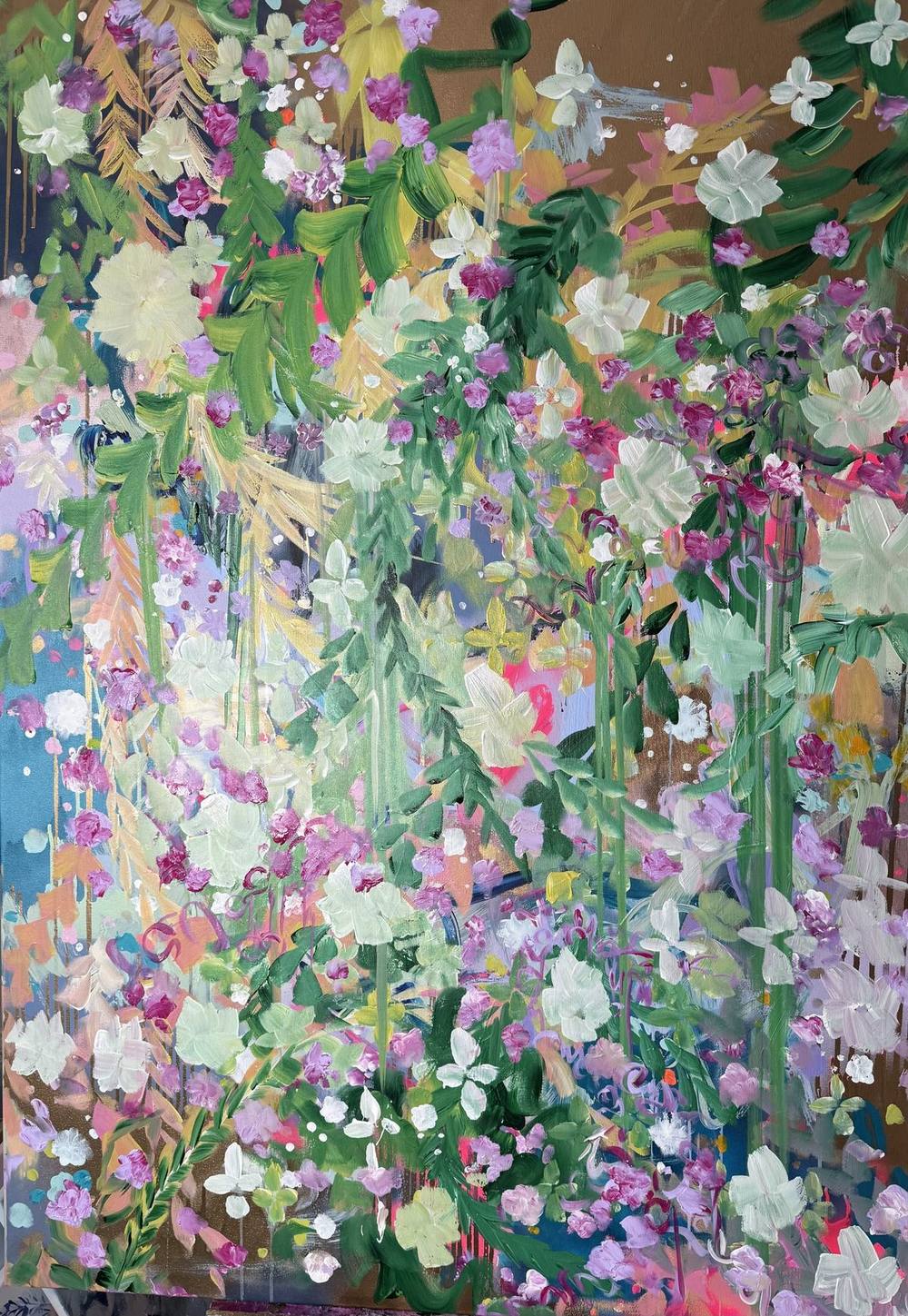
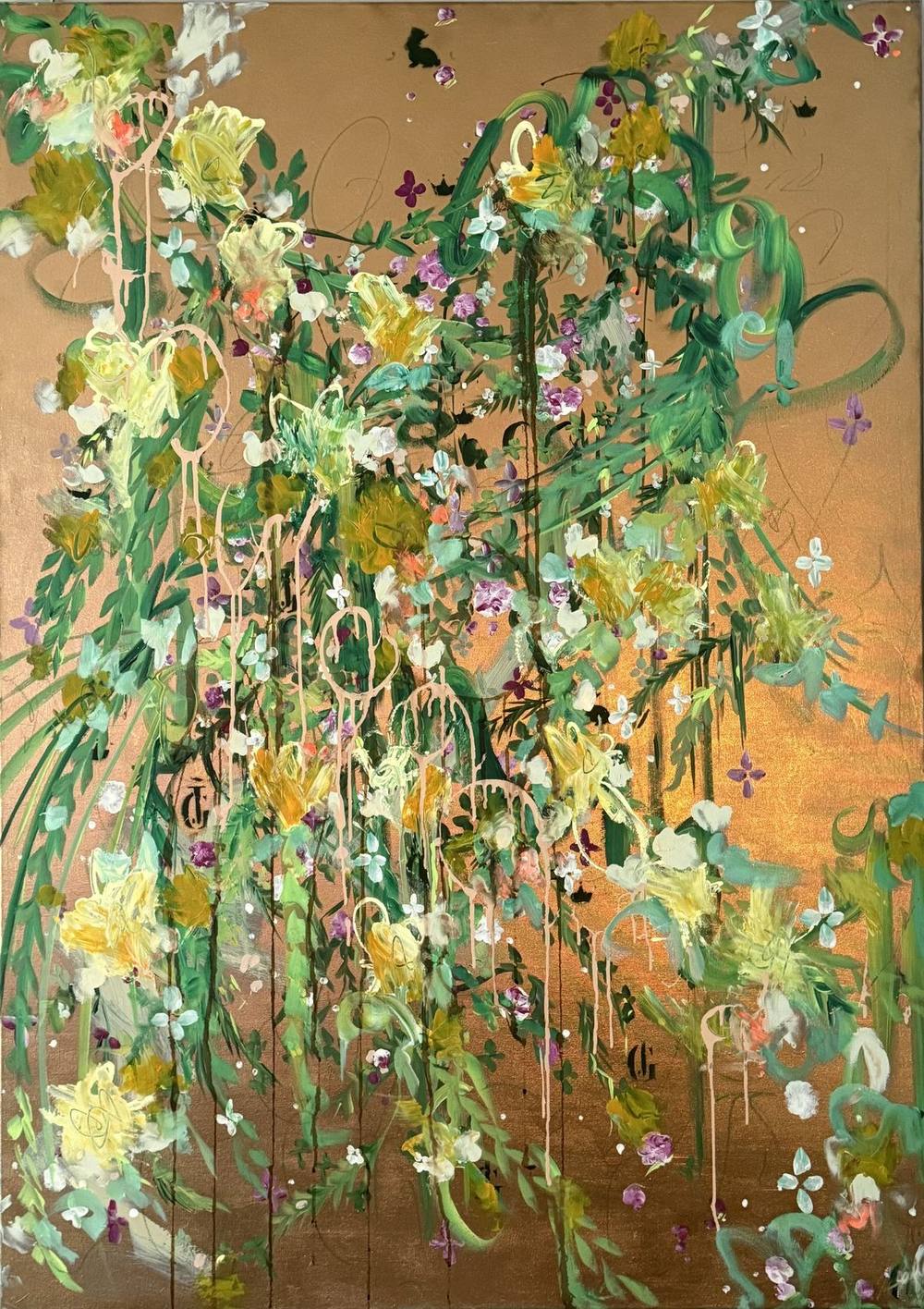
07 | 2025 from the series Fifth Season #heaven can wait lets green tendrils fall across a glowing ground of gold lacquer, caught between blooming and fading. It suits a park whose history “Parkomania” tells as a sequence of growth, reshaping and preservation. 05 | 2025 holds a cascade of blossom and foliage in spontaneous gestures.
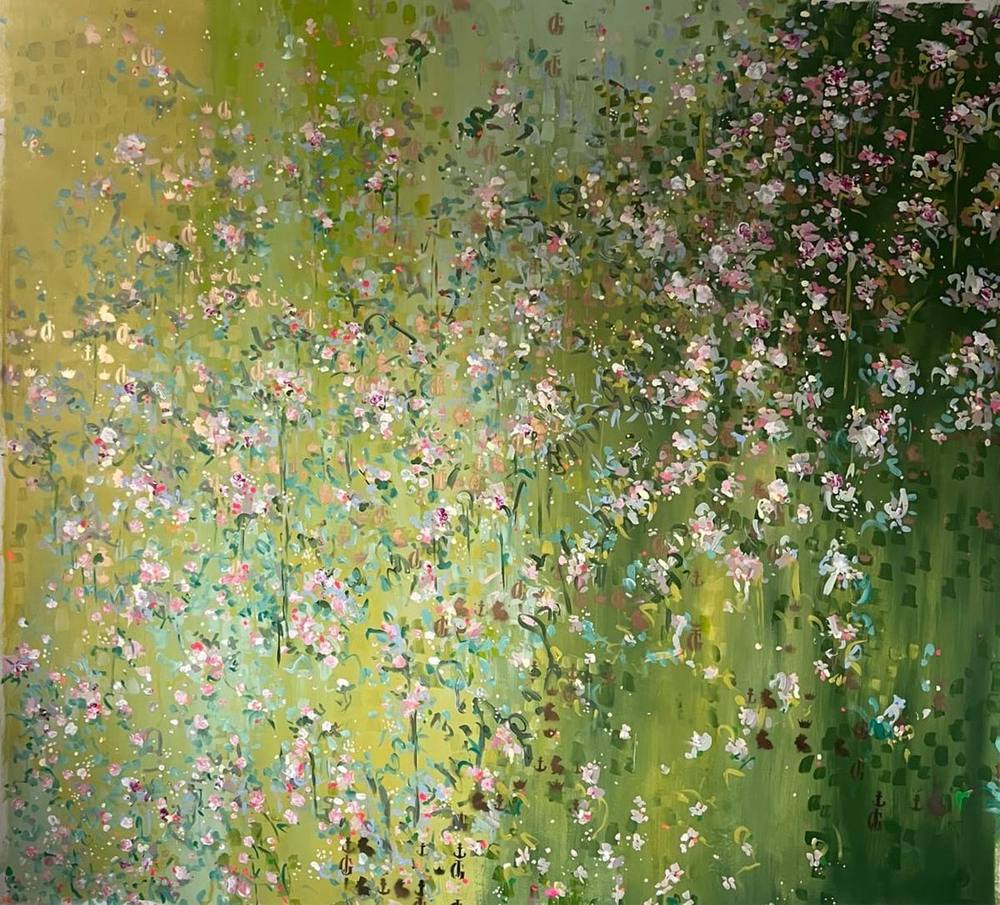
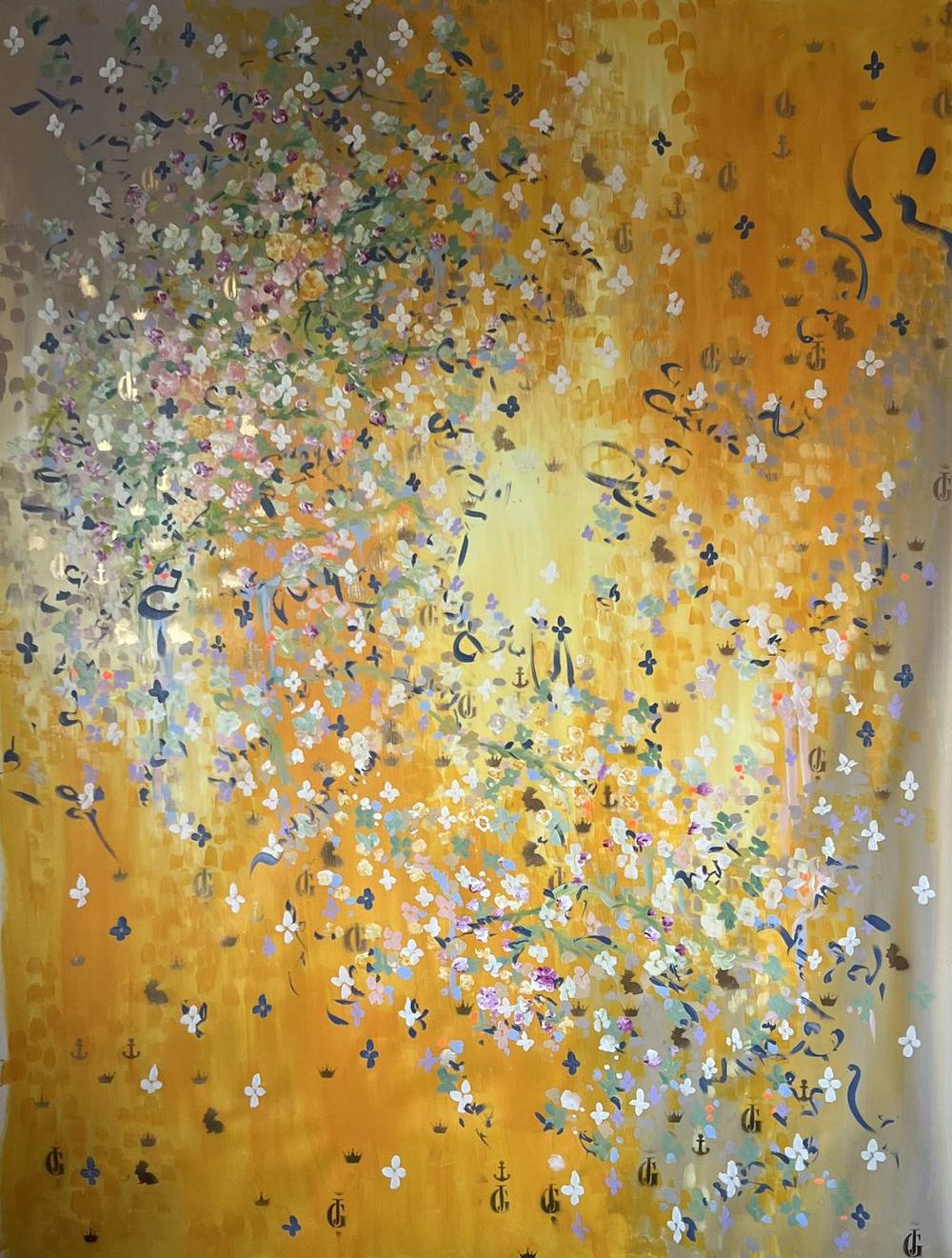
Two works from the series Fifth Season suit tall, quiet rooms. 507 | 2024 spreads a veil of blossom over green and golden layers across two metres by two. 516 | 2024 lets blossoms and signs rise from a golden ground, a light that recalls late afternoons above the Elbe. None of these pictures depicts the Jenischpark. What they share with it is the idea that a garden is nature given form.
Opening hours and admission are given by the two museums on their own websites. Also on the Elbchaussee, in Nienstedten, Juliane Golbs works as artist in residence at the Louis C. Jacob. Her works can be found in the catalogue of works, and a studio visit can be arranged through the contact form.
Works from this article
Frequently asked questions
Who built Jenisch Haus?
Senator Martin Johan Jenisch had the country house built between 1831 and 1834. The plans were drawn up by Franz Gustav Forsmann and revised, at Jenisch’s request, by Karl Friedrich Schinkel. The result is a three-storey white cube with a Doric portico facing the Elbe.
What can you see in Jenisch Haus today?
Historic rooms furnished in styles from the Baroque to the Biedermeier, along with a permanent display on Caspar Voght. The upper floors are used for temporary exhibitions. Since 2008 the house has belonged to the Stiftung Historische Museen Hamburg as a branch of the Altonaer Museum.
What does the Ernst Barlach Haus hold?
According to the museum, around 150 sculptural works, more than 450 drawings, almost all of the prints, as well as autographs, portfolios and archival material. Its nearly 30 wooden sculptures, a third of all Barlach’s works in wood, form the largest holding of this group anywhere.
Is the Barlach Halle K the same as the Ernst Barlach Haus?
No. The Ernst Barlach Haus is the museum in the Jenischpark founded by Hermann F. Reemtsma. The Barlach Halle K is a separate exhibition venue, where Juliane Golbs showed her work in December 2021.
Sources
6 sources
- Stiftung Historische Museen Hamburg: About Jenisch Haus
- Stiftung Historische Museen Hamburg: Permanent exhibition at Jenisch Haus
- Stiftung Historische Museen Hamburg: Parkomania. Untold stories from the Jenischpark
- Ernst Barlach Haus: History of the collection
- Ernst Barlach Haus: Architecture
- Ernst Barlach Haus: Exhibitions