Contemporary female artists in Germany – positions of the present
What does painting by women in Germany look like today? A look at a hard-won history, at defining positions of the present, and at what collectors can take from it.
Anyone looking for contemporary female artists in Germany today finds a field that is larger and more varied than ever. Women painters fill museums and fair halls, shape façades and hotel rooms, work with brands and foundations. None of this can be taken for granted. This article sketches where painting by women in Germany comes from, which positions define the present, and where the Hamburg painter Juliane Golbs stands in this picture. It is explicitly not a ranking.
A hard-won history
For a long time, the path into art was a detour for women in Germany. At the Academy of Arts in Berlin, women were only admitted to study in March 1919. Until then, they were left with private tuition, costly "ladies' classes" or schools of applied arts. An exhibition marking the centenary in 2019, titled "Class Ladies!", recalled this turning point.
How much was created nonetheless can be seen in a building in Bremen. The Paula Modersohn-Becker Museum on Böttcherstraße opened on 2 June 1927, designed by Bernhard Hoetger and commissioned by the merchant Ludwig Roselius. It is regarded as the first museum in the world devoted to the work of a woman painter.
Pioneers of modernism
Two women painters stand at the beginning of what is now called modernism in Germany.
Paula Modersohn-Becker, born in Dresden in 1876, settled in the artists' colony of Worpswede in 1898. She died in 1907, aged only 31. In this short time she created a body of work counted among the most important of early Expressionism: simplified forms, portraits of children and self-portraits, including early female nude self-portraits. What she painted was ahead of its time.
Gabriele Münter, born in Berlin in 1877, co-founded the group Der Blaue Reiter with Wassily Kandinsky and Franz Marc and helped prepare the almanac of 1912. In Murnau am Staffelsee, where she bought a house in 1909, she lived until her death in 1962. For her 80th birthday in 1957 she gave the Städtische Galerie im Lenbachhaus in Munich a large collection: her own paintings, drawings, sketchbooks and prints, together with an extensive holding of works by Kandinsky. Without this gift, the history of the Blaue Reiter would hardly be as visible today.
Both show that painting by women in Germany is no footnote, but part of the core of modernism.
Hamburg has its pioneer, too. Anita Rée, born in Hamburg in 1885, was one of the founding members of the Hamburg Secession in 1919. The Hamburger Kunsthalle showed her first retrospective only in 2017/2018, almost ninety years after her death. More on painting in the city can be found in the article on painters in Hamburg.
What "contemporary" means
Contemporary, first of all, simply means: of today. It refers to artists working in the present whose work is still developing. For collectors, this is a decisive difference from classical modernism. You do not acquire a completed oeuvre, but accompany a practice that continues: new series, new places, new questions. You can meet the artist, visit her studio, talk with her about a work. This closeness is part of the appeal of contemporary art.
Positions of the present
The present no longer knows a shared school, rather a wide spectrum. Two names show how broad it is.
Painting as space: Katharina Grosse
Katharina Grosse, born in Freiburg im Breisgau in 1961, studied in Münster and Düsseldorf and taught as professor of painting at the Kunstakademie Düsseldorf from 2010 to 2018. Since the late 1990s she has applied unmixed acrylic paint with an industrial sprayer – onto walls, floors, trees, entire buildings. In her work, painting leaves the canvas and becomes a space one walks into.
Painting as precision: Karin Kneffel
Karin Kneffel, born in Marl in 1957, was a master student of Gerhard Richter at the Kunstakademie Düsseldorf and has been a professor at the Academy of Fine Arts Munich since 2008. Her still lifes and interiors are of great exactness; she often layers places, objects and memories into pictures in which the gaze never quite comes to rest.
Between these poles – colour as event and the picture as a carefully constructed space – moves much of the painting being made in Germany today.
Visibility and the market
The stage has grown; the market remains uneven. According to Artsy's Women Artists Market Report, as reported by The Art Newspaper, around 9.3 per cent of global auction sales in 2022 went to works by female artists. Across 2012 to 2022, the share was around 6 per cent.
For collectors, this is more than a statistic. It means that many strong positions have not yet arrived in the prices and collections that would match their standing. Those who acquire works by women artists today do not collect out of duty, but with an eye for what art history is now catching up on.
Hamburg: the studio of Juliane Golbs
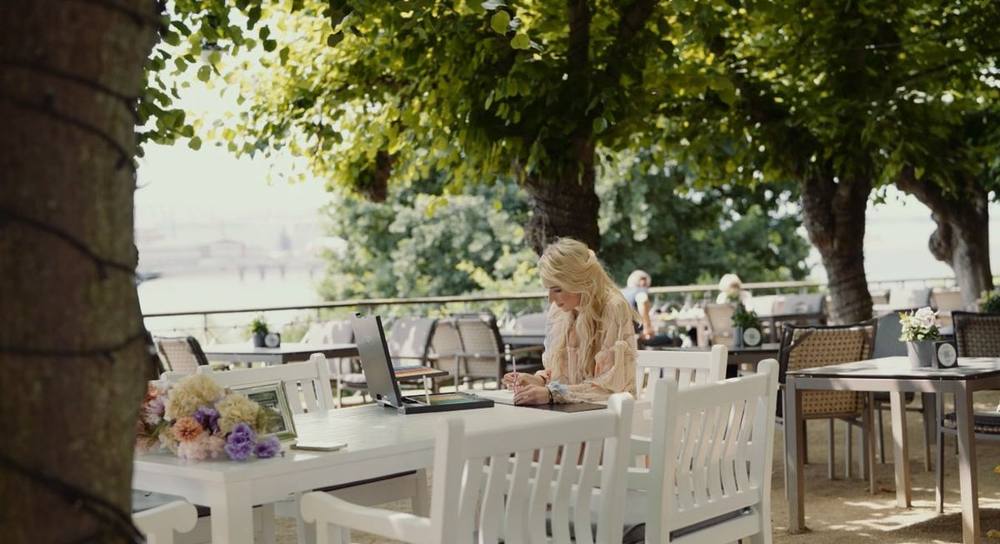
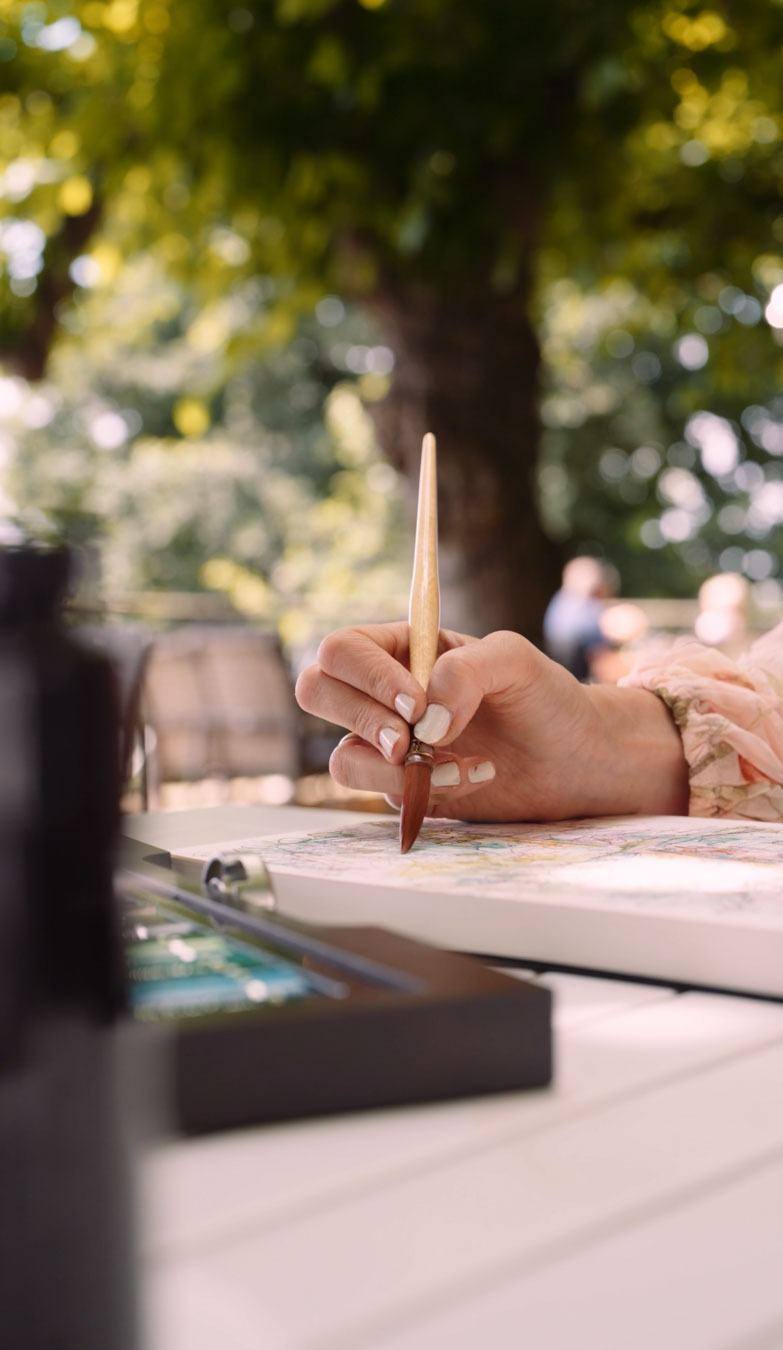
Juliane Golbs works in Hamburg. Born in Schwerin, she moved to Hamburg at eighteen, and the city became her chosen home. Her painting combines floral and romantic motifs with an expressive line, often completed with 24-carat gold leaf or gold lacquer.
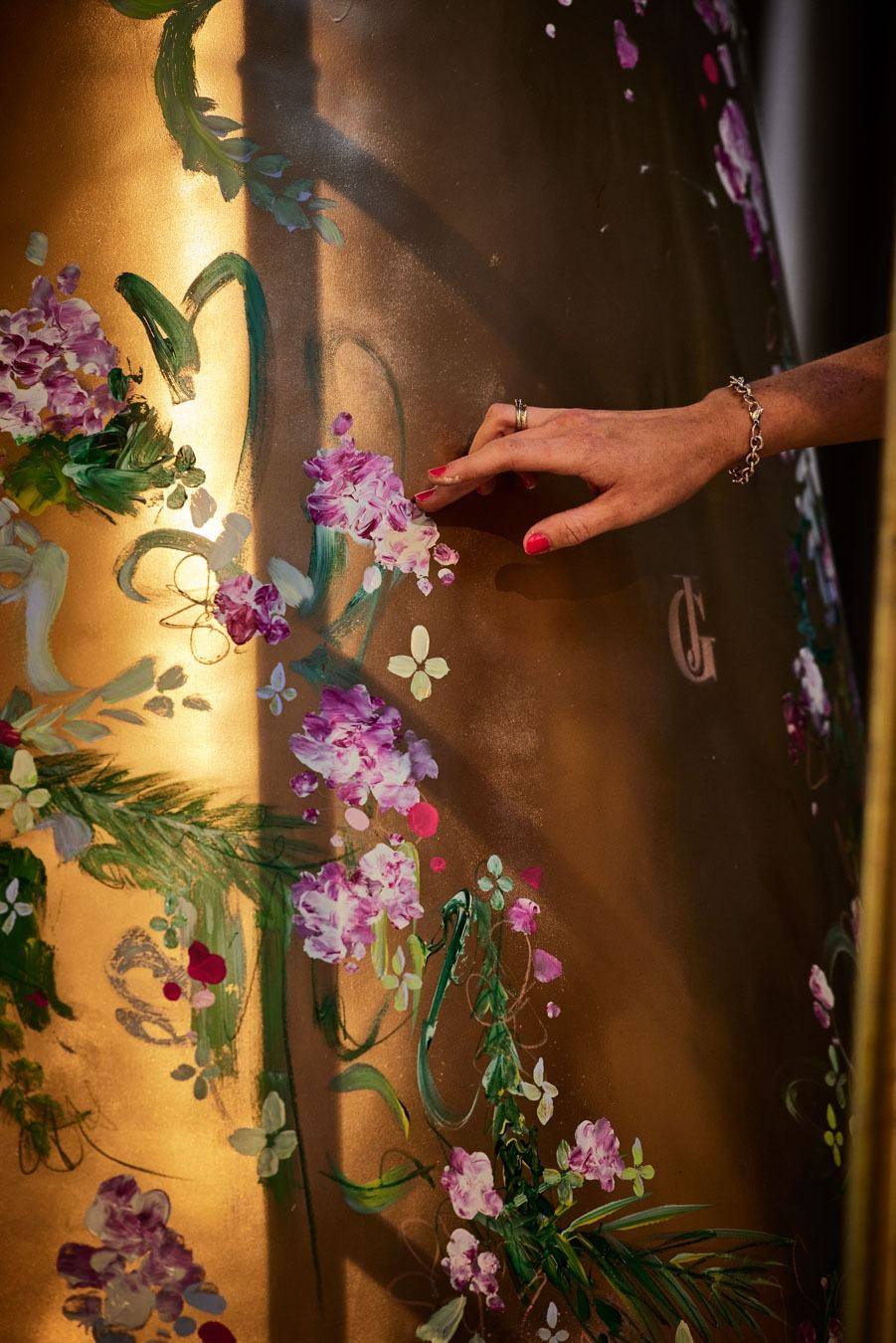
Her works are ordered in series that can be read as atmospheres: Fifth Season on lived time and the light of the present; its continuation Heaven can't wait with stronger drawn traces; Golden Things as a study of gold and light; Everlasting Blossoms as floral abstraction; and the Signature Collection with the JG monogram.
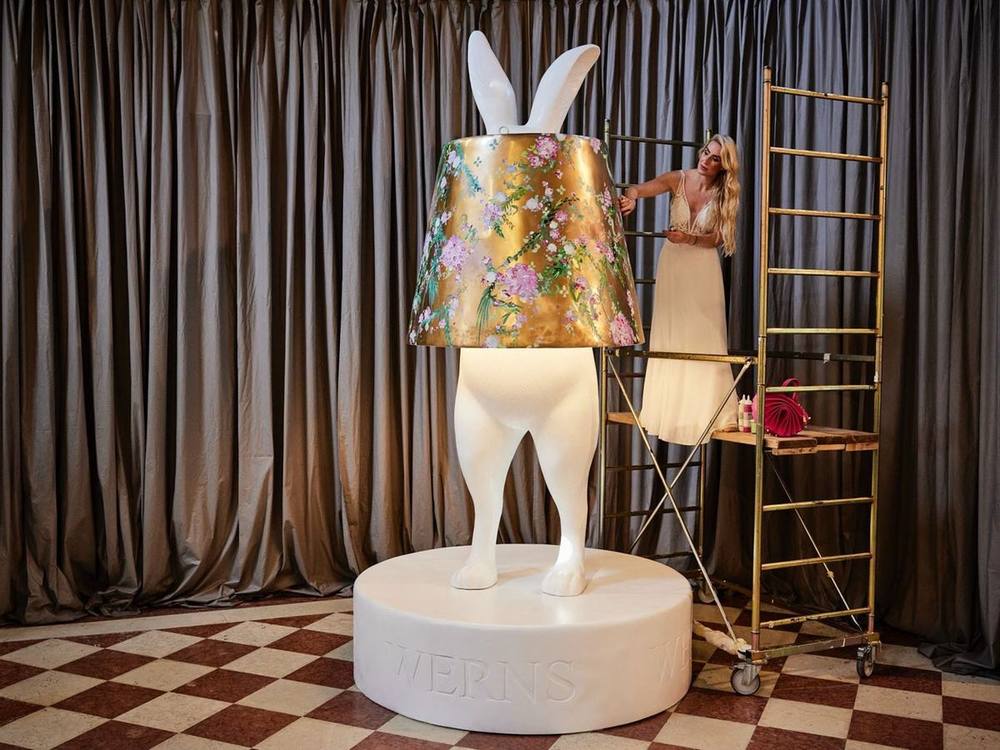
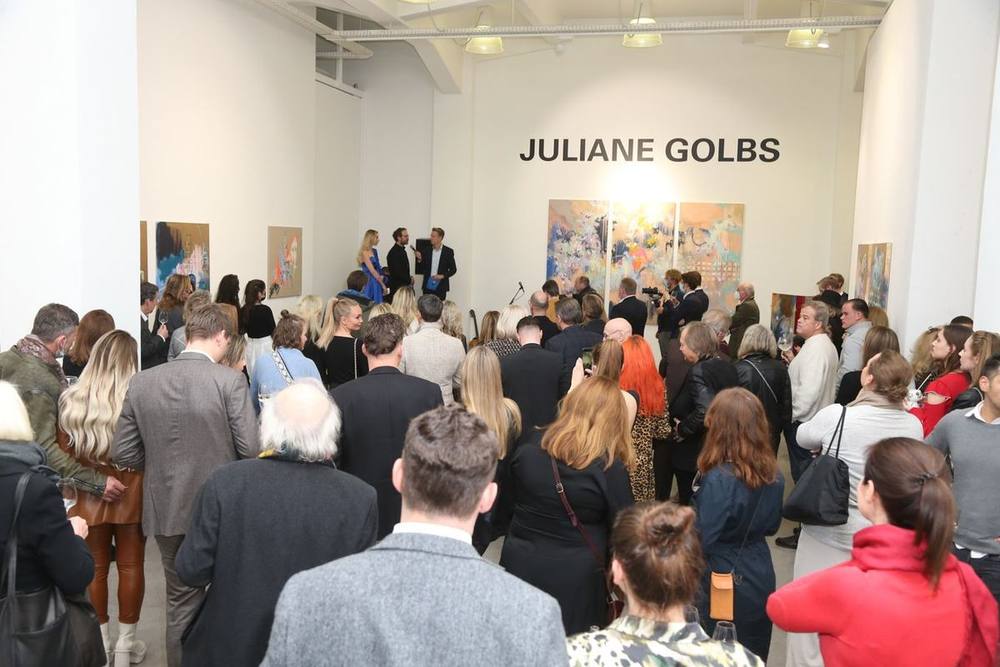
Among other places, she exhibited at Barlach Halle K in Hamburg in 2021. In 2025, together with the Hamburg studio WERNS, she showed a monumental hare sculpture at Venice Design Week; since 2025 she has been artist in residence at Hotel Louis C. Jacob on the Elbchaussee. At Elbjazz 2026 she painted live together with Joss Stone. Since 2018 she has been an ambassador of the NCL Foundation, which fights childhood dementia. All stations are listed on the page Exhibitions & Press.
What sets her work apart
Juliane Golbs should not be placed in a line with Grosse or Kneffel, and she does not do so herself. More interesting is where her painting moves within this spectrum.
With the room-filling gesture of the present she shares a delight in colour as an independent force. Yet her pictures remain pictures: canvases, often large formats, intended for living rooms, houses and hotels. What separates her from the precise tradition is the spontaneous – running paint, traces of chalk and pencil. What remains is a third stance: painting as a turning towards life, with gold as a material that does not merely reflect light but seems to multiply it in a room. How this works technically is described in the article on gold leaf painting.
Where to discover contemporary female artists
The paths to contemporary art have multiplied. The open studios and annual exhibitions of the art academies show what is being made right now. Kunstvereine – art associations such as the Kunstverein in Hamburg on Klosterwall – present positions before the market knows them. Art fairs bring galleries and studios together in one place; Juliane Golbs, for example, showed at ARTMUC in Munich in 2023.
Then there are places one does not immediately associate with art: hotels that work with artists, foundations, festivals, pop-up exhibitions. Here in particular one often encounters painting unexpectedly and in everyday life – just as guests of the Louis C. Jacob encounter the works of Juliane Golbs.
And finally the studio itself. Many artists open their workspaces by appointment. Such a visit shows more than any exhibition: works at different stages, materials, light, the way an artist speaks about her work.
Collecting contemporary female artists: three pointers
Know the biography. Exhibitions, collaborations, commitments: a traceable chronology shows how an artist works and where her work is heading.
Understand the series. A single work grows richer when you know which group it comes from and which question that group asks. The overview of series by Juliane Golbs is a good place to start.
See the original. Gold, lacquer and chalk change with the light. A studio visit by appointment, or hanging a work on trial for a small fee that is credited on purchase, replaces any reproduction.
A beginning, not a canon
The history of women artists in Germany has not been fully written, and every collection writes a part of it. Those who would like to approach the painting of Juliane Golbs will find all available originals in the catalogue of works, or can let the art advisor guide them in four steps to the works that suit their own space.
Frequently asked questions
Since when have women been allowed to study at art academies in Germany?
At the Academy of Arts in Berlin, women were admitted to study in March 1919. Before that, they depended on private tuition, expensive "ladies' classes" or schools of applied arts.
Which contemporary female artists shape painting in Germany?
Internationally known positions include Katharina Grosse with her room-filling colour installations and Karin Kneffel with her precise still lifes and interiors. Many other painters work in the cities, studios and galleries of the country – in Hamburg, for example, Juliane Golbs.
Are works by women underrepresented on the art market?
Yes. According to Artsy's Women Artists Market Report, around 9.3 per cent of auction sales in 2022 went to works by female artists, and around 6 per cent across 2012 to 2022.
Where can I see works by Juliane Golbs?
In her Hamburg studio by appointment, at Hotel Louis C. Jacob on the Elbchaussee, and in the catalogue of works on julianegolbs.com.
Sources
8 sources
- Long Night of Museums Berlin 2019: "Class Ladies!" – 100 years of women at the academy
- Wikipedia (German): Paula Modersohn-Becker Museum
- Wikipedia (German): Paula Modersohn-Becker
- Wikipedia (German): Gabriele Münter
- Wikipedia (German): Anita Rée
- Wikipedia: Katharina Grosse
- Gagosian: Karin Kneffel
- The Art Newspaper: Women artists still dwarfed by male counterparts at auction (8 March 2023)