The Elbphilharmonie in art: a concert hall becomes a picture
A cocoa warehouse from the 1960s with a wave of glass on top. How the Elbphilharmonie became a motif within a few years, on a coin, in photography and in the paintings of Juliane Golbs.
Few buildings of our time have turned into a picture as quickly as the Elbphilharmonie. Since it opened in January 2017 it has appeared in photography, on a circulating coin and on canvas. Anyone looking into Elbphilharmonie art soon meets two questions at once: what makes the building remarkable as architecture, and why does it lend itself so well to painting? The answer begins at the bottom, in the base of an old harbour warehouse.
A warehouse by Werner Kallmorgen
The site has a longer history than the concert hall. As early as 1875 the Kaiserspeicher stood here, a warehouse with 19,000 square metres of storage space. After damage in the Second World War it was blown up in 1963. In its place, to designs by the architect Werner Kallmorgen, Kaispeicher A was built between 1963 and 1966 to store cocoa, tobacco and tea.
For the port, Kallmorgen’s warehouse was a functional building; for the later Elbphilharmonie it became the plinth. In painting it remains the heavy base beneath the shining glass. Look at almost any painting of the Elbphilharmonie and you will see this division: the store below, the light above.
The design by Herzog & de Meuron
In 2003 the developer Alexander Gérard commissioned Herzog & de Meuron to sketch a concert hall on top of the old warehouse. Jacques Herzog and Pierre de Meuron worked on it together with Ascan Mergenthaler. The foundation stone was laid in 2007, and after a long halt in construction the project was restructured in 2013. The Elbphilharmonie officially opened on 11 January 2017.
Herzog & de Meuron describe the building as a new vertical accent in a cityscape that had until then been predominantly horizontal. The City of Hamburg gives its height as 110 metres above sea level; the tower of the Michel, by comparison, measures 132 metres. Since then a building of the twenty-first century has stood beside the old church spires in the city’s skyline. It is precisely this silhouette that painters and photographers take up.
Glass, wave and Plaza
According to the Elbphilharmonie, the facade consists of 1,100 glass elements, the last of which was fitted on 31 January 2014. Herzog & de Meuron describe a rectangular grid of coated panels printed with myriad dots, some curved, some carved open. Their appearance keeps changing as they catch the reflections of the sky, the water and the city.
The roof rises in an undulating sweep from the lower eastern end to the Kaispitze. It is made of eight large curved surfaces, on which 6,000 sparkling sequins are mounted. Between warehouse and glass body, 37 metres up, lies the Plaza, open to the public since 4 November 2016, two months before the concert halls. It is reached by an 82-metre escalator known as the Tube.
To a painter’s eye this is an unusually generous building. The outline of the roof is unmistakable even from afar, while the surface below breaks into countless points of light. A reflecting grid and a line that stays in the memory: a picture needs little more to name the place.
Elbphilharmonie art: the building as a motif
One modest example shows how far the building has become a sign of the city. In 2023 Germany opened the Bundesländer II series of 2-euro commemorative coins with Hamburg, and the coin shows the Elbphilharmonie, which the Deutsche Bundesbank calls the new landmark of the Hanseatic city. The national side was designed by the artist Michael Otto from Rodenbach, with a planned circulation of up to 30 million coins. The building has thus become an image you can carry in your purse.
The photographic artist Thomas Kellner took an entirely different approach. In October 2021 he made a series on the Elbphilharmonie, including the work 96#13, Hamburg, Elbphilharmonie, Südseite 2, a C-print measuring 45.5 × 73.2 centimetres. Kellner works with the principle of the contact sheet and assembles the building from many single frames, so that the facades tilt and break. He himself compares the effect to a storm at sea.
Coin and photograph mark the two poles between which painting also moves. On one side stands the clear emblem, on the other the dissolution of form into movement and light. A painting of the Elbphilharmonie can be both at once.
Golden Elbphi: the facade as a field of dabs
The Elbphilharmonie appears several times in the work of the Hamburg painter Juliane Golbs. The earliest example in the catalogue of works is Golden Elbphi of 2019, a portrait format of 120 × 160 centimetres in acrylic and acrylic lacquer on canvas from the Golden Things series. The work is no longer available and is now in a private collection.
The undulating roofline is set down in a few dark strokes. Beneath it the glass facade appears as a grid of blue, grey and white dabs, while the brick base blurs into pastel green, yellow, pale blue and pink. Fine runs of paint drip downwards, letting the building dissolve like a reflection in water, and small splashes of neon pink add accents. The copper-gold ground surrounds the architecture like an evening sky over the harbour.
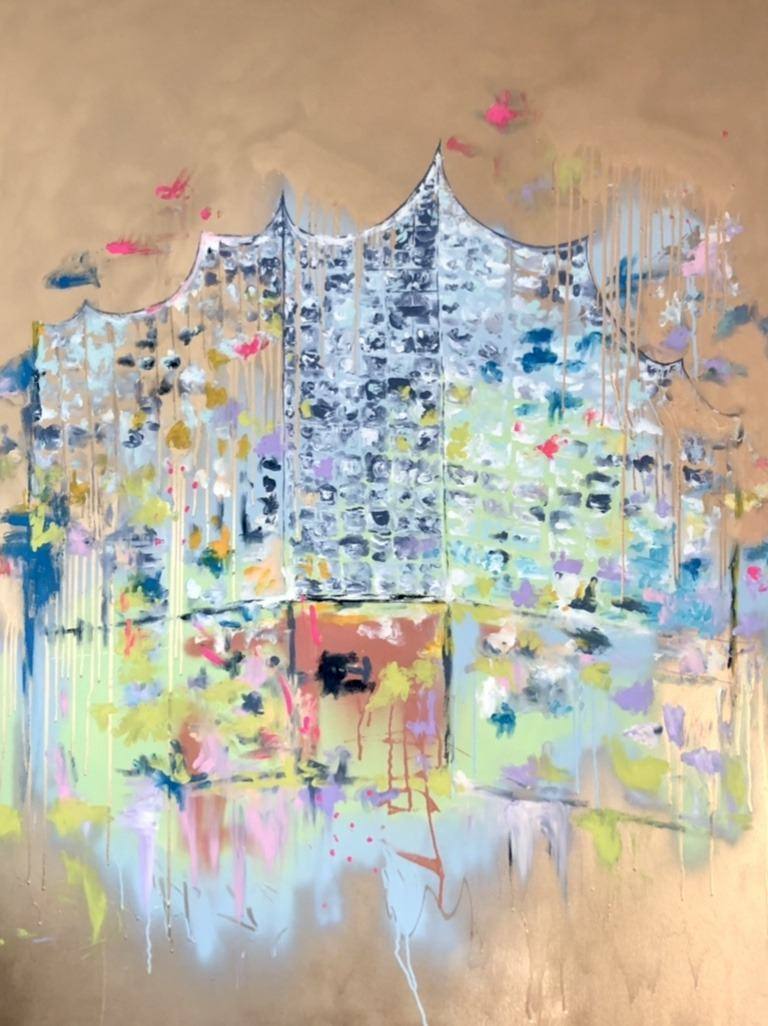
What is striking is how close this way of painting comes to the material of the building itself. Herzog & de Meuron printed their glass with dots; Juliane Golbs translates the facade into dabs of colour. You recognise the place at once without seeing a single detail.
43 | 2021 and “Close to the Elphie”
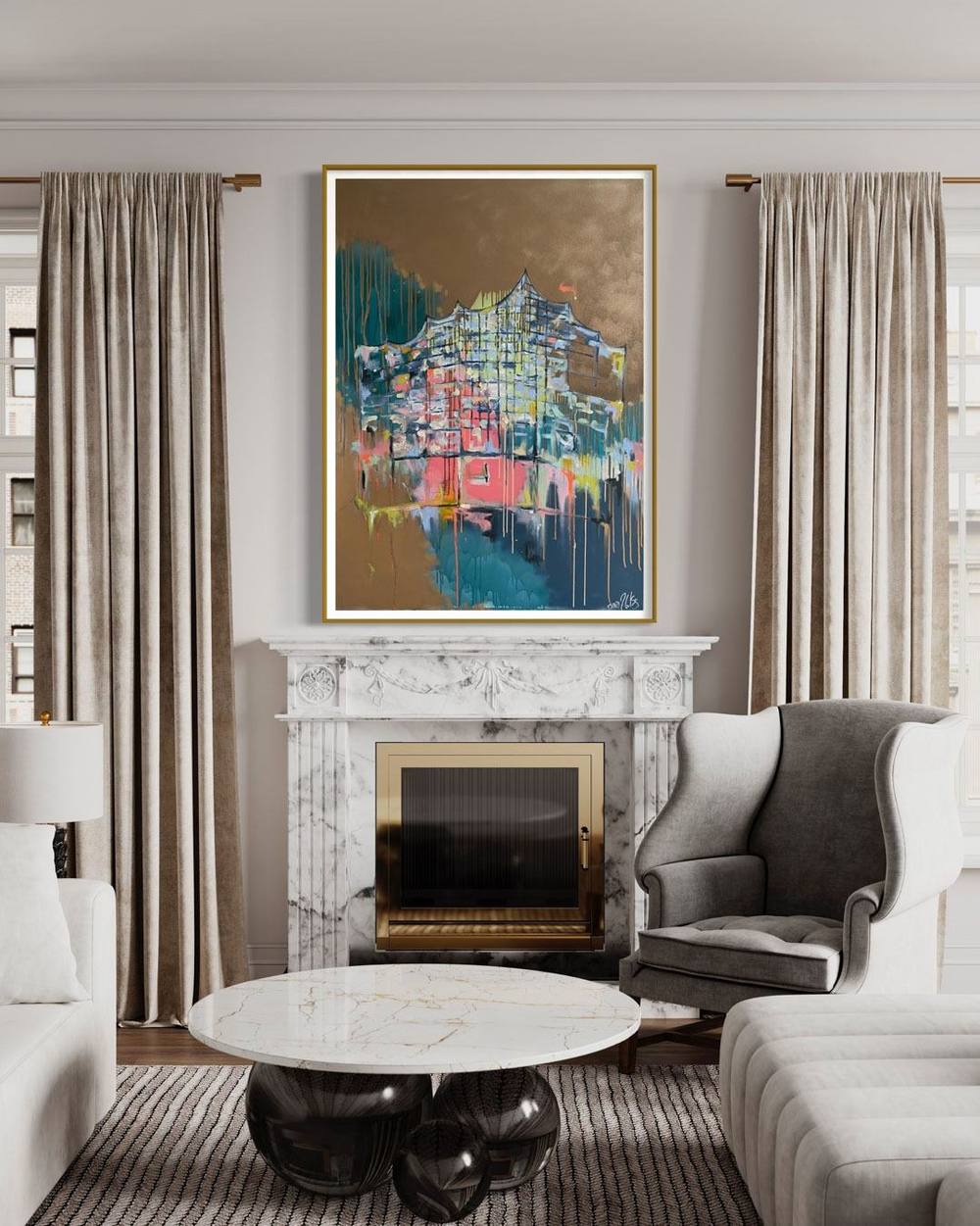
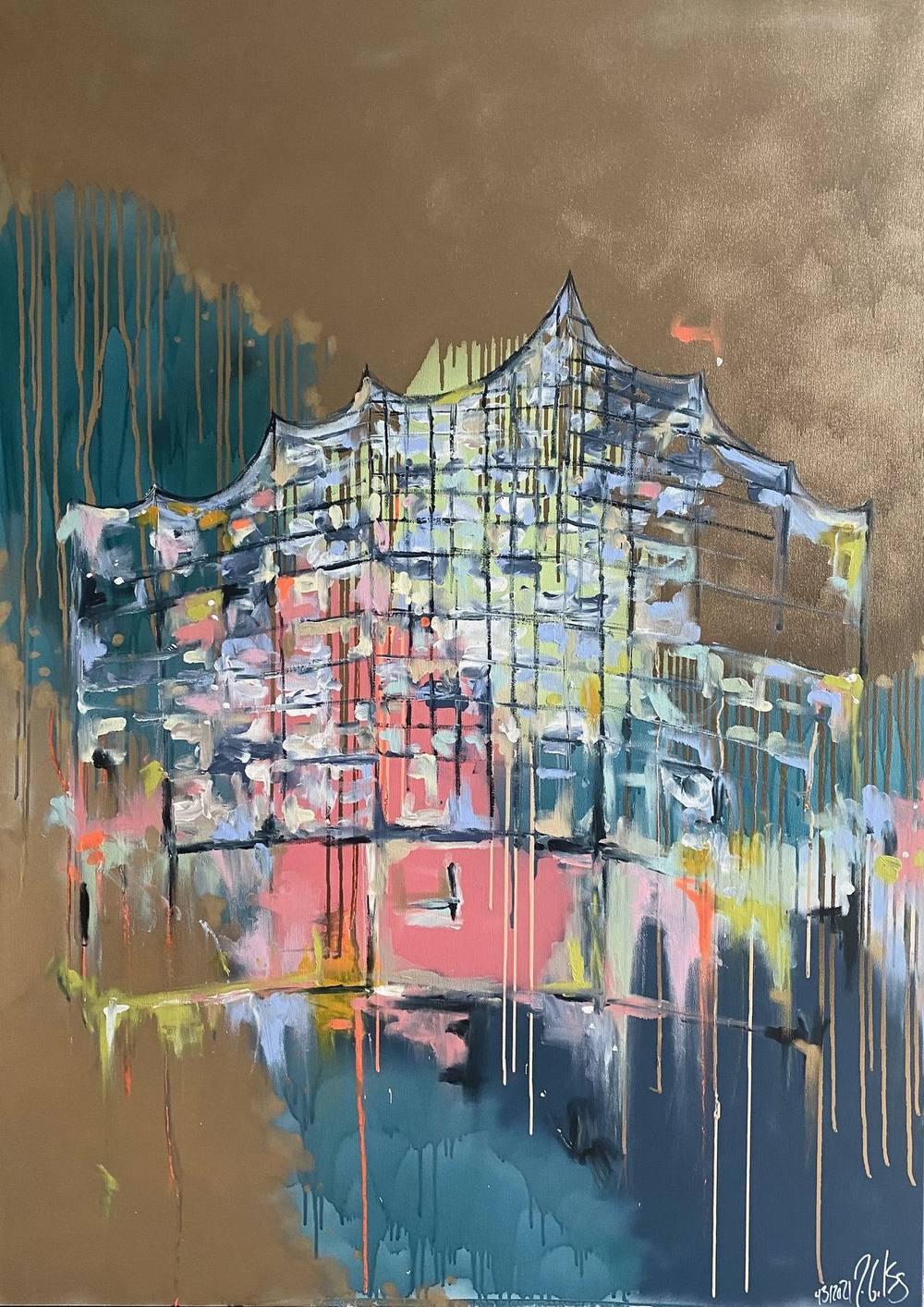
Two years later came 43 | 2021, also from the Golden Things series, at 100 × 140 centimetres in acrylic and acrylic lacquers on canvas. Here the facade is built more strictly: a grid of black contours filled with pale blue, rosé, lime yellow and coral. Above it spreads a wide sky of bronze and gold that keeps the upper part of the picture calm. Lower down the building dissolves into petrol and midnight blue, and runs of paint trickle like reflections into the Elbe.
The picture combines close observation of a silhouette with the artist’s free, fluid handling of paint. It belongs to the tradition of the townscape, yet it seeks to remember the place rather than document it. The room visualisation at the top shows the work above a white marble fireplace, where the bronze of the sky picks up the warm brass tones of the room.
In the same year Juliane Golbs held a solo exhibition in HafenCity entitled “Close to the Elphie”. The title itself names the closeness to the concert hall. In December 2021 she also exhibited at Barlach Halle K; an overview of all exhibitions can be found under Exhibitions.
504 | 2024: a concert hall made of light
The motif returns in the Fifth Season series. 504 | 2024 measures 80 × 100 centimetres and is painted in acrylic and gold lacquer. The curving silhouette stands at the centre in lavender and white, surrounded by a swarm of sprayed and dabbed flecks of turquoise, petrol, pale blue and rosé. Bright signal orange breaks through in individual splashes.
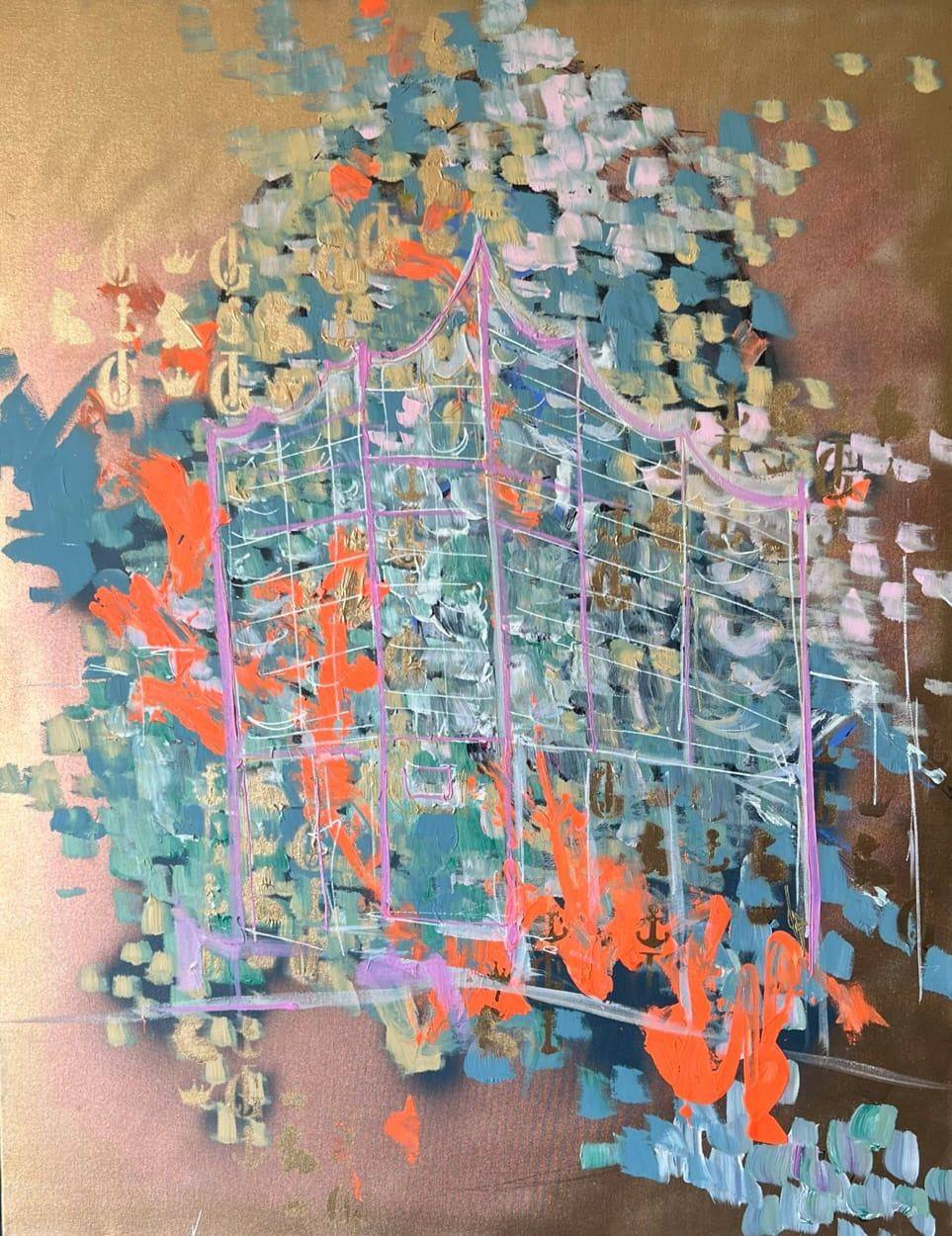
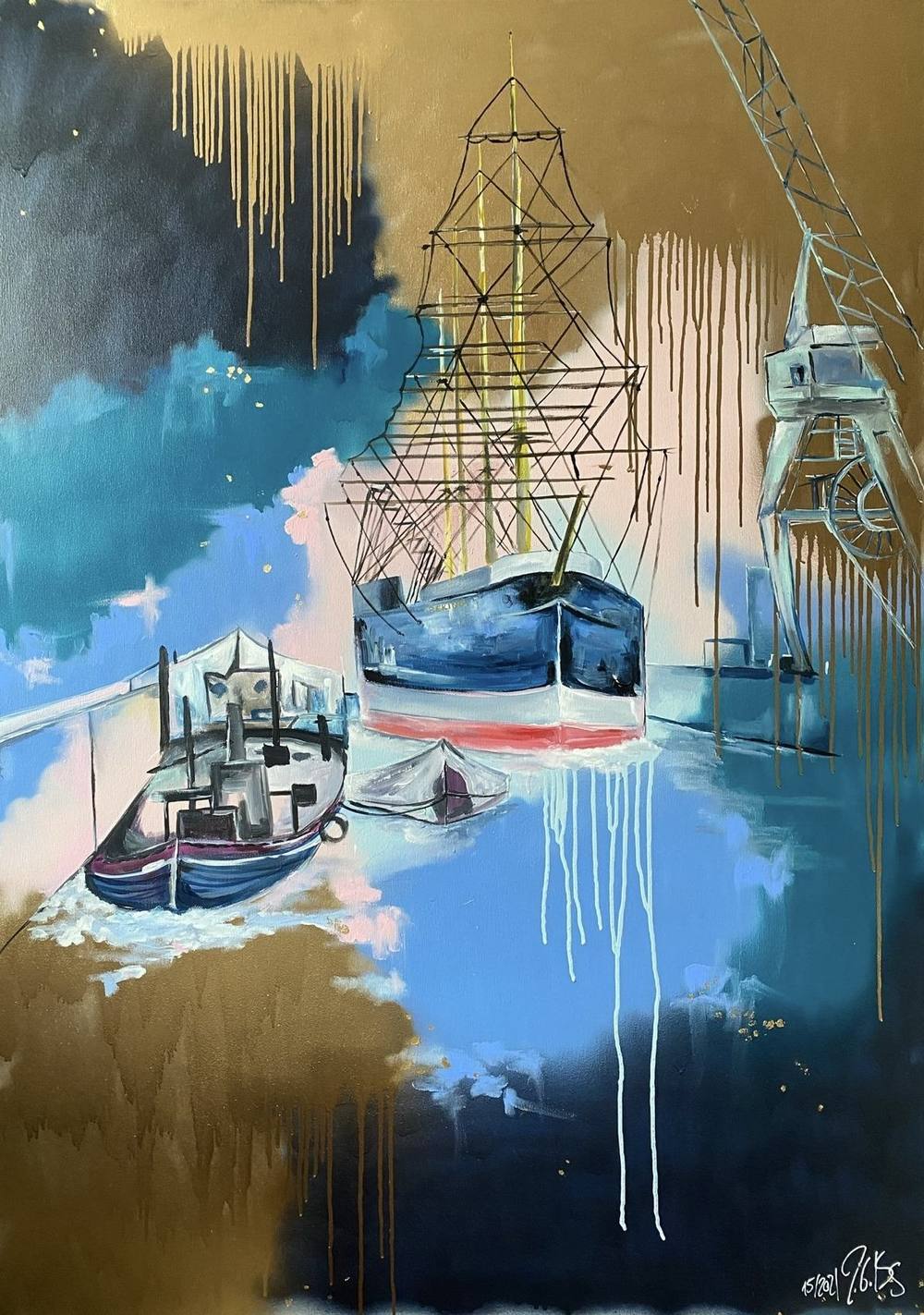
In the background a metallic ground shimmers, on which golden anchors and monograms appear and fade again. The building seems not constructed but assembled from colour and air, like an image you carry home after an evening concert. In a series about lived time, the place becomes a store of shared moments. If you are looking for the harbour itself, you will find it in 15 | 2021, a tall ship with a harbour crane between turquoise, midnight blue and gold.
In the Grand Hall: Elbjazz 2026
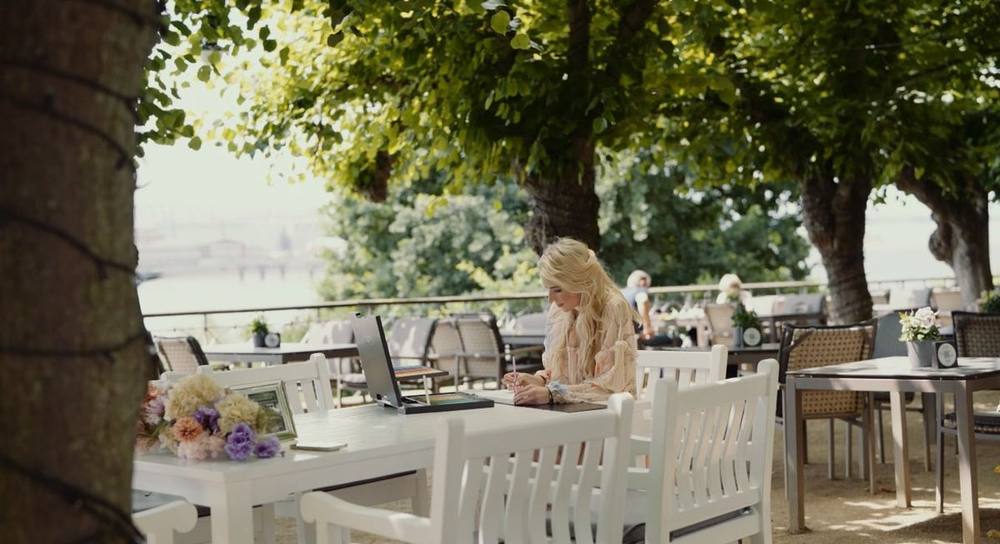
In 2026 the motif returned to its origin. At the Elbjazz festival Juliane Golbs painted live in the Grand Hall of the Elbphilharmonie to the music of the singer Joss Stone. On the easel a large-format picture of the Elbphilharmonie took shape. The unique work from the Golden Things series was auctioned for the NCL Foundation, whose ambassador she has been since 2018.
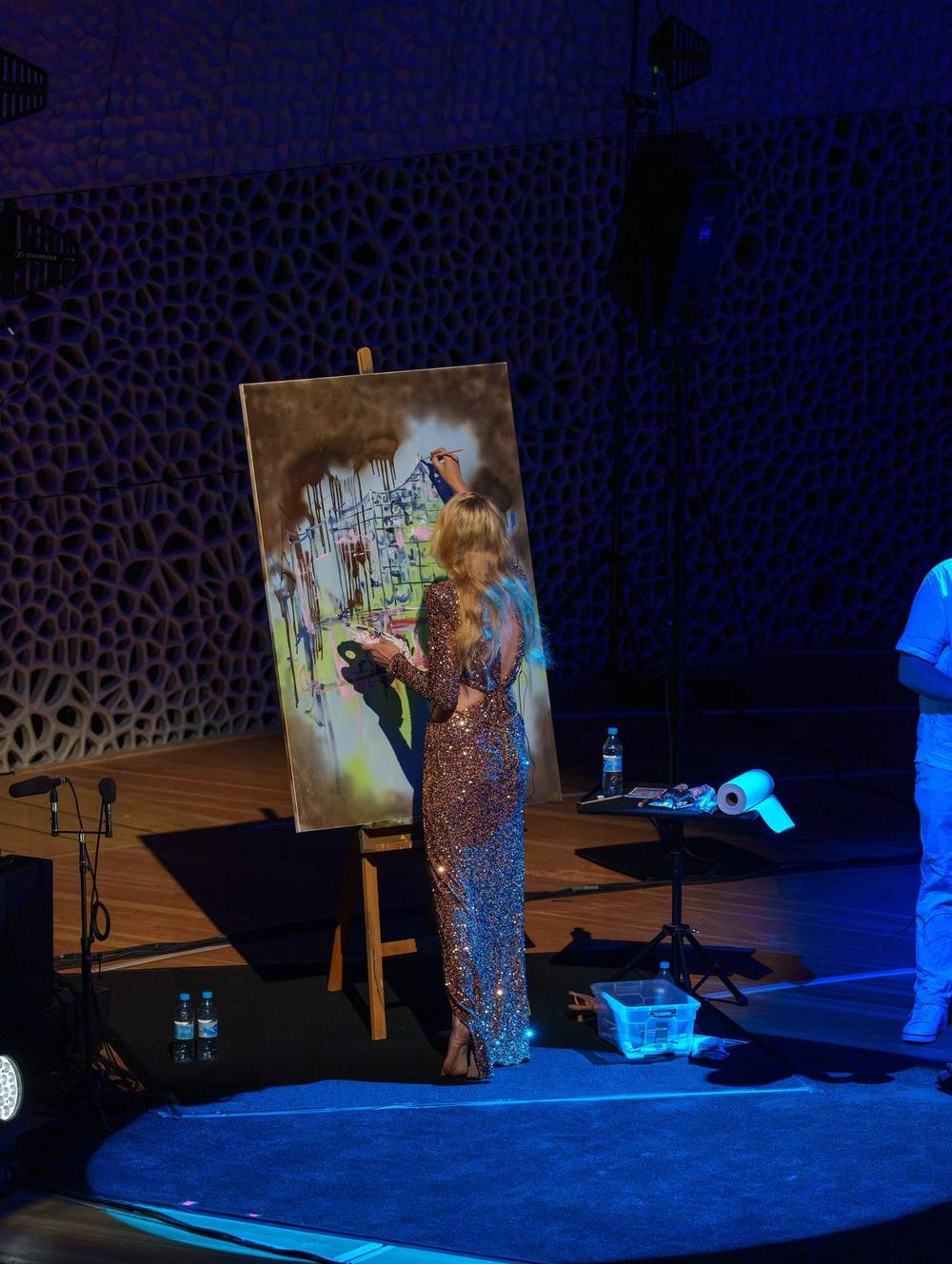
Behind her you can see the so-called White Skin, the wall and ceiling cladding of the hall made of some 10,000 gypsum fibre panels. A picture of the building, painted inside it, before an audience and within the span of a concert: motif and place of making rarely coincide so exactly. The article on the NCL Foundation tells more about the evening and the work for the foundation.
An Elbphilharmonie painting for your own space
A painting of the Elbphilharmonie is always also a declaration of affection for Hamburg. In an office overlooking the Elbe it mirrors the view; in a home far from the city it keeps a memory alive. Large formats such as 43 | 2021 can hold an entire wall, while 504 | 2024 also suits a study or a hallway.
If you would like to know Hamburg better as a place for art, the portrait of a female artist in Hamburg tells more about the studio and the way of working, and the article on painters in Hamburg traces a city whose painting often speaks of the light over the water. The catalogue of works shows every available piece, and the art advisor helps with format and mood. For questions about individual works, contact is the most direct route.
Kallmorgen built a warehouse for cocoa and tea; Herzog & de Meuron set a wave of glass on top of it. In painting the two become something else: a place you recognise even as it dissolves into colour.
Works from this article
Frequently asked questions
Who designed the Elbphilharmonie?
The architects Herzog & de Meuron. The glass building sits on Kaispeicher A, a warehouse designed by Werner Kallmorgen and built between 1963 and 1966. The Elbphilharmonie officially opened on 11 January 2017.
How many glass elements make up the Elbphilharmonie facade?
According to the Elbphilharmonie, 1,100. The last one was fitted on 31 January 2014. Some of the panels are curved, and the glass is printed with countless dots.
Which works by Juliane Golbs show the Elbphilharmonie?
Golden Elbphi of 2019, now in a private collection, as well as 43 | 2021 from the Golden Things series and 504 | 2024 from the Fifth Season series. At Elbjazz 2026 she also painted the Elbphilharmonie live in the Grand Hall.
Does the Elbphilharmonie appear on a coin?
Yes. The 2023 Hamburg 2-euro commemorative coin, which opened the Bundesländer II series, shows the Elbphilharmonie. The national side was designed by the artist Michael Otto from Rodenbach.