Hamburger Kunsthalle: Master Bertram, Friedrich and the present day
Founded by its citizens, shaped by Alfred Lichtwark and still sustained by gifts. A walk through the Hamburger Kunsthalle, from Master Bertram’s altarpiece to the Galerie der Gegenwart.
The Hamburger Kunsthalle is a museum its citizens asked for. It grew out of private collections, was built with donations and is sustained by gifts to this day. According to the museum it now holds around 145,000 works of art from the 14th century onwards, of which around 1,000 are permanently on display. Three buildings between the Inner and Outer Alster tell this story: a brick building of 1869, an extension built between 1912 and 1919 and a pale cube from 1997. Walking through them, you move from the Middle Ages to the present.
A foundation born of civic spirit
It began with a circle of collectors. As early as 1817, NDR reports, 19 men met regularly in Georg Ernst Harzen’s collection on Grosse Johannisstrasse to look at and discuss their collections. Out of this grew the Kunstverein, which the Kunsthalle describes as the first art institution in the city run by Hamburg’s citizens. Its members worked steadily towards a museum of their own.
The decisive step was a bequest with a condition attached. According to NDR, Harzen left the city 25,000 works in all, among them around 5,000 drawings. The gift came with the requirement that a Kunsthalle be built within six years. In 1863 the gifts of Harzen and Johann Matthias Commeter formed the core of the collection. Donations from citizens, above all, made possible Hamburg’s first museum building on the former Bastion Vincent, the Alsterhöhe. It opened on 30 August 1869.
The façade, in the style of the Italian Renaissance, is built of brick. It carries portraits in terracotta, 70 artist figures in all, among them Leonardo, Michelangelo, Raphael and Rubens. NDR quotes a remarkable observation: most of these masters were not yet represented in the collection at the time. The building promised on the outside what it still had to acquire within.
Alfred Lichtwark and the active museum
Until 1886 the Kunsthalle had no director. It was run by a commission of six. Then came Alfred Lichtwark, an art historian from the Hamburg area who had studied in Leipzig and Berlin. He summed up his programme in a sentence recorded by NDR: “We do not want a museum that stands and waits, but an institute that actively takes part in artistic education.” Lichtwark himself walked school classes through the galleries, above all classes of girls, discussing the works according to a fixed set of questions.
Under him the collection grew in new directions. In 1891 he founded the sculpture collection, today the museum’s third oldest holding. How he set out to teach Hamburg’s collectors to look is described in the article on female artists in Hamburg. How he invited painters to paint the city on the spot is told in the article on the harbour in painting. Here another side comes to the fore: Lichtwark brought the Middle Ages back to Hamburg.
Master Bertram and Master Francke
In 1898 Lichtwark acquired the Thomas Altarpiece that Master Francke had made for Hamburg’s merchants trading with England. He commented on the purchase with great ambition: “From now on the foundation of our picture collection is the work of the old Hamburg master Francke.” Five years later came the second masterpiece, the retable of the former high altar of Hamburg’s St Peter’s Church by Bertram von Minden, dated 1379/83 and known as the Grabow Altarpiece.
Lichtwark’s own words show how deliberately he went about it. Since the altarpiece had been recognised in the autumn of 1900 as the former high altar of St Peter’s, the Kunsthalle had regarded it as its most urgent task to trace its maker and to win his works back “for his home city”. Today North German medieval painting, with the altarpieces of both masters, is a focus of the Old Masters collection. The eventful history of the St Peter’s altarpiece, its dimensions and its form as a winged altar are covered in the article on the triptych in art.
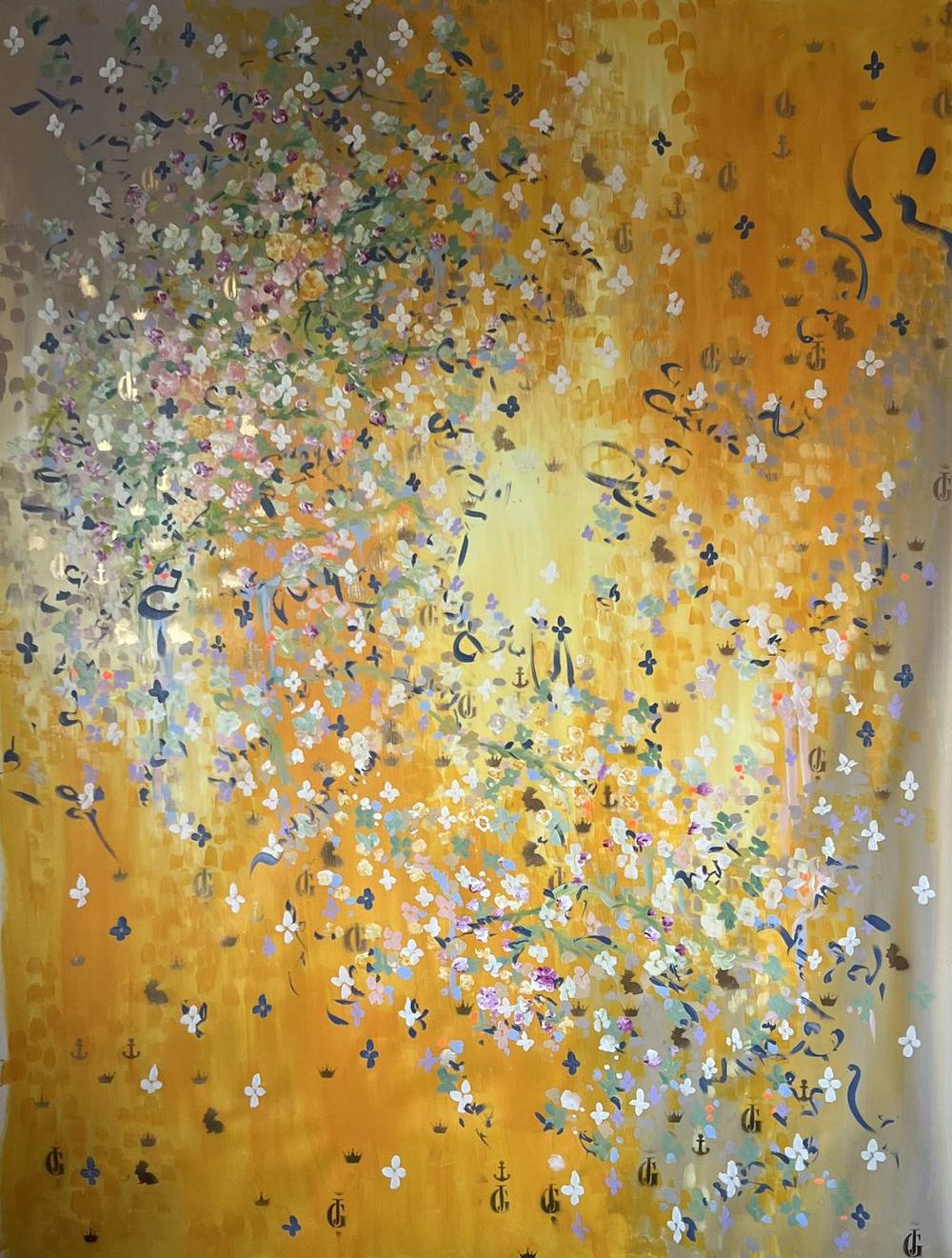
Standing before the golden panels of these altarpieces, you experience gold as light rather than ornament. That experience can be carried into the present. In 516 | 2024 by Juliane Golbs, the title image of this article, a golden yellow ground forms a field of light across which a swarm of small blossoms and signs drifts. The painting is acrylic on canvas and achieves its glow through gradations of colour alone. It recalls the tradition of the gold ground without quoting it.
The Wanderer above the Sea of Fog
Caspar David Friedrich’s Wanderer above the Sea of Fog, painted around 1817, is today regarded as the epitome of Romanticism, according to the museum’s online collection. No other work by Friedrich, it says, is reproduced so often. The oil painting measures 94.8 × 74.8 centimetres. It is rather unusual within Friedrich’s work, being one of his few upright formats. He rarely placed a single figure so large at the centre of a composition.
The online collection describes what makes the picture so distinctive. We see a man from behind, standing where we cannot easily follow. What he is looking at is withheld from us. Seeing itself becomes the subject. Friedrich took the rocky outcrop on which the figure stands from a drawing he made in Saxon Switzerland on 3 June 1813. Who the wanderer is cannot be reliably determined, the Kunsthalle notes.
The painting’s provenance has a story of its own. After the Second World War it came to the Allied Central Collecting Point in Marburg, and in April 1947 it was shown in Wiesbaden as a work by Carl Gustav Carus under the title “Wanderer am Abgrund”. In December 1970 it was acquired by the Stiftung zur Förderung der Hamburgischen Kunstsammlungen, today the Stiftung Hamburger Kunstsammlungen. Since then it has been on permanent loan to the Kunsthalle.
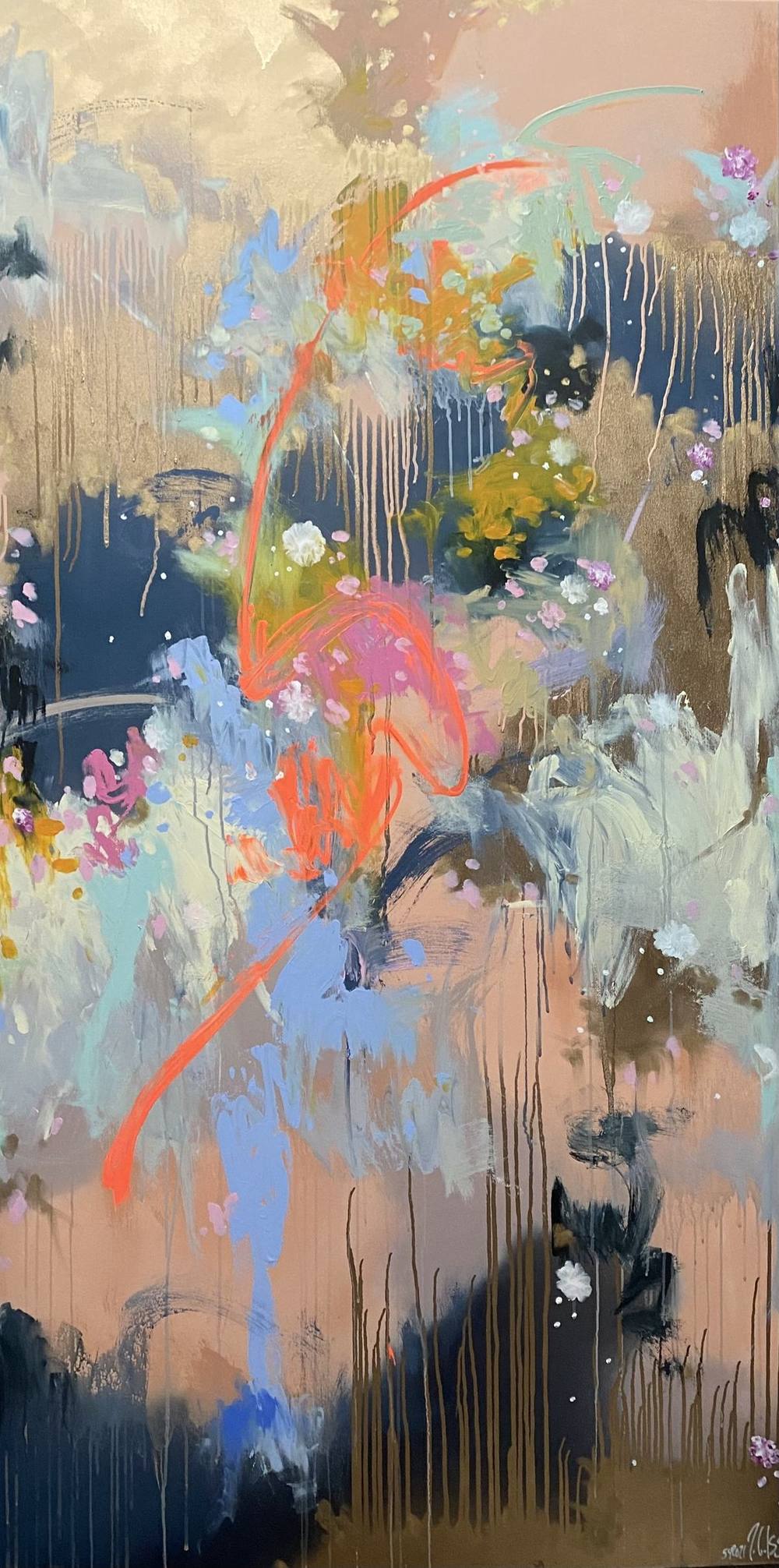
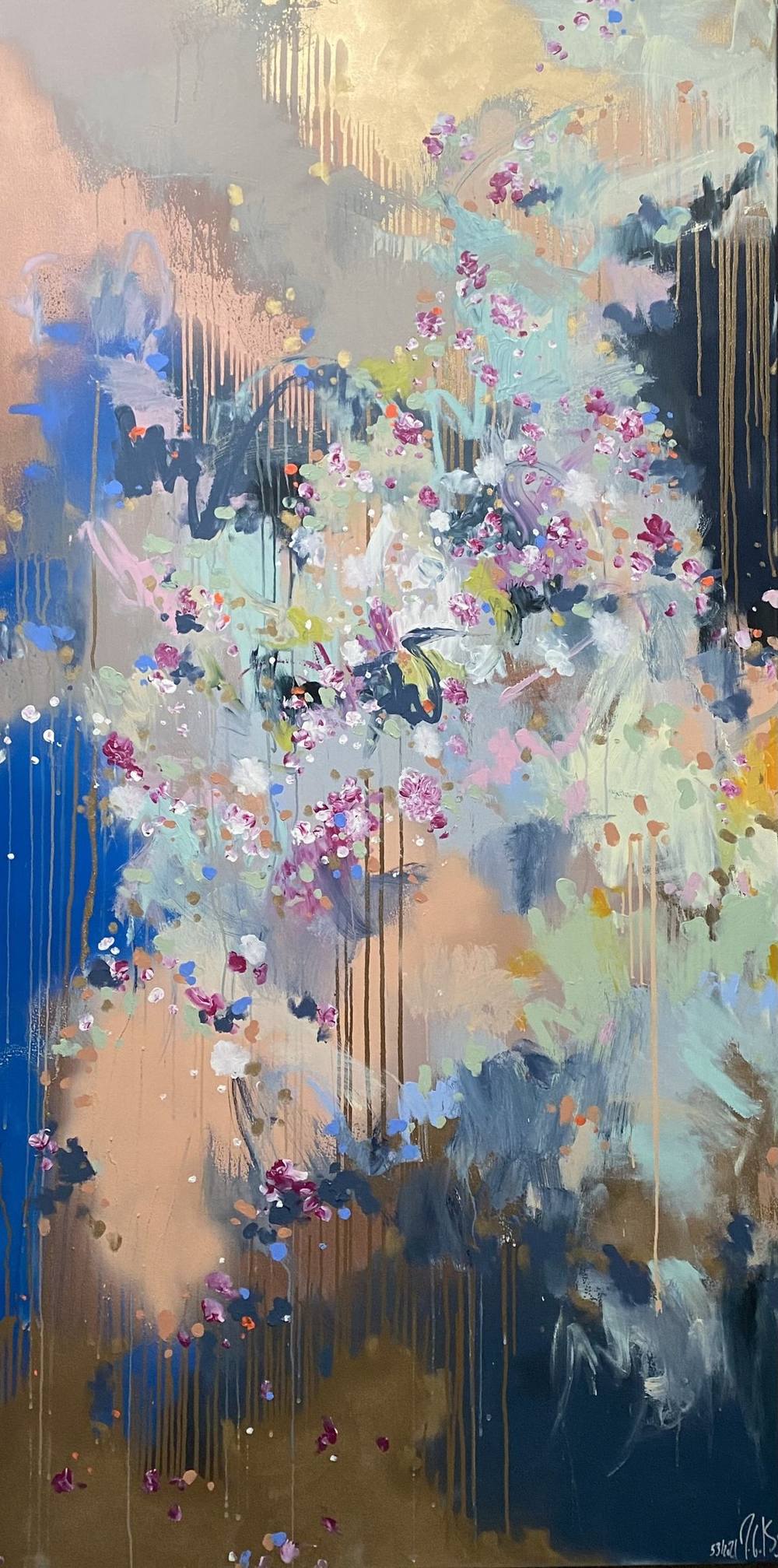
Friedrich’s fog is an image of what eludes the eye. A related mood, without any figure, can be found in 54 | 2021, the centre panel of a triptych by Juliane Golbs. Broad cloud forms in night blue structure a pale ground, and paint runs down in vertical trails. The gold leaf sits in the upper zones and makes the picture glow warmly in daylight.
The 19th century and modernism
In the Kunsthalle Friedrich keeps distinguished company. According to the museum, its 19th century collection includes extensive groups of works by Caspar David Friedrich, Philipp Otto Runge, Adolph Menzel and Max Liebermann. Alongside them are Impressionists such as Édouard Manet, Claude Monet, Auguste Renoir and Paul Gauguin. One work in this collection has a special link to the Elbe: Liebermann’s painting of the lime terrace of the Restaurant Jacob in Nienstedten, painted in 1902. Its story is told in the article Artist in residence at the Louis C. Jacob.
The Kunsthalle counts its modernist holdings among the most important in the German-speaking world, with groups of works by Edvard Munch, Max Beckmann, Paula Modersohn-Becker, Anita Rée and Emil Nolde. These holdings carry a wounded history. Under National Socialism, NDR reports, more than 1,000 modernist works were singled out as “degenerate art” and confiscated.
The Galerie der Gegenwart
In February 1997 the most recent part of the building opened. The Galerie der Gegenwart, designed by Oswald Mathias Ungers, is a cube with a striking white sandstone façade. With more than 5,600 square metres it is, according to the Kunsthalle, one of the largest buildings for contemporary art in Germany. For the first time Hamburg had a central museum for the art of the present.
Artists’ rooms were commissioned for the opening. Jenny Holzer’s Ceiling Snake accompanies the passage from the Lichtwark Galerie to the Galerie der Gegenwart, Ilya Kabakov installed his sickroom Healing with Paintings, and Richard Serra created Measurement of Time / Seeing Is Believing. Bogomir Ecker’s dripstone machine extends over every floor. The collection ranges from Sigmar Polke, Gerhard Richter and Georg Baselitz through Pop Art and Arte Povera to Minimal Art and Conceptual Art. By Bruce Nauman the museum owns the large video installation Anthro/Socio.
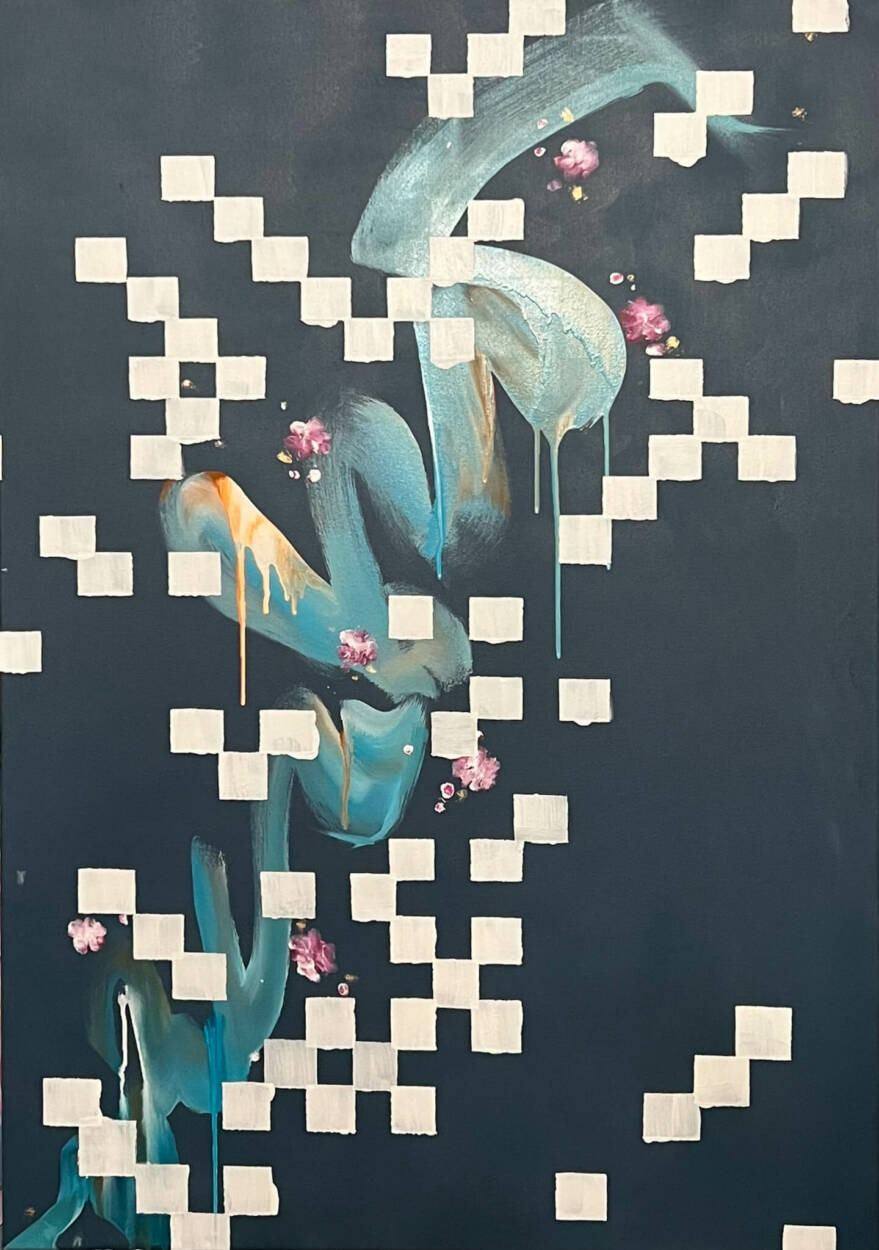
Minimal Art and Informel, grid and gesture: both poles of this collection can also be experienced on a small scale. In 28 | 2022 from the Signature Collection, pale squares stand in stepped diagonals on deep night blue. Broad bands of ice blue and petrol run straight through them. A work of 60 × 80 centimetres that lets two orders exist side by side.
Exhibitions at the Hamburger Kunsthalle
The Kunsthalle views its collection under the motto “All Art Has Been Contemporary” and names eight to nine exhibition openings a year. According to the Kunsthalle’s website (as of 16 November 2026), current exhibitions include David Novros. Painting until 21 February 2027, Carrie Yamaoka for the Maria Lassnig Prize until 10 January 2027 and Impressionism. Franco-German Encounters until 14 November 2027. Making History, on Hans Makart and 19th century salon painting, runs until 2 January 2028.
Since 20 November 2026 the Kunsthalle has been showing Unstable Media in the 21st Century, with highlights from the Centre Pompidou’s New Media collection. From 9 December 2026 it is followed by Signa. Ich lüge, um zu weinen. For 17 September 2027 the museum announces an exhibition on Philipp Otto Runge entitled Romantisch. Radikal. Modern. Anyone looking for Romanticism in Hamburg will then find a second great name of the period beside Friedrich.
Your visit: opening hours and free admission
According to the Kunsthalle’s website (as of 16 November 2026), the museum is open Tuesday to Sunday from 10 am to 6 pm, on Thursdays until 9 pm. It is closed on Christmas Eve 2026 and open from 10 am to 3 pm on New Year’s Eve. Regular admission is 18 euros, reduced 9 euros. Children and young people under 18 are admitted free.
Admission is free for everyone on the first Thursday of every month from 6 to 9 pm. It is also free with the Hamburg City Pass. For the whole Kunstmeile, which besides the Kunsthalle includes the Bucerius Kunst Forum, the Deichtorhallen, the Museum für Kunst & Gewerbe, the Kunsthaus Hamburg and the Kunstverein Hamburg, the museum offers combined tickets. Current details are given on the Kunsthalle’s website.
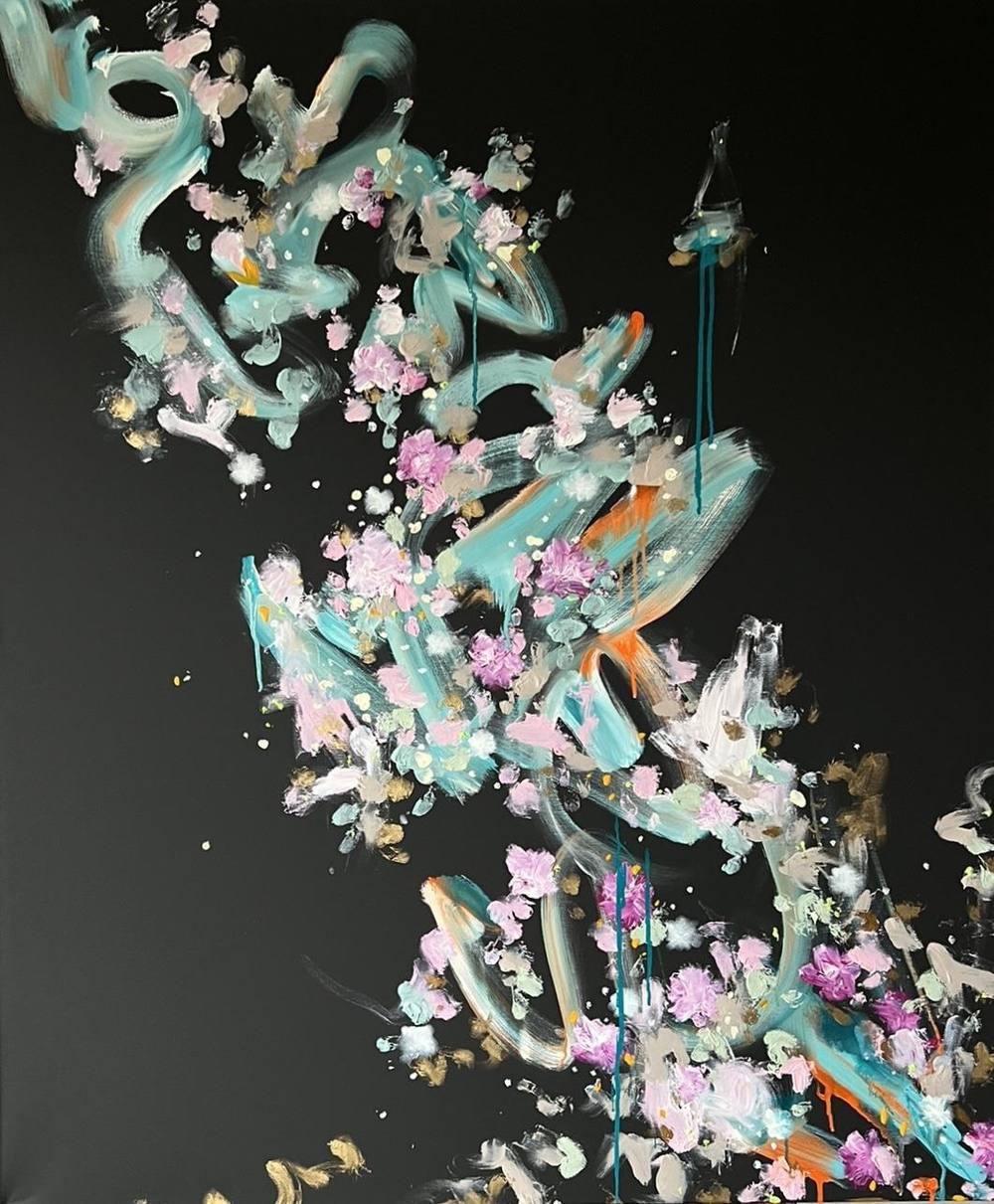
After a walk from the St Peter’s altarpiece to the Galerie der Gegenwart, you see contemporary painting with sharpened eyes. The Kunsthalle counts Informel among the movements in its collection, a painting that understands the gesture as an expression of the person. In 27 | 2022 by Juliane Golbs a single broad stroke in turquoise and mint rises diagonally across a black surface. Works by Juliane Golbs can be seen in the catalogue of works, at the Louis C. Jacob on the Elbchaussee and, by appointment, in the studio. For a studio visit, the contact form is open to you.
Works from this article
Frequently asked questions
When is admission to the Hamburger Kunsthalle free?
According to the Kunsthalle’s website (as of 16 November 2026), children and young people under 18 are admitted free. On the first Thursday of every month the museum is free for everyone from 6 to 9 pm. Admission is also free with the Hamburg City Pass.
Where is the Wanderer above the Sea of Fog?
In the Hamburger Kunsthalle. Caspar David Friedrich’s painting, oil on canvas from around 1817, is on permanent loan from the Stiftung Hamburger Kunstsammlungen, which acquired it in December 1970. The online collection lists it as on display.
Who was Alfred Lichtwark?
The art historian Alfred Lichtwark became the first director of the Hamburger Kunsthalle in 1886. He wanted a museum that would actively take part in artistic education. For the Kunsthalle he acquired Master Francke’s Thomas Altarpiece in 1898 and Master Bertram’s altarpiece from St Peter’s in 1903.
What is the Galerie der Gegenwart?
The newest building of the Hamburger Kunsthalle, designed by Oswald Mathias Ungers and opened in February 1997. With around 5,600 square metres it is, according to the Kunsthalle, one of the largest buildings for contemporary art in Germany.
Which exhibitions are on at the Hamburger Kunsthalle in winter 2026/27?
According to the Kunsthalle’s website (as of 16 November 2026), they include David Novros. Painting until 21 February 2027 and Carrie Yamaoka until 10 January 2027. Unstable Media in the 21st Century has been on since 20 November 2026, and Signa follows from 9 December 2026.
Sources
8 sources
- Hamburger Kunsthalle: About the Kunsthalle
- Hamburger Kunsthalle: Old Masters
- Hamburger Kunsthalle: Contemporary Art (Galerie der Gegenwart)
- Hamburger Kunsthalle, online collection: Caspar David Friedrich, Wanderer above the Sea of Fog, c. 1817
- NDR: The history of the Hamburger Kunsthalle
- Hamburger Kunsthalle: Our exhibitions (accessed 16 November 2026)
- Hamburger Kunsthalle: Opening hours (accessed 16 November 2026)
- Hamburger Kunsthalle: Prices, tickets and vouchers (accessed 16 November 2026)