Triptych art: from the winged altarpiece to the three-panel painting at home
Three panels, one wall. How the triptych moved from the church altar into modern painting, and why a three-part picture feels so calm in a home.
A triptych is made of three panels that together form one picture. Tate defines it simply as an artwork in three panels, which can be attached together or presented next to each other. Behind that brief definition lies a long history of triptych art. For centuries the threefold division was the form of the altarpiece; in the twentieth century it became a stage for the great pictorial narratives of modernism. Hang a three-part painting in your own home today and some of that history comes with it.
A picture that opens
The triptych began in the church. A winged altarpiece has a centre and movable side wings that can be closed and opened. Closed, it shows a restrained face; open, it unfolds colour, gold and story. The Museum of Modern Art in New York describes the format as one traditionally used, in Christian altarpieces for example, to convey an explicit narrative or meaning.
From the outset, then, the triptych was a picture that lived in time. What the faithful saw depended on the day in the church calendar. The wings framed the centre and guided the eye. They could conceal what mattered most and reveal it at the right moment.
The Ghent Altarpiece: dedicated on 6 May 1432
One of the best-known works of the genre stands in Ghent. Hubert van Eyck began the altarpiece and his brother Jan completed it after Hubert’s death in 1426. According to the Metropolitan Museum of Art, it was dedicated on 6 May 1432 in the Church of Saint John, now the Cathedral of Saint Bavo, above an altar in the chapel founded by Joos Vijd and his wife Elizabeth Borluut. A rhymed quatrain on the frame, discovered in 1823, names Hubert as the one who began the work.
Closed, the altarpiece shows the Annunciation, with the two Saints John below painted in grisaille, the stone-like greys of sculpture. Open, a continuous heavenly landscape with the Lamb of God spreads across the lower tier, a Deësis with angels presides above, and Adam and Eve stand at the outer edges. With its many panels, the Ghent Altarpiece is strictly speaking more than a triptych. The principle is the same, though: the change from the quiet view to the festive one belongs to the work itself.
Bosch: The Garden of Earthly Delights
How far the form could move away from the liturgy is shown by a work in the Prado. Hieronymus Bosch painted The Garden of Earthly Delights between 1490 and 1500 in oil on oak panel. On the outer faces he depicted, in grisaille, the third day of Creation, when the waters were separated from the earth. Open the wings and the interior glows in brilliant colour: on the left, Paradise with Adam and Eve; in the centre, a deceptive paradise given over to lust; on the right, Hell.
The Prado stresses that all three panels are joined by a single, continuous landscape with a high horizon. The frames divide, the landscape unites. The setting is remarkable too. According to the Prado, Engelbert II of Nassau commissioned the work for the Coudenberg Palace in Brussels, where an account by Antonio de Beatis places it on 30 July 1517. A triptych in a palace rather than a church is already an early step towards the home.
Hamburg: Master Bertram’s Petri Altar
Hamburg has an important winged altarpiece of its own. The Hamburger Kunsthalle holds the retable of the former high altar of St Peter’s Church, known as the Grabow Altarpiece and dated 1379/83. Master Bertram is documented in Hamburg from 1367. A source quoted by the Kunsthalle records in Low German: “Anno 1383 wort de tafel des hogen altares tho S. Peter tho Hamborch gemaket. De se makede, hetede mester Bartram van Mynden.” In 1383 the panel of the high altar of St Peter’s was made, by a master named Bertram of Minden.
The altarpiece was designed as a transforming retable with three views. On weekdays the painted outer wings were visible; these are now lost. On Sundays the first pair of wings was opened to reveal 24 painted scenes, from the Creation of the World to the childhood of Christ. Only on high feast days was the carved sculpture shrine shown. Here the number three lies less in the panels than in time.
In 1721 the altarpiece was removed from St Peter’s, and the centre and inner wings were given to the town church of Grabow in Mecklenburg. Alfred Lichtwark acquired the work for the Kunsthalle in 1903. At 217.5 × 726 centimetres, according to the Kunsthalle, it is a picture the width of an entire wall.
Triptych art in the modern age: Max Beckmann
In the twentieth century Max Beckmann took up the old altarpiece form and filled it with secular content. His Departure was painted in Frankfurt in 1932 and in Berlin from 1933 to 1935, oil on canvas in three panels. The Museum of Modern Art, which owns it, calls it the first of Beckmann’s several major paintings in the form of a triptych. The side panels measure 215.3 × 99.7 centimetres; the centre panel is a little wider at 115.2 centimetres.
Beckmann painted it in a time of mounting terror and uncertainty, as Adolf Hitler gained power in Germany. The Nazi party deemed his art “degenerate”. Even so, he refused to supply a single message. As MoMA records, he insisted that the picture had no tendentious meaning and could be applied to all times. When his dealer asked for explanations, he replied that if people could not understand it of their own accord, there was no sense in showing it.
Francis Bacon, 1944
A decade later Francis Bacon chose the threefold form for a painting that still unsettles. Three Studies for Figures at the Base of a Crucifixion dates from 1944 and belongs to Tate. According to the artist’s estate it is painted in oil and pastel on fibreboard, each panel measuring about 94 × 74 centimetres. The title refers to the figures who stand at the foot of the cross in Christian paintings of the Crucifixion. Bacon himself said the creatures represented the ancient Furies.
He first exhibited the work at the Lefevre Gallery in London in April 1945. Art UK describes its lurid orange background and thickly laden paint. The critic Raymond Mortimer saw in it “symbols of outrage rather than works of art”. Bacon stayed with the form; Tate also owns his Triptych August 1972. In his hands the frames isolate the figures rather than connect them.
A triptych from the Signature Collection
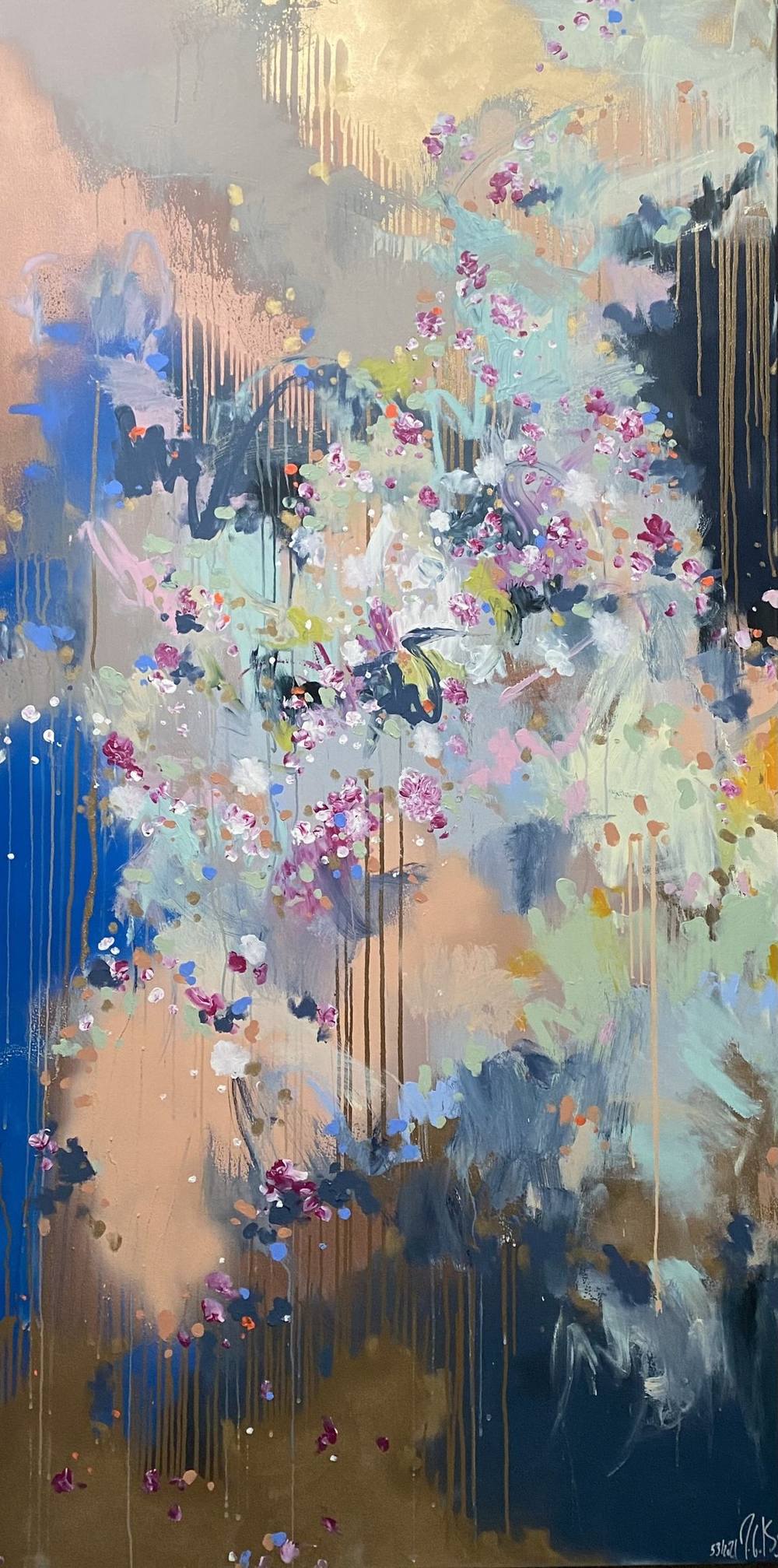
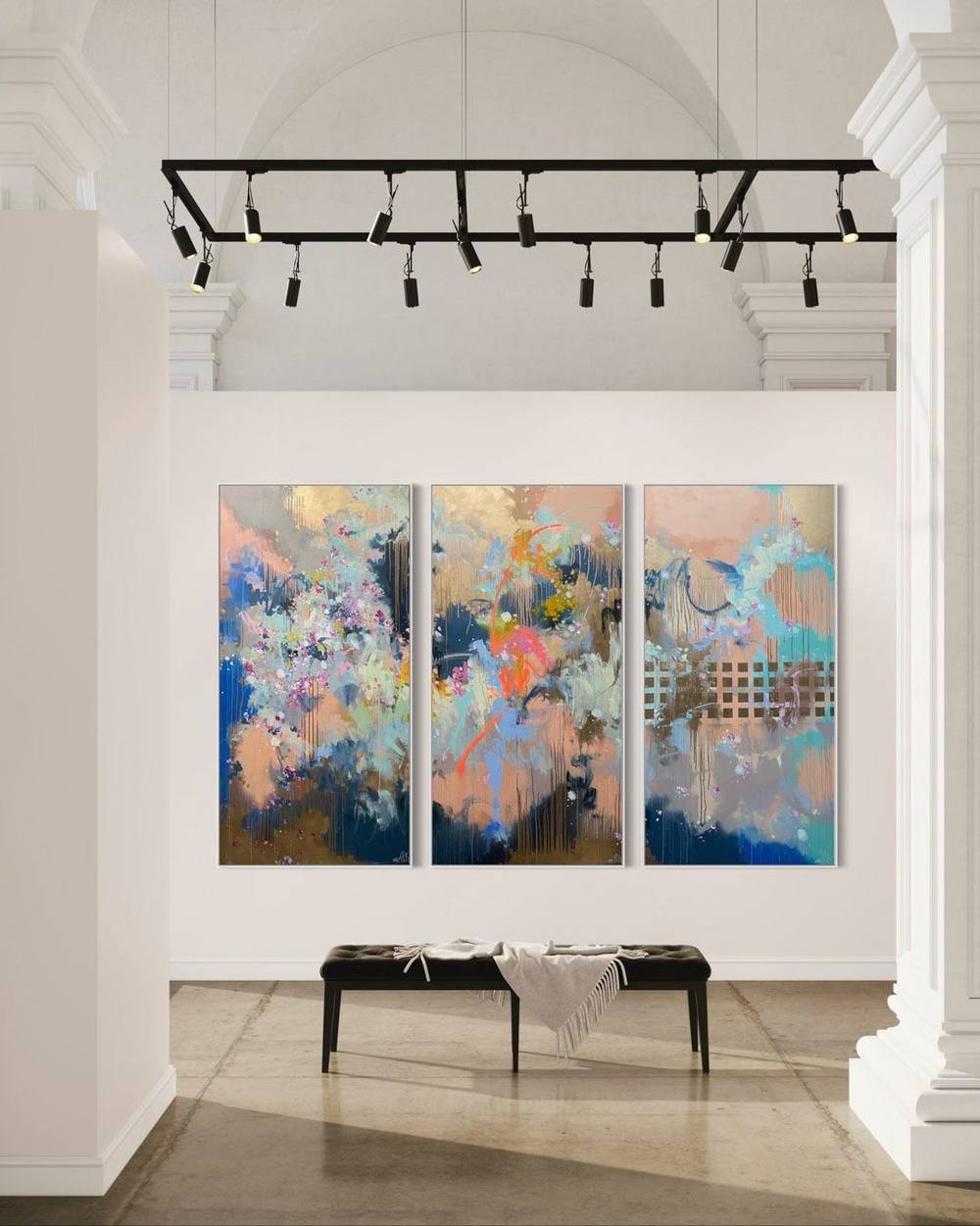
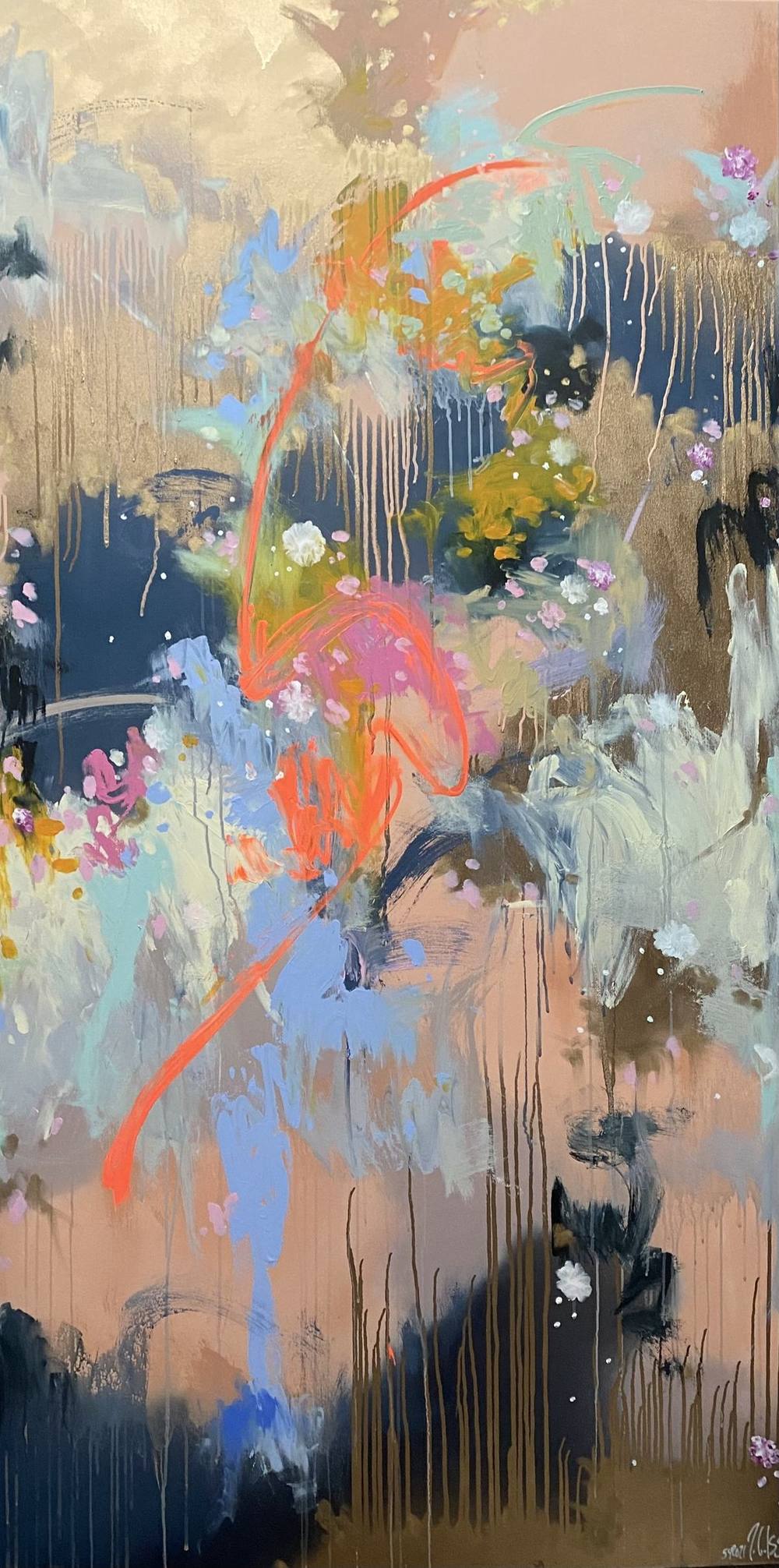
In Juliane Golbs’s Signature Collection, 53 | 2021, 54 | 2021 and 55 | 2021 form a three-part ensemble. Each panel measures 100 × 200 centimetres and is painted in acrylic and gold leaf on canvas. Unlike Beckmann’s, there is no wider centre. The three upright formats are identical in size, so order arises from colour and rhythm alone.
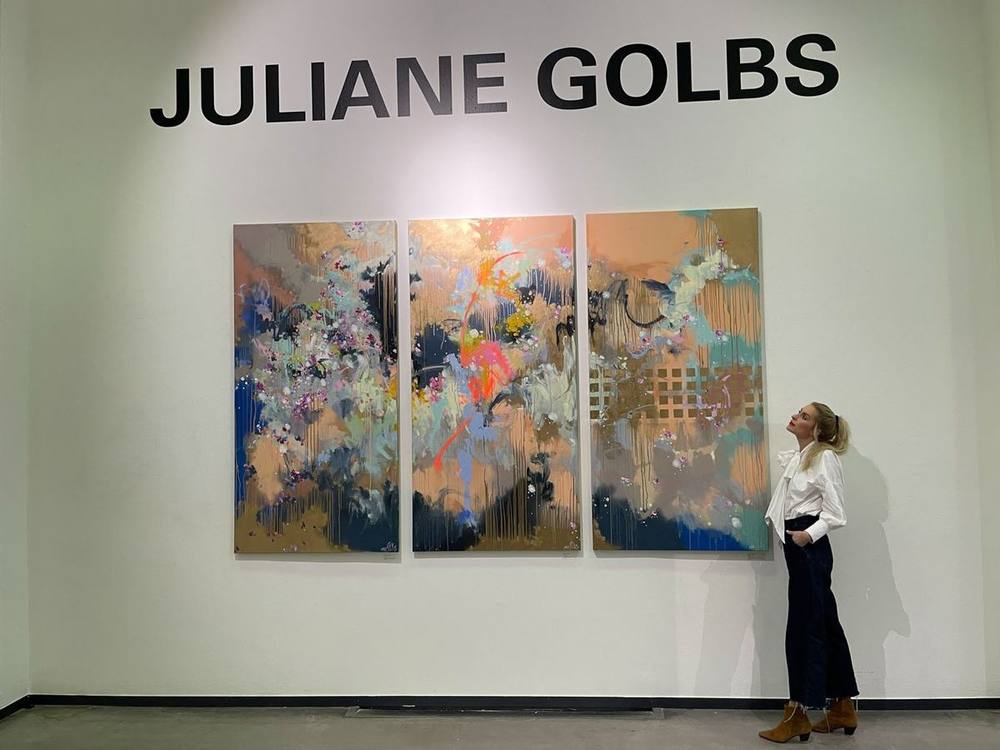
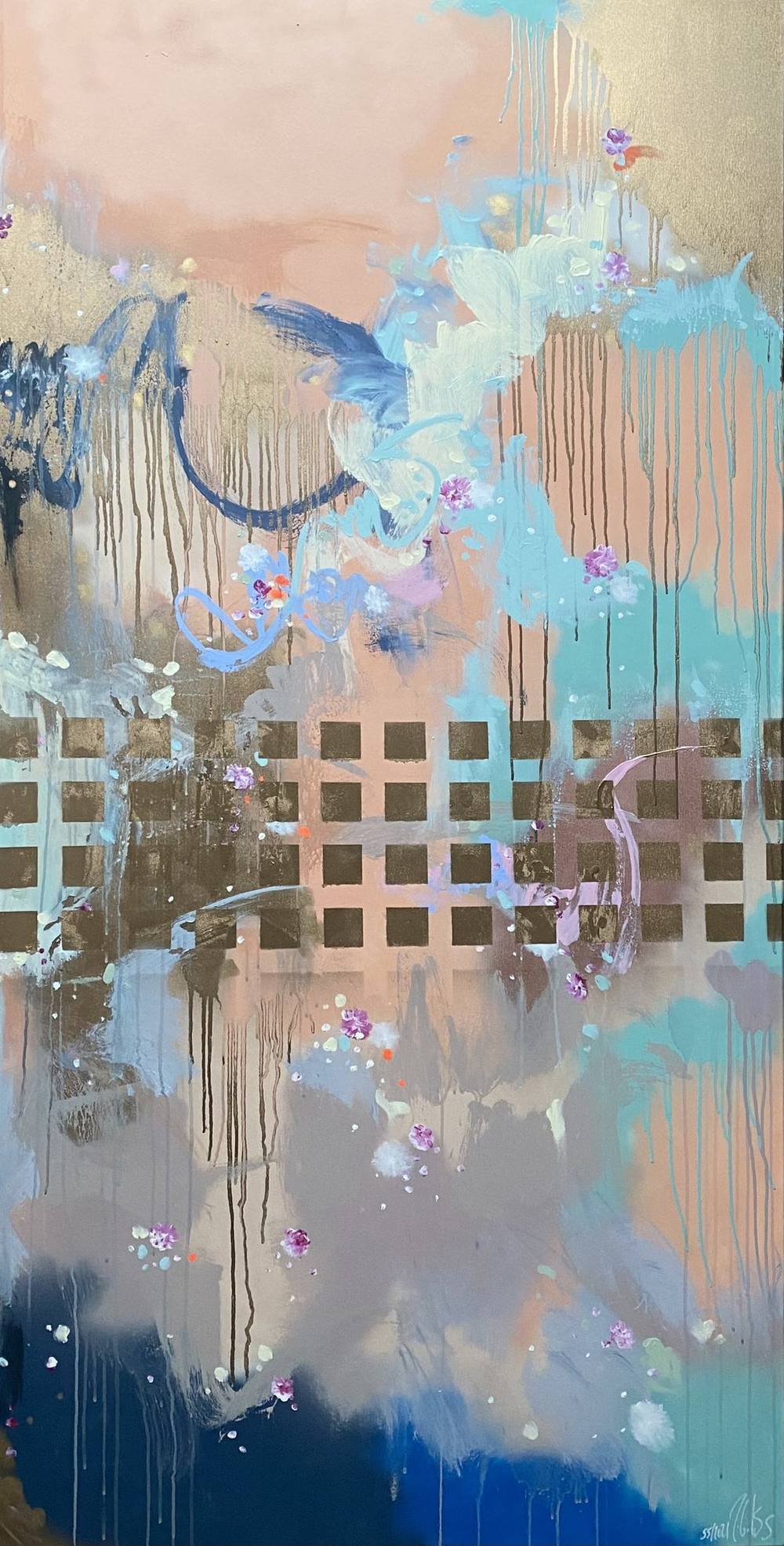
On the left, 53 | 2021 holds a field of gold leaf in its upper third, with clouds of midnight blue, cobalt, apricot and mint gathering below, scattered with hundreds of tiny blossoms in plum, lilac and white. The centre, 54 | 2021, opens onto a light ground of champagne gold and peach, crossed by a glowing orange line. On the right, in 55 | 2021, a grid of gold-leaf squares lies over powder pink, ice blue and turquoise. Vertical drips link all three panels like fine rain.
The gold recalls the gold ground of early panel painting without quoting it. As in Bosch, fields of colour carry across the frames, so that the joins become pauses for breath. More on the signs and heraldic ideas behind the series can be found in the article on monogram art and the Signature Collection.
01 | 2023 offers another reading of the threefold form: three black canvases, together 300 × 120 centimetres, arranged as a horizontal frieze of turquoise brushstrokes, small blossoms and white squares. The work is no longer available.
A three-part painting in the living room
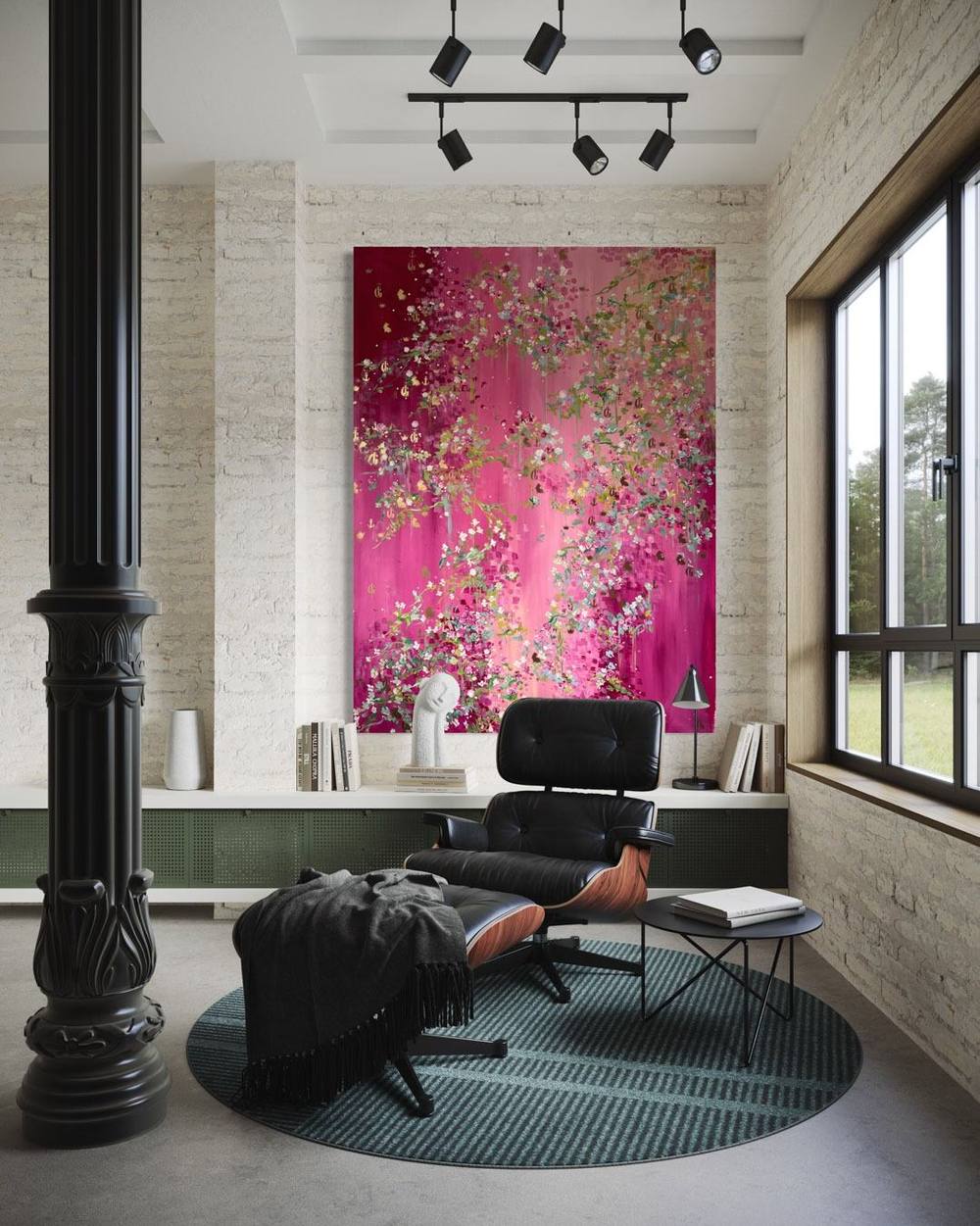
A triptych in a living room reads as one large picture, articulated by two narrow pauses. Those pauses give the work a calm rhythm. A three-part painting is also easier to transport than a single canvas of the same width. With panels of 100 × 200 centimetres each, however, you need a wall more than three metres wide, room to breathe on either side and a ceiling high enough for a picture two metres tall.
A few general principles help with hanging:
- Think of it as one. The reference point is the centre of the whole group, not a single panel.
- Equal gaps. The spaces between the panels should be equal and narrow enough for the eye to read the three parts as one picture.
- Clean lines. Top and bottom edges sit on one line; otherwise the rhythm falters.
- Mark it first. Paper templates or masking tape on the wall show the total width, gaps included, before any drilling.
- Even light. Gold leaf responds to every light source. A spotlight that catches only one panel breaks the ensemble apart.
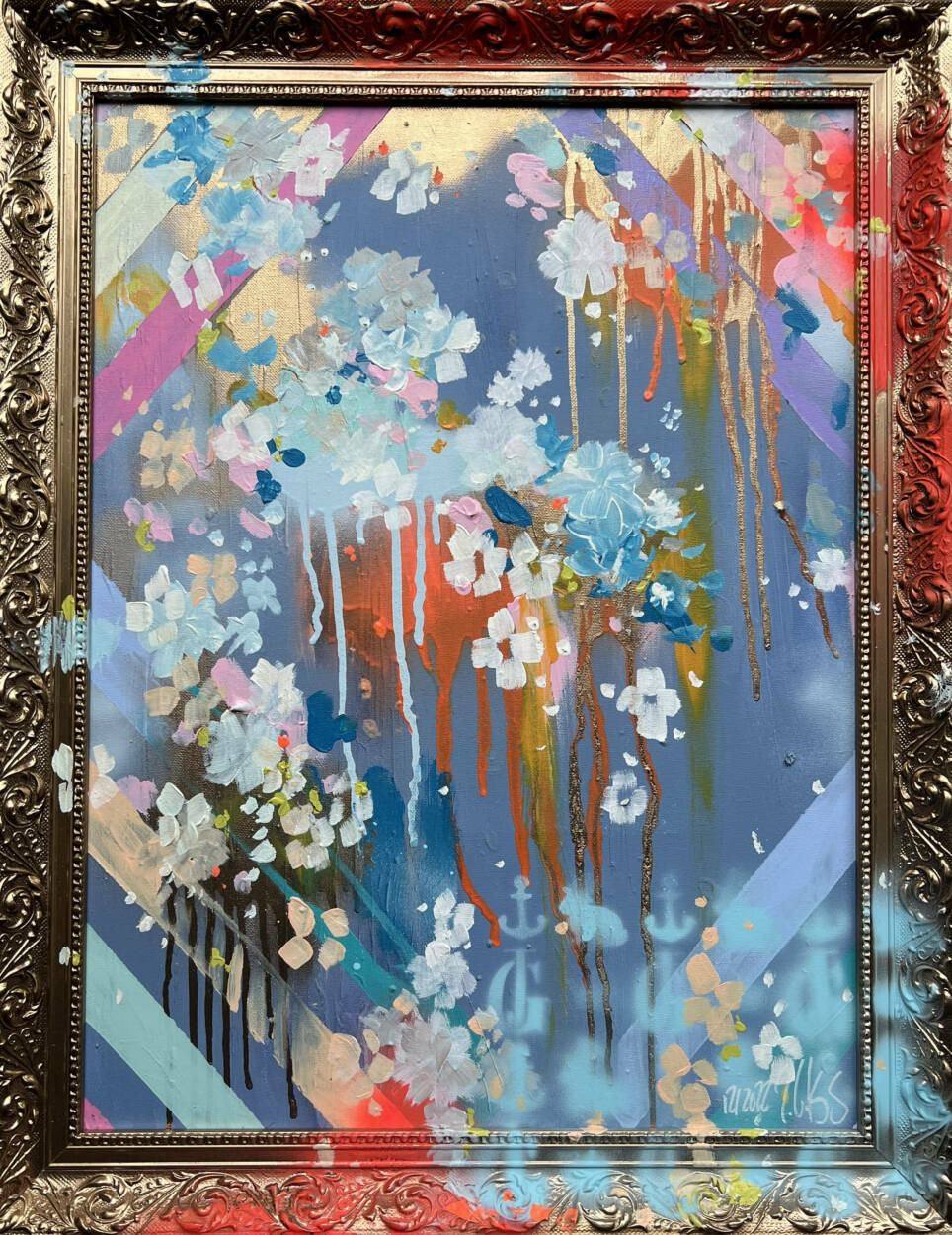
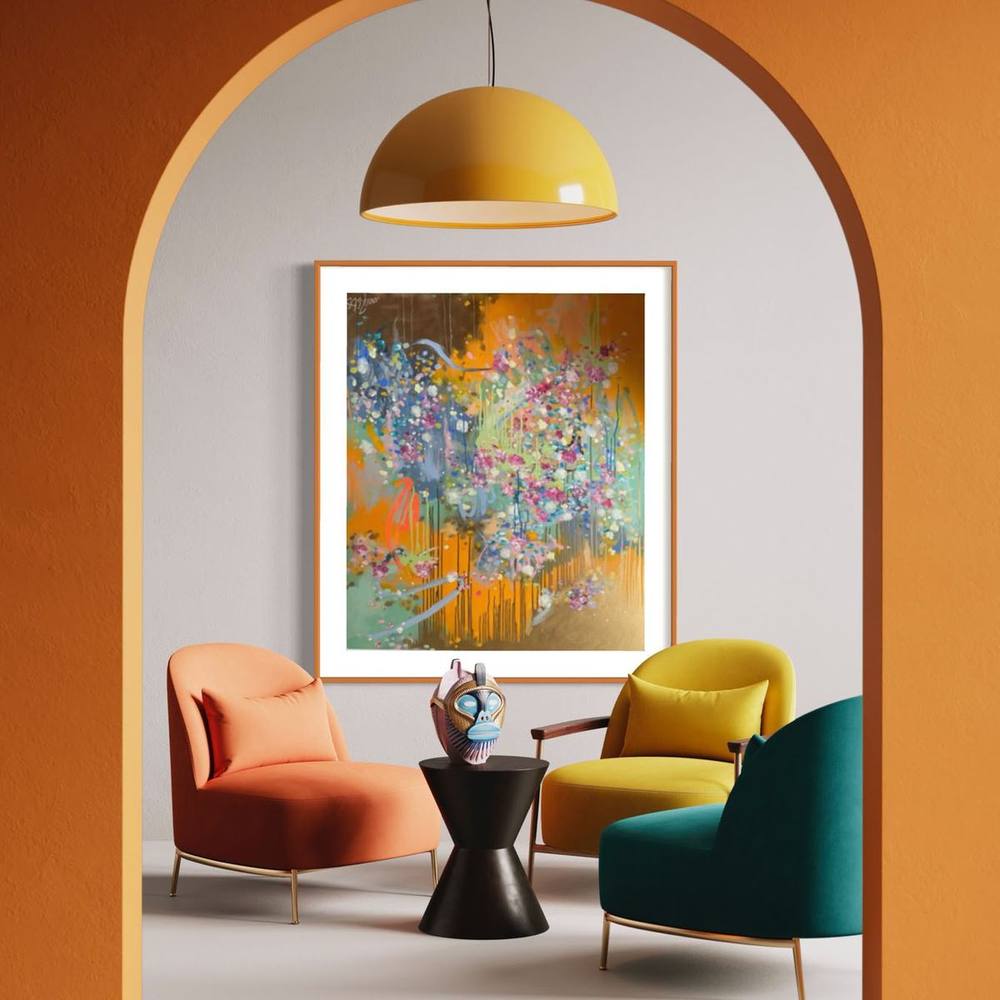
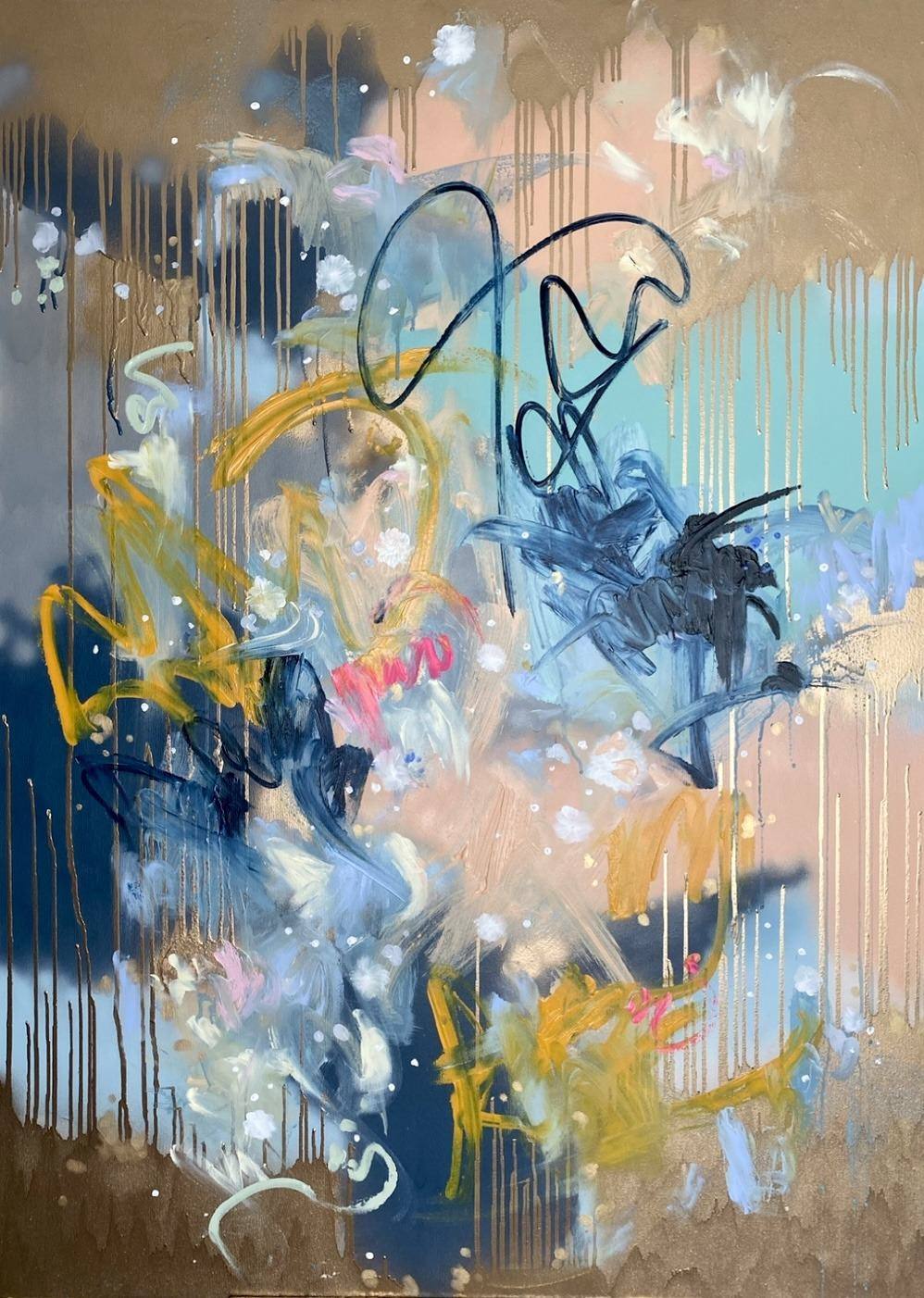
For more on formats, hanging height and distance from furniture, see the article on the large painting in the living room. If there is room for only one panel, the series offers related single works. 38 | 2021 shares the palette of blue, apricot and gold, while 42 | 2021 lets golden light run over a geometric grid; both measure 100 × 140 centimetres.
For a small fee, credited against the purchase price, any available work can be hung on trial. The art advisor helps you choose by colour and format, and for a personal conversation the way leads through contact.
From the Ghent Altarpiece to the Signature Collection, the form has barely changed: three fields that relate to one another. Its effect has stayed too. A triptych asks you to let your gaze wander, from left to right and back again.
Works from this article
Frequently asked questions
What is a triptych?
A work of art in three panels, either joined together or shown side by side. The form has its origins in the winged altarpiece, whose side wings could be closed and opened. In the twentieth century painters such as Max Beckmann and Francis Bacon took it up for secular subjects.
Is the Ghent Altarpiece a triptych?
Strictly speaking, no. The altarpiece begun by Hubert van Eyck and completed by his brother Jan has far more than three panels and was dedicated on 6 May 1432. It follows the same principle, however: a quieter closed view and a richly coloured open view for feast days.
Is there a famous winged altarpiece in Hamburg?
Yes. Master Bertram’s Petri Altar, also known as the Grabow Altarpiece, was made in 1379/83 for the high altar of St Peter’s Church in Hamburg. Alfred Lichtwark acquired it for the Hamburger Kunsthalle in 1903.
How should a triptych be hung in a living room?
As a single unit: with equal, narrow gaps between the panels, top and bottom edges aligned, and the centre of the whole group as the reference point. It helps to mark the total width, gaps included, on the wall beforehand.
Which triptych by Juliane Golbs is there?
In the Signature Collection, 53 | 2021, 54 | 2021 and 55 | 2021 form a three-part ensemble, each panel 100 × 200 centimetres, painted in acrylic and gold leaf on canvas. The three-part frieze 01 | 2023 is no longer available.
Sources
8 sources
- Tate: Art Term Triptych
- The Metropolitan Museum of Art: The Ghent Altarpiece
- Museo Nacional del Prado: The Garden of Earthly Delights Triptych
- Hamburger Kunsthalle, Online Collection: Bertram von Minden, Retable of the former high altar of St Peter’s Church (Grabow Altarpiece)
- The Museum of Modern Art: Max Beckmann, Departure
- Tate: Francis Bacon, Three Studies for Figures at the Base of a Crucifixion (1944)
- The Estate of Francis Bacon: Three Studies for Figures at the Base of a Crucifixion
- Art UK: Capturing bestial humanity. Francis Bacon’s Three Studies for Figures at the Base of a Crucifixion