Harbour paintings: ships, cranes and light from Amsterdam to Hamburg
Since the seventeenth century the harbour has been a stage of its own in painting. A path from the marine painters of Amsterdam via Turner and Monet to the Hamburg harbour pictures of the Kunsthalle and the present day.
Few places join work and poetry as naturally as a harbour. Ships come and go, cranes rise above the quays, and the water gives back a sky that changes by the hour. Harbour paintings have held a rank of their own since the seventeenth century, and anyone who follows their trail arrives sooner or later in Hamburg. Here the Kunsthalle had ships, mooring posts and chimneys painted on purpose, long before the city gained its present landmark on the Elbe.
Amsterdam in the seventeenth century: the ship as portrait
The Dutch Republic owed its wealth to the sea, and its painters made the ship a subject of real weight. At the heart of this marine painting stand a father and son: Willem van de Velde the Elder and Willem van de Velde the Younger. The father was a self-taught draughtsman. He pioneered what is known as pen painting and sailed out with the fleet to sketch naval actions as they happened, among them the Battle of Solebay.
The son carried this precision into oil, often working from his father’s drawings. The Rijksmuseum shows his Cannon Shot of around 1680. A Dutch man-of-war lies in a perfect calm, its sails hanging loose, as it fires a cannon. Sloops float on either side, and in the distance another ship rests with lowered sails. Its companion piece, The Gust, shows a ship on the high seas caught by a squall. Stillness and turmoil: painting of the water has moved between these two poles ever since.
From Amsterdam to Greenwich
The Dutch remember 1672 as the Rampjaar, the Disaster Year. The two Van de Veldes left the Republic at the invitation of Charles II. The king paid them a salary equal to that of his Principal Painter, Sir Peter Lely. He also gave them a studio in the Queen’s House at Greenwich, where they lived and worked for twenty years.
Royal Museums Greenwich describes them as the founders of the English school of marine painting. The National Maritime Museum holds the largest collection of their work in the world, including some 1,400 drawings. How far their influence reached is captured in a remark J. M. W. Turner is said to have made about a picture by the younger Van de Velde: “This made me a painter.”
Turner and the Fighting Temeraire
In 1839 Turner himself produced one of the most famous ship paintings of all. The Fighting Temeraire shows the last journey of a 98-gun three-decker that had defended Nelson’s flagship HMS Victory at Trafalgar in 1805. A paddle-wheel steam tug draws the old warship up the Thames from Sheerness to Rotherhithe, where she is to be broken up. She berthed there on 6 September 1838.
According to the National Gallery, Turner probably did not witness the tow and reconstructed the scene from contemporary reports. He gave the hull a pale white and gold, left the lower masts standing and set the whole against a burning sunset. The tug’s smoke drifts back through the rigging: the age of sail gives way to steam. That the sun sets in the wrong direction for a ship on this course is poetic licence. Turner kept the picture until his death in 1851 and called it his “Darling”. It came to the National Gallery in London with the Turner Bequest of 1856.
Monet in Le Havre: a harbour names a movement
Some three decades later a young painter stood at a window of the Hôtel Amirauté in Le Havre. Around November 1872 Claude Monet painted the outer harbour at dawn: cranes, chimneys and masts in the mist, with an orange sun above. The Musée Marmottan notes that he added the rowing boats and the sun only towards the end. The canvas measures just 50 × 65 centimetres.
When Monet showed it in 1874 at the first exhibition of the future Impressionists, held in the photographer Nadar’s former studio, he listed it in the catalogue simply as Impression, since it could hardly pass as a view of Le Havre. The critic Louis Leroy seized on the title and headed his review in Le Charivari of 25 April 1874 “L’exposition des impressionnistes”. A few days later Jules Castagnary used the word approvingly. A harbour in fog had given a whole movement its name.
Harbour paintings in the Hanseatic city
In Hamburg the motif found an institution of its own. Alfred Lichtwark, first director of the Hamburger Kunsthalle from 1886, founded the “Collection of Paintings from Hamburg” in 1889. He invited artists to paint the city on the spot. The results entered the Kunsthalle’s collection, from Hamburg painters such as Ernst Eitner and Arthur Illies to Max Liebermann, Lovis Corinth and Max Slevogt. In 1913 Pierre Bonnard and Édouard Vuillard spent several weeks in the city.
The painter who made his name in this context was Leopold von Kalckreuth. Lichtwark invited him again and again. In his large harbour pictures of 1894, as the Kunsthalle puts it, he captured the atmosphere of the shipyard workers’ hard labour in an almost Impressionist manner. One of them, Duckdalben im Hamburger Hafen, mooring posts in the port of Hamburg, is an oil painting of 140 × 200 centimetres. It entered the Kunsthalle in the year it was painted, a gift from the Kunstverein in Hamburg.
In 1911 Lovis Corinth painted his View of the Köhlbrand from a house on the Palmaille in Altona. The branch of the Elbe appears as part of a port then being modernised, with chimneys rising steeply. Against this industrial landscape Corinth set a broad sky of drifting cloud. This picture, too, entered the collection in the year of its making. How Hamburg has shaped artists over generations is the subject of Painters in Hamburg.
Juliane Golbs: a harbour in golden light
A work made in a Hamburg studio continues this line. In 15 | 2021 a tall ship with finely drawn rigging lies at the centre, beside it a smaller vessel and a rowing boat. At the right edge a harbour crane is suggested only in line. The scene is set within clouds of turquoise, sky blue and night blue, framed by broad fields of gold.
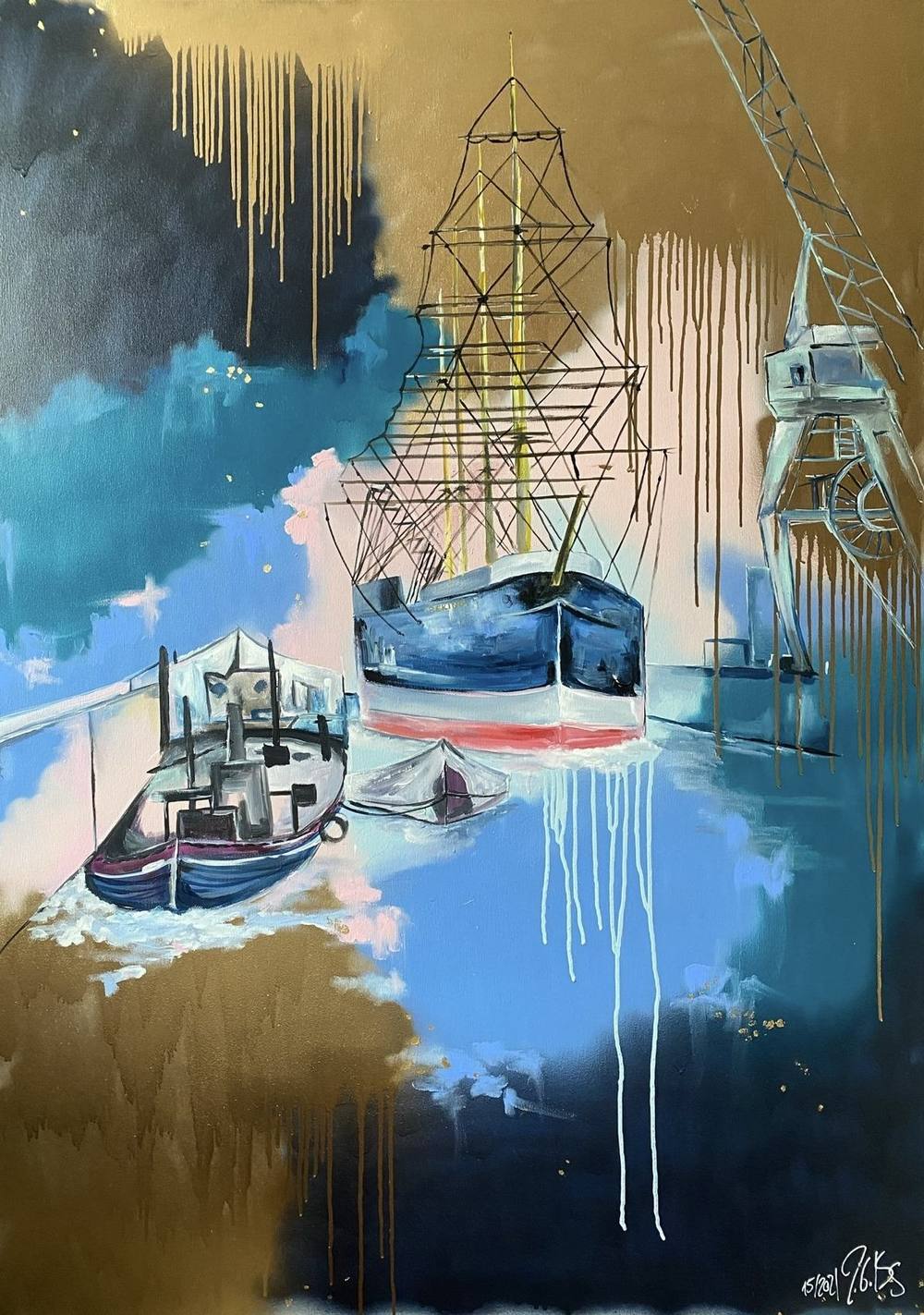
Gold and white drips run vertically through the picture, so that the water seems seen through a veil of rain. Juliane Golbs works here in acrylic and mixed media on canvas and lets drawing and painting stand one over the other. The pairing of line and fluid colour recalls the washed veduta, translated into a large format. As with Corinth, firm forms stand against a moving sky, though here ship and crane themselves dissolve into colour.
The picture makes no topographical claim. It belongs to the Golden Things series, in which gold stands for the light of a particular hour. Turner’s Temeraire glows in the sunset, Monet’s Le Havre in the morning haze. In Golbs’s harbour the light falls as gold.
Hamburg between the Elbphilharmonie and the anchor
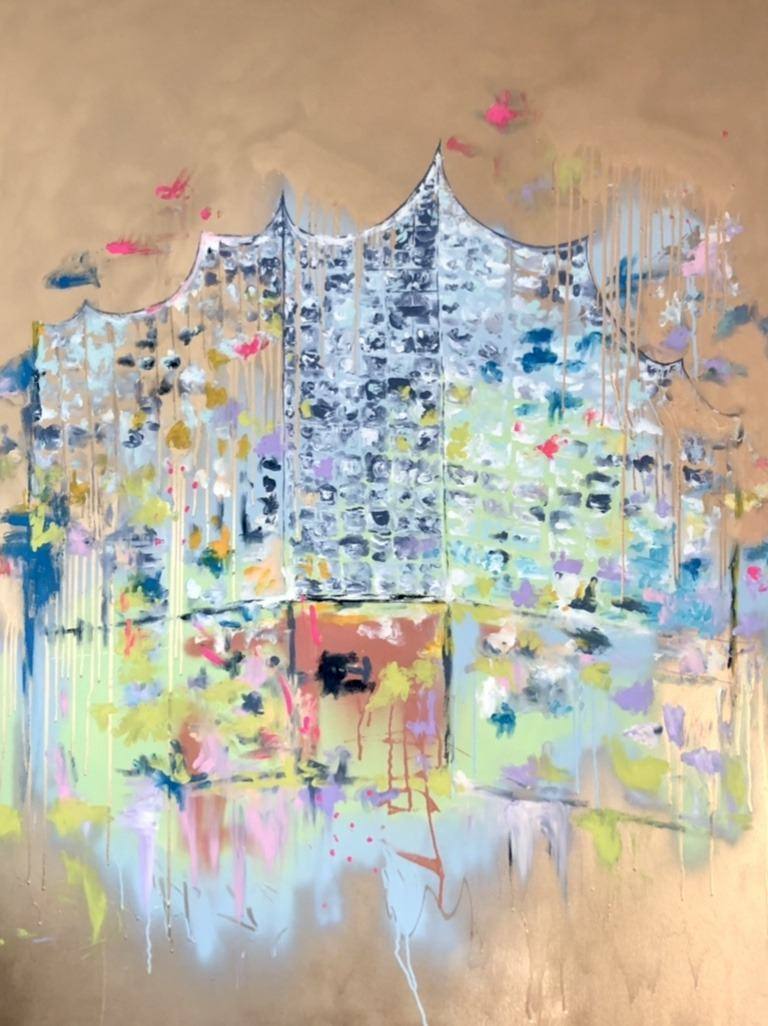
The harbour also appears in Juliane Golbs’s work where no ship is to be seen. Golden Elbphi of 2019 shows the Elbphilharmonie with its wave-like roofline as a grid of blue, grey and white. Below, the brick base blurs into pastel, and drips run downwards like a reflection in the water. The copper-gold ground reads like a sunset sky over the port. The work measures 120 × 160 centimetres and is now in a private collection.
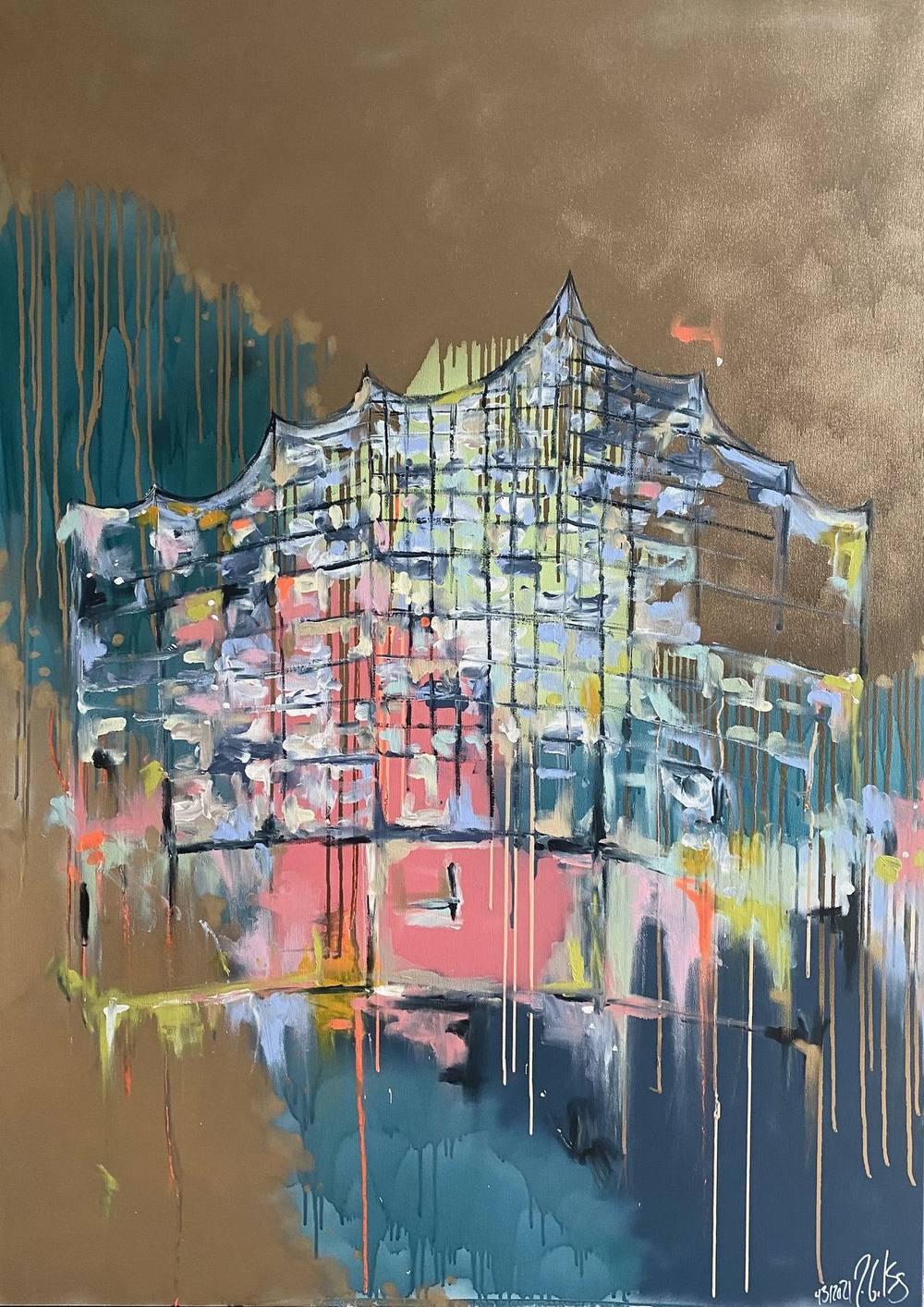
Still available is 43 | 2021, a second Elbphilharmonie from the Golden Things series in acrylic and acrylic lacquers, 100 × 140 centimetres. Here the glass façade becomes a grid of black outlines filled with pale blue, rosé, lime yellow and coral, while the lower part of the building dissolves into petrol and night blue. Above it lies a calm sky of bronze and gold.

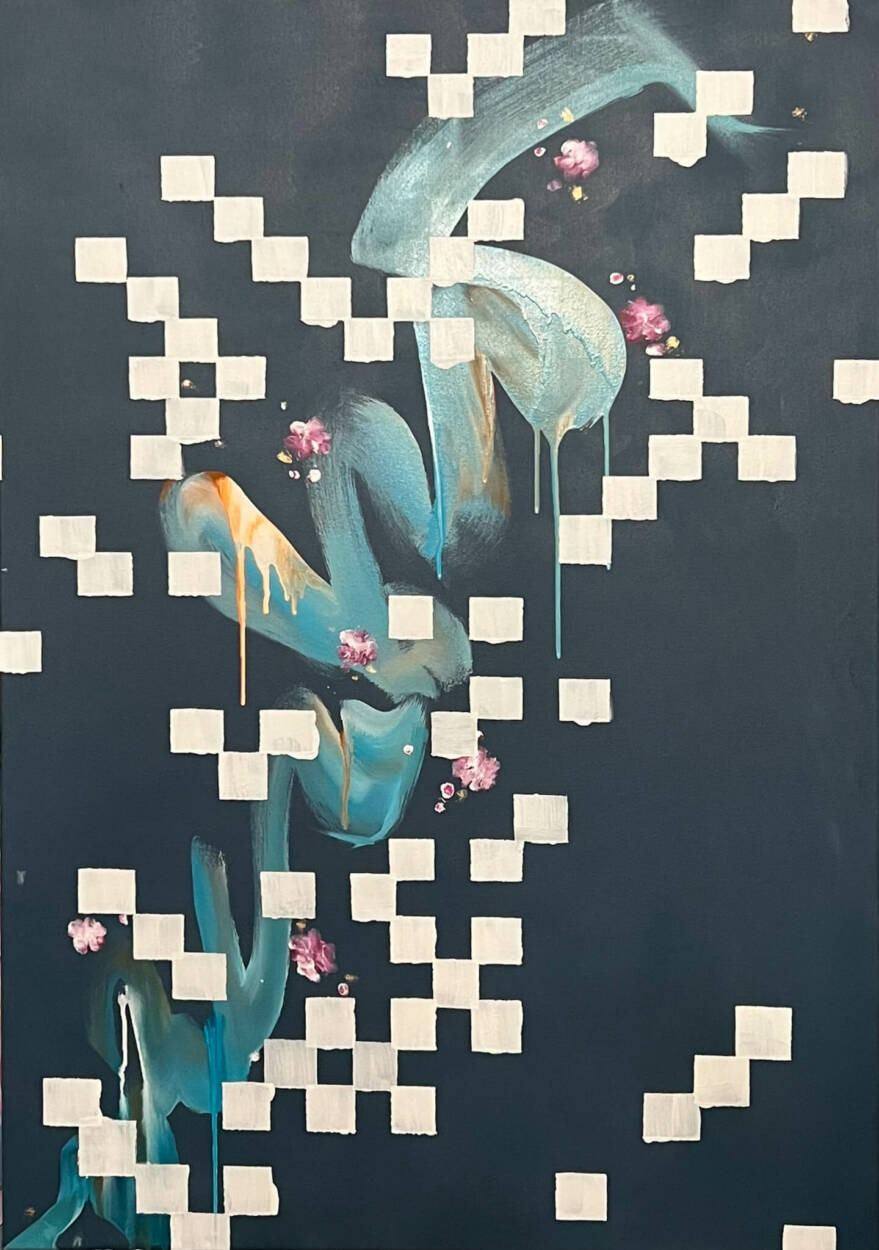
508 | 2024 from the Signature Collection does without a harbour scene altogether. Over a ground of cobalt blue, petrol and turquoise, in which pale wave crests break, lies a grid of golden signs: monogram, crown, hare and anchor. The anchor stands for Hanseatic steadfastness. The part blue plays in these pictures is explored in Blue in art.
A harbour painting for your own room
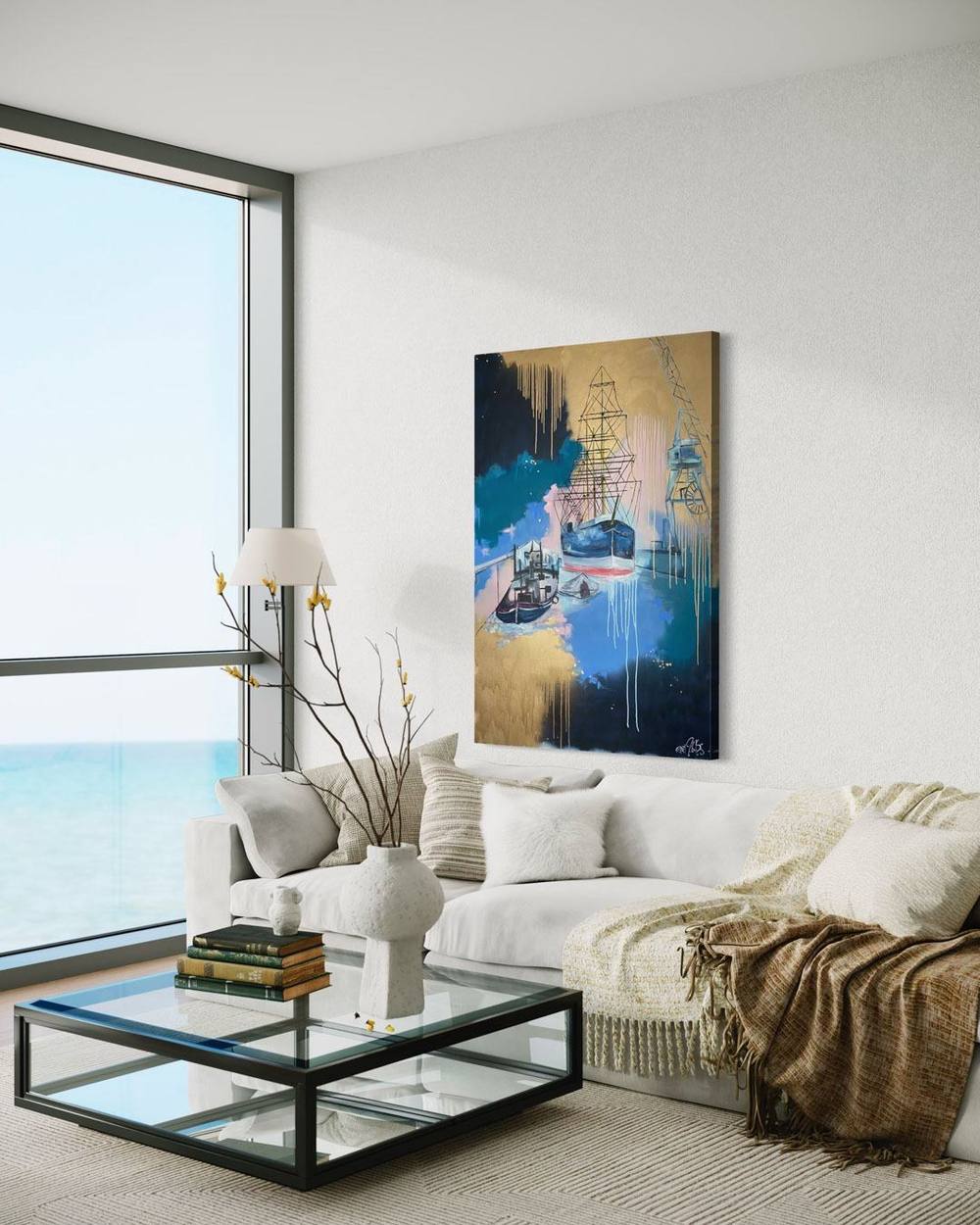
A harbour painting brings a sense of distance into a room, even in a city flat without a view of the Elbe. Portrait formats such as 15 | 2021 or 43 | 2021 need a calm wall and a little space around them so that sky and water can breathe. Gold surfaces respond strongly to light: muted in the morning, glowing under warm evening light, much like the sunset over Turner’s Thames. Those who prefer something smaller and more emblematic will find the harbour as a symbol in a round format such as 508 | 2024.
In the catalogue of works the paintings can be filtered by colour, and the art advisor asks about mood and format. For Hamburg interiors with a connection to the water, a conversation about a commission is also worthwhile; the way there leads through contact.
From a cannon shot in a calm to a harbour crane in golden light, painting’s view of the harbour has shifted steadily, from the exact portrait of a ship to the mood of an hour. What remains is the water and the light that falls upon it.
Works from this article
Frequently asked questions
Who founded the English school of marine painting?
Willem van de Velde the Elder and his son Willem van de Velde the Younger. After the Dutch Disaster Year of 1672, Charles II brought the two to England and gave them a studio in the Queen’s House at Greenwich. The National Maritime Museum now holds the largest collection of their work in the world.
Why is Impressionism named after a harbour painting?
In 1874, at the first exhibition of the future Impressionists, Claude Monet showed a view of the port of Le Havre in morning mist and listed it in the catalogue simply as “Impression”. The critic Louis Leroy then headed his mocking review “L’exposition des impressionnistes”.
Where can one see paintings of the port of Hamburg?
At the Hamburger Kunsthalle, whose first director Alfred Lichtwark built up the “Collection of Paintings from Hamburg” from 1889. It includes Leopold von Kalckreuth’s “Duckdalben im Hamburger Hafen” of 1894 and Lovis Corinth’s “View of the Köhlbrand” of 1911.
Has Juliane Golbs painted a harbour?
Yes. 15 | 2021 from the Golden Things series shows a tall ship, a smaller vessel, a rowing boat and a harbour crane between turquoise, night blue and gold, in acrylic and mixed media on canvas, 100 × 140 cm. The work is available.
Sources
8 sources
- Royal Museums Greenwich: The Van de Veldes. Greenwich, Art and the Sea (press release)
- Rijksmuseum: Willem van de Velde (II), The Cannon Shot, c. 1680
- The National Gallery, London: Joseph Mallord William Turner, The Fighting Temeraire, 1839
- Musée Marmottan Monet: Claude Monet, Impression, soleil levant
- Hamburger Kunsthalle: Lichtwark revisited
- Hamburger Kunsthalle: Leopold von Kalckreuth. Poetischer Realist
- Hamburger Kunsthalle, Online Collection: Leopold Graf von Kalckreuth, Duckdalben im Hamburger Hafen, 1894
- Hamburger Kunsthalle, Online Collection: Lovis Corinth, Blick auf den Köhlbrand, 1911