Peony art: from Luoyang to Everlasting Blossoms
In China it was the emperor among flowers, in Paris Manet’s favourite. A short history of the peony in art and of the Everlasting Blossoms series by Juliane Golbs.
Few flowers have shaped as many artistic traditions as the peony. In China it was the flower of the imperial court, in Japan it was given its own baskets and its own woodblock prints, and in Paris Édouard Manet devoted a whole series of still lifes to it. Anyone who follows peony art across the centuries meets the same question again and again: how do you hold on to an abundance that lasts only a few weeks? The Everlasting Blossoms series by Juliane Golbs offers its own, contemporary answer.
Where the name comes from
In German the peony is called Pfingstrose, the “Pentecost rose”, and the name gives away the season. According to a plant sheet from the University of Natural Resources and Life Sciences in Vienna, it points to the flowering time in early June, around the Christian feast of Pentecost. An article in the journal of Frankfurt’s Palmengarten from 1984 gives June as the month for the herbaceous peonies, while the tree peonies open as early as May, when the late tulips are still standing.
The botanical genus name Paeonia is older. It goes back to the Greek legend of Paeon, whom Hades, as the story has it, turned into the flower that has carried his name ever since. For a long time the plant was valued above all as a medicinal herb. Only later did its beauty become a reason to grow it in gardens.
Mudan: peony art in China
In China the tree peony is called mudan. Brighton & Hove Museums describe it as a symbol of power, wealth and beauty, closely associated with the imperial family. The Metropolitan Museum of Art in New York calls it the “King of Flowers”, a sign of power, dignity and prosperity. These sources do not speak of a queen: Chinese tradition imagines the peony as a ruler.
It gained its rank under the Tang dynasty. According to the Palmengarten article, the tree peony moved to the centre of Chinese interest between 618 and 907, and the city of Luoyang has been its principal growing region ever since. The author calls it the “emperor of the plant kingdom” and the “flower of the empress”, a symbol of wealth and splendour. To paint peonies in China was therefore never simply to paint a flower. It meant painting rank, dignity and a spring that belonged to the court.
Japan: a basket and a woodblock print
The tree peony reached Japan early. The Palmengarten article mentions Buddhist monks who brought it there between the sixth and eighth centuries, while the Metropolitan Museum dates the arrival of the genus and its symbolism to the eighth century. In Japan the flower was prized as elegant and auspicious. A tall basket of bamboo and rattan from the second half of the nineteenth century, now at the Met, was woven specifically for peonies.
Around 1833 or 1834 Katsushika Hokusai made a colour woodblock print of peonies and a butterfly. The sheet in the RISD Museum in Providence measures 25.9 × 38.3 centimetres and was published by Nishimuraya Yohachi. It belongs to a set now known as Large Flowers. The name alone states the idea: the single bloom is seen on a grand scale, as the protagonist of the picture.
Manet and the peonies of 1864
In Paris, Édouard Manet painted a series of peony still lifes in 1864 and 1865. The Metropolitan Museum, which owns one of them, writes that the peony was reportedly his favourite flower. He grew it in his garden at Gennevilliers. According to the museum, its broad petals and delicate hues suited his loose, sensuous brushwork.
The Musée d’Orsay holds two paintings from these years. The Vase de pivoines sur piédouche of 1864 measures 93.3 × 70 centimetres. Manet showed it in 1865 at the Galerie Martinet and in 1867 in his own pavilion at the time of the Paris Exposition Universelle. In 1906 it entered the national collections with the gift of Étienne Moreau-Nélaton. The small Branche de pivoines blanches et sécateur, also from 1864, measures 30.5 × 46.5 centimetres: a branch of white peonies beside a pair of pruning shears. Manet gave the picture to Champfleury, and through the bequest of Count Isaac de Camondo it came to the Louvre in 1911.
Between the lavish bouquet on its pedestal and the branch beside the shears lies the whole subject of the flower: abundance and its end. How the flower still life went on to develop towards abstraction is told in the article on abstract floral painting.
Everlasting Blossoms: spring, preserved
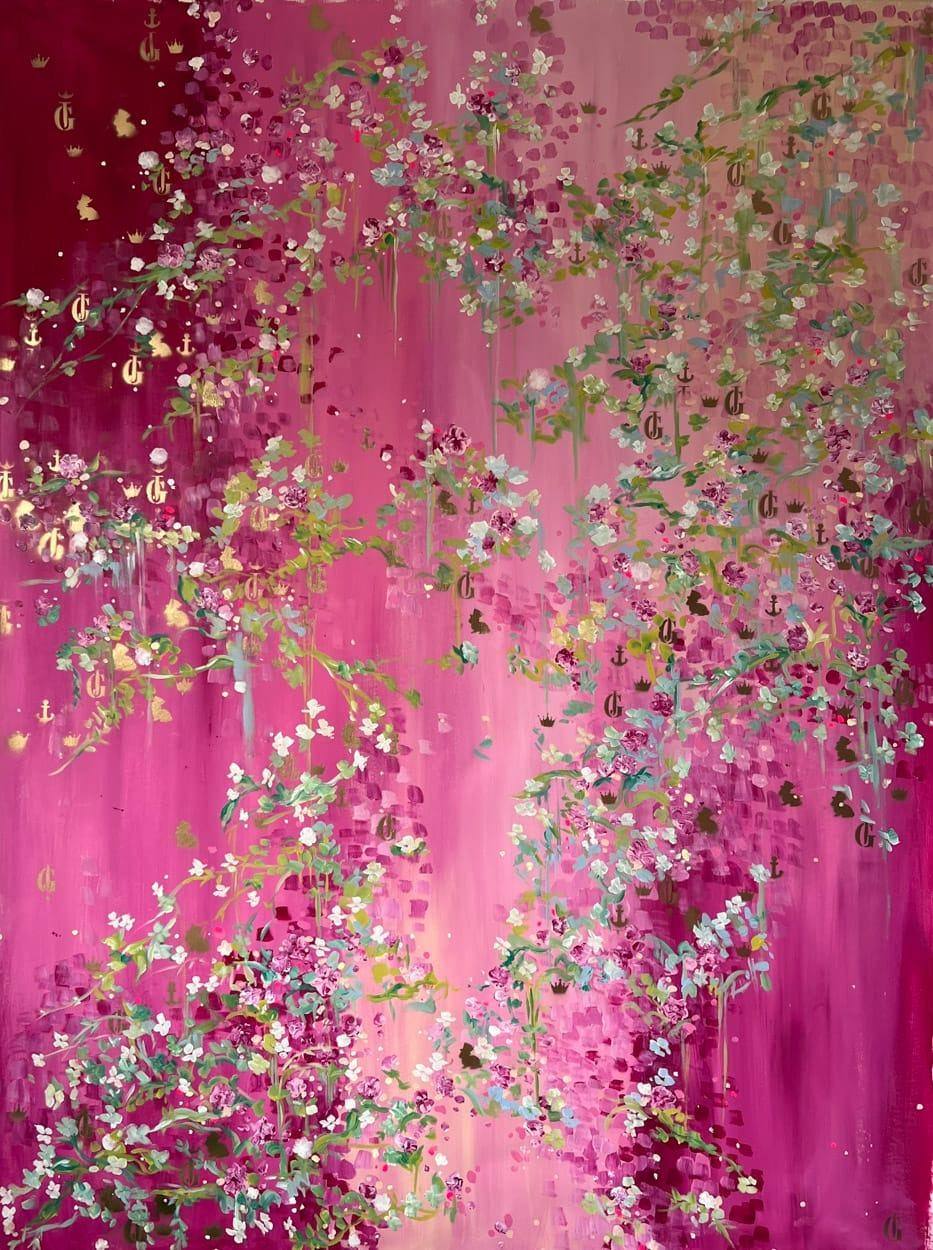
In the work of Juliane Golbs this idea has a name of its own. The Everlasting Blossoms series stands under the heading “Eternity” and the line “Spring, preserved”. The series page reads: “Nature knows no stillness, only the cycle of becoming and passing.” The series understands itself as an aesthetic resistance against transience, as floral abstractions that never wilt.
The catalogue lists five works in the series, painted between 2018 and 2023. All of them are in acrylic, most with acrylic lacquers and gold lacquer, on canvas, on black canvas or on linen, one in mixed media. Part of the proceeds from the series supports the NCL Foundation in its fight against childhood dementia. What that means for collectors is described in the article on the NCL Foundation.
Peonies on raw linen
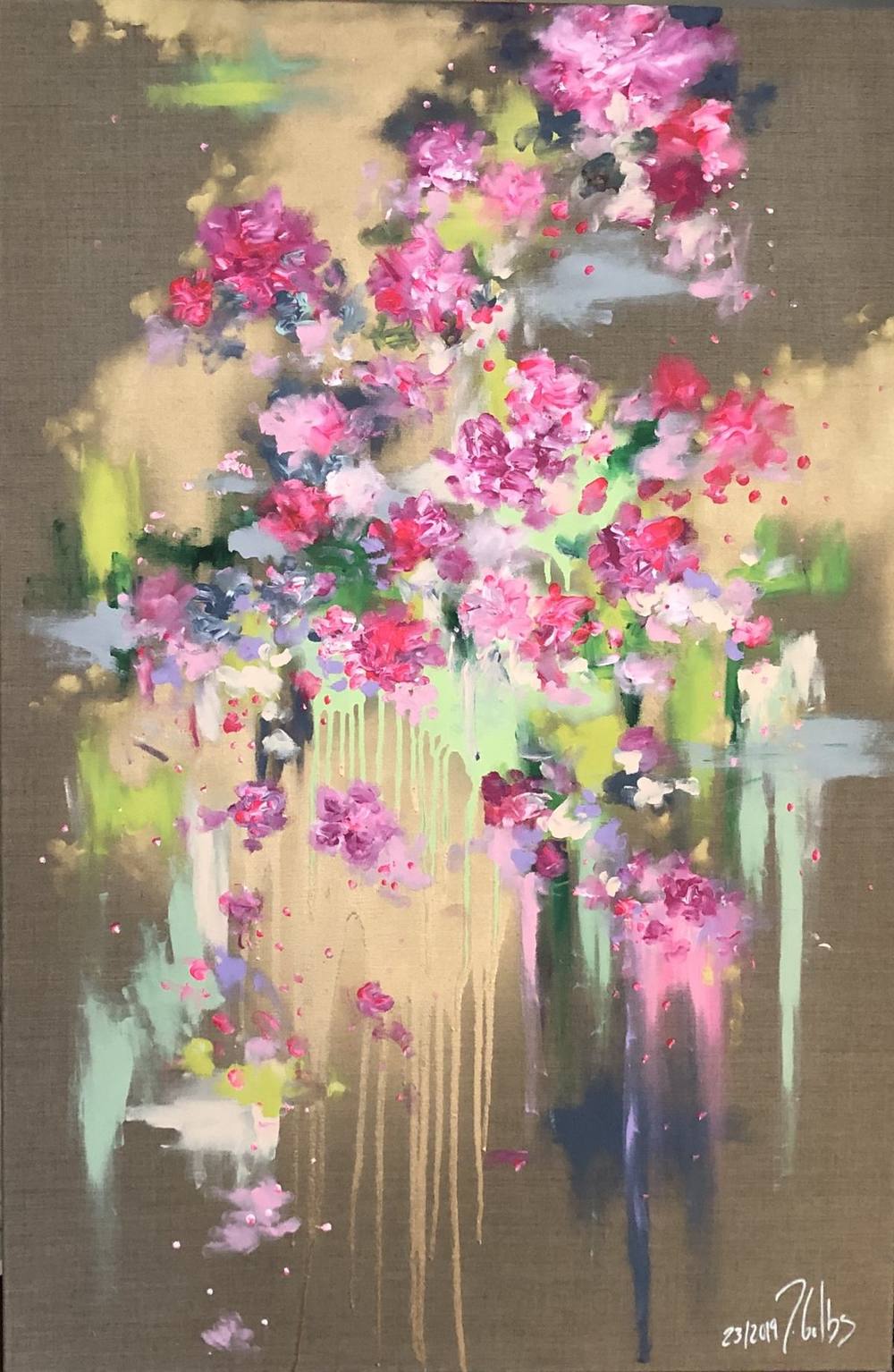
The peony appears most clearly in 23 | 2019. Its curated catalogue text is headed “Peonies on linen”. On untreated linen measuring 80 × 100 centimetres, the blooms sit in pink, magenta and old rose, applied with short, circling brushstrokes that suggest the volume of the petals. Towards the bottom they dissolve into runs of paint, while passages of gold lacquer shimmer behind them. The role the pink plays in this work is explored in the article on pink in art.
Here there is a kinship with Manet. He, too, was less interested in botanical drawing than in what the brush can do with broad petals. The bloom comes from the movement of the hand, not from the outline.
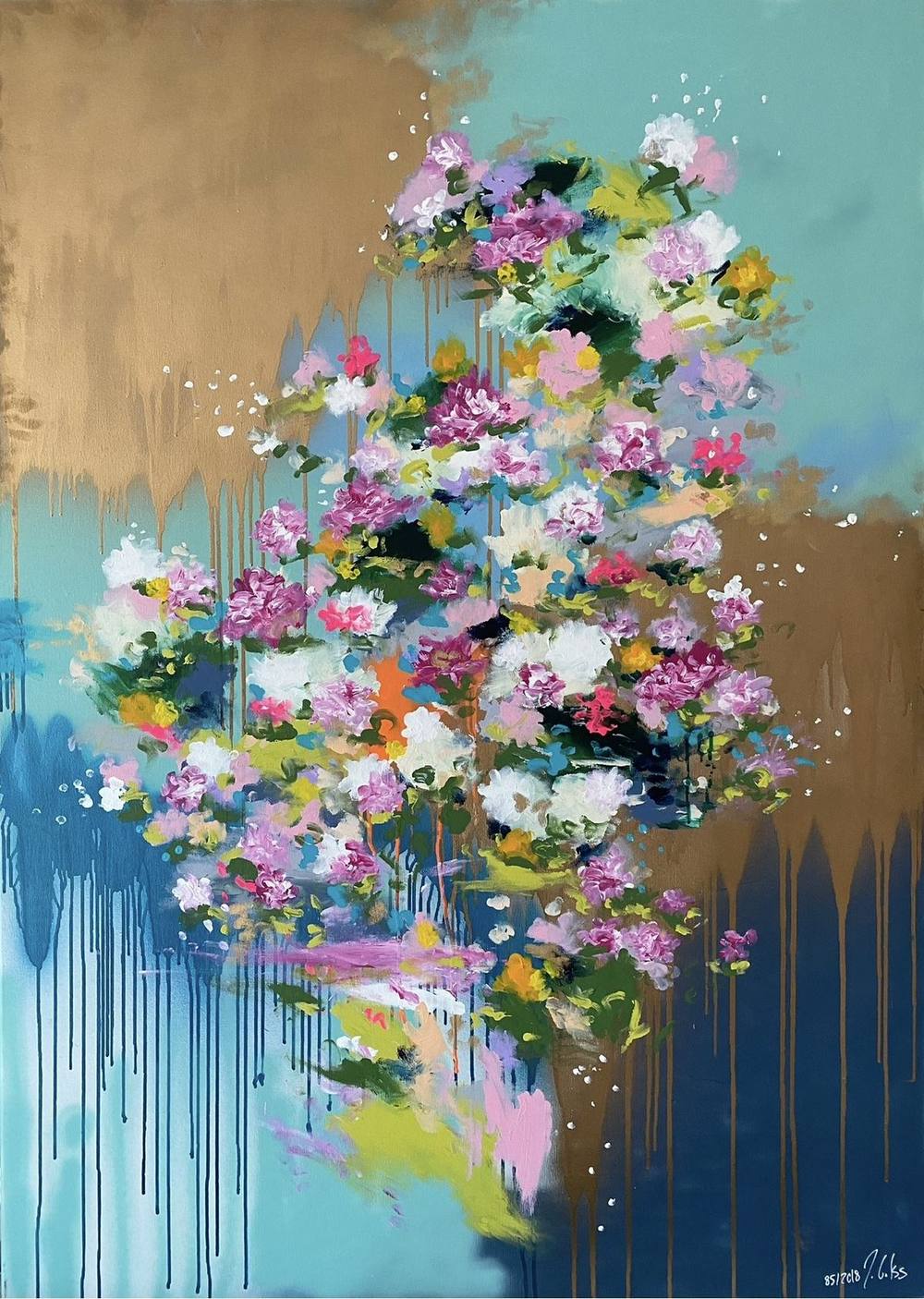
A year earlier came 85 | 2018, at 100 × 140 centimetres the largest portrait format in the series. A dense mass of impasto dabs in pink, lilac and white, interspersed with dark green, stands before a ground divided into two chords: a warm, metallic gold on one side and a cool turquoise on the other. Bands of blue and white run downwards, as if the bouquet were growing and dissolving at once. The catalogue text reads the picture against the flower still life and its vanitas meaning. Here, though, transience is not a warning but part of the beauty.
Gold, midnight blue and a pink frame
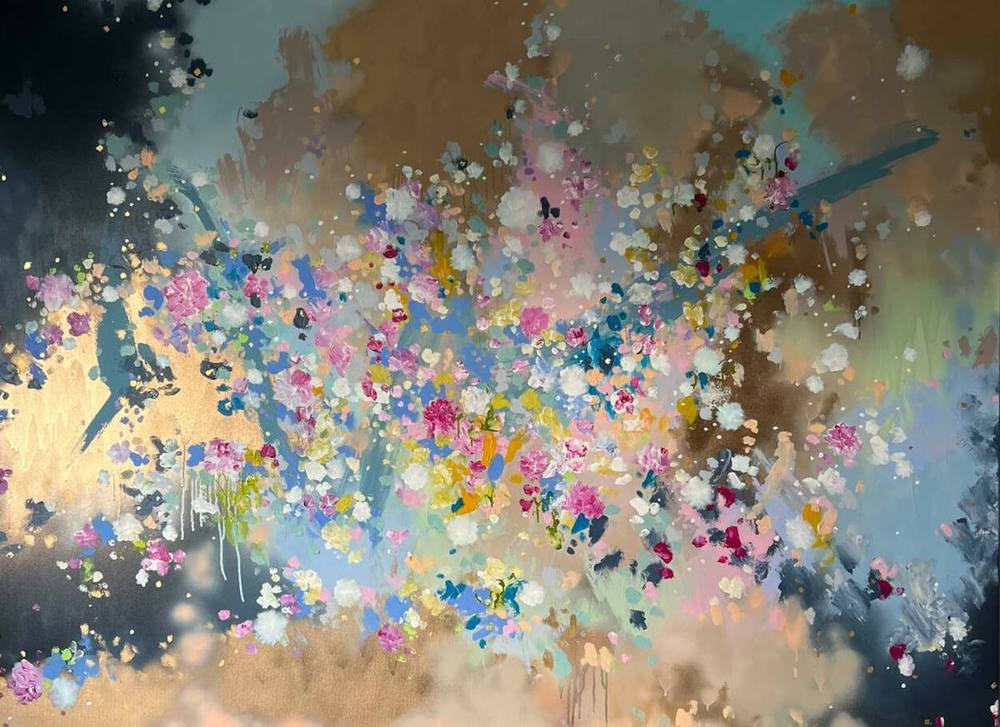
The later works open up the format. In 24 | 2022 a cloud of blossoms in white, pink, yellow, sky blue and lilac stretches horizontally across 200 × 150 centimetres, with a dark midnight blue above and a warm gold ground below. The catalogue text refers to Japanese folding screens with their gold backgrounds and floating plant motifs, without the picture quoting them. The work is now in a private collection.
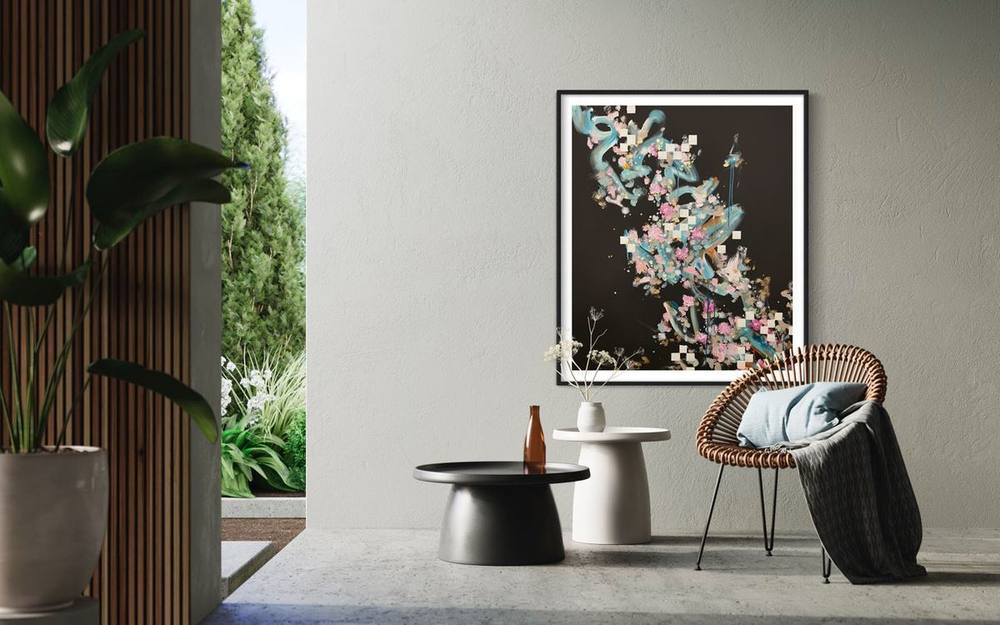
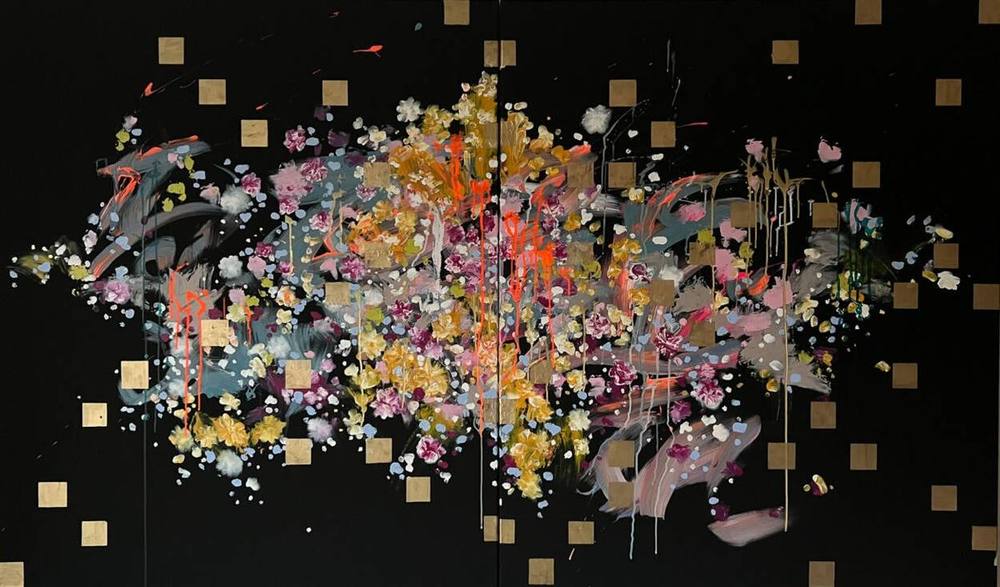
02 | 2023 sets its blossoms on black canvas, 200 × 120 centimetres wide. In the centre a cloud of gold, ochre, pink, coral and white spreads out like fireworks against the night sky. Small gold squares are scattered around it in a loose order and give the movement a calm counterweight. The glossy lacquers stand on the matt black like points of light.
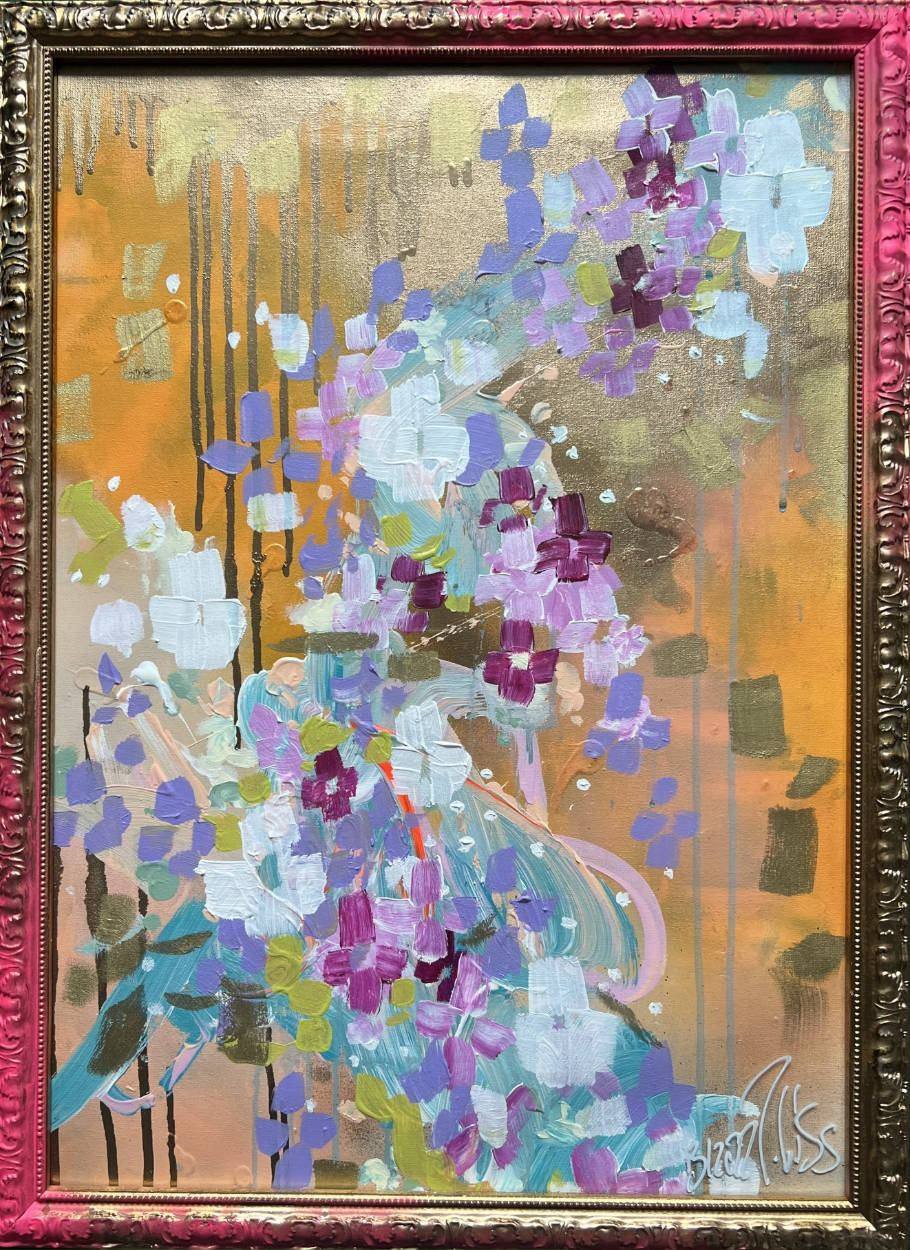
The smallest work, 13 | 2022, measures 48 × 65 centimetres. Juliane Golbs carries the painting behind and over a golden glass frame, which is itself held by an ornamental moulding in vivid pink. On orange and golden ochre, a cascade of blossoms unfolds in lilac, aubergine, lavender and white. The frame takes on the role that the vase on its pedestal plays for Manet: it holds the flower and presents it. The work is no longer available.
Seen side by side, the five works trace the lifetime of a bloom. 85 | 2018 and 23 | 2019 show its opening and dissolving, 02 | 2023 stands, in the words of its catalogue text, for the moment of greatest abundance, and 13 | 2022 for a bloom that is held and preserved. The peony suits this idea precisely because its splendour is brief: Manet’s pruning shears and the runs of paint on the linen tell the same story in different ways.
A peony painting at home
A painting of peonies needs space around it and a quiet wall. For 23 | 2019 the catalogue text suggests rooms with wood, stone and pale textiles, where the raw linen offers a calm counterpoint to the pink. 85 | 2018 works well above a console table or in an entrance hall, 02 | 2023 on a long wall above a sofa or in a dining room with subdued light.
You will find all available works in the series in the catalogue, and the art advisor helps you choose by mood and format. For questions about individual works, you can reach Juliane Golbs through the contact page. The peony blooms for a few weeks a year. In painting, it stays.
Works from this article
Frequently asked questions
Why is the peony called Pfingstrose in German?
The German name, literally “Pentecost rose”, refers to the flowering season: many peonies bloom around the Christian feast of Pentecost, herbaceous peonies in June and tree peonies as early as May. The botanical genus name Paeonia goes back to the Greek legend of Paeon.
What does the peony mean in Chinese art?
In China the tree peony is called mudan. It is known as the King of Flowers and stands for power, wealth and dignity. Since the Tang dynasty (618 to 907) Luoyang has been its principal growing region.
Which peony paintings did Édouard Manet make?
Manet painted a series of peony still lifes in 1864 and 1865. The Musée d’Orsay holds the Vase de pivoines sur piédouche and the Branche de pivoines blanches et sécateur, both from 1864, and the Metropolitan Museum owns another painting from the series.
What is the Everlasting Blossoms series?
Everlasting Blossoms is a series of floral abstractions by Juliane Golbs, conceived as an aesthetic resistance against transience. Part of the proceeds supports the NCL Foundation in its fight against childhood dementia.
Sources
8 sources
- The Metropolitan Museum of Art: Édouard Manet, Peonies (1864–65)
- Musée d’Orsay: Édouard Manet, Vase de pivoines sur piédouche (1864)
- Musée d’Orsay: Édouard Manet, Branche de pivoines blanches et sécateur (1864)
- The Metropolitan Museum of Art: Basket for Peonies (Japan, Meiji period)
- RISD Museum: Katsushika Hokusai, Butterfly and Peonies (ca. 1833–1834)
- Brighton & Hove Museums: Flower Power from the Far East – Peony, the King of Flowers
- Der Palmengarten (Frankfurt am Main): Bruno Müller, Pfingstrosen (1984)
- University of Natural Resources and Life Sciences, Vienna (BOKU): Paeonia Lactiflora group