The round picture: the tondo painting in art
Since fifteenth-century Florence the round picture has stood for focus and perfection. A short history of the tondo, from the Medici birth tray to the present.

A round picture changes the way we look. There are no corners to stop the eye and no edge to decide what is top and what is bottom. The gaze circles and keeps returning to the centre. Art history has its own name for the form: the tondo painting, from the Italian “rotondo”, round. Its great age began in fifteenth-century Florence, and painters have returned to the circle ever since.
The tondo: a word from Florence
According to the National Gallery in London, circular panel paintings became popular in Italy around the middle of the fifteenth century, having been favoured earlier in French art. The Warburg Institute places the invention of the tondo in Florence in that century. The term itself was in loose use there from around 1430 and could describe many things, plates as much as round pictures in the home.
That closeness to the household is the key. The tondo was above all a picture for the house. The Uffizi notes that round paintings of the period were usually intended for secular settings, particularly noble homes, and often marked a marriage or a birth. Its story begins with a tray.
From birth tray to tondo
In fifteenth-century Florence the birth of a child was celebrated with painted wooden trays, the deschi da parto. They were gifts and keepsakes at the same time. Out of this domestic object grew one of the loveliest pictorial forms of the Renaissance.
A celebrated example now belongs to the Metropolitan Museum of Art in New York. Giovanni di ser Giovanni Guidi, known as Scheggia and a younger brother of Masaccio, painted The Triumph of Fame around 1449 to mark the birth of Lorenzo de’ Medici. The round tray measures 92.7 centimetres in overall diameter and is painted in tempera, silver and gold on wood. On the reverse are the device of Lorenzo’s father Piero and the arms of the Medici and Tornabuoni families.
Lorenzo, later called “il Magnifico”, kept the tray in his private rooms. The inventory of the Medici palace drawn up after his death in 1492 lists it hanging in his room as “uno desco tondo da parto”, a round birth tray. A household object had become a picture on the wall, still hanging near its owner when he died.
Michelangelo’s Doni Tondo
Few works show the status of the round picture as clearly as Michelangelo’s Holy Family in the Uffizi, known as the Doni Tondo. It was painted for the Florentine merchant Agnolo Doni. The Uffizi connects the commission with his marriage to Maddalena Strozzi in 1504 and with the birth of their first child, and dates the panel to 1505 to 1506. It is painted in tempera grassa on wood and measures 120 centimetres in diameter.
Michelangelo had already explored the circle in marble, in the Pitti Tondo and the Taddei Tondo. The Uffizi describes the painting as conceived like a sculpture: the pyramidal group fills almost the entire panel. The frame belongs to the work too. Probably designed by Michelangelo and carved by Francesco del Tasso, it shows the head of Christ and four prophets, with the Strozzi emblem of half moons hidden at the top left. According to the museum it is the only finished panel painting by Michelangelo to survive.
Botticelli and Raphael: the Madonna in the round
Sandro Botticelli’s Madonna of the Magnificat in the Uffizi dates from around 1483. It is painted in tempera on wood and measures 118 centimetres across. The Virgin sits before a window opening onto a bright, peaceful landscape and, guided by her son, writes the canticle “Magnificat anima mea Dominum”. Two angels hold a crown above her, and her blonde hair is finished in shining gold. Because of its size, this particular panel may have hung in a tribunal of the Florentine Republic, rooms that were often decorated with holy images. Its original destination is unknown. The work was bought from a private collection in 1784.
More intimate is Raphael’s Madonna della Seggiola in the Palazzo Pitti, which the Uffizi dates to around 1512: oil on wood, 71 centimetres in diameter. The three figures of Mary, the Child and the young St John are arranged to follow the circular shape of the panel. The name comes from the chair on which Mary sits, a seat reserved for high dignitaries of the papal court, and the orbs on its uprights seem to allude to the Medici arms. Grand Prince Ferdinando had the picture moved from the Tribuna to the Palazzo Pitti and placed it in his bedroom. A round picture as the most personal of possessions: in this the Madonna della Seggiola remains a relative of the old birth tray.
Why the circle
The Warburg Institute sums up its meaning. The circle was believed to be an incredibly powerful shape, linked to Christianity and to the heavenly perfection of God, while the square was seen as more earthly. Domes and round oculi carried the idea of heaven down into the human space.
Within a picture the circle does two things. It gathers the eye, because every movement leads back to the centre. And it demands its own composition, since whatever might drift to the edge of a rectangle has to settle into the curve. Raphael’s figures follow the rim of the panel, while Michelangelo’s group fills it almost completely. The format is never neutral: it shapes the subject.
The tondo painting in modern art
In the nineteenth century the circle returned in an unexpected way. Jean-Auguste-Dominique Ingres delivered The Turkish Bath to Prince Napoléon as a rectangular painting in December 1859. According to the Fondation Napoléon, the prince gave it back early in 1860. Ingres then cut the canvas down to its present round shape. The picture is signed 1862, with a proud note that the painter was 82. It now hangs in the Louvre.
Half a century after Ingres, the circle became a subject in its own right. In Paris in 1913 Robert Delaunay painted Simultaneous Contrasts: Sun and Moon, oil on canvas, 134.5 centimetres in diameter, now in the Museum of Modern Art in New York. The museum describes the circular frame as a sign for the universe. Sun and moon are not depicted; they appear only as a flux of reds and oranges, greens and blues. What had once framed a Madonna now framed the cosmos.
Round paintings by Juliane Golbs
Juliane Golbs’s catalogue contains two round works, both from 2024 and both 80 centimetres in diameter. The first, 508 | 2024, belongs to the Signature Collection. Over a moving ground of cobalt, petrol and turquoise, where crests of waves break, lies a strict grid of gold signs: the JG monogram, the crown, the hare and the anchor. It is painted in acrylic, acrylic lacquers and gold lacquer on canvas. The gold sits slightly raised on the surface and travels with the light.
In the round, this grid gains a particular tension. The rows run straight across the surface, yet the circular edge cuts each of them at a different point. The result is an emblem that recalls a coin, a seal or a woven heraldic cloth. How the signs of the Signature Collection came about and what they mean is the subject of the article on monogram art.
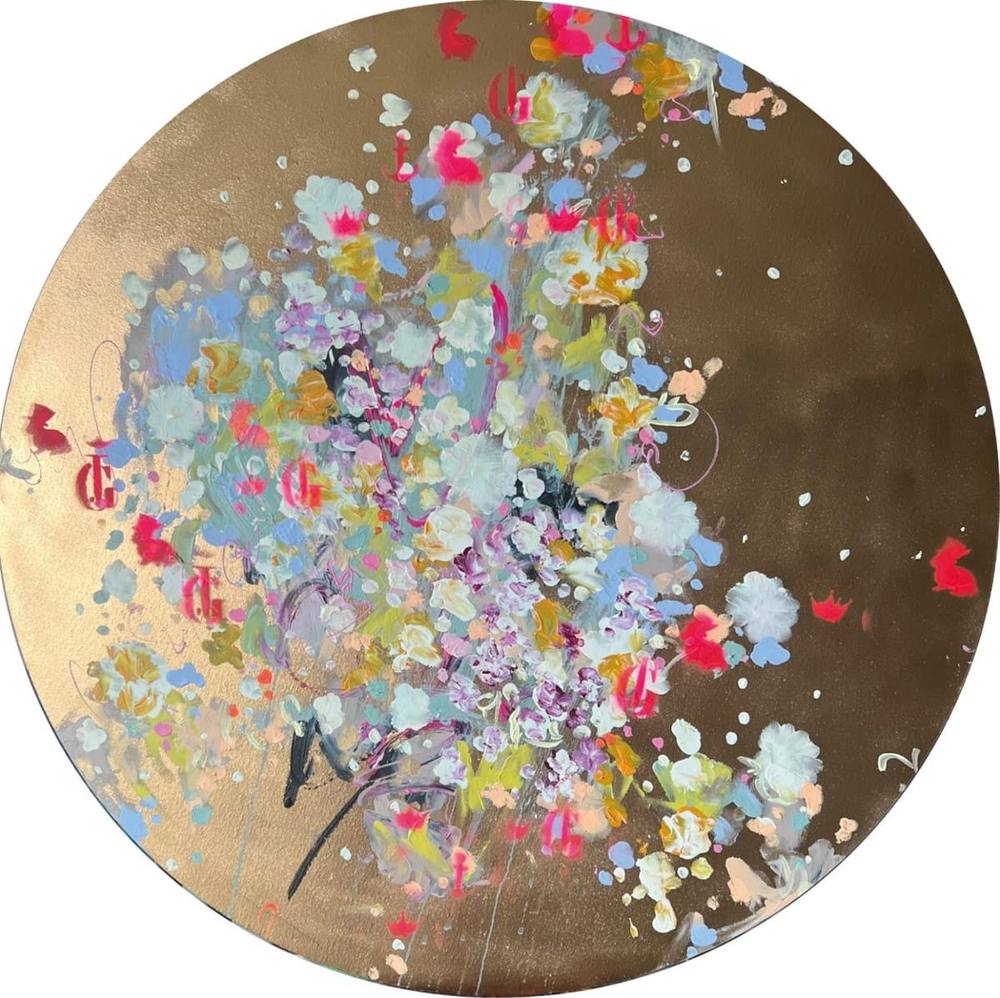
The second round work, 510 | 2024 from the Fifth Season series, is no longer available. On an even ground of gold lacquer, a lavish bouquet of lilac, pale blue, lemon yellow and white gathers just left of centre. The blossoms are applied thickly, often with a palette knife, so that they stand out in relief from the glossy surface. Around them, bright pink crowns, hares and monograms leap out like sparks. The gold ground recalls the panels of Florence, where gold caught the light of the room.
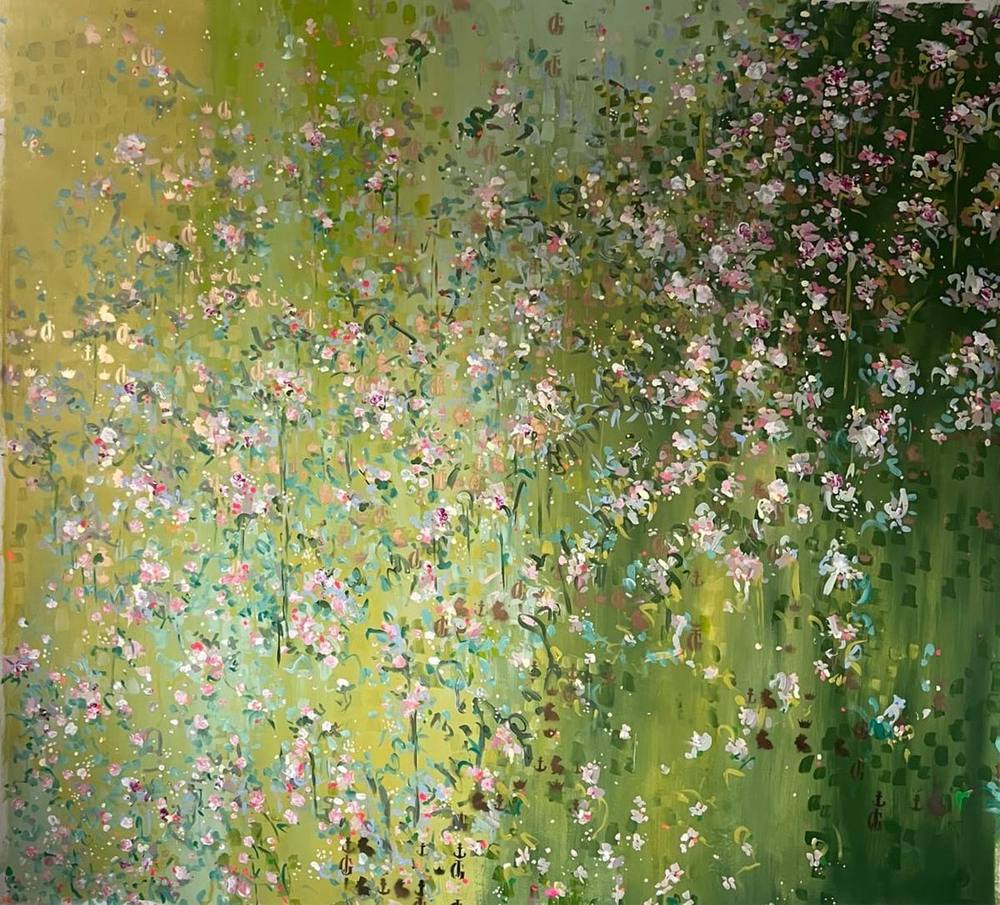
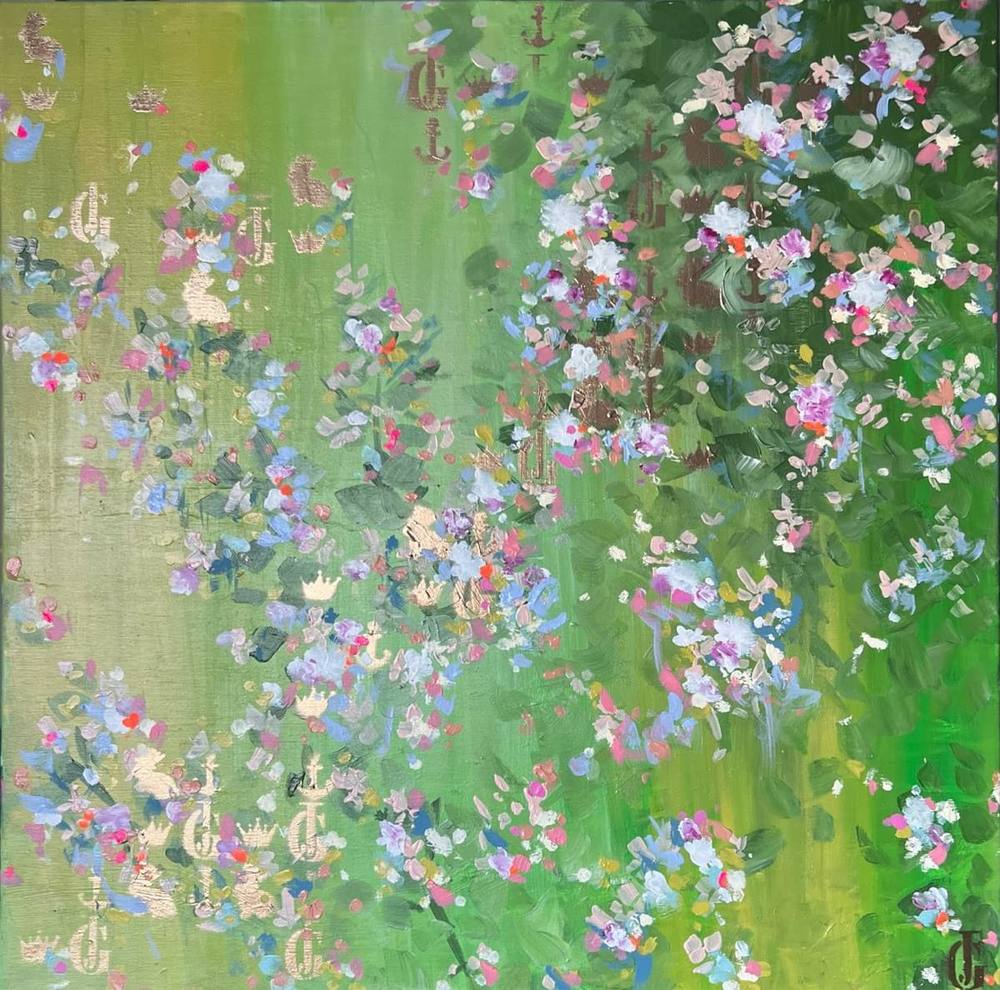
How much the format decides the effect becomes clear in comparison with 503 | 2024. This painting from the same series has the same dimensions of 80 × 80 centimetres but is square. Blossoms in lilac and pink spread across two greens, with monogram and crowns shimmering in gold lacquer. The square lets the surface run on to left and right, like a section cut from a garden. The circle, by contrast, encloses the bouquet and turns it into an object. The meadow of 507 | 2024, at 200 × 200 centimetres, shows the opposite pole: a landscape breadth.
How to hang a round painting
A round picture follows its own rules on the wall. There is no top or bottom edge to align. What matters is the centre, and for that the familiar rule of thumb for rectangular pictures applies: the middle of the picture sits roughly at eye level.
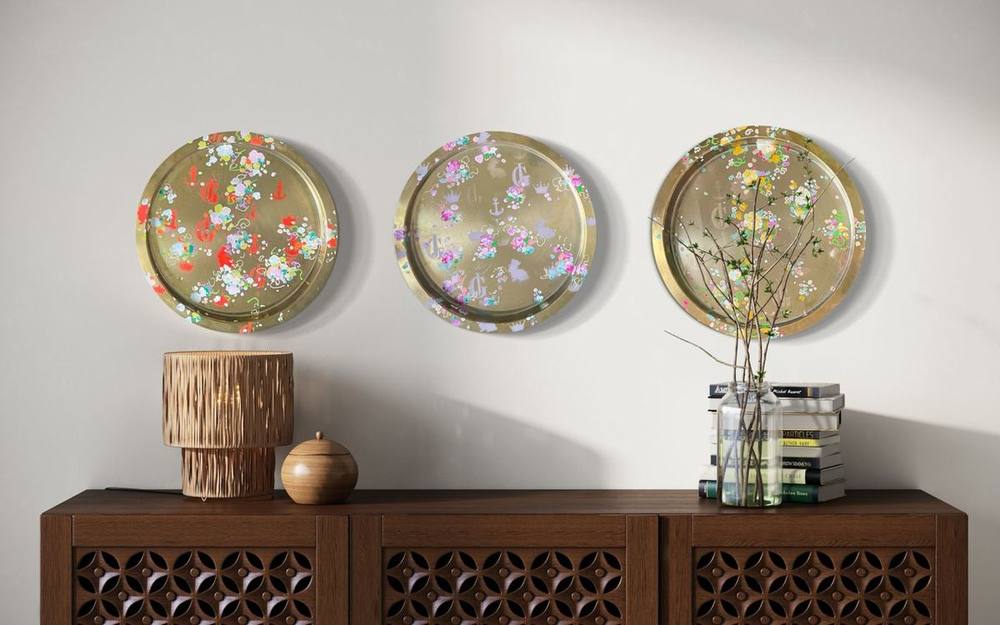
A circle needs space. Because the eye is drawn to the centre, a tondo is at its strongest with clear wall around it. It sits well above a sideboard or console, in an alcove or on a narrow wall where a rectangle would feel too severe. Beside rectangular works it sets a counterpoint, and several round formats in a row create an even rhythm.
A round picture still has a top, even if its shape does not reveal it. In 510 | 2024 the stem at the lower edge sets the direction, and in 508 | 2024 the signs stand upright in their rows. The hanging fixture on the back fixes this orientation. If you are unsure how a work will look in your own space, the catalogue shows every format and the art advisor helps with the choice. For questions about individual works, the contact page is the direct route.
Ever since Lorenzo de’ Medici’s own birth tray hung in his room, the round picture has remained a picture for one’s own room. It asks to be seen up close, and it rewards those who do.
Works from this article
Frequently asked questions
What is a tondo?
A round picture, usually a painting on panel or canvas, occasionally a relief. The word derives from the Italian “rotondo”, meaning round. According to the National Gallery in London, circular panel paintings became popular in Italy around the middle of the fifteenth century.
Which tondo paintings are the most famous?
Among the best known are Michelangelo’s Doni Tondo and Botticelli’s Madonna of the Magnificat in the Uffizi, and Raphael’s Madonna della Seggiola in the Palazzo Pitti. Later examples include Ingres’s The Turkish Bath in the Louvre and Robert Delaunay’s Simultaneous Contrasts: Sun and Moon at the Museum of Modern Art.
Why did Renaissance artists paint round pictures?
The circle was considered an extraordinarily powerful shape and was associated with the heavenly perfection of God. The tondo was also a picture for the home: many were made for private houses, often to mark a marriage or a birth.
Which round paintings has Juliane Golbs made?
Her catalogue includes two round works, each 80 centimetres in diameter: 508 | 2024 from the Signature Collection and 510 | 2024 from the Fifth Season series. 510 | 2024 is no longer available.
How should a round painting be hung?
Align it by its centre rather than by an edge. A round picture needs space around it and looks particularly calm above a sideboard, in an alcove or on a narrow wall.
Sources
8 sources
- Uffizi Galleries: Michelangelo, Holy Family (Doni Tondo)
- Uffizi Galleries: Botticelli, Madonna of the Magnificat
- Uffizi Galleries: Raphael, Madonna della Seggiola (Palazzo Pitti)
- The Metropolitan Museum of Art: Scheggia, The Triumph of Fame (desco da parto)
- The Warburg Institute: From Desco to Tondo in Renaissance Florence
- The National Gallery London: Glossary, Tondi
- The Museum of Modern Art: Robert Delaunay, Simultaneous Contrasts: Sun and Moon
- Fondation Napoléon: Ingres, Le Bain turc