Monogram art: from the ruler’s sign to the Signature Collection
Since late antiquity people have condensed names into signs. A short history of the monogram, from a ruler’s silver coin to the JG monogram of the Signature Collection.

A monogram is a name that has condensed into an image. Two or three letters become a figure that we recognise long before we read it. The history of monogram art runs from Roman mosaics through the charters of Frankish kings and the prints of Albrecht Dürer to the brands of the modern age. In The Signature Collection by Juliane Golbs it finds a painterly continuation.
A name as a sign: the Chi-Rho
One of the best-known monograms in history consists of two Greek letters. Chi and rho, written like an X and a P, are the first two letters of the name of Christ. Laid over one another they form the Chi-Rho, a sign that stands in for a name without spelling it out.
A striking example comes from a Roman villa at Hinton St Mary in Dorset. According to Historic England, the floor mosaic from the 4th century is the earliest depiction of Christ found in Roman Britain. The figure is set against the Chi-Rho and flanked by two pomegranates. The mosaic is now in the British Museum. What stands out is the hierarchy: the monogram sits there as naturally as a portrait would, identifying the person.
The ruler’s monogram
In the early Middle Ages the monogram became a sign of power. Charlemagne had his name struck on coins as an interlaced figure of letters. The Coin Collection of the Kunsthistorisches Museum in Vienna holds a silver denier minted in Treviso around 771 to 794, barely 19 millimetres across. It bears the KAROLVS monogram.
In Carolingian charters, too, the monogram had a fixed role. The Abbey Archives of St Gall explain this with a royal charter of 23 November 879, issued under Charles III. The letters K, R, L and S from KAROLUS are arranged around a square set on its point, with A and O inside it. Together with the chancery mark and the wax seal, the monogram authenticated the document. It took the place of the witnesses who were named in private agreements. A sign made of letters vouched for the truth of a document.
Albrecht Dürer and the AD
With Albrecht Dürer the monogram took on a new meaning: it now stood for an artist’s hand. Dürer placed his AD on his prints, where it became so well known that others wanted to profit from it. The engraver Marcantonio Raimondi copied sheets from Dürer’s woodcut series of the Life of the Virgin. An impression in the Victoria and Albert Museum shows the Presentation of Christ in the Temple, and on a small placard on the left-hand column even Dürer’s AD is reproduced.
What followed is recorded by Giorgio Vasari, writing in 1568. Dürer, he says, travelled to Venice for the express purpose of taking action against Raimondi. King’s College London describes the case as the earliest lawsuit over artistic copyright. The outcome was a compromise: Raimondi could go on copying Dürer’s compositions but could no longer use his monogram. According to the V&A, none of his later copies after Dürer carries the AD. What was protected was not the image but the sign that stood for its author.
A crown above the initials
In court tradition the monogram moved close to the coat of arms. A royal cypher is not a coat of arms in the heraldic sense, but it performs a related task: it makes a person visible as an office. When King Charles III introduced his cypher in September 2022, the design magazine Dezeen described its structure. A C for Charles is interlinked with an R for Rex, the Roman numeral III sits within the R, and the Tudor Crown rests above. The options were created by the College of Arms, the official body responsible for the United Kingdom’s flags and national symbols.
The cypher appears on official buildings, post boxes, passports and stationery. It shows how a monogram becomes an insignia: it needs the crown above it to turn a name into a dignity. Precisely this union of letters and crown returns in the Signature Collection.
The monogram as a brand
At the end of the 19th century the idea passed into the world of goods. In 1896 Georges Vuitton created the Monogram canvas of the house of Louis Vuitton as a tribute to his father Louis. LVMH describes it as a signature originally conceived to safeguard the house’s creations. The design drew on Neo-Gothic ornament and on Japonism. In 2026 the house marks 130 years of the Monogram.
Here the circle closes back to Dürer. Once again the subject is authorship and recognition; once again a sign becomes a guarantee. What is new is where the sign sits. The monogram no longer stands as a signature beneath a work. It has become part of the very material the work is made of.
Monogram art today: The Signature Collection
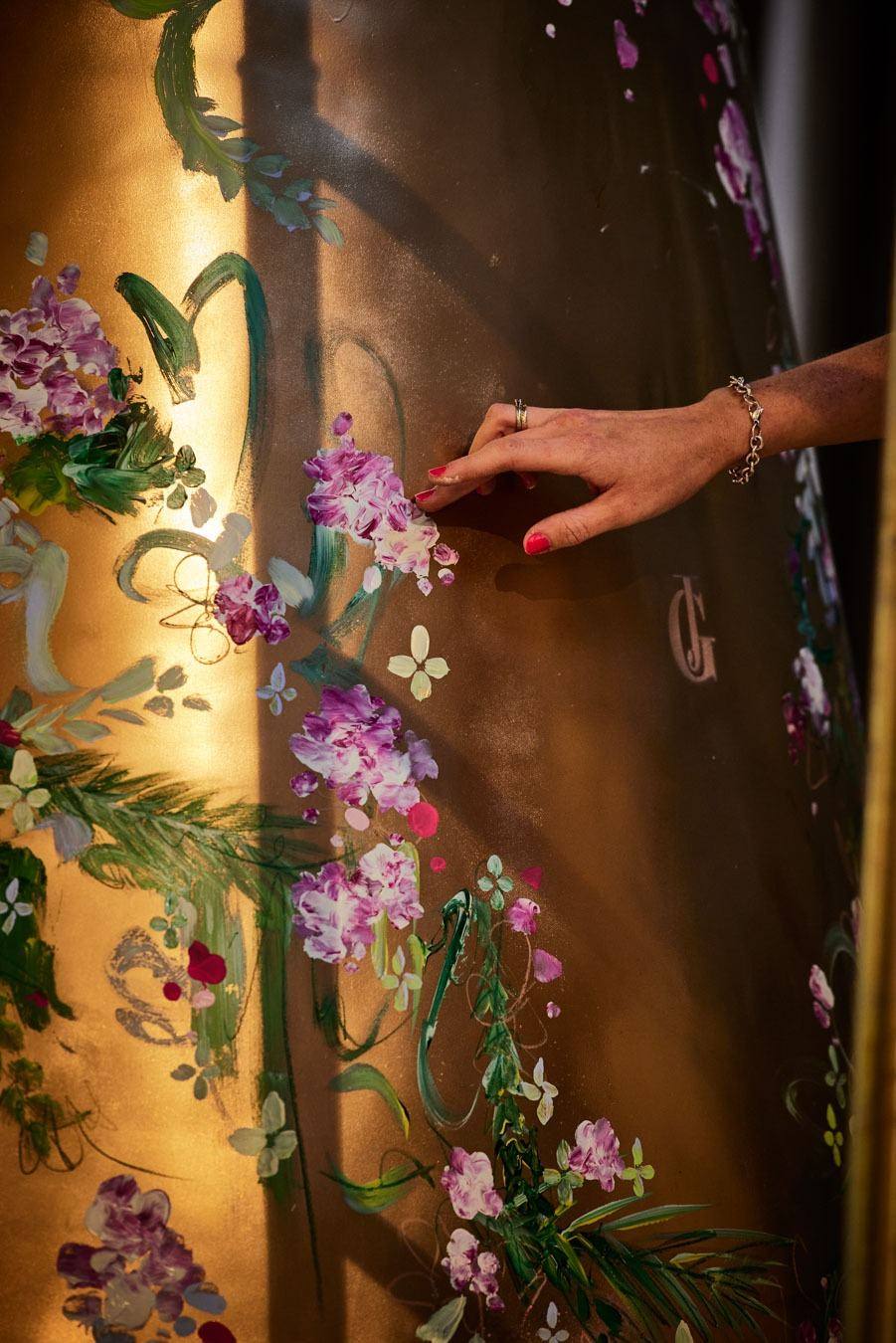
Juliane Golbs takes up this long history and turns it towards the personal. Her series The Signature Collection carries the subtitle “The monogram as a coat of arms of modernity”. The studio describes a series that treats the JG monogram not as a logo but as an architectural foundation. Each work is a palimpsest, built up layer by layer. Crown, hare and anchor merge with the initials into a coat of arms for the 21st century.
The catalogue lists 14 works from 2021 to 2024. They are painted mainly in acrylic, acrylic lacquers, gold lacquer and gold leaf, in formats from 50 × 60 to 300 × 120 centimetres. Blue, gold and white shape the palette, with accents of orange, rosé and turquoise.

Crown, hare, anchor
The key work of the series is the tondo 508 | 2024, 80 centimetres in diameter. Over a sea of cobalt, petrol and turquoise, where crests of waves break into pale bands, lies a strict grid of golden signs: the JG monogram, the crown, the hare, the anchor. Set in rows, they recall a woven heraldic cloth. Here all the symbols stand side by side as equals, each with its own meaning. The crown stands for sovereignty, the hare for quickness of mind, the anchor for Hanseatic steadfastness.
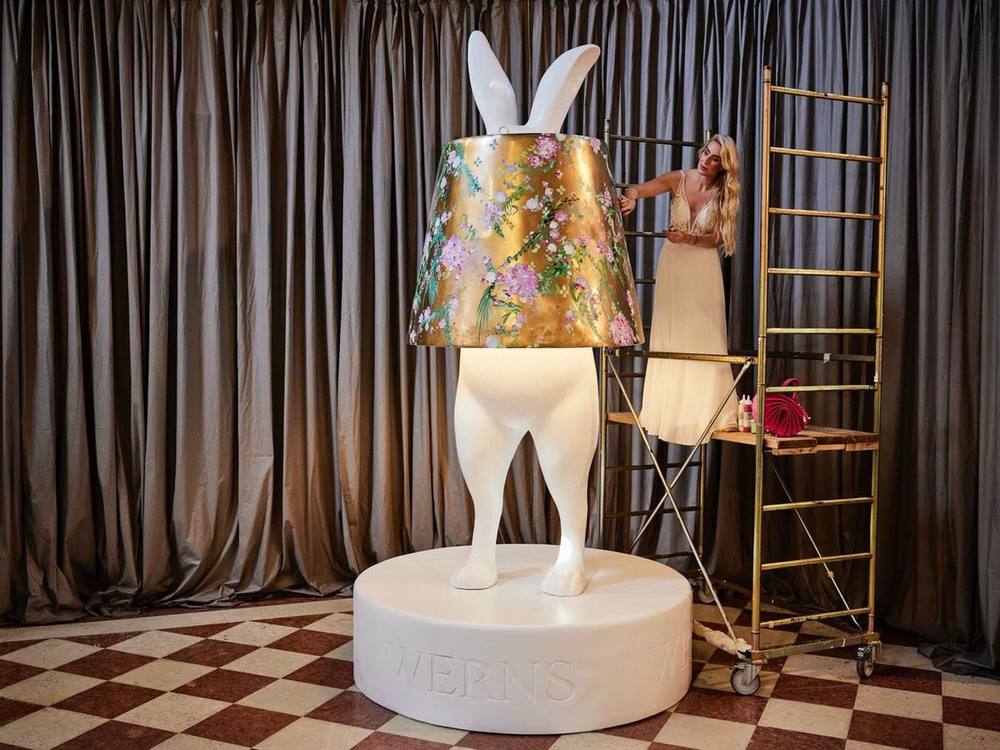
The hare has since acquired a story of its own. At Venice Design Week 2025 Juliane Golbs painted a hare sculpture by the label WERNS, some 3.5 metres tall, in the church of San Leonardo; the festival chose it as its emblem. How well form and meaning came together there is told in the article The emblem of Venice.
12 | 2022 and 11 | 2022 work quite differently. Both are painted in acrylic, acrylic lacquers and gold lacquer on canvas over frame. The paint spills onto heavy, ornate gilt frames sprayed over in red and blue. In the lower third, stencilled anchors and JG monograms surface, half veiled by blossoms and runs of colour. The historic frame, once a sign of bourgeois display, becomes part of the picture.

The hand as a coat of arms
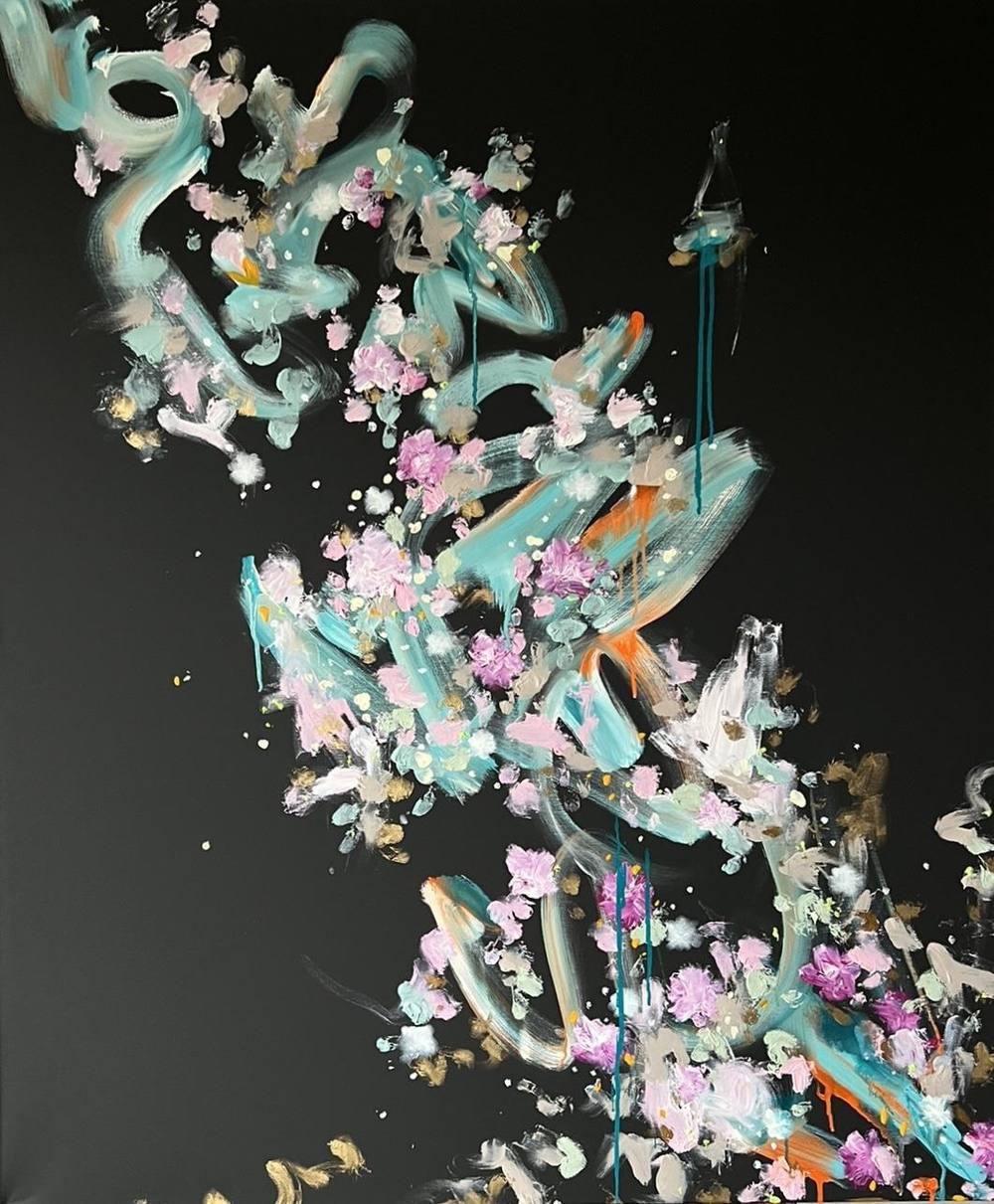
Not every work in the series shows the monogram. In 27 | 2022 a single broad brushstroke in turquoise and mint rises out of the black, twists and swings on like a line of script whose meaning stays open. Here the handwriting itself is the personal sign, before any letter appears. In 26 | 2022 Juliane Golbs sets a swirling sweep of rosé and mother-of-pearl against a stepped pattern of white squares. The signature at the lower right belongs to the composition.
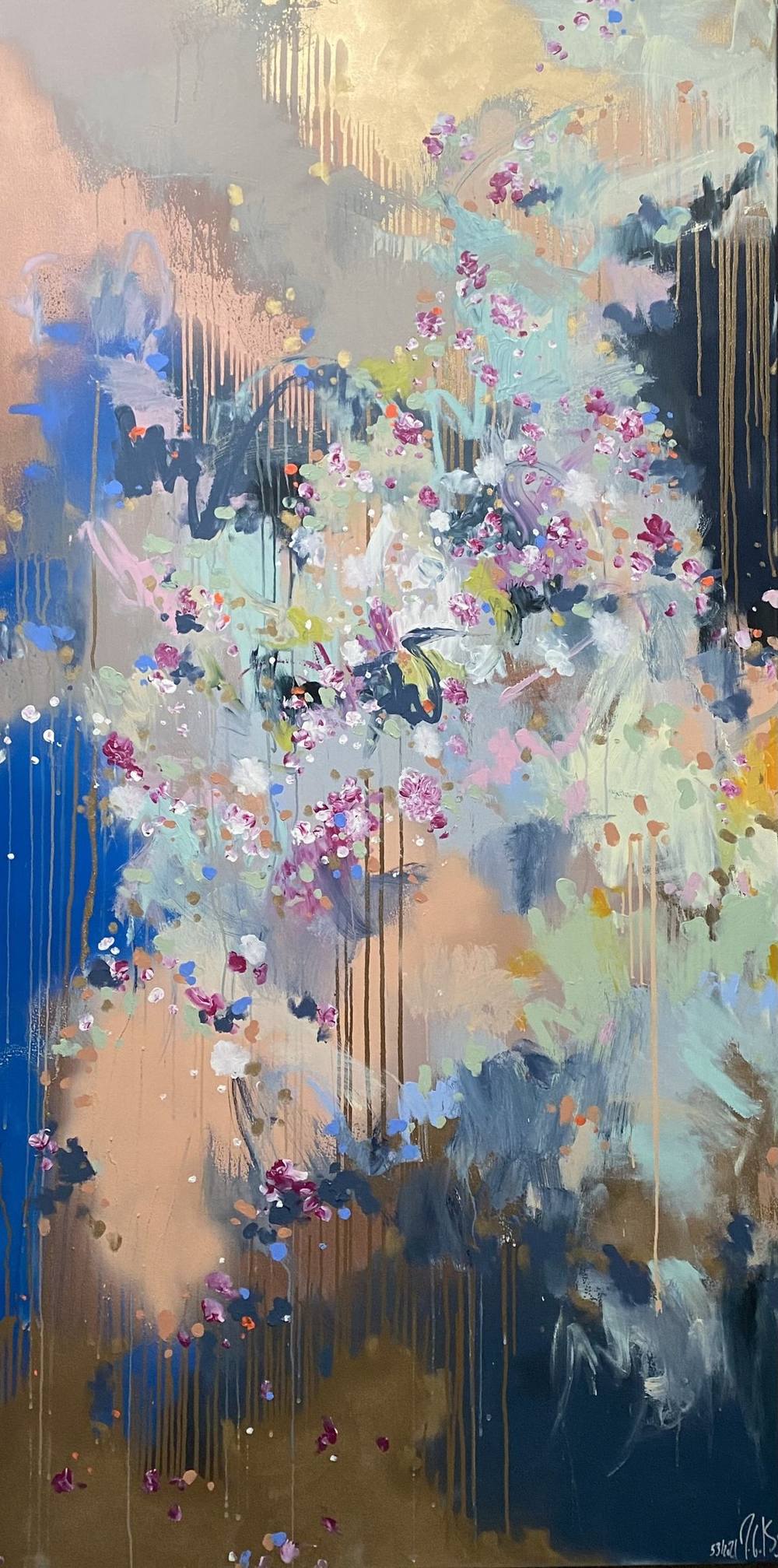
The triptych panels 53, 54 and 55 | 2021, each 100 × 200 centimetres, carry the idea of the coat of arms into a free architecture of colour. Gold leaf lies in the upper zones, with clouds of midnight blue, apricot and mint below. In 55 | 2021 a grid of gold-leaf squares spreads across the surface like an abstract system of signs.

In this the series picks up something the history of the monogram already teaches. A sign grows strong when it is recognised. It becomes personal when a hand has shaped it. Dürer protected his AD because it stood for his work. In the Signature Collection the painting hand is that sign.
A coat of arms of your own
The series gives rise to a particular kind of commission. Families, houses and companies can commission a work with their own initials, dates or emblems. These are not painted on as lettering but woven into the painting, so that they reveal themselves only on close looking. How such a work comes into being, from the first conversation to the handover, is described in the article on commissioning art.
If you would first like to see the existing works, all 14 are on the page of the Signature Collection and in the catalogue. The art advisor helps you choose by format and mood. For a small fee, credited against the purchase, an available work can be hung on approval. That way you can see how the gold behaves in your own light before you decide.
Works from this article
Frequently asked questions
What is a monogram?
A sign in which several letters of a name are joined into a single figure. The Chi-Rho combines the first two Greek letters of the name of Christ; Charlemagne’s monogram combines the letters of KAROLUS.
Why is Albrecht Dürer’s monogram so famous?
Dürer placed his AD on his prints, where it became his mark. According to Giorgio Vasari, writing in 1568, Dürer took action in Venice against Marcantonio Raimondi, who had copied his woodcuts together with the monogram. Raimondi was allowed to go on copying the compositions but no longer to use the monogram.
What is the Signature Collection by Juliane Golbs?
A series of 14 works from 2021 to 2024. It makes the JG monogram the foundation of the painting and combines it with crown, hare and anchor into a coat of arms for the 21st century.
Can I commission a painting with my own monogram?
Yes. The Signature Collection is the natural starting point for commissions with the initials, dates or emblems of a family or a house. They are woven into the painting rather than applied as lettering.
Sources
7 sources
- Historic England: Roman mosaic from Hinton St Mary, Dorset
- Kunsthistorisches Museum Vienna, Coin Collection: Denier of Charlemagne with KAROLVS monogram
- Abbey District of St Gall: Authentication marks of a royal charter, 23 November 879
- Victoria and Albert Museum: Marcantonio Raimondi after Albrecht Dürer, The Presentation of Christ
- King’s College London: The first copyright
- Dezeen: King Charles III reveals royal cypher topped with Tudor Crown (27.09.2022)
- LVMH: Louis Vuitton celebrates 130 years of its Monogram (19.01.2026)