Frida Kahlo paintings: flowers, self-portraits and the Casa Azul
Flowers in braided hair, a blue house in Coyoacán, a garden full of Mexican plants. What Frida Kahlo’s paintings show, where the originals are today and what floral painting can learn from her.
Think of Frida Kahlo and you will most likely see a face first: braided hair, flowers in it, a steady gaze out of the picture. Few painters of the twentieth century are so closely bound to their own likeness. Yet Frida Kahlo paintings tell of more than a portrait. They speak of a blue house in Coyoacán, of a garden full of Mexican plants and of a body that caused her pain all her life. This article follows the flowers through her work and explains where the originals are today. It closes with a look at floral painting in the present.
Frida Kahlo: a life in a few dates
According to Mexico’s Instituto Nacional de Bellas Artes y Literatura (INBAL), Frida Kahlo was born in Mexico City on 6 July 1907. She died on 13 July 1954 at the age of 47. Her father came from Germany. The Ibero-Amerikanisches Institut in Berlin, which keeps material on him in its image archive, names him Wilhelm, known in Mexico as Guillermo Kahlo: born in Pforzheim in 1871, he emigrated to Mexico in 1890 and worked as a photographer from 1898. He introduced his daughter to photography.
As a child Frida Kahlo contracted polio. In 1925, at the age of 18, she was gravely injured in a bus accident. The consequences stayed with her until her death. INBAL counts 143 works in her output, 55 of them self-portraits. That is a slender body of work for so famous a painter. Almost every single picture has therefore been studied, described and interpreted.
The Casa Azul in Coyoacán
The place where this work was made is a museum today. According to the Museo Frida Kahlo, Guillermo Kahlo built the house in 1904 in the style of the period, with a central patio surrounded by the rooms. Frida Kahlo was born here, and she died here too. In November 1955 the poet Carlos Pellicer described the house as painted blue within and without. The museum dates the blue outer walls to around 1937/38, when the property was enlarged by a plot of 1,040 square metres for the garden.
In 1946 the painter Diego Rivera, her husband, asked the architect Juan O’Gorman to build a studio for her. The easel in it was a gift from Nelson Rockefeller. The New York Botanical Garden notes that this studio looked directly onto the garden with its cobalt blue walls. Until her death in 1954 she tended a garden of native Mexican plants there, a refuge as much as a source of ideas. Kahlo and Rivera both wished to leave their works and possessions to the Mexican people. In 1958, four years after her death, the Casa Azul opened as a museum.
Flowers in her hair: dress as self-image
The flowers in her hair are the best known detail of her appearance. They were no accident. The Fine Arts Museums of San Francisco describe a fixed, threefold structure that Kahlo always kept to: a hairstyle of braids and flowers, together with a blouse and a full skirt, often in the Tehuana manner. Even when she combined European garments, the scheme remained.
According to the museum, the dress also had a practical side. It drew the eye to her head and torso and away from her injured lower body. She painted and decorated her corsets as well, so that a medical aid became part of the self-image. In this logic the flower in the hair sits at the very top: it is the first thing one sees.
How carefully she chose these clothes became clear only much later. In late 2003 access was granted to the bathroom next to her bedroom in the Casa Azul, where her belongings had been stored since Rivera’s death in 1957. Among them, the San Francisco museum reports, were 16 Tehuana blouses and 25 Tehuana skirts, some sewn and altered by Kahlo herself. This also unsettled the story that Rivera had pushed her into wearing such dress.
The self-portrait at the heart of the work
More than a third of her paintings are self-portraits. In them the flowers, the braids and the dress return, often surrounded by animals, leaves and tendrils. Self-Portrait with Thorn Necklace and Hummingbird of 1940 is one of the best known examples. The New York Botanical Garden counts it among the pictures that reveal her interest in the plant world.
A particularly small self-portrait hangs in Paris. In January 1939 André Breton and the Surrealists invited Frida Kahlo to Paris. According to the Centre Pompidou, she was to show 18 small pictures in the group exhibition “Mexico”. The Frame was the only picture she managed to sell. She had bought the small glass frame at the market in Juquila in the state of Oaxaca. It is adorned with birds, a traditional motif of Mexican folk art. Her face, as the museum puts it, seems to pierce through the luxuriant decoration.
This picture shows how closely portrait and ornament belong together in Kahlo’s work. The face never stands alone. It is framed by patterns, blossoms and colours drawn from Mexican folk art. The self-portrait thus becomes a picture of where she came from.
Flowers in the paintings: plants she knew
Frida Kahlo’s flower paintings are not decorative bouquets. They show plants she knew from her garden and her surroundings. From 16 May to 1 November 2015 the New York Botanical Garden devoted the exhibition Frida Kahlo: Art, Garden, Life to this subject, by its own account the first to focus exclusively on her interest in botany. It was guest curated by the art historian Adriana Zavala.
In her earlier, more surreal works the Botanical Garden identifies red angel’s trumpet, prickly pear, fuchsia and poinsettia among others. In the still lifes many plants can be clearly identified. The works the Garden names include Flower of Life of 1944, Still Life with Parrot and Flag of 1951 and Self-Portrait Inside a Sunflower of 1954. As early as 1931 she had painted the American plant breeder Luther Burbank, one of her most surprising pictures.
For Kahlo, then, the flower is never mere ornament. It is part of a landscape, of a body, of an origin. Where the Dutch painters around 1600 assembled precious blooms into impossible bouquets, as the article on abstract floral painting describes, she painted plants that grew outside her window.
Frida Kahlo paintings in the original: where they are and why they are rarely sold
Anyone looking for an original by Frida Kahlo should know one thing: it is practically impossible to buy one. In July 1984 a decree published in Mexico’s official gazette declared her entire output an artistic monument of the nation, INBAL reports. According to PBS NewsHour, works in public and private collections in Mexico therefore cannot be sold abroad. Only a few paintings are in private hands outside Mexico.
One of them came to auction at Sotheby’s in New York in November 2025: El sueño (La cama) of 1940, a picture in which Kahlo lies asleep in a bed floating among the clouds. According to PBS it fetched 54.7 million US dollars, making it the most expensive work by a woman artist ever sold at auction. The previous record was held by Georgia O’Keeffe’s Jimson Weed/White Flower No. 1, sold for 44.4 million US dollars in 2014. The article on Georgia O’Keeffe’s flowers tells more about that blossom.
What is sold under Frida Kahlo’s name is, as a rule, prints, posters and reproductions. The originals are seen in museums. The Casa Azul in Coyoacán shows the house, the studio and the garden. In Europe, The Frame at the Musée National d’Art Moderne in the Centre Pompidou in Paris is the obvious place to see an original picture by her.
Floral painting today: a different path
Frida Kahlo gave the flower a firm place in a woman painter’s image of herself. Floral painting today treats it in many different ways. Some artists work figuratively, others dissolve the blossom entirely into colour. The article on contemporary female artists in Germany gives an overview of positions in painting.
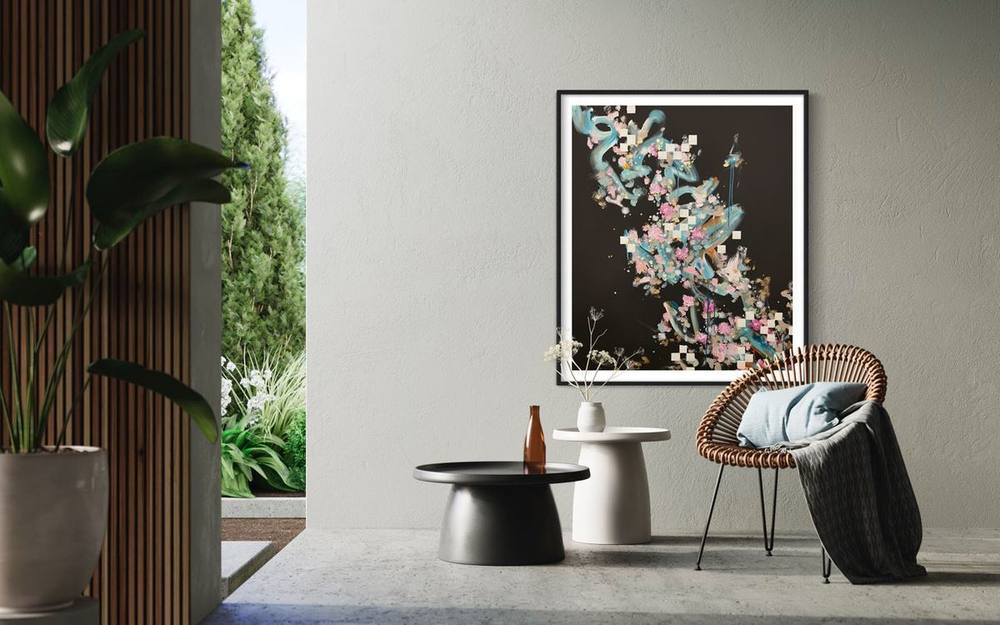
The Hamburg painter Juliane Golbs takes a path quite unlike Kahlo’s. Her pictures contain no face and no story about herself. The blossom appears as gesture, as a layer of colour, as a trace. What the two share is above all the motif of the garden. For Golbs it stands for lived time. In the series Fifth Season #heaven can wait, she combines painting with lines drawn in pencil and chalk.
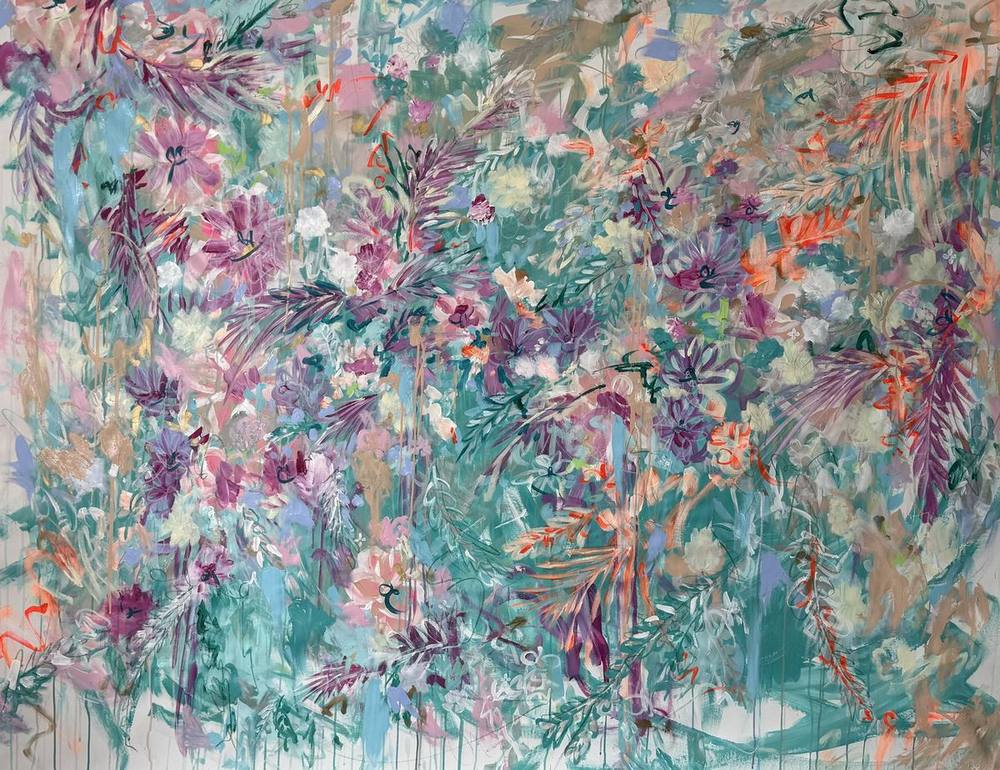
In 05 | 2026 a garden that resists all order spreads across a landscape format of 200 × 150 centimetres. Violet palm fronds and blossoms in plum, old rose and cream lie over leaves in turquoise and emerald. Red and orange lines drawn in pencil settle over the paint like notes. The curated text on the work refers to millefleurs tapestries, in which plants fill the entire surface.
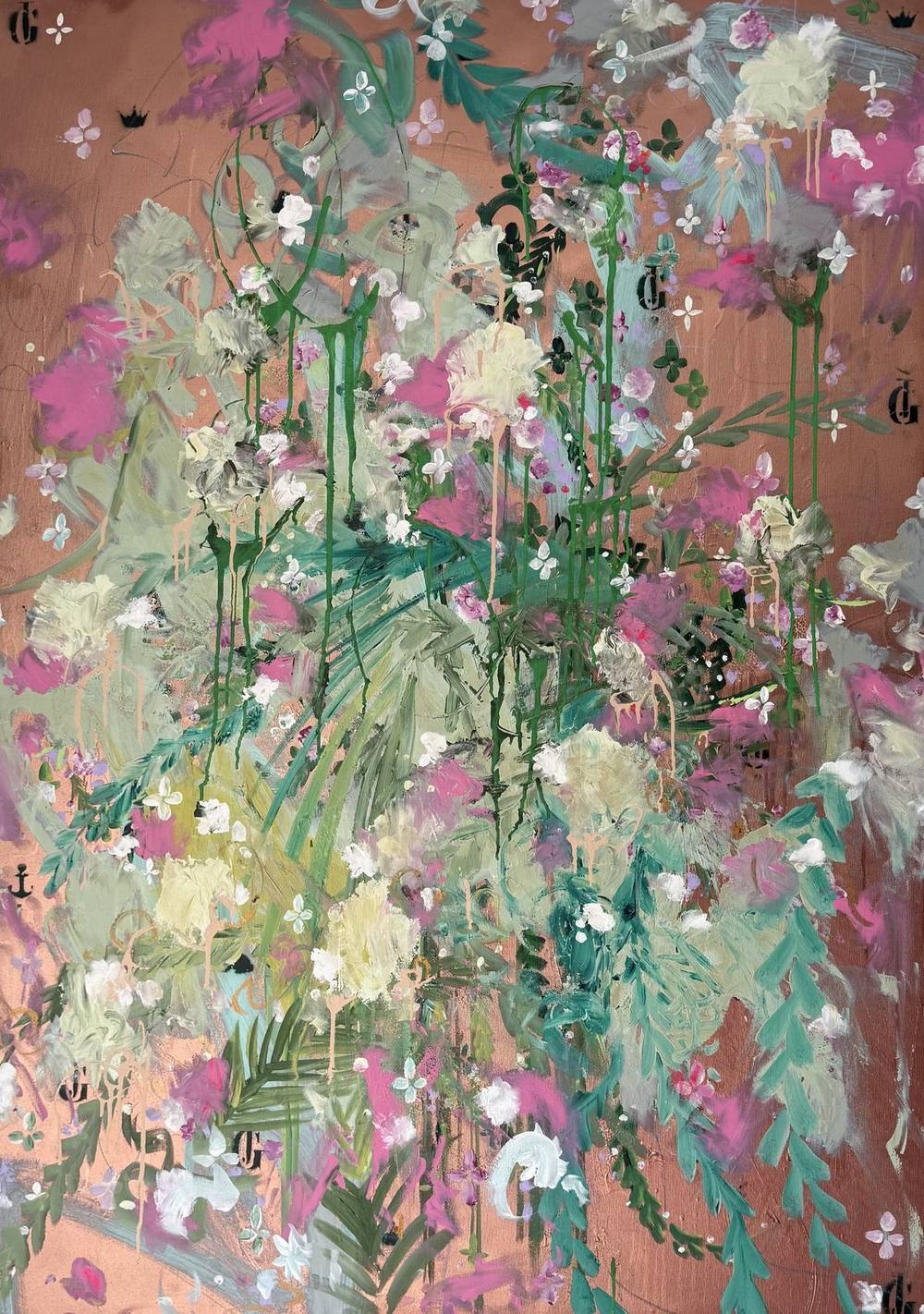
06 | 2025 shows a garden between bloom and decay. Leaves, stems and blossoms in sage and fir green, cream and magenta overlap in front of a warm ground of bronze lacquer. Small signs, crowns and the monogram lie on top like notes in a herbarium. The text on the work reads the picture as a reflection on time: lush bloom and the beginning of decay stand side by side.
Blossoms in colour: red, green and light
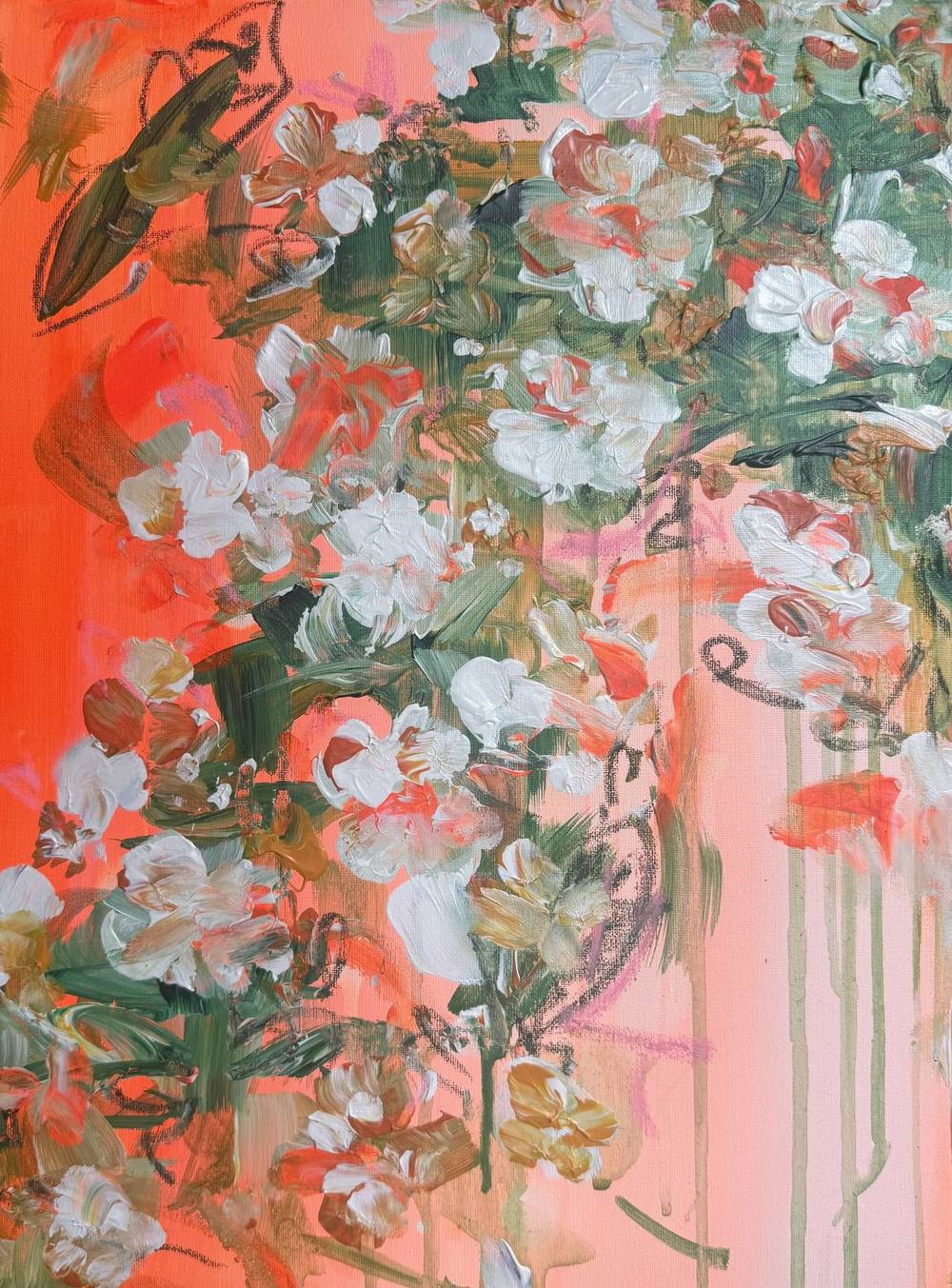
Blossoms against dark foliage, red beside green: such contrasts carry many pictures of plants. A small work such as 08 | 2026 uses this contrast without any figure at all. On a ground of coral red that fades downwards into salmon pink stand cream white blossoms and dark green leaves. The blossoms are thickly applied, often modelled with a single stroke of the brush. At 30 × 40 centimetres this spontaneity feels especially immediate.
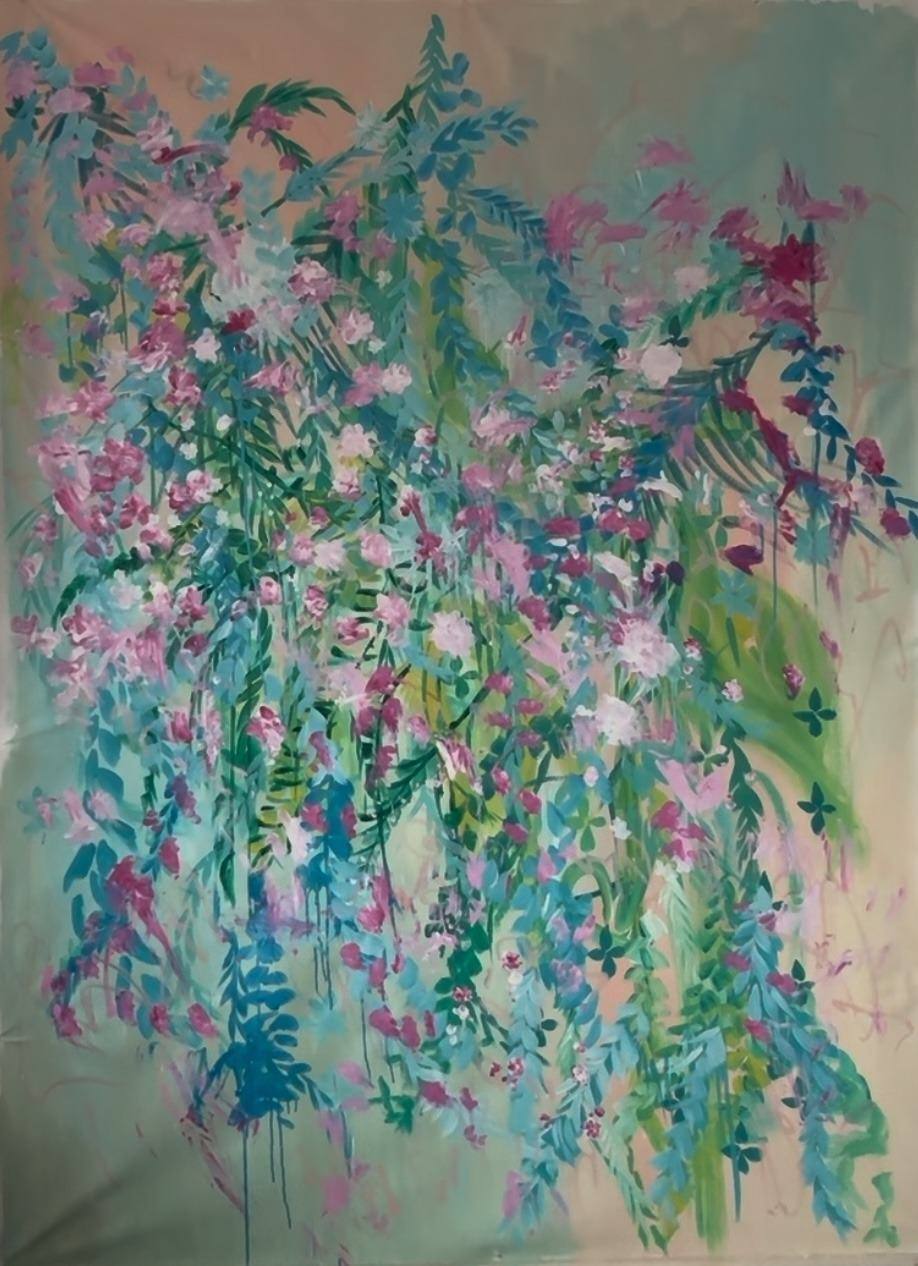
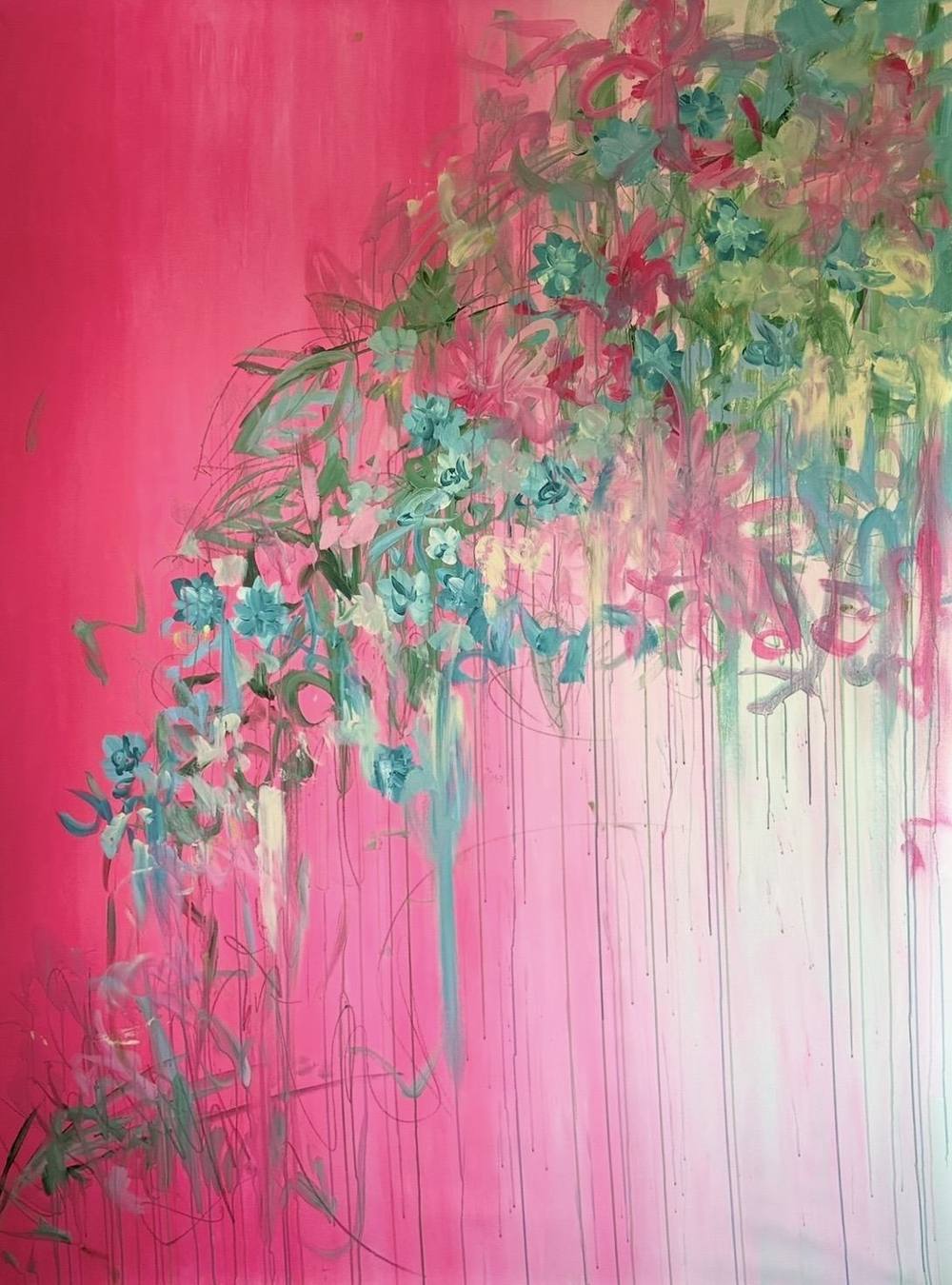
01 | 2025 is calmer. Tendrils in petrol and emerald hang down from the top edge, with blossoms in old rose, raspberry and white between them. The text on the work compares the vertical movement to a wisteria or an overgrown trellis. Towards the bottom the plants dissolve into single brushstrokes and drops.
Unlike Frida Kahlo’s, the originals by Juliane Golbs are not museum pieces beyond reach. Every work is a hand-signed original. What matters when buying an original is described in the article on the certificate of authenticity. You will find all available works in the catalogue of works, and the art advisor helps you choose by colour and format. For questions about individual works, a message via the contact page is all it takes.
Works from this article
Frequently asked questions
How many paintings did Frida Kahlo make?
Mexico’s Instituto Nacional de Bellas Artes y Literatura counts 143 works. 55 of them are self-portraits.
Why did Frida Kahlo wear flowers in her hair?
The flowers belonged to a fixed structure of dress: a hairstyle of braids and flowers, a blouse and a full skirt in the Tehuana manner. According to the Fine Arts Museums of San Francisco, this dress drew the eye to her head and torso and away from her injured lower body.
Can you buy an original Frida Kahlo?
Practically not. In 1984 Mexico declared her entire body of work an artistic monument of the nation, so works in Mexican collections cannot be sold abroad. Only a few paintings are in private hands outside Mexico. What is offered for sale under her name is, as a rule, prints and reproductions.
Where can you see Frida Kahlo’s paintings in the original?
The Casa Azul in Coyoacán, the house where she was born and died, has been the Museo Frida Kahlo since 1958. In Europe, the Musée National d’Art Moderne at the Centre Pompidou in Paris holds the small self-portrait The Frame of 1938.
Which flowers and plants did Frida Kahlo paint?
For her earlier works, the New York Botanical Garden names red angel’s trumpet, prickly pear, fuchsia and poinsettia among others. Her paintings with plants include Flower of Life of 1944 and Self-Portrait Inside a Sunflower of 1954.
Sources
8 sources
- INBAL: La creación artística de Frida Kahlo, ícono internacional, a 112 años de su natalicio (press release)
- Museo Frida Kahlo: The Blue House, Frida Kahlo’s Intimate Universe
- Fine Arts Museums of San Francisco: Frida Kahlo’s Construction of Identity: Disability, Ethnicity, and Dress
- New York Botanical Garden: Frida Kahlo: Art, Garden, Life (press release 2015)
- New York Botanical Garden, Plant Talk: Frida Kahlo’s Natural World
- Centre Pompidou: Focus on Frida Kahlo’s The Frame
- PBS NewsHour: $54.7M sale of Frida Kahlo self-portrait breaks auction record for female artists (2025)
- Ibero-Amerikanisches Institut Berlin: Kahlo, Guillermo (1871-1941)