Georgia O’Keeffe’s flowers: the blossom seen up close
Georgia O’Keeffe moved so close to the blossom that it became the whole world of the picture. Her life, her flower paintings and a look at floral painting today.
Think of Georgia O’Keeffe and you will most likely picture a single blossom, so large that it fills the entire canvas. Few painters of the twentieth century are so closely tied to one motif. Yet Georgia O’Keeffe’s flowers are only one part of a body of work that reaches from New York to the desert of New Mexico. This article follows her life, her best-known blossoms and her own words about them. It closes with a look at how floral painting approaches the blossom today, through the work of Juliane Golbs.
Georgia O’Keeffe: origins and training
Georgia O’Keeffe was born on 15 November 1887. According to the Georgia O’Keeffe Museum in Santa Fe, she was the second of seven children and grew up on a farm near Sun Prairie, Wisconsin. Her training took her through several schools. The Metropolitan Museum of Art lists the school of the Art Institute of Chicago in 1905, the Art Students League in New York in 1907/08, the University of Virginia in 1912 and Teachers College at Columbia University in New York between 1914 and 1916.
The decisive moment came in January 1916. The photographer and gallery owner Alfred Stieglitz saw her charcoal drawings and showed them at his gallery 291. The Georgia O’Keeffe Museum notes that Stieglitz was the first to exhibit her work. The two married in 1924. In the years that followed, O’Keeffe worked within the circle of the New York avant-garde that had formed around Stieglitz.
New York, Stieglitz and the first large blossoms
By the mid-1920s, the museum in Santa Fe writes, O’Keeffe was known for two bodies of work, both seen as radical: her views of New York skyscrapers and her flowers. The Metropolitan Museum dates the start of her magnified close-ups of flowers to 1924. She enlarged the petals until they filled a canvas of 30 × 40 inches. The forms looked abstract as a result, although they were based on close observation of nature.
The Figge Art Museum in Davenport, which showed Flower Abstraction of 1924 on loan from the Whitney Museum, points to photography as a stimulus. The tight crop recalls photographers such as Paul Strand, who used the camera to make abstract images. O’Keeffe carried this way of looking into painting. The blossom is cut off at the edges and almost bursts the frame. The eye no longer finds any distance.
Georgia O’Keeffe’s flowers: what close looking does
In 1926 O’Keeffe showed fifty recent paintings at Stieglitz’s Intimate Gallery. For that occasion she set out what she wanted to achieve through enlargement. The Georgia O’Keeffe Museum records her words: everyone has many associations with a flower, but one rarely takes the time to really see a flower. She had painted what each flower was to her. She had painted it big enough so that others would see what she saw.
Scale, for her, is not an effect. It is a means against the passing glance. A small blossom that one barely notices on the way past becomes a landscape of folds, cups and transitions on the canvas. The viewer has to engage, because there is nothing else left to look at. A thought from the 1920s, also quoted by the museum, describes the principle: only by selection, by elimination and by emphasis do we get at the real meaning of things.
Jimson Weed/White Flower No. 1 of 1932
The best-known example of this close view dates from 1932. Jimson Weed/White Flower No. 1 shows the white blossom of a jimson weed, painted in oil on canvas and measuring 121.9 × 101.6 centimetres. Crystal Bridges Museum of American Art in Bentonville, Arkansas, whose collection the painting now belongs to, describes how O’Keeffe depicted the flower at a massive scale, cropping tightly around her subject. Through this close focus, the museum writes, the painting offers an immersive look into the details and rhythms of nature.
On 20 November 2014 the painting was auctioned at Sotheby’s in New York. According to PBS NewsHour it fetched 44.4 million US dollars, more than three times the estimate. The seller was the Georgia O’Keeffe Museum in Santa Fe, which wanted to strengthen its acquisitions fund. Artnet News gave the high estimate as 15 million US dollars. The previous auction record for a work by a woman artist stood, according to Artnet, at 11.9 million US dollars for a painting by Joan Mitchell. With Jimson Weed, a painting by a woman sold for more than ever before at auction.
The figure says a great deal about the market and little about the picture. More revealing is a sentence by O’Keeffe that Crystal Bridges quotes beside the work: “When you take a flower in your hand and really look at it, it’s your world for the moment.” She wanted to give that world to someone else.
Her own view of the interpretations
Critics read the flower paintings differently from the way O’Keeffe intended them from early on. The Figge Art Museum sums it up: the soft colours and ruffled forms were taken as an expression of female eroticism and of a woman artist’s sensibility. O’Keeffe did not accept this reading.
She put it most clearly in 1939, in the text “About Myself”, published for the exhibition of her oils and pastels at Stieglitz’s gallery An American Place. The Georgia O’Keeffe Museum reproduces the passage. In a way, she wrote, nobody sees a flower, really, it is so small, we haven’t time. So she would paint what the flower was to her, but paint it big. Yet viewers had hung all their own associations with flowers on her flower. They wrote about her flower as if she thought and saw what they thought and saw of it. Her reply was brief: “and I don’t.”
As early as 1930 the New York newspaper The World had quoted her as saying that the subject matter of a painting should never obscure its form and colour, which are its real thematic contents. Anyone looking at her flowers today can take this sentence as a guide. The pictures are about seeing itself: about colour, about transitions, about what happens when one gives a small thing one’s full attention.
New Mexico and the museum in Santa Fe
In the summer of 1929 O’Keeffe made her first extended trip to New Mexico. The landscape never let her go. In 1949, three years after the death of Stieglitz, she made the state her permanent home. Her summer house, the Georgia O’Keeffe Museum notes, lies twelve miles from Abiquiú on the edge of Ghost Ranch, a property of 21,000 acres. The house in Abiquiú was her winter residence. According to the Metropolitan Museum, the black door in its walled patio alone inspired more than thirty paintings.
Georgia O’Keeffe died on 6 March 1986 in Santa Fe, at the age of 98. Her ashes were scattered over the New Mexico landscape. Today the Georgia O’Keeffe Museum in Santa Fe holds paintings and works on paper as well as personal belongings, documents and photographs. For anyone who wants to see her pictures in the original, it is the place to begin.
In Germany her work has rarely been shown on a large scale. From 3 February to 13 May 2012 the Kunsthalle München presented the retrospective Georgia O’Keeffe: Life and Work, by its own account the first comprehensive retrospective of the artist in Germany. Around 75 paintings, sculptures and works on paper were on view, together with 50 photographs by Alfred Stieglitz, Paul Strand, Ansel Adams and others. The exhibition was curated by Barbara Buhler Lynes of the Georgia O’Keeffe Museum.
Floral painting today: close view and abundance
Georgia O’Keeffe gave the flower a new standing in twentieth-century painting. Since then floral painting has become a wide field in which very different attitudes exist side by side. One of them is the close view: a single blossom, seen large, isolated from the rest of the world. Another is abundance: many blossoms spread across the whole surface without a centre, so that the eye has to wander. How the flower picture developed from the Dutch bouquets to abstraction is the subject of the article on abstract floral painting.
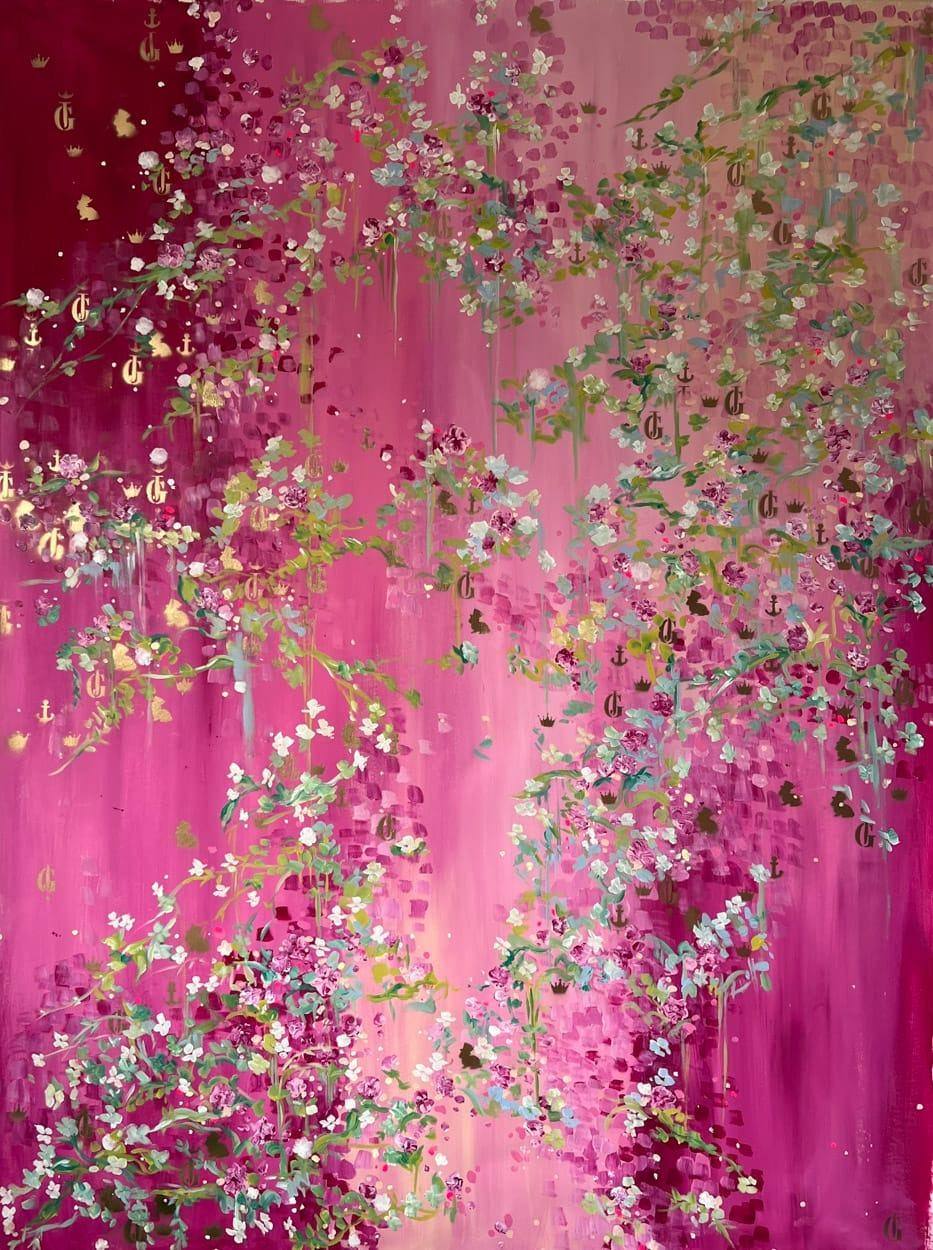
The Hamburg painter Juliane Golbs works with the second of these attitudes. In her floral paintings a single blossom rarely stands at the centre. The curated text on 515 | 2024 from the Fifth Season series notes that the composition follows no centre. It spreads like a flowering shrub across the full height of 200 centimetres. Branches with countless small blossoms in white, old rose and moss green lie over a ground of magenta and raspberry red, with golden monograms glinting in between.
501 | 2024, according to its text, also deliberately does without a focal point. Short, impasto brushstrokes in magenta, rosé, lilac and white form an almost textile carpet of blossoms over fields of turquoise and sage green. Where O’Keeffe narrows the gaze to a single form, here the surface opens out across its width.
Looking at the blossoms of Juliane Golbs
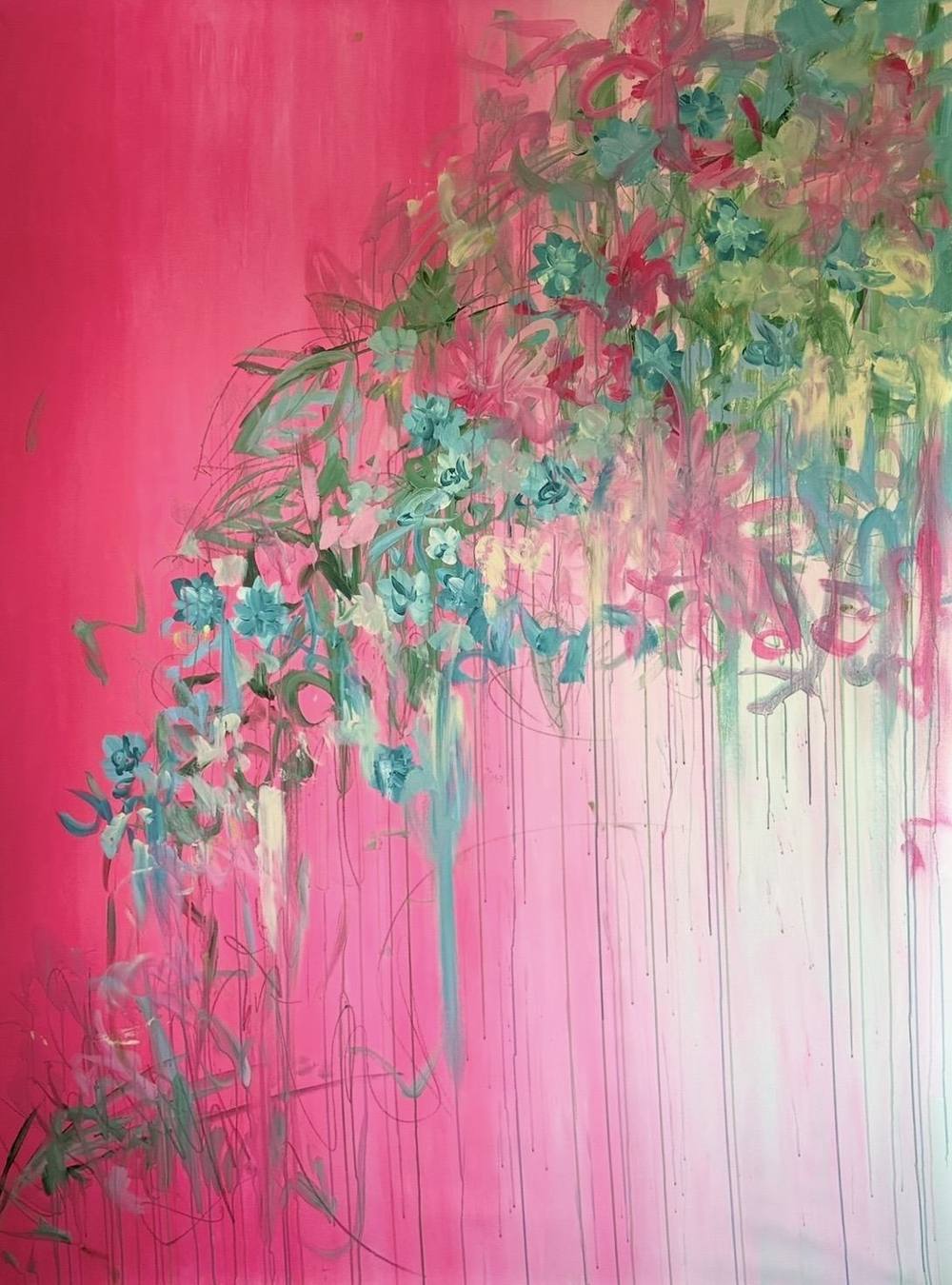
In the series Fifth Season #heaven can wait drawing gains weight. In 09 | 2026 a tendril of turquoise and green blossoms descends diagonally across a canvas of 150 × 200 centimetres. Below it the colour runs from deep magenta through rosé into an almost white light. Fine lines in coloured pencil merely suggest stems and the edges of leaves. According to the curated text, the blossom is not held fast here. It is on the point of dissolving.
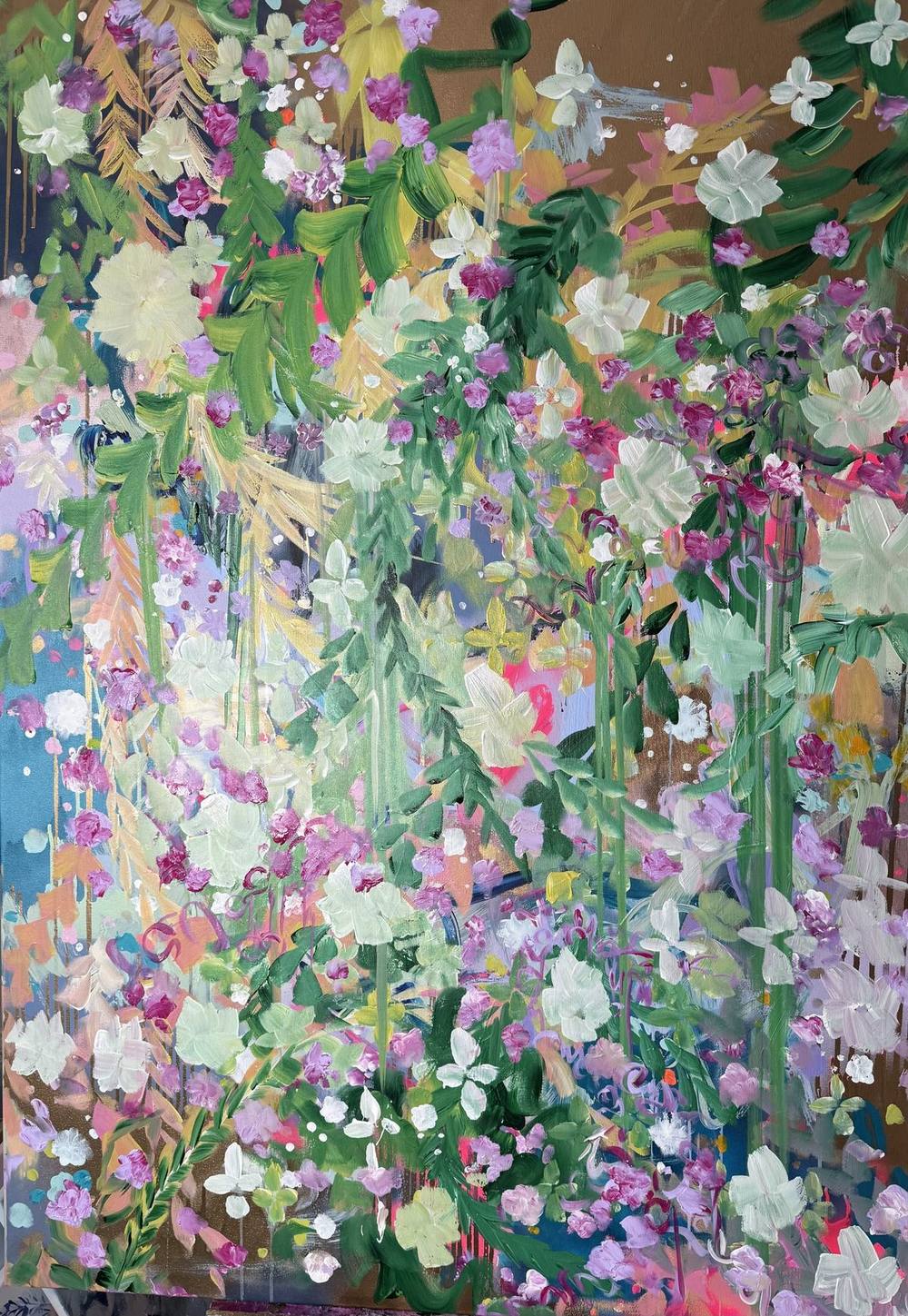
05 | 2025 shows abundance at its densest. A curtain of foliage falls into the picture from above, with white blossoms, violet sweet peas and dabs of magenta in between. Here and there a warm, cardboard-brown ground shows through. The curated text describes the picture as if nature had grown over itself several times.
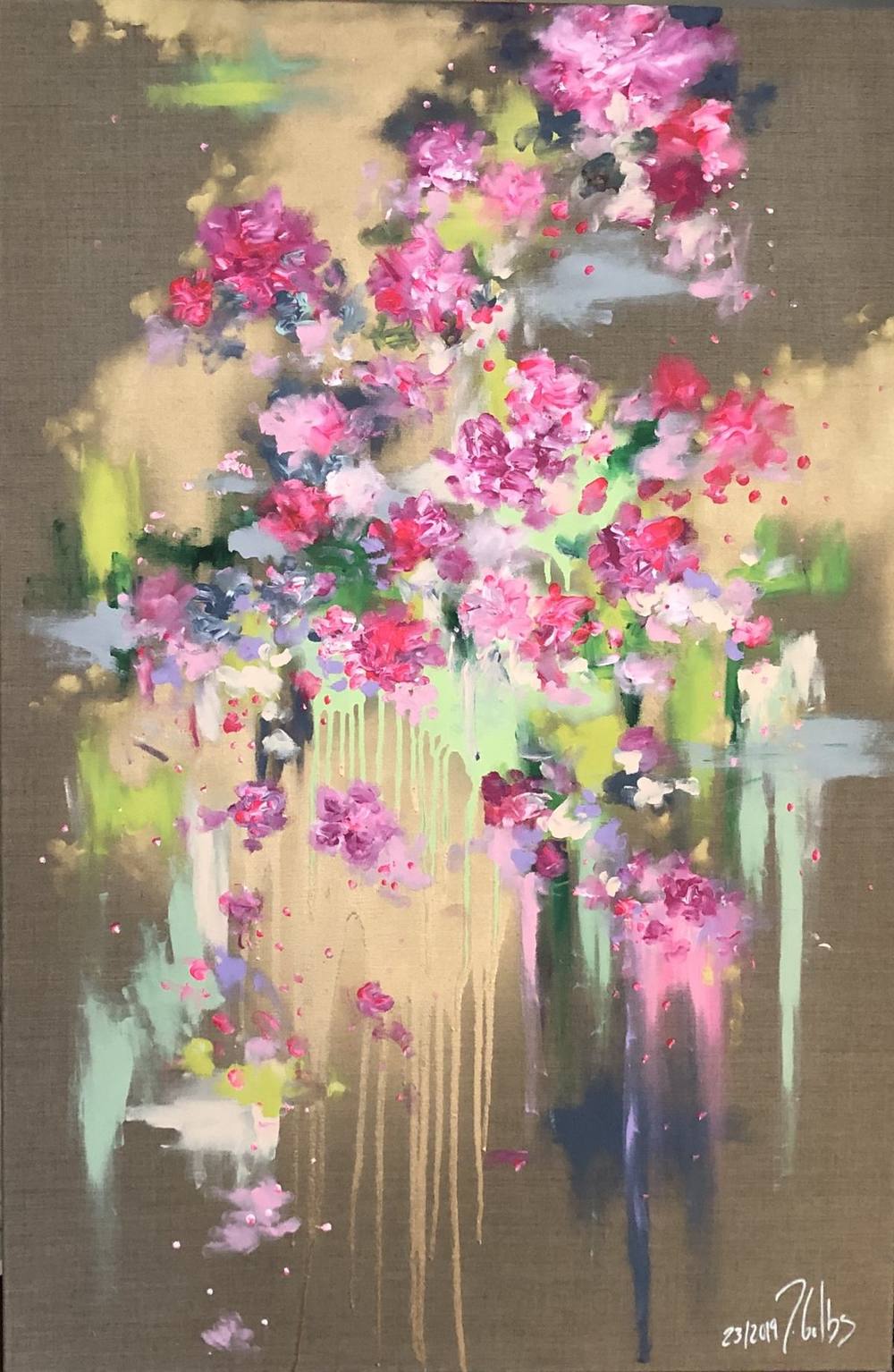
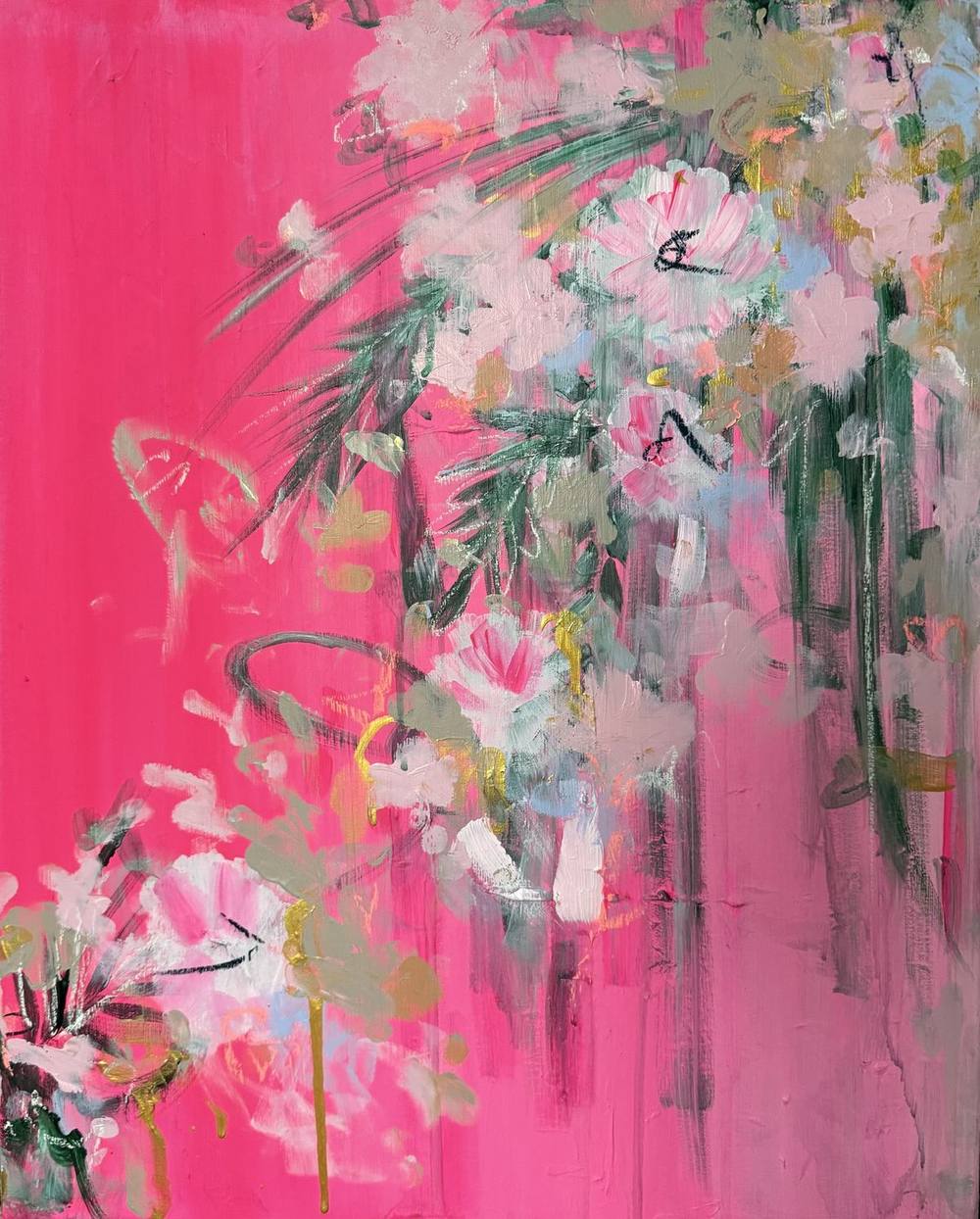
That the close view matters in a small format too is shown by 07 | 2026, measuring 30 × 40 centimetres. On a strong pink, white and pale pink blossoms cluster, threaded with dark green leaves. On the left floats a barely visible form drawn in chalk that recalls a butterfly. Here the eye moves close to the gesture itself: to dry chalk, to paint running down in fine streaks.
Above all, Georgia O’Keeffe leaves us with one request: to take time. Her large blossoms ask us to stop and stand still. The floral paintings of Juliane Golbs ask the same in a different way, through abundance rather than enlargement. How the Everlasting Blossoms series understands the blossom as a preserved spring is told in the article on the peony in art. You will find all available works in the catalogue. The art advisor helps you choose by colour and format. For questions about individual works, a message via the contact page is all it takes.
Works from this article
Frequently asked questions
When did Georgia O’Keeffe live?
Georgia O’Keeffe was born on 15 November 1887 and grew up on a farm near Sun Prairie, Wisconsin. She died on 6 March 1986 in Santa Fe, New Mexico, at the age of 98.
When did Georgia O’Keeffe begin painting flowers up close?
According to the Metropolitan Museum of Art, she began her magnified close-ups of flowers in 1924. The petals fill an entire canvas, so the forms look abstract even though they rest on close observation of nature.
What is Jimson Weed/White Flower No. 1?
An oil painting of 1932 showing the white blossom of a jimson weed, measuring 121.9 × 101.6 centimetres. It sold at Sotheby’s in New York on 20 November 2014 for 44.4 million US dollars and is now in the collection of Crystal Bridges Museum of American Art in Bentonville, Arkansas.
How did Georgia O’Keeffe respond to interpretations of her flowers?
She rejected them. In 1939 she wrote that viewers had hung all their own associations with flowers on her flower and wrote about it as if she thought and saw what they thought and saw. Her answer: “and I don’t.”
Has there been a major Georgia O’Keeffe exhibition in Germany?
Yes. From 3 February to 13 May 2012 the Kunsthalle München showed Georgia O’Keeffe: Life and Work, which the museum describes as the first comprehensive retrospective of the artist in Germany.
Sources
8 sources
- The Metropolitan Museum of Art, Heilbrunn Timeline of Art History: Georgia O’Keeffe (1887–1986)
- Georgia O’Keeffe Museum, Santa Fe: About Georgia O’Keeffe
- Georgia O’Keeffe Museum, Santa Fe: In Her Words
- Crystal Bridges Museum of American Art: Georgia O’Keeffe, Jimson Weed/White Flower No. 1 (1932)
- PBS NewsHour: Auction brings record for O’Keeffe, women artists (2014)
- Artnet News: O’Keeffe Painting Sells for $44 Million at Sotheby’s (2014)
- Figge Art Museum: Georgia O’Keeffe, Flower Abstraction (1924)
- Kunsthalle München: Georgia O’Keeffe. Life and Work (2012)