The eagle in art: from Jupiter’s armour-bearer to the “fat hen”
A bird no thunderbolt can strike, the standard of the legions, the symbol of an Evangelist and a heraldic bird that Bonn nicknamed the “fat hen”. A short history of the eagle in art.
The eagle in art has held more offices than any other animal. It was Jupiter’s bird, it led the Roman legions as their standard, it became the symbol of John the Evangelist, and to this day it hangs as a heraldic emblem behind the presiding officers in the plenary chamber of the German Bundestag. Naturalists have drawn it, sculptors have shaped it, painters have shown it as predator, messenger and sign. This article follows a few stations of that history. It ends with an animal portrait by the Hamburg painter Juliane Golbs in which gold becomes light.
Jupiter’s armour-bearer
Pliny the Elder devotes several sections of the tenth book of his Natural History to the eagle. There we read that it is the only bird never killed by a thunderbolt. For this reason, Pliny says, custom made the eagle Jupiter’s armour-bearer. The bird that lightning cannot harm thus serves the god who wields it. Much of the eagle’s symbolism over the following two thousand years flows from this pairing.
Painting has told of the bond between god and bird above all through the myth of Ganymede. Zeus sends an eagle, or becomes one himself, to carry the young son of the king of Dardania up to Olympus. Rembrandt painted the scene in 1635 on a canvas of 177 × 129 centimetres, and the picture now belongs to the Gemäldegalerie Alte Meister of the Staatliche Kunstsammlungen Dresden. Here the eagle is no emblem. It is an animal in action, snatching the boy up into the sky.
Aquila: the standard of the legions
In the next section Pliny explains how the eagle became the sign of the Roman army. Gaius Marius assigned it to the legions as their special badge in his second consulship, in 104 BC. The eagle had been their first standard even before then, though alongside four others. Marius abolished those altogether. From then on the eagle, in Latin aquila, was the emblem of the legion.
For the history of images this step had lasting consequences. The companion of a god had become a sign that stood for a community and was carried at its head. The eagle was now, once and for all, an image of belonging. In that role it would return in the coats of arms of emperors and kings.
The eagle of St John
A second, quite different line begins in the Bible. In the first chapter of the Book of Ezekiel, verses 4 to 14, the prophet describes a vision of four creatures. In the Book of Revelation, chapter 4, similar beings surround the throne of heaven. The Fitzwilliam Museum in Cambridge explains how, over time, these four creatures were interpreted as symbols of the four Evangelists: the winged man for Matthew, the lion for Mark, the ox for Luke.
The eagle, the creature that dwells closest to heaven, stands for John, because of his visions and because of the heavenly opening of his Gospel. Wherever John is shown writing his Gospel, the eagle is therefore usually present. Albrecht Dürer took up the motif too. The Städel Museum in Frankfurt holds the title page of the Latin edition of his Apocalypse of 1511, a woodcut of 396 × 282 millimetres entitled “The Virgin Appearing to St John”. The museum records John on Patmos writing his Gospel, with the eagle as his symbol.
Eagle symbolism in the Empire: from the double eagle to the federal eagle
The German Bundestag describes the eagle as the oldest and most traditional German state symbol, with origins reaching back to the early days of the Holy Roman Empire. Unlike the single-headed royal eagle, the emperor’s arms bore the double-headed eagle. Introduced in 1433, it remained the arms of emperor and Empire until the Empire’s end in 1806. In 1848 the National Assembly in Frankfurt’s Paulskirche chose the double eagle once more. With the founding of the German Empire in 1871, however, the single-headed eagle of Prussian tradition was adopted.
On 11 November 1919, Reich President Friedrich Ebert decreed that the arms of the Reich should show a single-headed black eagle on a golden-yellow ground, its head turned to the right. The proclamation of the Federal President of 20 January 1950 adopted this text almost word for word. For art, one detail of these rules is remarkable. Essentially all that is fixed is that the eagle has a single head and that it turns to the right. The artistic design is left open, which is why the Federal President, the Bundesrat, the Federal Constitutional Court and the Bundestag each use a differently designed eagle.
Ludwig Gies and the “fat hen”
The best known of these designs is the work of a sculptor. The Cologne artist Ludwig Gies created the eagle in 1953 for the plenary chamber in Bonn, where it hung behind the seat of the President of the Bundestag. People called it the “Fette Henne”, the fat hen.
When parliament moved to Berlin, the eagle went too. A version reworked by Studio Laeis in 1999 now hangs in the plenary chamber of the Reichstag Building. It shows exactly what the rules of 1950 leave open: Gies turned a handful of requirements into a form entirely his own.
Audubon’s White-headed Eagle
Alongside myth and heraldry stands the observation of nature. The naturalist and draughtsman John James Audubon published his great work “The Birds of America” in instalments. Plate 31 appeared in the seventh of 87 parts. Its title is “White-headed Eagle”, the bird we now call the bald eagle, Haliaeetus leucocephalus. It was engraved, printed and coloured in 1828 by R. Havell & Son in London, and the Fitzwilliam Museum holds one of the impressions.
The legend also names the bird’s prey: a fish, “vulgo Yellow mud Cat”, in other words a catfish. The plate also bears the note “Drawn from nature”. With Audubon the eagle steps out of the coat of arms and becomes an animal again, one that feeds, holds its ground and asks to be looked at closely. The print is a counterpart to the heraldic eagle, which needs only a few binding features to be recognised.
The eagle in art today: “ein Adler”
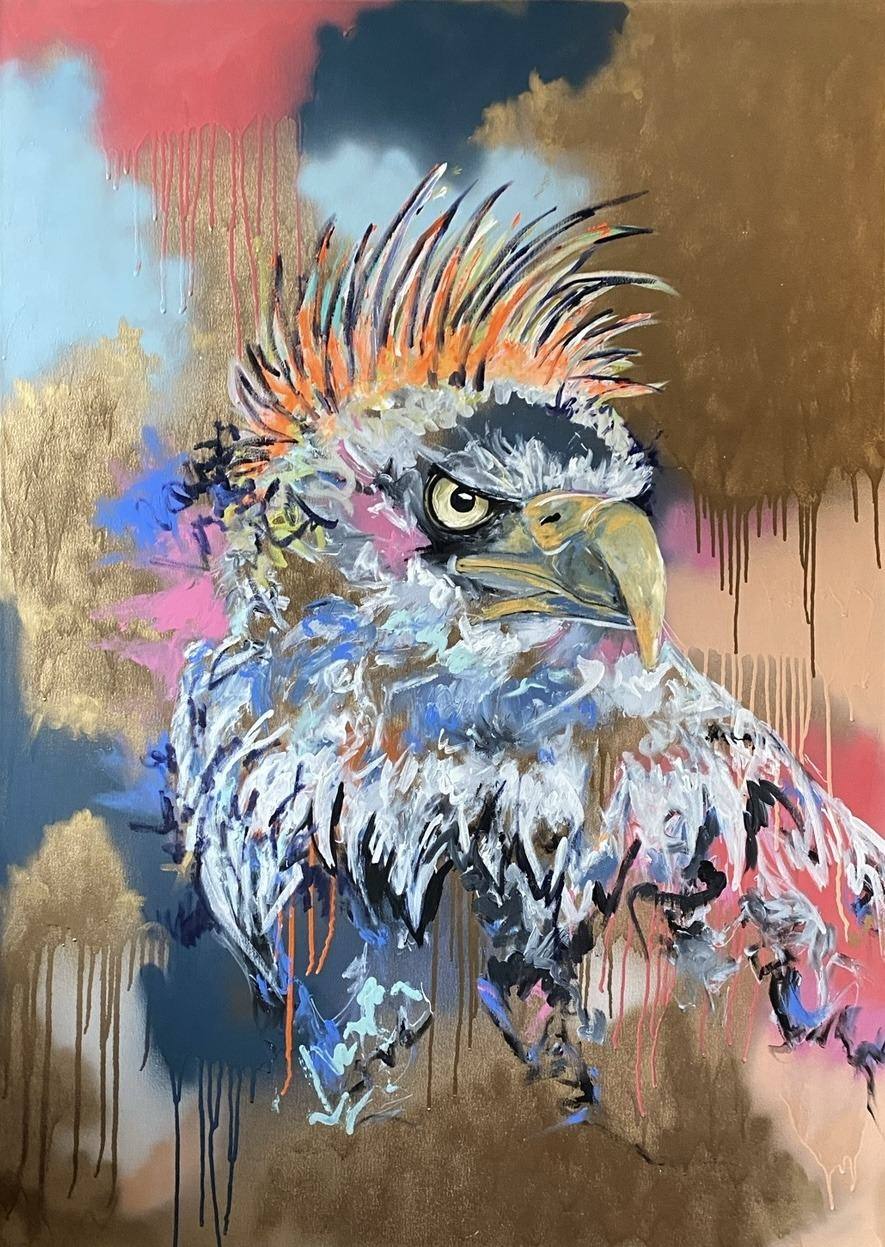
In contemporary painting the eagle may be both animal and sign. Juliane Golbs painted ein Adler in 2017, and it is the earliest work in her catalogue. It belongs to the Golden Things series and measures 100 × 140 centimetres, painted in acrylic, acrylic lacquers and gold lacquer on canvas. It is less an eagle painting in the classical sense than a portrait seen at very close range.
The head sits in the upper half of the picture slightly right of centre and turns towards the right-hand edge. A single yellow eye, sharply ringed in black, holds the viewer’s gaze beneath a dark brow. The beak is painted in ochre and gold, its hook pointing downwards. Above the head a crest rises, built from quick, tapering strokes in orange, black and pink, like a headdress. The plumage of neck and breast is made of white, blue and black brushstrokes that thin out towards the bottom and dissolve into single lines.
Behind the bird drift sprayed clouds in salmon pink, sky blue and midnight blue. The right side is filled by a broad field of gold bronze, from whose lower edge paint runs down in long vertical threads. On the left, golden clouds rise, also trailing drips that cross the picture like rain. The result is a tension that the work’s own text captures well: the eagle seems at once wild and vulnerable. It is not a heraldic bird proclaiming power. It is a counterpart whose gaze you have to meet.
Golden Things: gold as light
In the Golden Things series Juliane Golbs treats gold as light rather than as a frame. This is clearest in her figurative works, where a motif appears against a golden ground and dissolves at the same time. The eagle of 2017 stands at the beginning of this group.
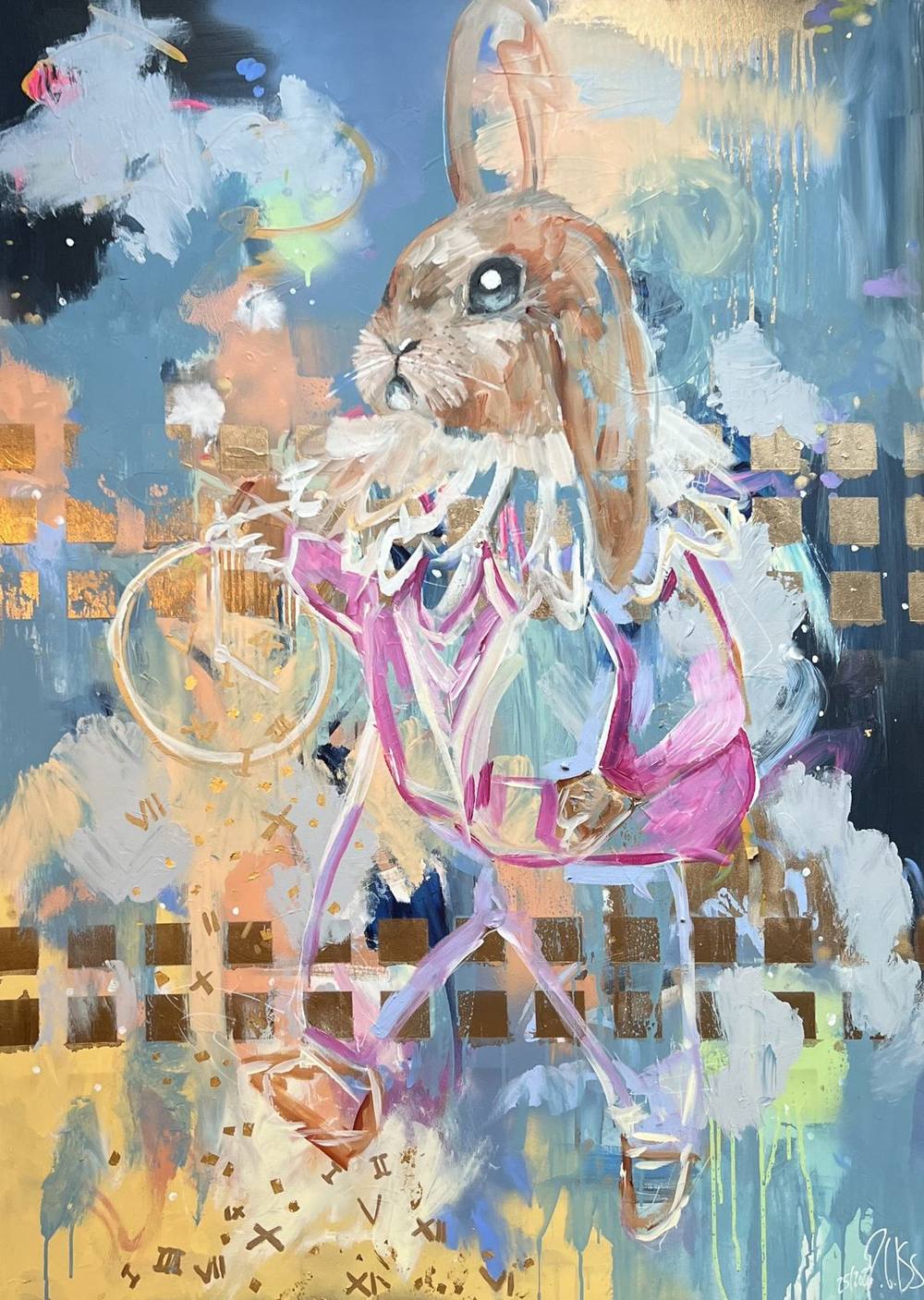
A relative of the eagle is the hare in 25 | 2022. It stands in half profile, with a ruff and a pink costume, drawn only in outline so that the blue-grey sky shows through it. Two bands of square gold fields structure the surface. How this animal has travelled through the history of art is told in the sister article The hare in art.

In 15 | 2021 the same way of painting turns to a harbour: a tall ship with delicate rigging lies beside a smaller vessel, a crane stands at the right edge, all framed by gold and deep blue. In 07 | 2022 she draws a classic roadster with the brush on black canvas, a golden cloud rising behind it. The group also includes the still life with carafe 1756 | 2022 and the New Year’s Eve scene with a trumpet in 01 | 2021, both no longer available.

Almost two thousand years after Pliny, the eagle is no longer an armour-bearer or a standard. In the work of Juliane Golbs it is a gaze emerging from colour and gold. “ein Adler” is available and can be found in the catalogue. For questions about individual works, you can reach the artist through the contact form.
Works from this article
Frequently asked questions
Why is the eagle considered Jupiter’s bird?
Pliny the Elder reports in his Natural History that the eagle is the only bird never killed by a thunderbolt. For this reason, he writes, custom made it Jupiter’s armour-bearer.
When did the eagle become the standard of the Roman legions?
According to Pliny, Gaius Marius assigned the eagle to the legions as their special badge in his second consulship, in 104 BC. He abolished the four other standards that had been in use until then.
Why is the eagle the symbol of St John the Evangelist?
The four creatures from the visions of Ezekiel and the Book of Revelation came to be read as symbols of the Evangelists. The eagle, the creature that dwells closest to heaven, stands for John because of his visions and the heavenly opening of his Gospel.
Who designed the federal eagle in the plenary chamber?
The Cologne artist Ludwig Gies, in 1953, for the plenary chamber in Bonn. In a version reworked by Studio Laeis in 1999, the eagle moved with parliament to Berlin. In Bonn it was known as the “Fette Henne”, the fat hen.
Which work by Juliane Golbs shows an eagle?
The painting “ein Adler” of 2017 from the Golden Things series, painted in acrylic, acrylic lacquers and gold lacquer on canvas and measuring 100 × 140 centimetres.
Sources
8 sources
- Pliny the Elder: Natural History, Book 10 (trans. Rackham), attalus.org
- ColourLex: Rembrandt, The Rape of Ganymede (1635)
- The Fitzwilliam Museum: The symbols of the Evangelists
- Städel Museum: Albrecht Dürer, Apocalipsis cum figuris, title page of the Apocalypse, Latin edition 1511
- Deutscher Bundestag: Der Adler
- Deutscher Bundestag: The plenary chamber in the Reichstag Building
- KuLaDig (LVR): Bundeshaus Bonn
- The Fitzwilliam Museum: Audubon, Plate 31: White-headed Eagle (1828)