Large abstract paintings: when a statement work is worth it
A large painting is no longer decoration but architecture. Why statement works calm a room more than one might think, and how to find the right format.
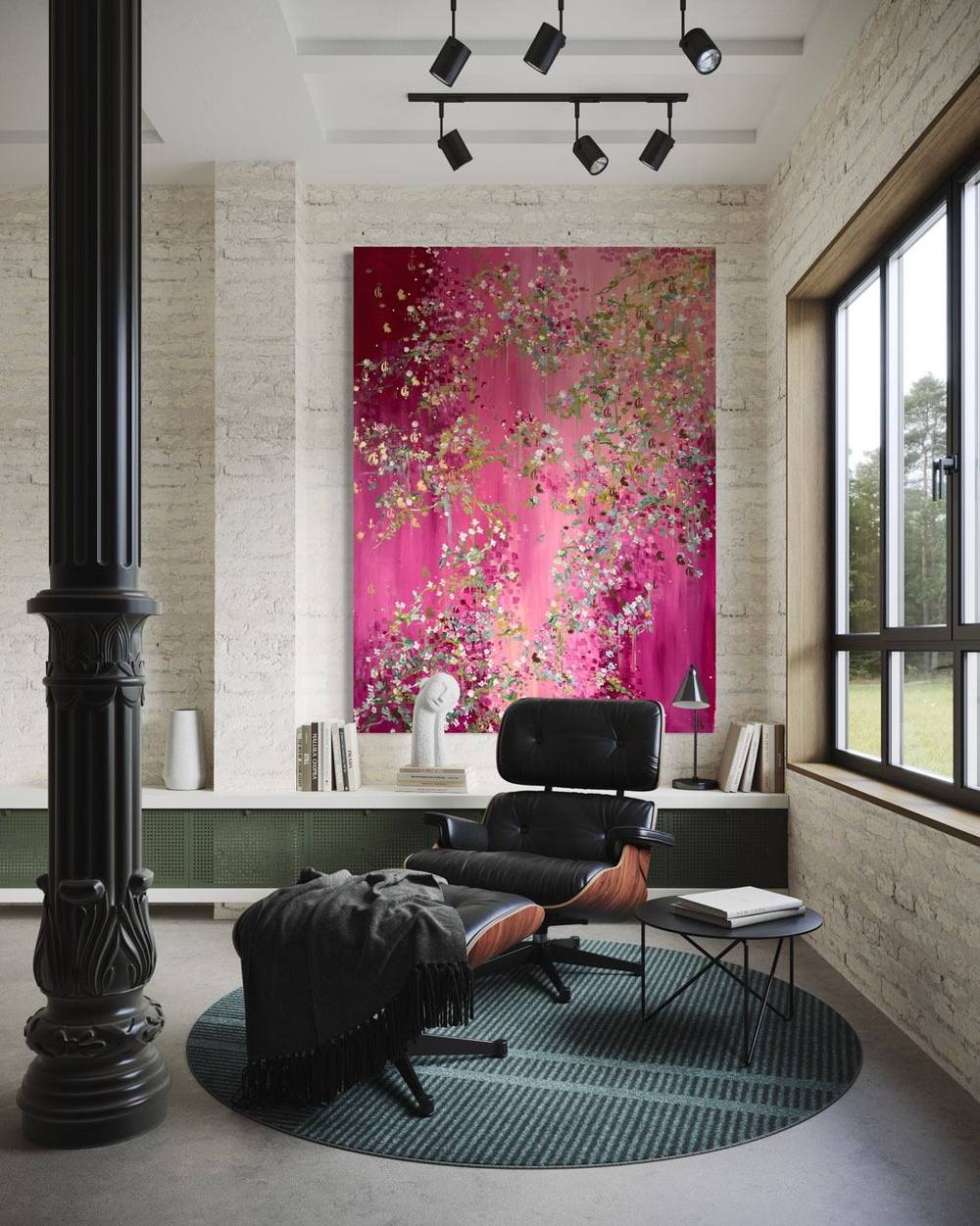
Many people buy paintings that are too small. Not out of taste, but out of caution. In a shop or on a screen a large format feels like a big decision, and so the wall above the sofa ends up with a picture that disappears against it. Yet it is often the large work that calms a room.
This article explains when a large abstract painting is worth it, how to find the right size, and how to choose a statement work that holds up over time.
Why scale changes perception
In the 1920s Georgia O’Keeffe transferred small blossoms onto large canvases, tightly cropped and magnified, inspired by modern photography. Her Flower Abstraction of 1924 measures about 122 × 76 centimetres, and the flower seems to grow beyond the edges of the canvas. Her reasoning, as the Whitney Museum records it, was simple: “Paint it big and they will be surprised into taking time to look at it.”
Claude Monet went further still. His Water Lilies at the Musée de l’Orangerie in Paris hang in two oval rooms: eight compositions running nearly 100 linear metres across some 200 square metres, lit by daylight from above. Standing there, you no longer look at a picture. You stand inside one.
Both examples show the same principle: beyond a certain size, a painting stops being an object on the wall. It becomes the surroundings. That is exactly what a statement work does in a home.
When a large painting makes sense
A large abstract painting is worth it above all in four situations:
- Above wide furniture. Above a sofa, a sideboard or a dining table a picture needs weight, otherwise the furniture looks lost.
- On high walls. Period apartments, lofts and rooms with open staircases have wall surfaces that swallow small pictures.
- In calm rooms. A single large work organises a room. Many small pictures create restlessness unless they are hung with great care.
- As the centre of a home. A work visible from the entrance becomes a point of reference. Every later decision, from fabrics to lamps, takes its cue from it.
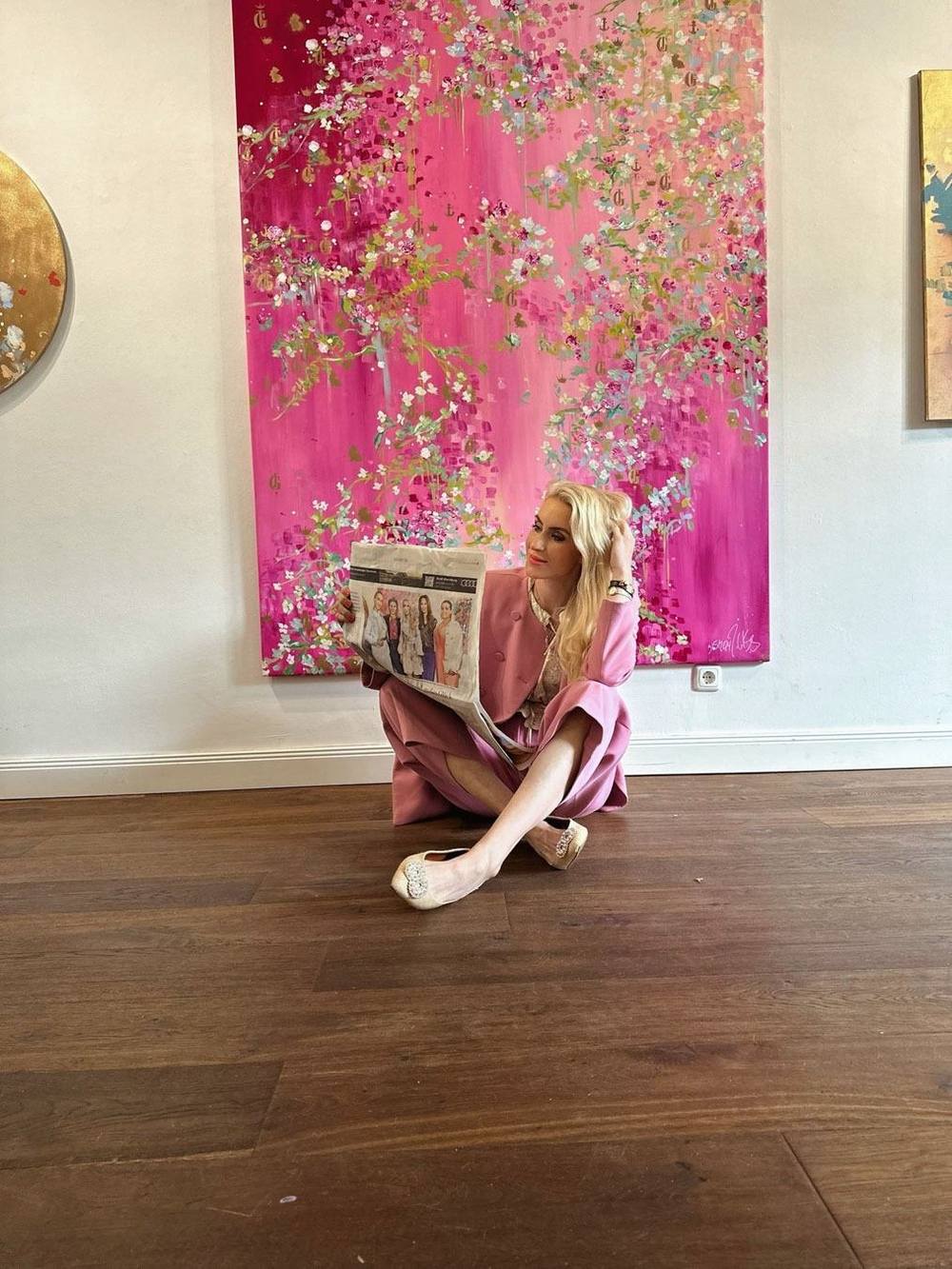
Finding the right size
The most reliable rule of thumb for pictures above furniture is about two thirds of the furniture’s width. For a sofa of 2.40 metres, that means a picture around 1.60 metres wide. A little less is fine; much less quickly looks accidental.
For height in a living room, the centre of the picture sits roughly at eye level, at about 1.45 to 1.55 metres. Above a sofa a painting may hang a little lower, so that furniture and work read as one. Between the back of the sofa and the lower edge of the frame there is usually 20 to 30 centimetres of air.
Very tall formats such as 150 × 200 centimetres often hang with their lower edge just above the furniture. Large squares of 200 × 200 centimetres need a wall that gives them room and look best with at least a hand’s width free on either side.
A practical test before any decision: mark the desired format on the wall with masking tape and live with it for a few days. On every work page, the size comparison also shows the painting to scale next to a door, a sideboard and an armchair.
Portrait, landscape, square
The format changes how a room is read.
- Portrait formats stretch a room and lead the eye upwards. They suit narrow walls, spaces beside doors and stairwells. Works such as 09 | 2026 or 03 | 2026, each 150 × 200 centimetres, belong to this family.
- Landscape formats calm and widen. Above sofas and dining tables they are the natural choice. 05 | 2026 at 200 × 150 centimetres, or the dark 02 | 2023 at 200 × 120 centimetres, are such pictures.
- Squares feel self-contained and architectural. A large square such as 04 | 2026 or 507 | 2024, both 200 × 200 centimetres, is a room within a room.
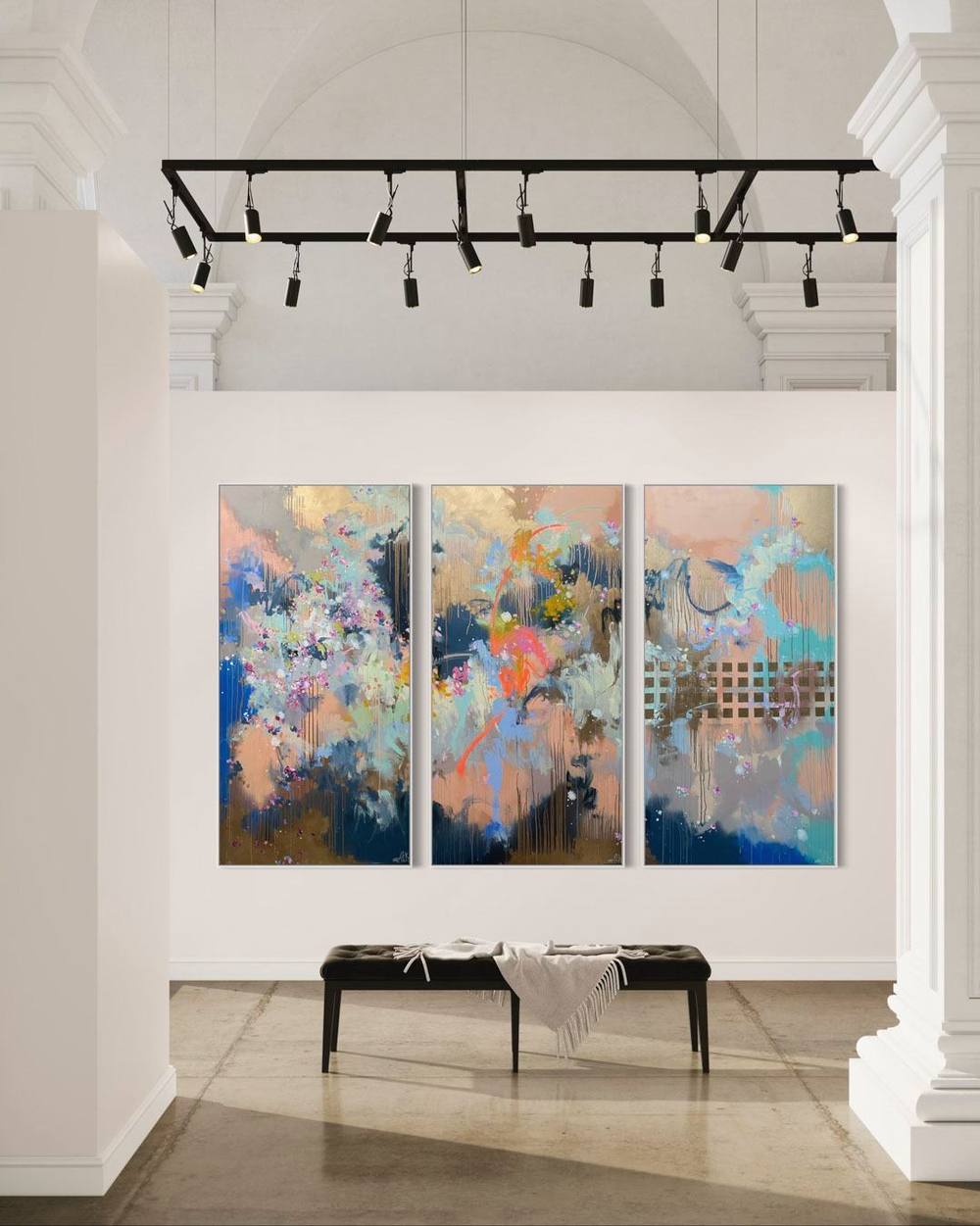
A special case is the triptych. Three panels side by side read as one large picture, yet are easier to transport and more flexible to hang. In the Signature Collection, the parts 53, 54 and 55 | 2021, each 100 × 200 centimetres, form such an ensemble.
Colour decides between calm and tension
A large format amplifies everything that is in the picture. A light, finely layered palette becomes a large, quiet field, almost like a window. A strong pink, or a black ground with gold, becomes a centre nobody walks past.
To calm a room, choose works with few main colours and soft transitions. To wake a room up, choose contrast. That is why the art advisor asks about the colour world first and the format second. Its “Statement” preset of 200 × 200 centimetres shows the large originals currently available.
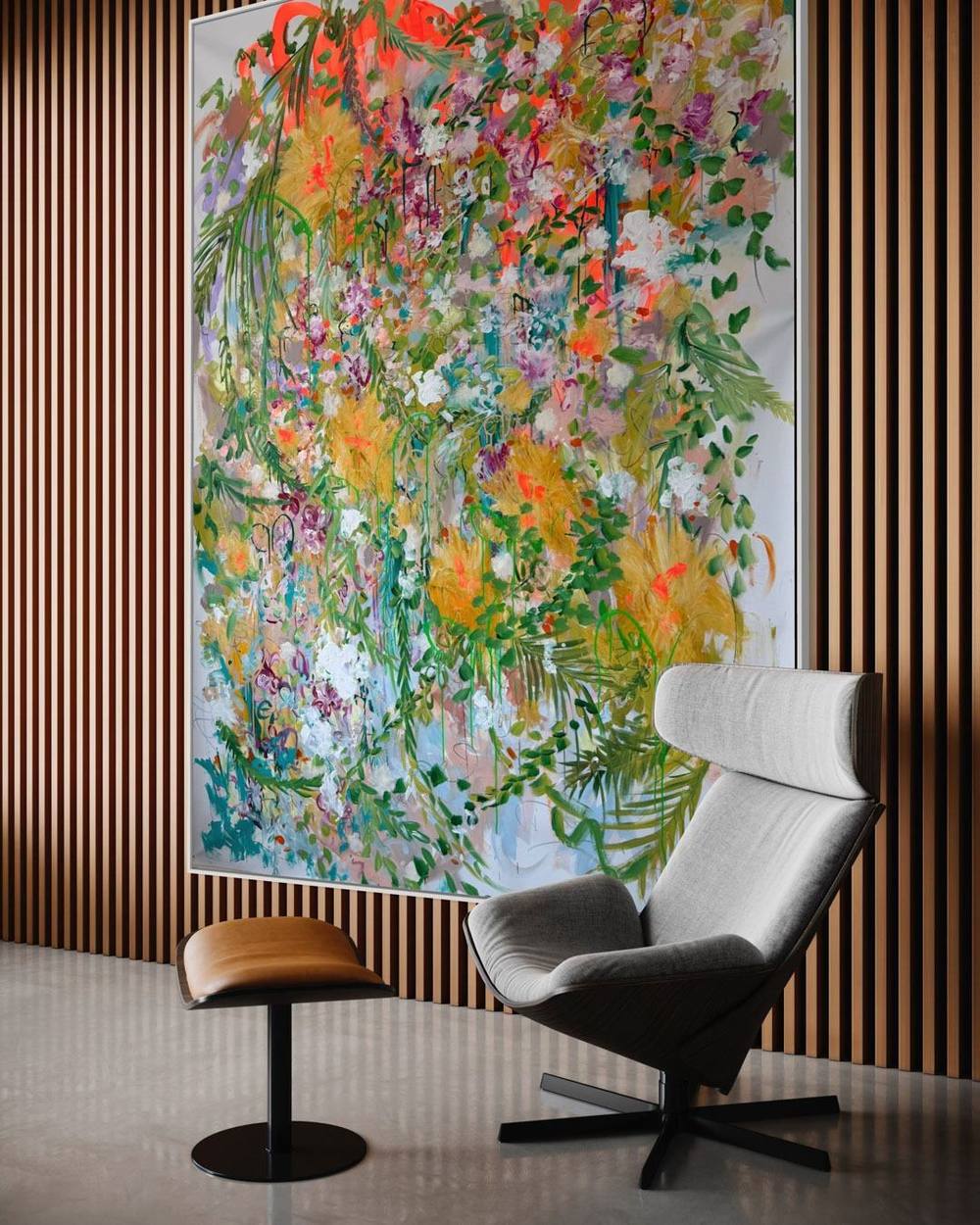
One large work or a group?
The alternative to a single large painting is a group: several smaller works that together fill a large surface. Both can succeed, but they create different rooms.
A group feels more personal and lively, but demands discipline. The spacing has to be right, and the works need a shared idea, whether a colour family, a frame or a theme. Without that bracket, it quickly looks like an accumulation.
The single large work is calmer. It gives the room one clear centre and lets the surroundings breathe. For people who long for order and concentration, it is usually the better choice. Those who want both can begin with one large work and add smaller pieces in other rooms. Small formats such as 08 | 2026 at 30 × 40 centimetres then pick up the language of the large picture without competing with it.
Room by room
The living room is not the only space that benefits from a large format.
- Dining room: above a long table, a wide landscape format reads like a second table. Because people sit here, the picture may hang a little lower than in standing areas.
- Bedroom: above the bed, a large, light work with soft transitions is calming. Two paintings of equal size side by side are a fine alternative when the wall is very wide.
- Stairwell and hallway: high walls and long sightlines call for portrait formats. A picture discovered slowly on the way up changes how a passageway is perceived.
- Study: here a work that is easy to see from the desk and does not distract is worth it. A large, calm painting behind the desk also works in every video call.
Light, hanging, transport
Large works raise practical questions worth settling early:
- Light: large formats benefit from even, warm light. Works with gold lacquer or gold leaf change with daylight; low light from a window makes gold glow, while direct midday sun is best avoided.
- Hanging: large canvases hang more securely on two points than on one, and they stay straight.
- Transport: before buying, check the stairwell, lift and door widths. A 200-centimetre format does not fit through every door.
Five common mistakes
- Buying too small. The most common mistake of all. When in doubt, the larger format almost always looks more natural.
- Hanging too high. A picture floating under the ceiling detaches itself from furniture and people. The centre belongs at eye level.
- Crowding it. A large work needs air. Shelves, a television or other pictures right next to it rob it of its strength.
- Fighting the light. A picture opposite a large window reflects on glossy surfaces. Light from the side is almost always better.
- Deciding on screen only. The colours, surface and scale of an original reveal themselves only in the room.
Keep these points in mind and a large work is hard to get wrong.
Trial hanging: experiencing scale in the real room
No screen conveys the scale of a large work reliably. That is why the studio offers to hang an original on trial for a small fee. If you decide to keep the painting, the fee is credited in full against the purchase price. With large formats, this step is often the moment when a guess becomes certainty.
If you are looking for a work for a particular wall that does not yet exist, you can request a commission. All available large formats are in the catalogue of works.
A large painting is a decision for a room, not for a wall. Made with care, it rewards you every day.
Frequently asked questions
How large should a painting above a sofa be?
A reliable rule of thumb is about two thirds of the sofa’s width. For a sofa 2.40 metres wide, that means a picture around 1.60 metres wide, as a single work or as a group.
When is a painting considered large?
There is no fixed threshold. In a living space, a format with sides of about one metre or more is usually considered large. Juliane Golbs’ large formats go up to 200 × 200 centimetres, and up to 300 centimetres wide as a triptych.
Will a large painting overwhelm a small room?
Rarely, if the palette is calm. A single large work often organises a room better than many small pictures, because it creates a clear centre. Colour, light and distance to furniture are what matter.
Can I try a large painting in my home before buying?
Yes. For a small fee, credited against the purchase price, the original comes to you. With large formats this is especially worthwhile, because scale and light are hard to judge on a screen.