The emblem of Venice: Juliane Golbs at Venice Design Week 2025
A white sculpture, a historic church, an evening full of music. How a live performance became the leitmotif of an entire festival.
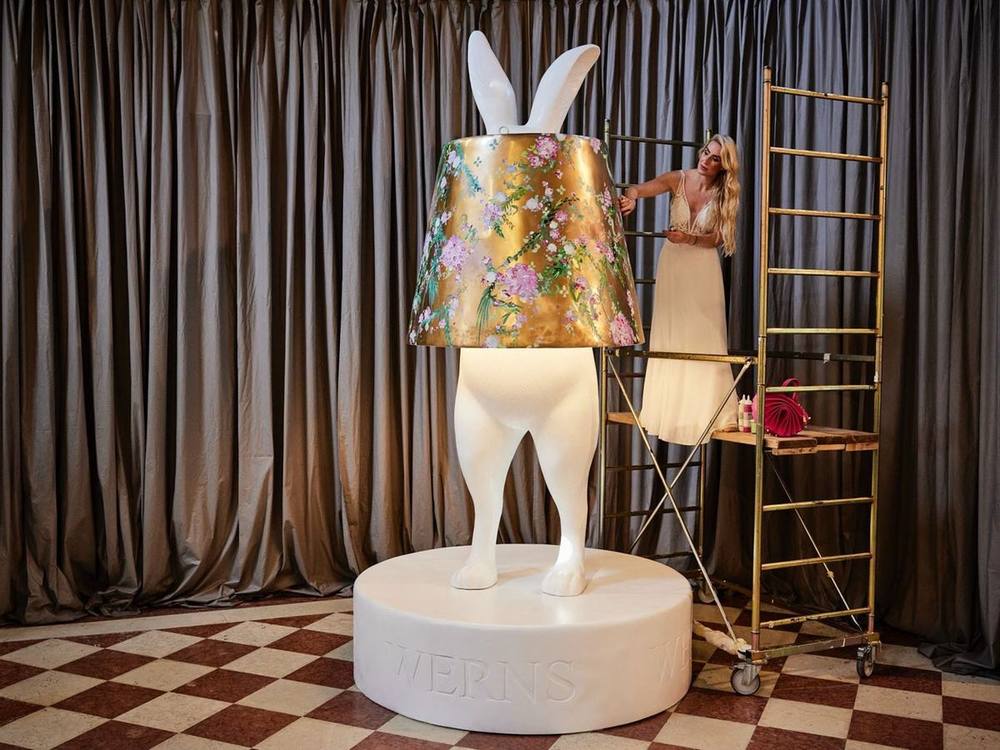
In Venice, every new work stands beside centuries of art history. In October 2025 an artist from Hamburg showed a piece there that became the face of an entire festival: a hare sculpture, painted in front of an audience, in a church, in a single evening.
Venice Design Week
Venice Design Week is younger than its setting might suggest. The festival was launched in 2010 by the Venetian cultural association Arte e Design. It has no central exhibition hall but is spread across the city: private galleries, museums, apartments and artists' studios, shops, workshops. Following the programme means walking through Venice and discovering design where it is made and lived.
The 2025 edition ran from 11 to 19 October under the title “Tempora”. It was about time, about the link between past and future, about design as a bridge between eras, cultures and knowledge. The festival includes themed walks – to the city's goldsmiths, for instance – and an award ceremony for young talent in design, art and architecture.
For a festival concerned with time, Venice is the most obvious place in the world. Hardly any city shows so openly how the new grows into the old.
San Leonardo: a church as a stage
One of the venues of Venice Design Week 2025 was the church of San Leonardo in the Cannaregio district, not far from the busy Strada Nova. There the German design label WERNS showed an installation based on its award-winning “Hiding Rabbit Lamp”. The lamp shows a hare whose head disappears beneath a lampshade. It hides – and precisely for that reason it stands out.
For Venice the lamp became a sculpture: made in Germany, brought to Italy, some 3.5 metres tall. Looking back on the performance, WERNS itself even speaks of almost four metres. It stood on a round plinth in the middle of the church, between heavy curtains and on the characteristic chequerboard floor.
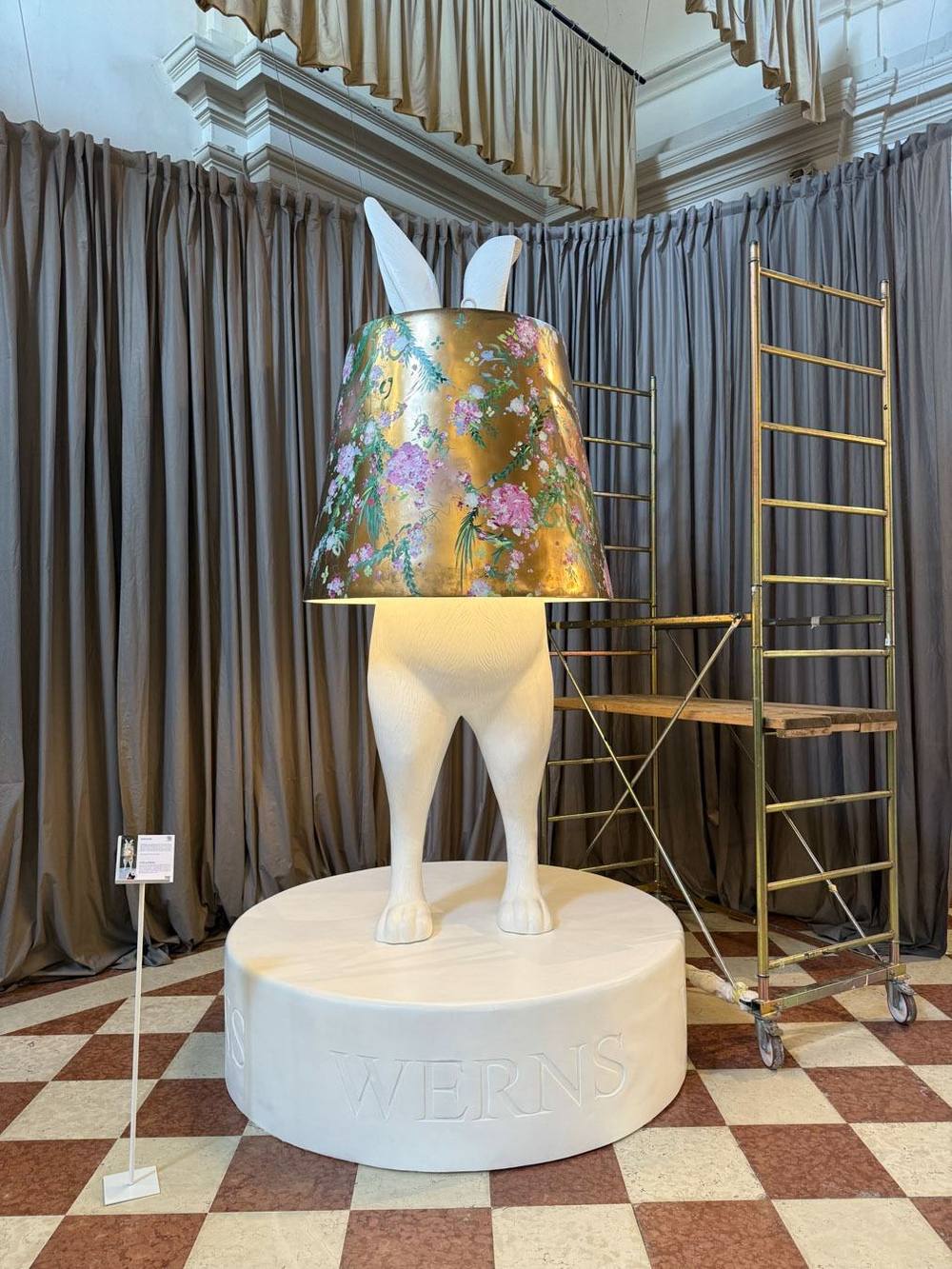
A church interior changes how one looks at an object. Light falls from above, voices carry far, and everything feels a little more solemn than at a trade fair. The installation benefited from this. The hare stood there not like a product but like a figure.
From white sculpture to work of art
The hare arrived in Venice white. On the opening evening, 11 October 2025, Juliane Golbs transformed it into a work of art in front of an audience. Accompanied by music, she worked layer by layer – with brushes, spray paint, her bare fingers and fine detail. The guests could watch colour, light and form come together.
Anyone who has painted in front of an audience knows how much concentration it demands. A canvas in the studio forgives detours. A live performance has a fixed end: when the evening is over, the work has to hold up. Juliane Golbs knows this situation from other contexts, such as her joint live painting with Joss Stone. Here the size of the object was added. She painted from a scaffold, on a curved surface that one never sees all at once.
The motifs took up fleeting moments of everyday life and played with echoes of “Alice in Wonderland”. WERNS describes the installation as a story about curiosity, transformation and community. The hare that lures Alice into another world became a threshold itself: between design and art, between functional object and picture. According to WERNS, the artist's visual language moves between art, design, culture and fashion, and is timeless and elegant while remaining playful and modern.
A work becomes an emblem
The organisers chose the installation as the emblem and leitmotif of Venice Design Week 2025. The work thus stood for the entire festival. For an artist from Germany this is remarkable recognition, all the more so in a city that cultivates its pictorial tradition with great self-assurance.
WERNS and Juliane Golbs describe their collaboration as the meeting of two disciplines that are interested in each other. That is where its value lies. A design object kept its form and its function as a sign, but gained a handwriting. And a painter found a surface that is not rectangular, does not hang on a wall and is seen from all sides.
At the festival's award ceremony, WERNS donated a white Hiding Rabbit Lamp as a prize for young designers. The hare thus became the symbol of this edition in more than one sense: of curiosity, of light and of inspiration passed on.
Venice and gold
There is a reason why a golden shade looks so natural in Venice of all places. Hardly any city is so closely bound up with gold. The mosaics of St Mark's Basilica cover more than 8,000 square metres. Most of them were made between the 11th and 13th centuries. Besides coloured glass, they consist of gold tesserae: small glass cubes with gold leaf fused into them. The golden ground reflects the light and makes the figures in front of it glow. To this day the Venetian manufacturer Orsoni, founded in 1888, supplies glass and gold tesserae for the restoration of the domes and the façade.
In these mosaics gold has no decorative task in today's sense. It stands for a space beyond the everyday, for light that does not come from the sun. Anyone who knows the works of Juliane Golbs understands why this tradition is close to her. For her, too, gold is not ornament but light. It changes with the time of day and with the viewer's position. How she works with 24-carat gold leaf and what the material means in art history is explained in Gold leaf in painting.
Colour as a Venetian legacy
In art history Venice stands for something else as well: colour. In 16th-century Italy two attitudes were distinguished. Florence stood for disegno, drawing as the intellectual foundation of the picture. Venice stood for colorito, a painting in which colour dominates and carries the sensual, expressive effect of the image. The National Gallery in London sums up this contrast in two names: Titian on the Venetian side, Michelangelo on the Florentine.
One detail is remarkable: in the Venetian understanding, colour was not separated from its application. Whoever emphasised colorito also emphasised the way of painting – the brushstroke, the visible movement of the hand.
In this sense Juliane Golbs's painting stands closer to Venice than to Florence. Her pictures live from layers of colour, from gesture, from the expressive line that can still be recognised in the finished work as a movement of the hand. The performance in San Leonardo made this process public. What one saw was not a finished composition being filled in, but a picture finding its direction as it came into being.
Limited editions for a good cause
Two limited unique pieces were created to accompany the installation. Juliane Golbs painted a full-size Hiding Rabbit Lamp and a couture handbag by the Italian manufacturer Thaden. Both pieces were auctioned for a good cause.
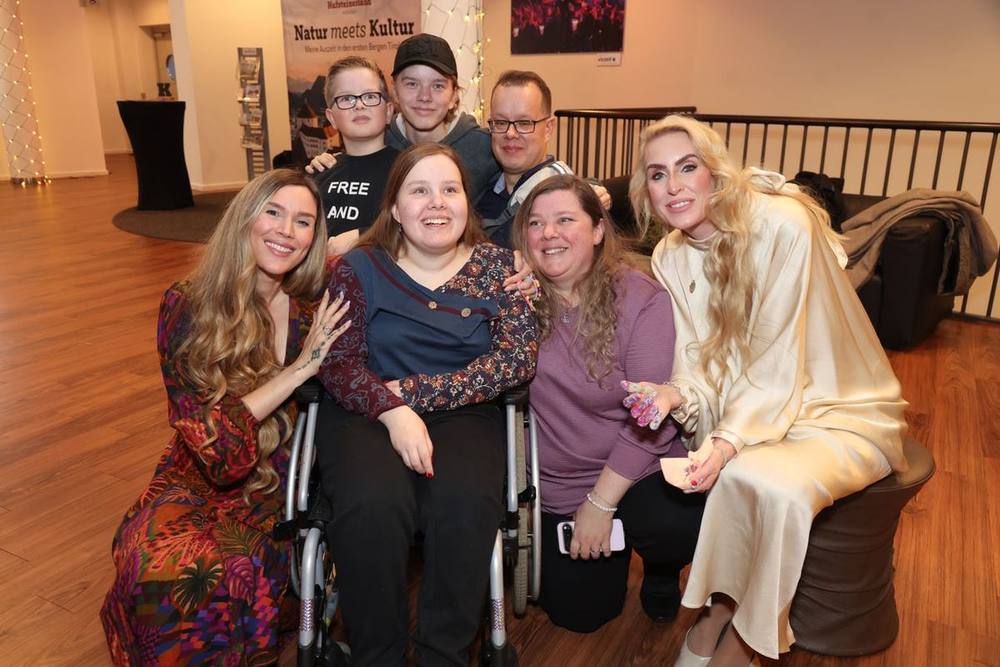
This connects the work in Venice with an attitude that runs through the artist's entire œuvre: beauty should make a difference. Since 2018 Juliane Golbs has been an ambassador for the NCL Foundation, which supports children with the rare metabolic disease NCL. More in Art that carries responsibility.
Why the hare fits
Anyone who knows Juliane Golbs's work will recognise the hare. In her Signature Collection it stands beside the crown and the anchor as a sign: for quickness of thought, for alertness, for curiosity. In Venice, two visual worlds met that were already related. WERNS brought the hare as a form; the artist brought it as a meaning.
That is exactly what makes the collaboration credible. A brand did not simply book an artist to decorate an object. Two sides found, in a shared motif, something that had already occupied both of them.
Venice in the evening
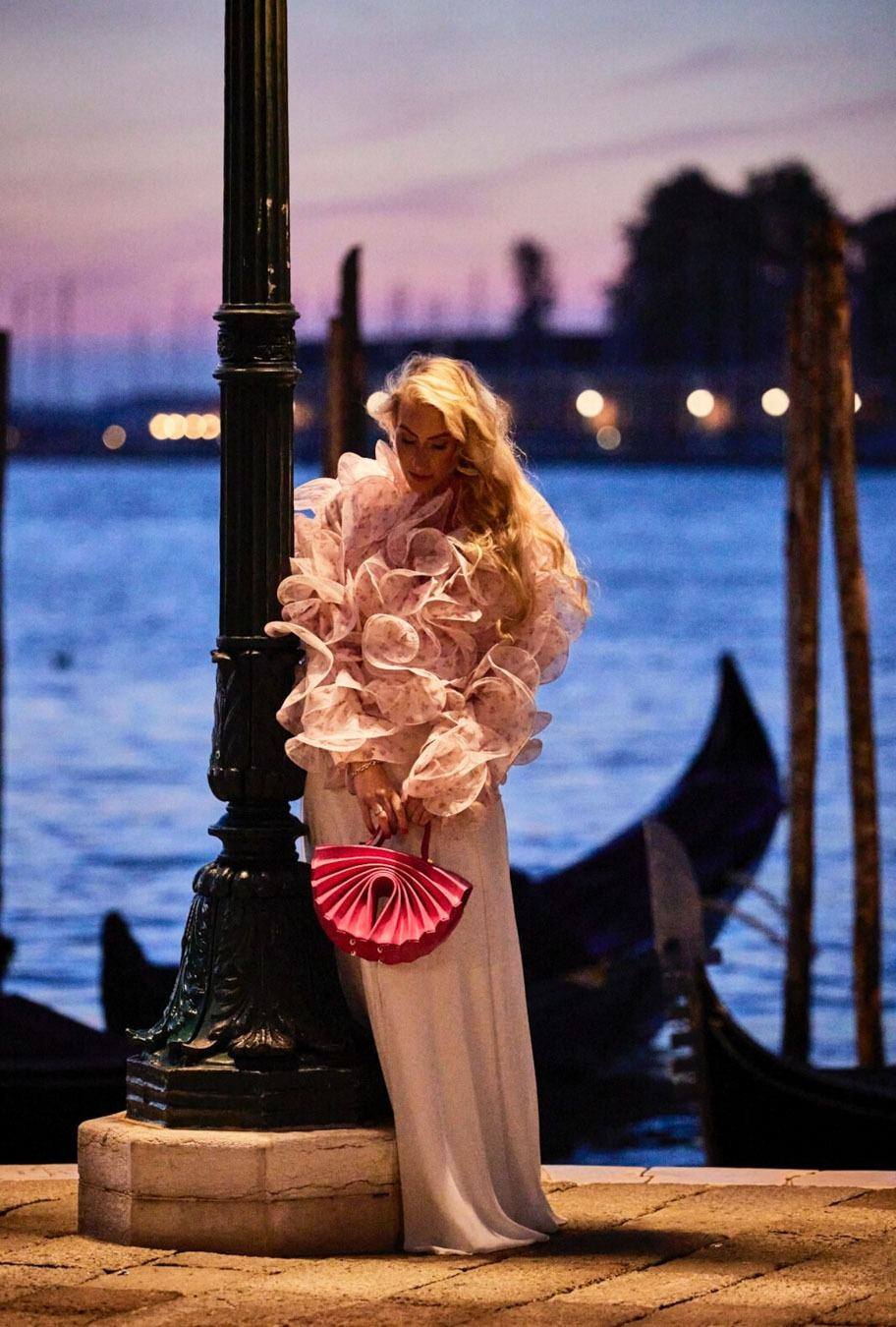
Venice is one of the places that have shaped the artist: Schwerin, where she was born; Hamburg, where she has lived since the age of 18; the Côte d’Azur, Deauville, Venice. These are places where water and light determine perception. Anyone who paints on the Elbe knows the shimmer on the surface, the constantly changing grey, silver and gold. In the lagoon this light is softer and warmer. Yet the kinship can be felt.
The work in San Leonardo shows how naturally a Hamburg painter moves in this international setting. And it shows how closely her collaborations are tied to her painting. The motif came from her own work, the gold from her technique, the attitude from her commitment.
What remains
Often only photographs remain of a festival. Of this installation more remains: a work that represented an entire festival, two unique pieces whose proceeds helped, and a collaboration that shows how design and art can enhance each other.
All of Juliane Golbs's partnerships, from Venice to IFA in Berlin, can be found on the Dialogues page. Her newest connection leads to the Elbchaussee: read about the collaboration with Hotel Louis C. Jacob in Artist in residence at the Louis C. Jacob. Houses of distinction wishing to discuss a collaboration of their own can reach the artist via the contact form.
Works from this article

Frequently asked questions
What is Venice Design Week?
An annual festival of contemporary design in Venice, launched in 2010 by the cultural association Arte e Design. The 2025 edition took place from 11 to 19 October and was spread across galleries, workshops, studios and historic venues throughout the city.
Which work did Juliane Golbs show in Venice?
A hare sculpture some 3.5 metres tall by the German label WERNS, based on its “Hiding Rabbit Lamp”. Juliane Golbs painted it live in the church of San Leonardo on 11 October 2025. The festival chose the installation as its emblem.
What happened to the Venice editions?
Juliane Golbs also painted a full-size Hiding Rabbit Lamp and a couture handbag by Thaden. Both unique pieces were auctioned for a good cause.