Acrylic on canvas: the history and properties of acrylic painting
Oil paint has a history of centuries, acrylic a history of a few decades. How a plastic from the laboratory became a painting medium, and what collectors should know about acrylic on canvas.
Acrylic on canvas has become so familiar that it is easy to forget how young the combination is. Oil painting looks back on centuries, acrylic painting on a few decades. Tate describes acrylic as a water-based, fast-drying paint that artists have used widely since the 1960s. Its path leads from a doctoral thesis in Tübingen through a colour workshop in Manhattan to the studios of today.
From the laboratory: Otto Röhm and the acrylic resins
It began with chemistry. In 1901 Otto Röhm received his doctorate from the University of Tübingen with a dissertation on the polymerisation products of acrylic acid. In 1907 he founded the firm of Röhm & Haas in Esslingen with the businessman Otto Haas, and two years later the company moved to Darmstadt. According to Evonik’s corporate history, research into acrylic compounds proper began there in 1911.
The best-known result came onto the market in 1933: Plexiglas, developed by Otto Röhm and the head of the laboratory, Walter Bauer. At first this had nothing to do with painting. Yet the family of acrylates and methacrylates studied so systematically in Darmstadt is the same family from which the binders of artists’ paints would later come. Otto Haas took over the management of the office in Philadelphia and never returned to Germany.
New York in the late 1940s: Magna
At the same time, artists were looking for paints that belonged to the industrial present. In 1936 the Mexican muralist David Alfaro Siqueiros painted Collective Suicide in lacquer on wood; the Museum of Modern Art notes that he used commercial and industrial paints and methods. This was not yet acrylic. The direction, however, had been set: away from the recipes of easel painting and towards the materials of industry.
In Manhattan, Leonard Bocour and his nephew Sam Golden had been grinding oil colours by hand since the 1930s. Golden Artist Colors counts Barnett Newman, Mark Rothko, Willem de Kooning and Jackson Pollock among the artists who came to their shop on 15th Street. Between 1946 and 1949, after much trial and error, the first artists’ acrylic was ready for production there: Magna. CAMEO, the materials database of the Museum of Fine Arts, Boston, dates its introduction to 1947.
Magna consisted of pigments in a butyl methacrylate resin and was thinned with turpentine or mineral spirits. It was, in other words, a solvent-based acrylic. It dried quickly to a hard, matt film that does not yellow. Morris Louis, Kenneth Noland and Roy Lichtenstein all worked with it. Bocour discontinued the line in the mid-1970s.
Water instead of turpentine: the first emulsion paints
The decisive step was the emulsion. Here pigment and resin are dispersed in water; the paint can be thinned with water and is water-resistant once dry. In Cincinnati the colour chemist Henry Levison, whose firm Permanent Pigments had been milling oil colours since 1933, developed such a paint under the name Liquitex. According to the manufacturer, an acrylic gesso came first in 1955, followed in 1956 by the water-based artists’ colour. CAMEO gives 1954 as the year it was first marketed.
The early binder was Rhoplex AC-33 from Rohm & Haas, a company whose name goes back to the two founders from Esslingen. The first paints were thin and runny. Only in 1963 was the formula thickened enough to be sold in tubes. Sam Golden, too, developed a water-based acrylic, called Aquatec, which proved more popular than Magna. According to Tate, acrylic reached Europe only about a decade later.
Colour fields and a swimming pool: acrylic in modern art
In October 1952 Helen Frankenthaler painted Mountains and Sea, her first picture in the soak-stain technique, in which the paint sinks into the weave instead of resting on it. According to the Guggenheim Bilbao’s chronology, Clement Greenberg showed the painting to Morris Louis and Kenneth Noland in 1953, and both began experimenting with the method. Louis was among the earliest users of Magna. Frankenthaler herself began working with acrylics in 1962.
Mark Rothko combined materials as well. For Black on Maroon of 1959, one of the Seagram paintings at Tate Modern, Tate lists oil paint, acrylic paint and glue tempera on canvas. Here the new medium joined the old ones without replacing them.
The most famous example of acrylic on canvas is probably David Hockney’s A Bigger Splash of 1967 at Tate Britain. Hockney stapled white cotton duck to the wall and, without drawing first, rolled on the blocks of colour in two or three layers until they were opaque. He left a wide border of raw canvas. For the splash itself he used small brushes and needed two weeks; the David Hockney Foundation quotes him as saying that it took him two weeks to paint an event lasting two seconds. Tate calls Hockney one of the first artists to make extensive use of acrylic, because the fast-drying paint suited large areas of flat colour and the clear light of California.
What defines acrylic on canvas
The first property is drying. Acrylic dries much faster than oil, so there is no need to wait days for the next layer. With more or less water it can be used as a thin wash or thickly for an opaque surface. Once dry, water no longer dissolves it.
The second is elasticity. Golden Artist Colors describes the flexibility of the paint film and its lack of brittleness as principal virtues of the material; harder polymers would make a painting more susceptible to cracking from impact or movement in transit. For a canvas, which responds to climate and gives a little, this is an advantage.
The third is lightfastness. It depends above all on the pigments. The American standard ASTM D5098 for artists’ acrylic paints sets requirements for pigment identification and lightfastness. Liquitex states that in 1984 it became the first maker to label its paints to ASTM standards. Anyone acquiring an original is entitled to ask about the materials.
Heat, cold, dust: how acrylic paintings age
Acrylic is a thermoplastic material. The Getty Conservation Institute explains that such paint media can turn extremely brittle at low temperatures and expand, soften and even become sticky when heated. Rates of soiling change with them, as does the response to fluctuations in temperature and relative humidity. A Tate research paper of 2006 puts it simply: at low temperatures the film behaves like glass, at higher temperatures like rubber.
This explains why the surface is sensitive. The Tate study names the softness of the paint layer, the absorption of dirt and sensitivity to water and solvents as concerns for conservation. Golden advises keeping direct contact with unprotected acrylic surfaces to a minimum, dusting included. Wet cleaning can drive dirt deeper into the surface.
This is where varnish comes in. Liquitex claims the first removable acrylic varnish for 1967. Golden recommends, where it suits the work aesthetically, an isolation coat and a removable varnish, because the surface can then be cleaned at much lower risk. Whether a painting is varnished is one of the questions worth asking at the point of purchase.
Acrylic, lacquer and gold in Juliane Golbs’s studio
In almost every one of Juliane Golbs’s medium lines, acrylic comes first. She works with highly pigmented acrylics, with pastel and chalk, with lacquers and spray paint. Much of it she applies with her bare fingers. The hand stays visible in the picture as the trace of a movement.
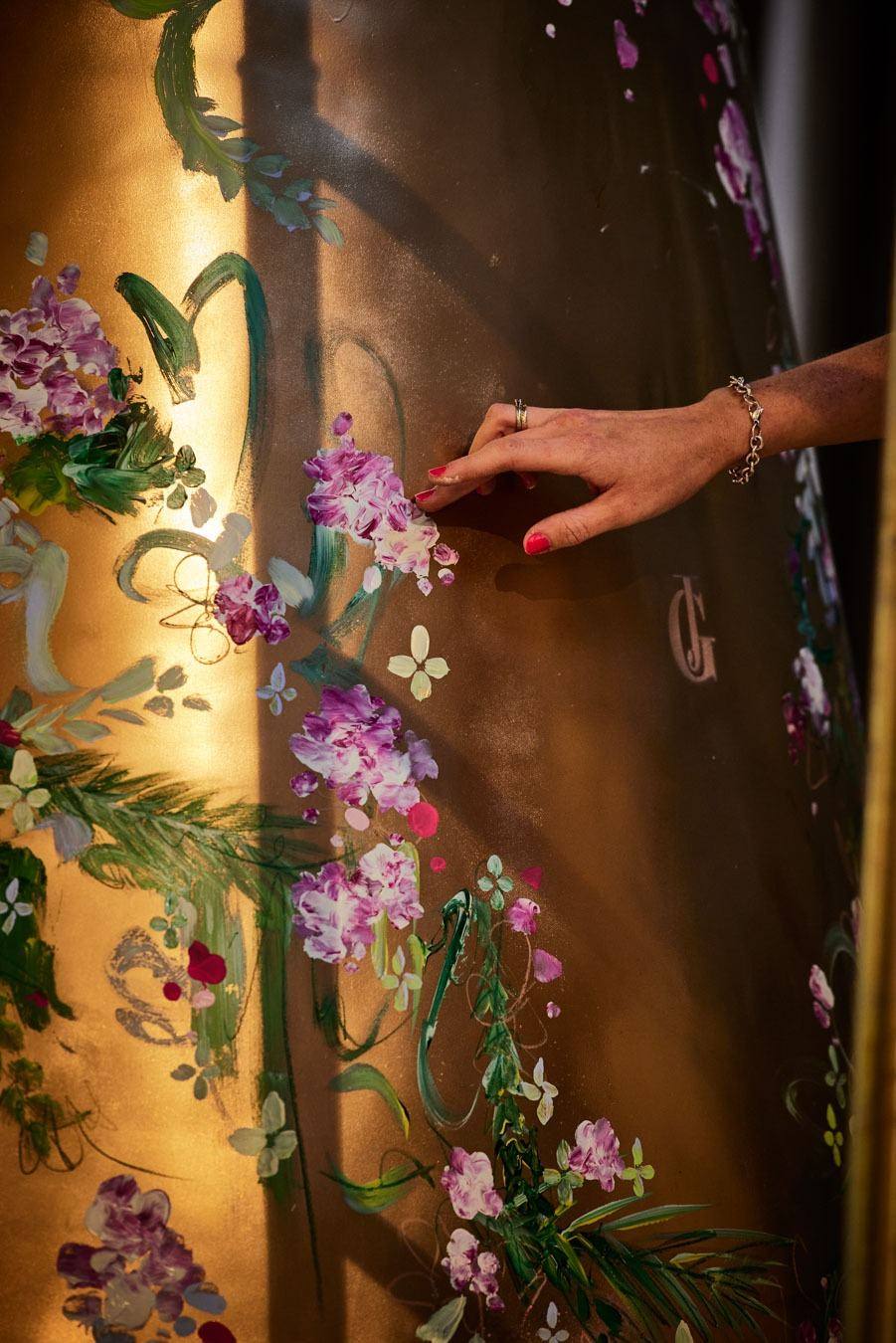
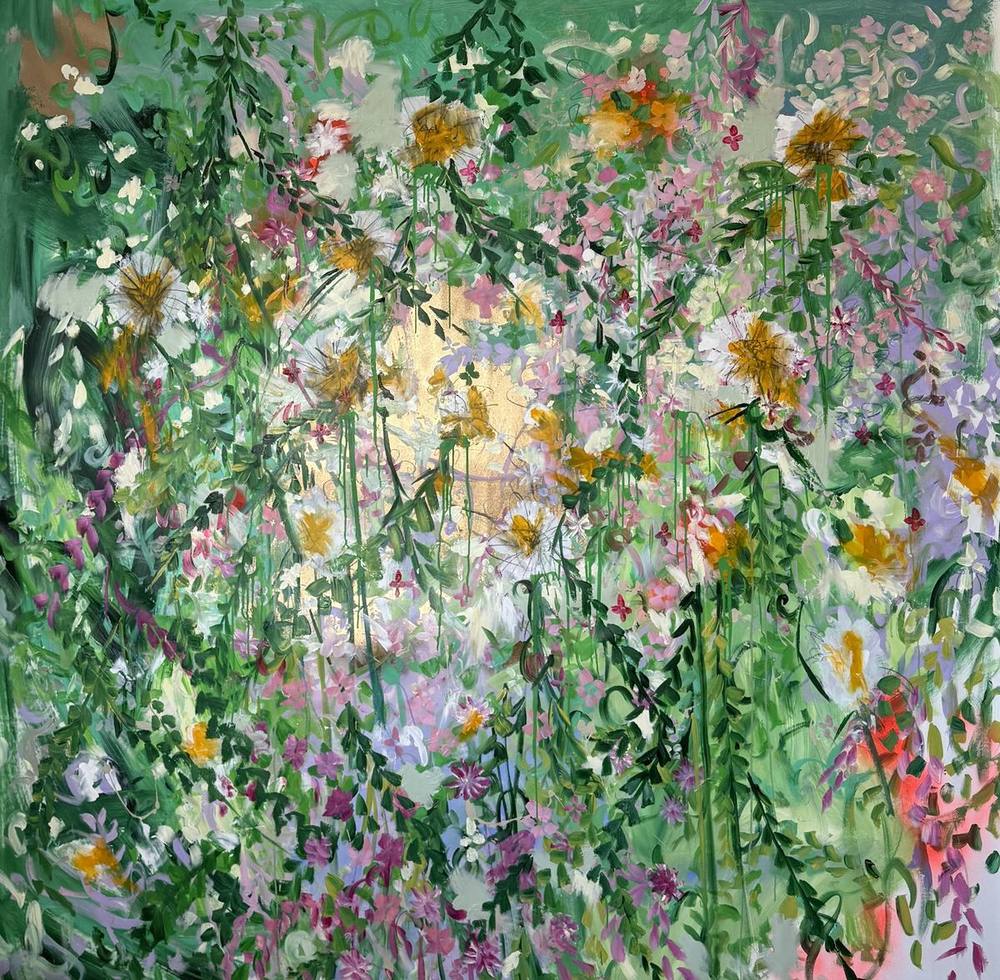
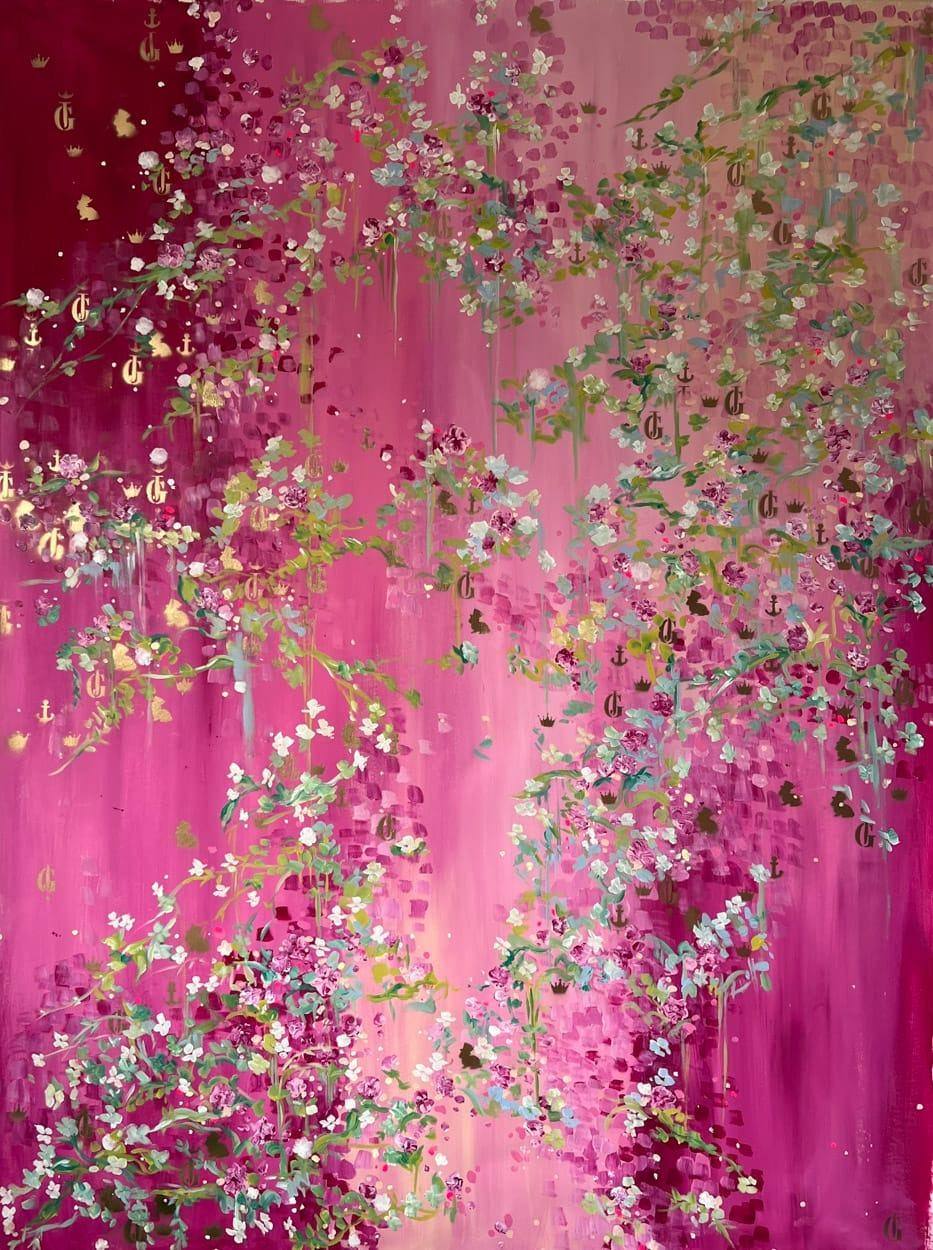
The medium lines show how the materials work together. 04 | 2025 is painted in acrylic, acrylic lacquers and gold lacquer on canvas, 200 × 200 centimetres; the technique allows shifts between opaque, glazed and glossy passages, and single drips run like rivulets through the green. 515 | 2024 sets a deep, matt ground of magenta against accents in gold lacquer that light up in raking light.
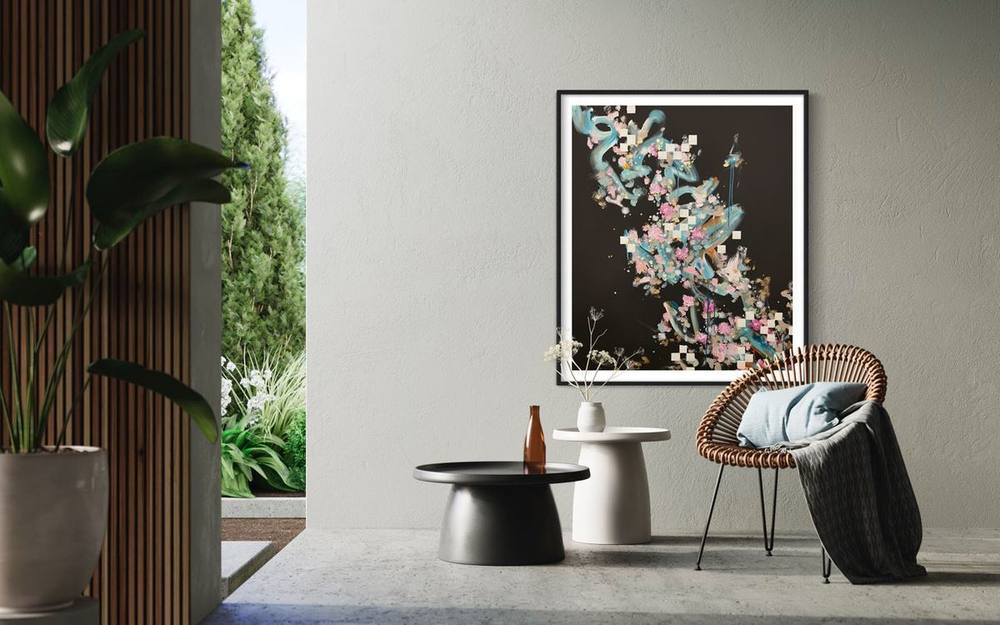
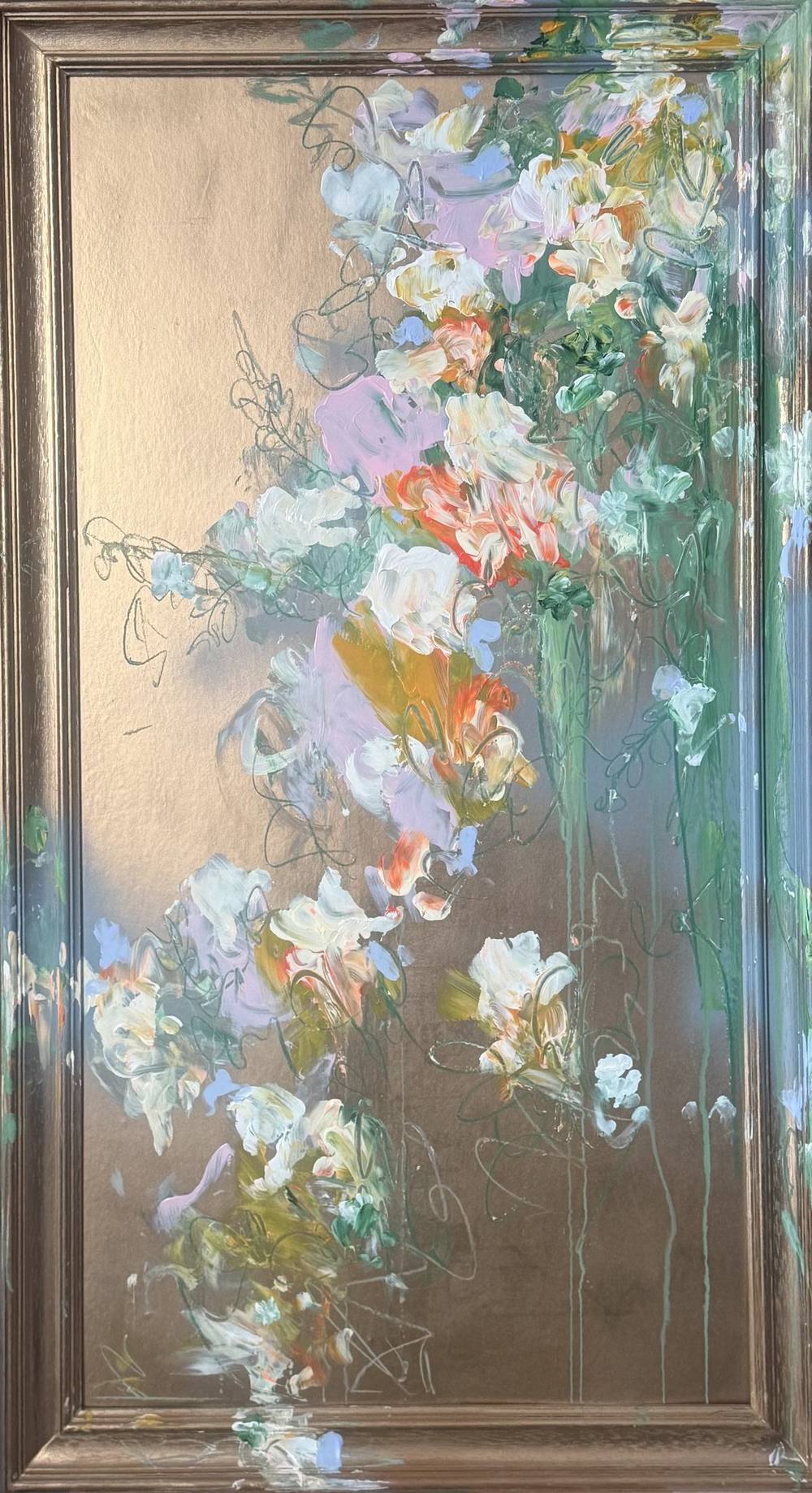
Some works begin on black. 02 | 2023 from the Everlasting Blossoms series and 07 | 2022 from Golden Things are painted in acrylic and gold lacquer on black canvas. The black absorbs light, while lacquer and gold throw it back. Others leave the canvas behind: 01 | 2026 was made with acrylic and fabric on a wooden panel set over a frame, with the blossoms growing across it.
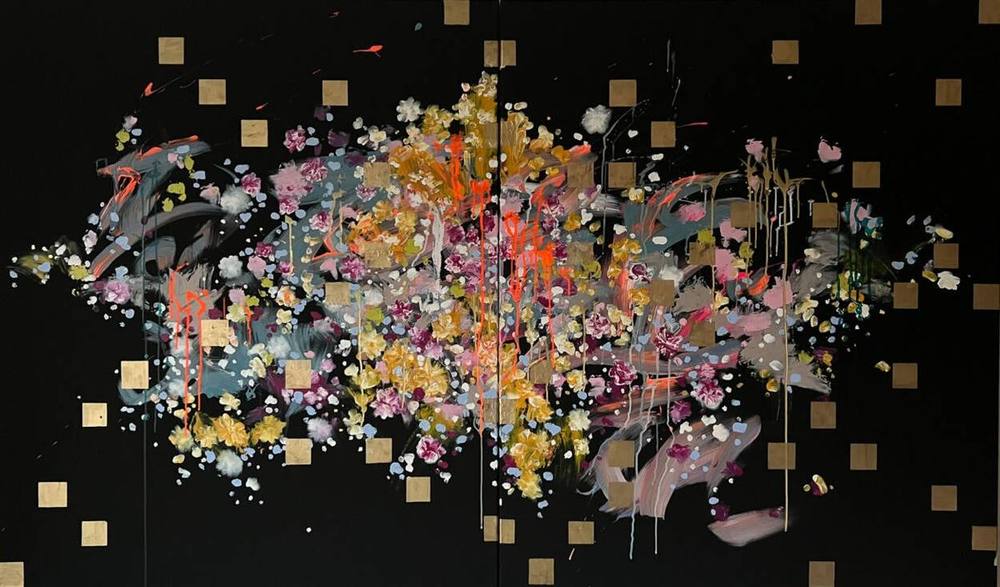
For lacquers and spray paint the artist wears a respirator. Each layer has to dry before the next one follows. A paint that dries through quickly suits this way of working in layers. In some pictures gold cream and 24-carat gold leaf come last, as in 42 | 2021, painted in acrylic and gold leaf on canvas. How the gold is bound and why it changes with daylight is described in the article on gold leaf in painting.

An acrylic painting in your own home
The properties of the material lead to a few clear rules. A steady room climate protects the paint layer, so an acrylic painting belongs neither directly above a radiator nor in an unheated vehicle in winter. Dust should be removed rarely and only dry, with a very soft brush. Damp cloths, cleaning products and solvents have no place on the surface.
Works with lacquer and gold call for the same restraint. How a work looks in your own space can be tested in Juliane Golbs’s studio by hanging it on approval, for a small fee that is credited against the purchase. The catalogue of works gives the medium and dimensions of every original, and the art advisor helps with the choice. Questions about materials are answered by the studio via the contact form.
Seventy years after the first Liquitex colour from Cincinnati, acrylic is no longer a new material. It has become a medium that allows speed and gesture, without making care for the finished painting any less necessary.
Works from this article
Frequently asked questions
When did acrylic paint for artists first appear?
The first artists’ acrylic was Magna by Bocour Artist Colors in New York, a solvent-based paint that was ready for production between 1946 and 1949. Water-based artists’ acrylics reached the market in the mid-1950s, among them Liquitex from Cincinnati.
How does acrylic differ from oil paint?
Water-based acrylic dries much faster than oil paint and is water-resistant once dry. With more or less water it can be applied as thinly as a glaze or thickly and opaquely.
How sensitive is an acrylic painting to heat and cold?
Acrylic films respond to temperature. In the cold they can become brittle, in warmth soft and slightly tacky. A steady room climate, with no radiator directly beneath the picture and no cold transport in winter, protects the paint layer.
How should dust be removed from an acrylic painting?
As rarely as possible and only dry, with a very soft brush. Damp cloths and cleaning products do not belong on the paint surface; wet cleaning can drive dirt deeper into the soft surface.
Sources
8 sources
- Tate: Acrylic paint (Art Term)
- Tate: Look Closer – Understanding David Hockney’s A Bigger Splash
- Evonik History: Otto Röhm
- Golden Artist Colors: History
- Museum of Fine Arts Boston, CAMEO: Magna Plastic Colors
- Liquitex: Evolving, innovating and pushing boundaries since 1955
- Getty Conservation Institute: Study of Physical Characterization of Modern Paints
- Golden Artist Colors (Just Paint): Techniques for Cleaning Acrylic Paintings