The anchor symbol in art: from the catacombs to the Signature Collection
A ring, a stock, two curved arms: for almost two thousand years the anchor has stood for hope and steadfastness. From the epitaphs of Rome and the seal of the Admiralty to the stencilled anchors of Juliane Golbs.
Few signs are as simply made as the anchor. A ring, a stock, a shank and two curved arms are enough for anyone to recognise it at once. The anchor symbol in art carries a meaning that reaches back to the first centuries of Christianity. It was carved on early Christian gravestones in Rome, pressed into the seals of the British Admiralty and tattooed on the skin of sailors. In the work of the Hamburg painter Juliane Golbs it returns as a stencil, sprayed and painted between blossoms and monograms.
A sure and steadfast anchor of the soul
It begins with a single sentence. The Epistle to the Hebrews speaks of the hope given to the faithful, “which hope we have as an anchor of the soul, both sure and stedfast”, in the words of the King James Version (6:19). Luther’s German Bible of 2017 renders it as a “sicheren und festen Anker unsrer Seele”.
The image is precisely chosen. An anchor holds a ship in a place that cannot be seen, because it lies beneath the water. Hope, understood this way, holds firm even though its ground remains hidden. The Catholic Encyclopedia of 1907 calls Hebrews the first text to link hope with the anchor. From here a tool of seafaring became a sign of faith.
The anchor in the catacombs of Rome
In the underground burial places of Rome the sign appears early. The Catholic Encyclopedia records an anchor on a fragmentary inscription from the catacomb of Domitilla, which it dates to the end of the first century. In the second and third centuries it becomes frequent, particularly in the oldest parts of the catacombs of Priscilla, Domitilla and Callixtus. In the catacomb of Priscilla alone the encyclopedia counts some seventy examples from before the fourth century.
On the grave slabs the anchor often stands beside wishes such as “pax tecum” or “in pace”, peace be with you, in peace. Sometimes it accompanies names derived from the Latin spes or the Greek elpis, both meaning hope. The most common form has a ring at the top, the crossbar beneath it and the curved arms below. Because true crosses were rarely depicted in the first four centuries, the Catholic Encyclopedia also reads the anchor as a disguised cross that outsiders would not recognise. By the middle of the third century it is already rare, and early in the fourth it disappears.
How closely anchor and fish belong together can be seen on the small marble stele of Licinia Amias, found near the Vatican necropolis. Below the letters D M, dedicated to the spirits of the dead, the Greek words ΙΧΘΥϹ ΖΩΝΤΩΝ read “fish of the living”. Beneath them are two fish with an anchor between them. Dates for the stele range from the second to the early third century. The sign had its place in daily life as well: the Church Father Clement of Alexandria recommended a dove, a fish, a ship, a lyre or a ship’s anchor as images for signet rings.
Faith, hope and charity: cross, heart and anchor
The First Epistle to the Corinthians names the three virtues that later became a motif of their own: “And now abideth faith, hope, charity, these three; but the greatest of these is charity.” Each received a sign. The cross stands for faith, the anchor for hope and the heart for charity. This is how the Museum of Witchcraft and Magic in Cornwall describes an enamelled charm with a blue cross, a green anchor and a red heart.
As jewellery the motif travelled widely. The collection of Henry Wellcome, now part of the Science Museum Group in London, holds a flat brass heart with an anchor and a cross, made in France between 1851 and 1920. At the National Maritime Museum in Greenwich there is a silver brooch, probably 20th century, in the form of a cross, anchor and heart set with seed pearls. The museum shows it in its Sea Things gallery. In such a setting it becomes clear how easily the Christian sign found its way back into the world of the sea.
A saint with an anchor
In medieval painting the anchor became the mark of a saint. The National Gallery in London owns a small panel by a follower of Simon Marmion from the late 1480s, oil on what is probably oak, 49.8 × 37 centimetres. It shows Saint Clement in a papal tiara and an embroidered cope beside a donor. In his hand he holds his attribute, an anchor.
The legend behind the image is a cruel one. Clement is said to have been thrown into the Black Sea tied to an anchor. The instrument of his martyrdom became his emblem. The panel was once the left wing of a triptych. Anyone looking at it recognised the saint by his anchor before reading his face.
The anchor in seafaring and heraldry
With seafaring the anchor became a sign of office. The National Maritime Museum in Greenwich keeps impressions of the seal of the British Admiralty. They show an anchor, catalogued as a foul anchor, surrounded by the Latin legend “SIGIL : OFF : MAG : ADMIR : MAG : BR: &C.” Here the anchor is no longer a sign of faith. It authenticates documents and stands for an institution that commands ships and harbours.
This brings the anchor close to the coat of arms. It needs neither shield nor rules of tincture to be understood. Its form is so clear that it remains legible even on a seal impression a few centimetres across. How the harbour itself became a subject of painting, from the marine painters of Amsterdam to the Hamburger Kunsthalle, is told in the article on harbours and ships in painting.
The anchor on the skin
From brooch to skin was not a long way. The US National Park Service, which runs the San Francisco Maritime National Historical Park, described in a 2019 article what a reputable tattooist had to offer on his flash sheets to attract sailors: anchors, full-rigged ships, pin-up girls and patriotic symbols. Royal Museums Greenwich cite a traditional reading according to which an anchor showed that its wearer had sailed the Atlantic.
Hamburg has its own share in this story. In St. Pauli, Christian Warlich worked as a tattooist from the early years of the Weimar Republic until his death in 1964. His estate now belongs to the collection of the Museum für Hamburgische Geschichte, which devoted the exhibition “Tattoo-Legenden” to him in 2019 and 2020. The museum also corrects a common misconception: in Europe tattoos were by no means reserved for sailors or the lower classes. According to a diary entry, even Empress Elisabeth of Austria, known as Sisi, wore a tattooed anchor.
The anchor symbol in art today: Juliane Golbs
The work of Juliane Golbs takes its place in this long line. She has created a small repertoire of signs of her own: the JG monogram, the crown, the hare and the anchor. In the studio’s curated texts the anchor stands for Hanseatic steadfastness, the crown for sovereignty and the hare for alertness. The meaning has become secular, yet it remains close to the old idea of hope: the anchor gives a hold.

This is clearest in the round painting 508 | 2024 from the Signature Collection, 80 centimetres in diameter. Over a sea of cobalt blue, petrol and turquoise, where pale crests of waves break, golden signs lie in strict rows. One row alternates hare and anchor, the next crown and monogram. The anchors have the classic form with ring, crossbar and curved arms, the same form found on the grave slabs of the catacomb of Priscilla. Here they really do lie above the water, as if someone had brought the sign back to its origin.
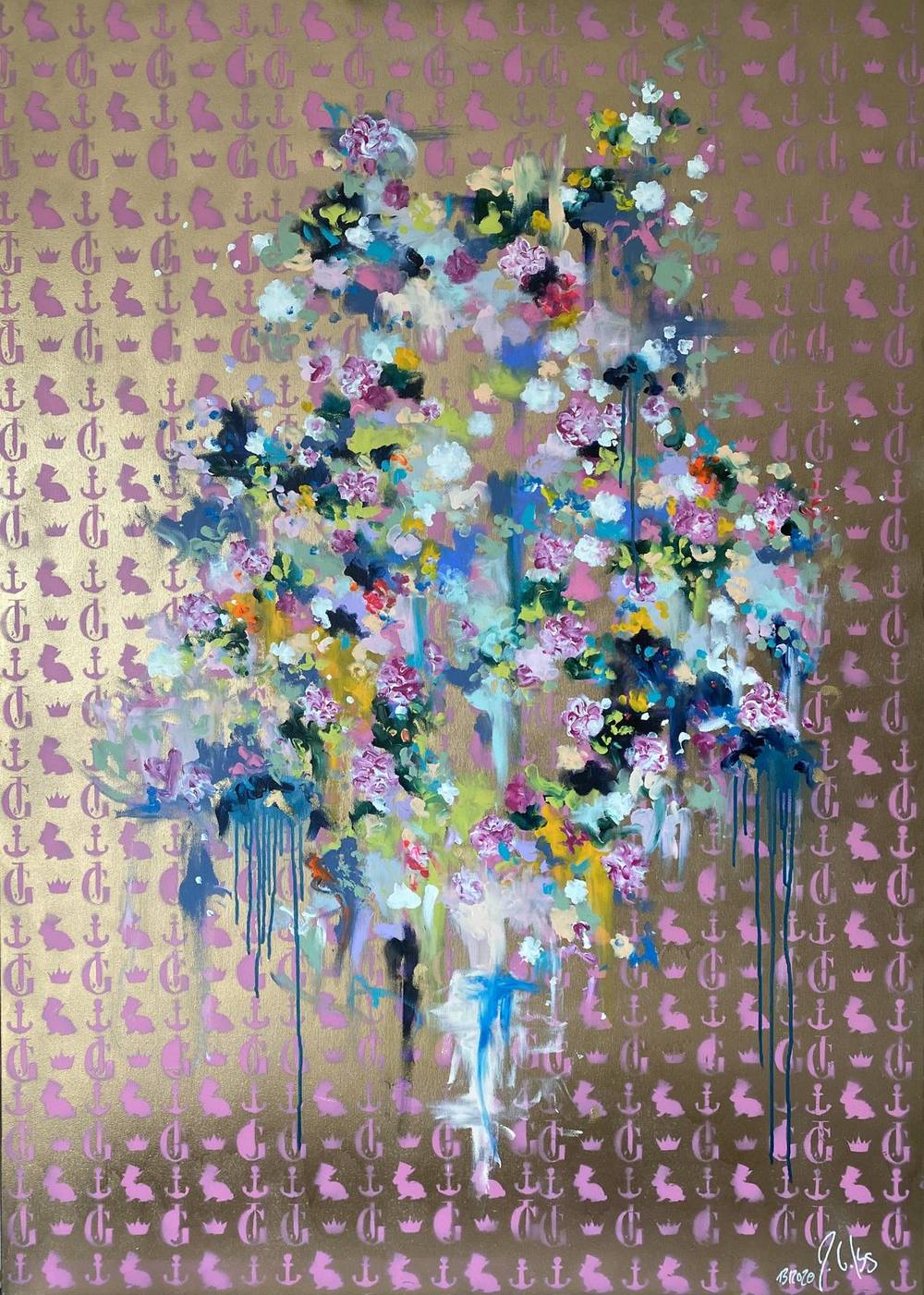
As early as 2020 Juliane Golbs tried out this grid in the Monogram series. In the title image of this article, 13 | 2020, anchors, hares, crowns and monograms are sprayed in lilac onto a gold ground, in a portrait format of 100 × 140 centimetres. In front of it a bouquet bursts open in pink, white, turquoise, mustard yellow and midnight blue, its paint running in long trails over the pattern.
Stencilled anchors in the Signature Collection
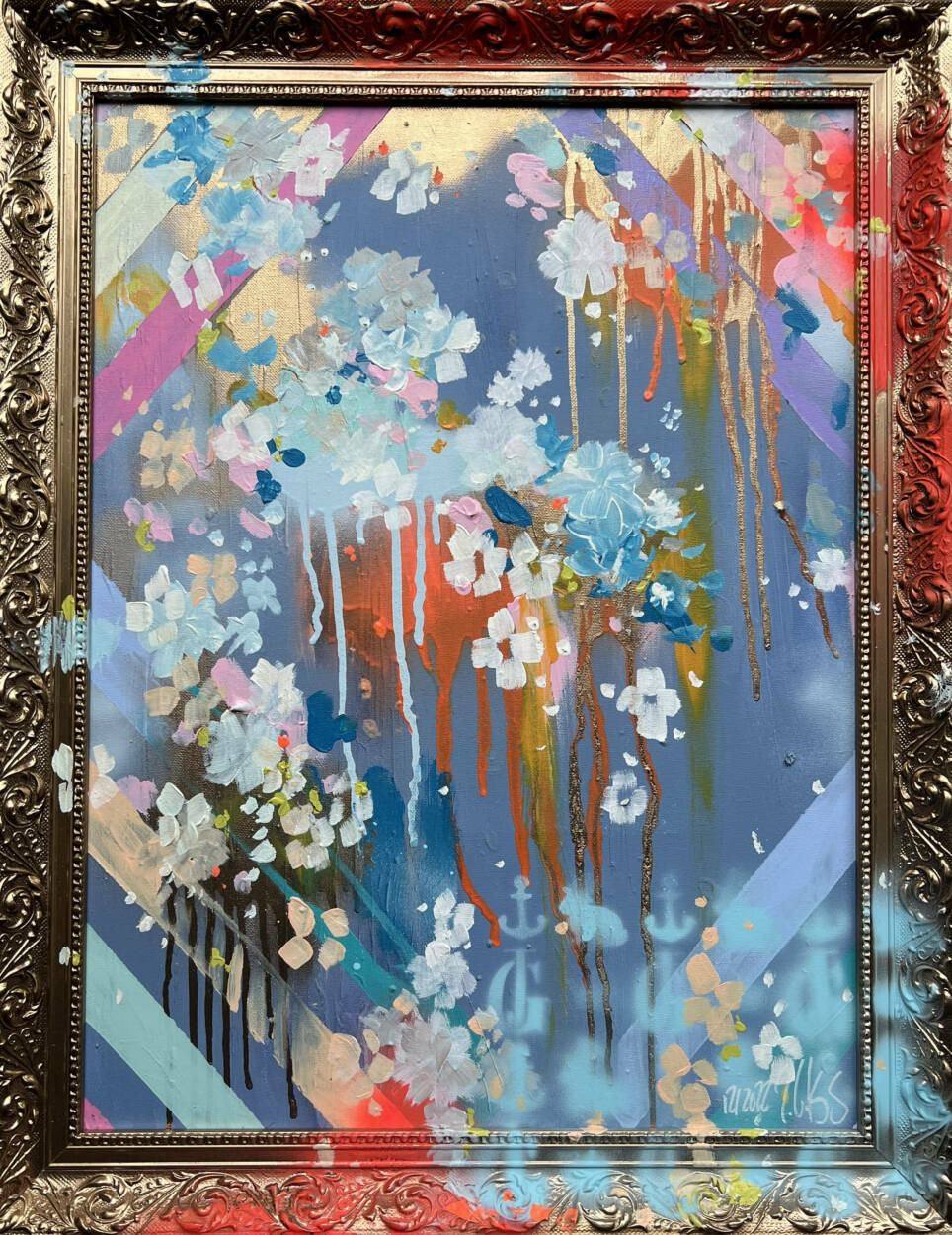
The anchors do not always stand in neat rows. In 12 | 2022 from the Signature Collection they surface in the lower third, stencilled in pale blue on a dove-blue ground with the JG monogram beneath them. Clouds of blossoms in white and pastel blue, diagonal stripes in lilac and drips of orange, gold and brown lie over them, so that the signs only reveal themselves at a second glance. The picture is painted in acrylic, acrylic lacquers and gold lacquer on canvas over a frame: the paint spills onto a heavy gilded frame sprayed in red and blue. At 53 × 69 centimetres it is a compact cabinet piece. The related work 11 | 2022, with anchor and monogram along its lower edge, is no longer available.
The anchor becomes loud and cheerful in the fruit still life 22 | 2022 from the Monogram series, 200 × 200 centimetres. Between pineapple, grapes and apples, sprayed anchors, crowns and monograms repeat like a textile pattern on orange and coral red, while the word “MAD” stands in a red circle at the centre. The work is no longer available. In the blossom paintings of the Fifth Season series the sign grows quiet. In 501 | 2024 anchors shimmer in gold lacquer in the left half of the picture between magenta, rosé and turquoise, while in 516 | 2024 they are dabbed in midnight blue and grey among the blossoms on a honey-gold ground.

How initials become a coat of arms, from Charlemagne to the Signature Collection, is described in the article on monogram art. All works with anchors can be found in the catalogue of works. If you would like a work with your own signs or initials, the studio can be reached via the contact page.
Works from this article
Frequently asked questions
What does the anchor mean as a Christian symbol?
It stands for hope. The Epistle to the Hebrews calls hope “an anchor of the soul, both sure and stedfast”. In the Roman catacombs the anchor appears above all in the second and third centuries on epitaphs, often alongside wishes of peace such as “in pace”.
What do the cross, heart and anchor stand for?
For the three virtues of the First Epistle to the Corinthians: the cross for faith, the anchor for hope, the heart for charity. Pendants and brooches with the motif survive from the 19th and 20th centuries, for instance in the Science Museum Group collection and at the National Maritime Museum in Greenwich.
Why did sailors have anchors tattooed?
The anchor was a standard design among tattooists who worked for sailors. According to a traditional reading cited by Royal Museums Greenwich, it showed that the wearer had sailed the Atlantic. It was popular beyond the sea, too: the Museum für Hamburgische Geschichte notes that even Empress Elisabeth of Austria wore a tattooed anchor.
What does the anchor mean in the work of Juliane Golbs?
Together with the JG monogram, the crown and the hare it belongs to her personal repertoire of signs, and in the studio’s texts it stands for Hanseatic steadfastness. It is seen most clearly in 508 | 2024 from the Signature Collection.
Sources
12 sources
- Bibleserver: Hebrews 6 (King James Version / Lutherbibel 2017)
- Bibleserver: 1 Corinthians 13 (King James Version)
- Catholic Encyclopedia (1907) via New Advent: Anchor
- Judaism and Rome (Heurist): Epitaph of Licinia Amias
- Clement of Alexandria, The Instructor III.11 (New Advent)
- Museum of Witchcraft and Magic: Charm, Anchor, cross, heart
- Science Museum Group: Pendant amulet in form of flat metal heart, France 1851–1920
- Royal Museums Greenwich: Brooch, Faith, Hope and Charity (JEW0314)
- The National Gallery, London: Follower of Simon Marmion, Saint Clement and a Donor
- Royal Museums Greenwich: Seal of the British Admiralty (SEC0657)
- National Park Service, San Francisco Maritime: Sea stories on the skin (2019)
- Museum für Hamburgische Geschichte: Tattoolegenden