Blankenese lighthouse: the front and rear lights on the Elbe and the lighthouse in painting
Two towers in Blankenese draw a line across the water. On the front and rear lights of 1984, the new towers of 2020 and the lighthouse as a motif in painting.
Stand on the Strandweg in Blankenese and you will see a slender tower in the water just off the pier. Upstream, on the Mühlenberg bank, rises a second one, almost twice as tall. The Blankenese lighthouse is in fact a pair: a front light and a rear light which together lay a line across the water. This article tells the story of both towers, from the Kanonenberg in Baurs Park to the new structures of 2020. It also asks what painters since Turner have seen in the lighthouse.
Two towers, one line
A range consists of two lights standing one behind the other. The front one is lower, the rear one taller. Seen from the river, when both lights stand exactly one above the other, you are on the intended line. If the upper light drifts to the left or right, you have left it. An invisible straight line becomes two visible points.
In Blankenese, according to Deutsche Leuchtfeuer, this line runs at 98.3 degrees. Both lights shine in unison with a four second rhythm, half light, half dark. Sitting on the bank in the evening, you can follow this quiet rhythm across the water.
The Blankenese lighthouse of 1984
The first generation of today’s range went into service on 29 November 1984. Deutsche Leuchtfeuer and Baken-Net both give this date; Baken-Net cites a notice from the Oberhafenamt dated 8 December 1984. Both towers were of reinforced concrete with red and white bands.
The old front light stood on the Elbe bank on an eleven metre deep caisson and was 42 metres tall. Its foundation carried a viewing platform that visitors reached across a stone causeway. The old rear light stood 1,350 metres away in Baurs Park on the Kanonenberg. The tower itself measured only 40 metres, yet its light sat 84 metres above the water, because the hill supplied the missing height. On top was a red lantern house six metres high. According to Deutsche Leuchtfeuer, a special lens concentrated the light of 30 watt bulbs.
Baurs Park and the Kanonenberg
A lighthouse standing in a landscape park is a peculiarity of Blankenese. Baurs Park goes back to the Altona merchant Georg Friedrich Baur; the article on the Elbchaussee tells more about the house and the park. The name of the hill is explained in the August 2020 issue of the Heimatbote, the journal of the Nienstedten civic society: from the Kanonenberg, the family once greeted its own passing ships with gun salutes.
From 1984 to 2020 the rear light stood on the same hill. A place of salute became a place of light. Here the lighthouse belonged not to a coast but to a garden above the river.
2020: two new towers
With the deepening and widening of the Elbe fairway, the river off Blankenese became broader. Deutsche Leuchtfeuer gives a widening from 225 to 385 metres. According to the Hamburg Port Authority the course line shifted south as a result, and the light in the river had to move 125 metres in that direction. The old line no longer fitted. Two new towers were built.
Foundation work for the new front light began in September 2019. Because the lanes of Blankenese are narrow, most of the material arrived by boat. The new rear light, the Heimatbote reports, was assembled on site from tubular sections, and a crane with a capacity of 500 tonnes lifted the head section onto the tower. The new lights went into service on 26 October 2020. Baken-Net records that the old lights went out that day at about 10.30.
The new rear light at the Mühlenberg yacht harbour
The new rear light stands 1,100 metres east of the front light, beside the Elbe riverside path at the Mühlenberg yacht harbour. The Hamburg Port Authority gives its height as 62.25 metres and calls it the fourth tallest lighthouse in Germany. Its light sits about 65 metres above the water. Four red lights at the top mark it for air traffic.
The new front light by the pier
The new front light is a steel tower of just over 32 metres. It stands in the water east of the Blankenese pier, roughly level with the Strandweg steps. A 22 metre bridge leads from the bank to a viewing platform at the tower, which according to Deutsche Leuchtfeuer draws many visitors, especially in summer. At one point a wedding room was even planned inside the tower. The idea was dropped because of the cost of building and maintaining it.
Farewell to the old towers
Dismantling of the old towers began in November 2020. The front light was not blown up but taken apart piece by piece. According to a report by the tool manufacturer LISSMAC, the tower weighed about 231 tonnes, its shaft was three metres in diameter with walls of 20 centimetres. A diamond wire saw cut it into four sections, the longest 13 metres. A floating crane lifted the segments away.
The foundation remains. The platform at the old site is still accessible, and a small navigation mark now stands on it. The lantern was taken by pontoon to a depot on the Köhlbranddeich to be restored as an exhibit. Work on the old rear light in Baurs Park also began in November 2020. Baken-Net documents it with photographs from January 2021.
The lighthouse as a motif in painting
Lighthouses are buildings of function. In painting they become something else: a figure standing alone, a vertical against sky and water. Three examples show how differently artists have read the motif.
Turner and the Bell Rock
In 1819 the Scottish engineer Robert Stevenson commissioned J. M. W. Turner to design a frontispiece for his account of the Bell Rock Lighthouse. The watercolour, with gouache and scratched out highlights, measures 30.6 × 45.5 centimetres and now belongs to the National Galleries of Scotland. John Horsburgh engraved the design, and it was published in the book in 1824. Turner probably never visited the lighthouse. He worked from drawings and still found an image for the single tower in the open sea.
Mondrian at Westkapelle
From 1908 Piet Mondrian repeatedly stayed at the seaside resort of Domburg on Walcheren in Zeeland. The Kunstsammlung Nordrhein-Westfalen describes how the light there fascinated him. He painted the dunes, the sea, the church tower of Domburg and the lighthouse at Westkapelle. A sheet of 1909 in ink, crayon and gouache on paper belongs to the Kunstmuseum Den Haag. Its colours already depart clearly from those of the real objects. These were the years in which Mondrian began to move away from depicting nature towards abstraction. The tower becomes a coloured vertical, long before the line alone carries the picture.
Hopper in Maine
According to the Metropolitan Museum, Edward Hopper spent his summers in Maine from 1914. In 1929 he painted The Lighthouse at Two Lights on a rocky headland at Cape Elizabeth, oil on canvas, 74.3 × 109.2 centimetres. He shows the tower from below and sets its silhouette against a wide blue sky. Bright sunlight falls on the building, with deep shadows beside it. In Hopper’s picture the lighthouse stands firm against change and nature.
Light over the river in the work of Juliane Golbs
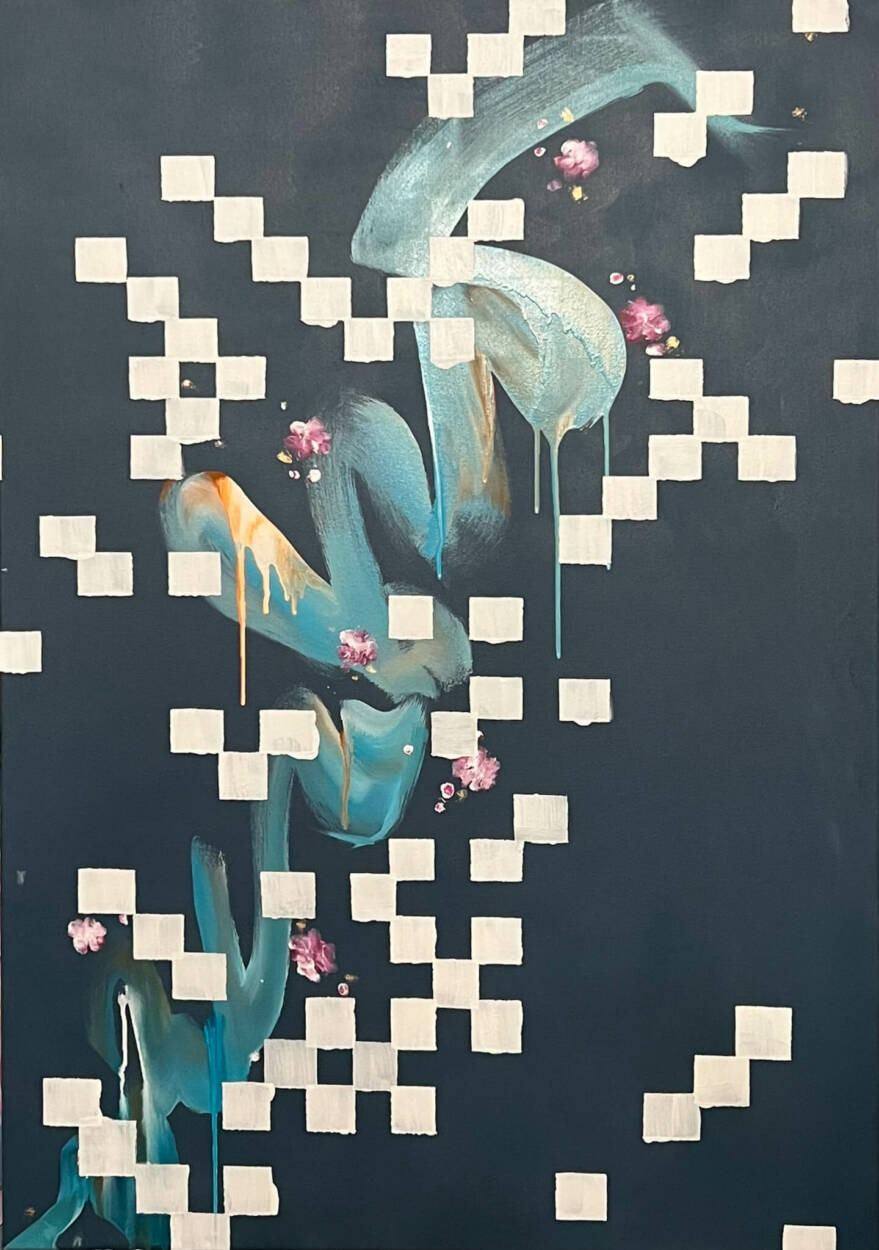
A lighthouse does not yet appear in Juliane Golbs’s catalogue of works. What gives the motif its force in painting, light in darkness and order above moving water, can nonetheless be found in several works. In 28 | 2022 from the Signature Collection, a grid of pale cream squares stands on deep night blue. Through the middle run broad bands of ice blue and petrol that recall water and run down the canvas. Coming from Mondrian’s path from the lighthouse to the line, you read this meeting of grid and gesture with different eyes. The work measures 60 × 80 centimetres and is available.
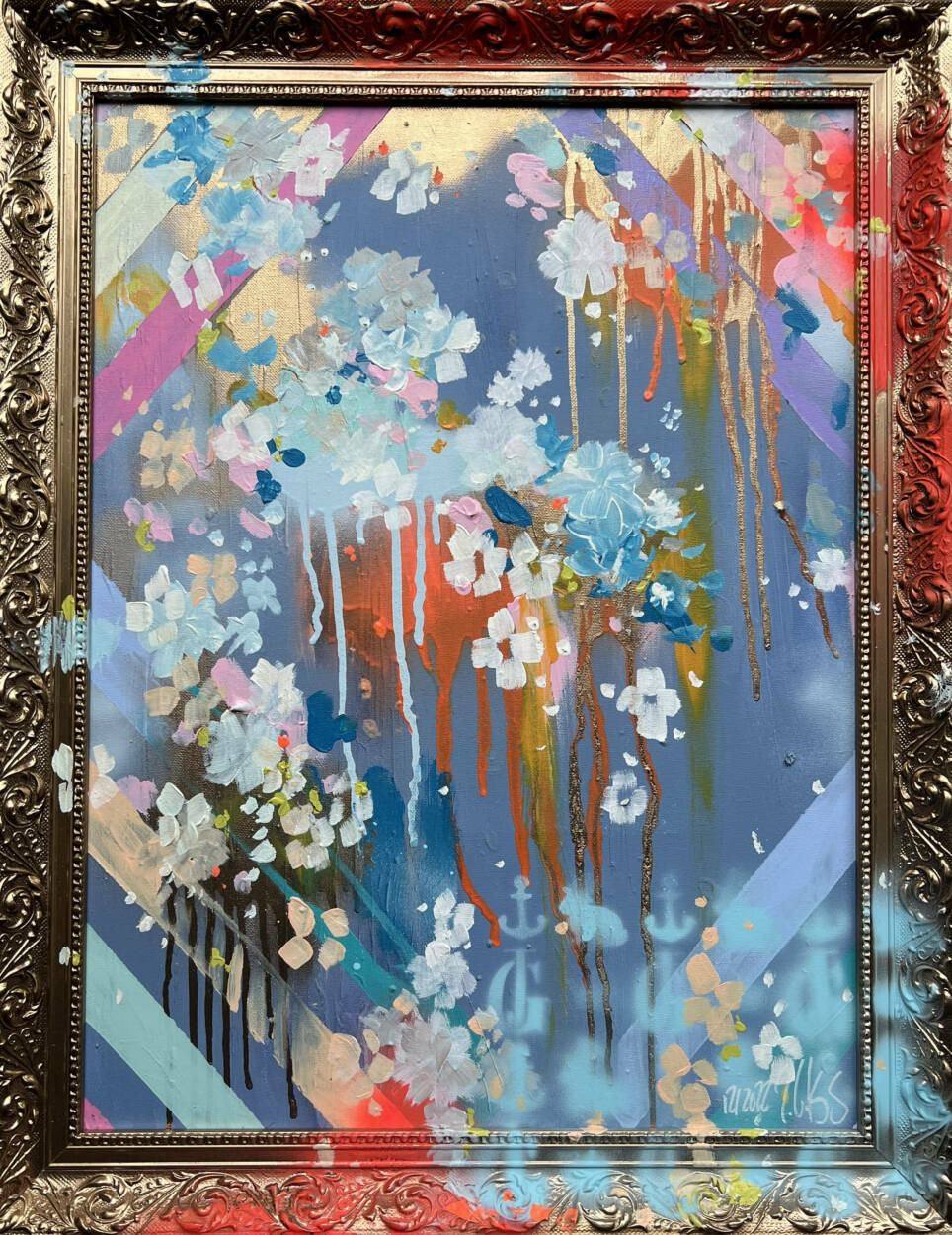
Water itself is the subject of 508 | 2024. Above a moving sea in cobalt blue, petrol and turquoise lies a grid of golden signs: monogram, crown, hare and anchor. The round painting is 80 centimetres in diameter. In 12 | 2022, stencilled anchors appear between clouds of blossom in white and pastel blue, and the paint spills over onto a heavy, over-sprayed gilt frame. What the anchor means in this visual language is described in the article on the anchor symbol.

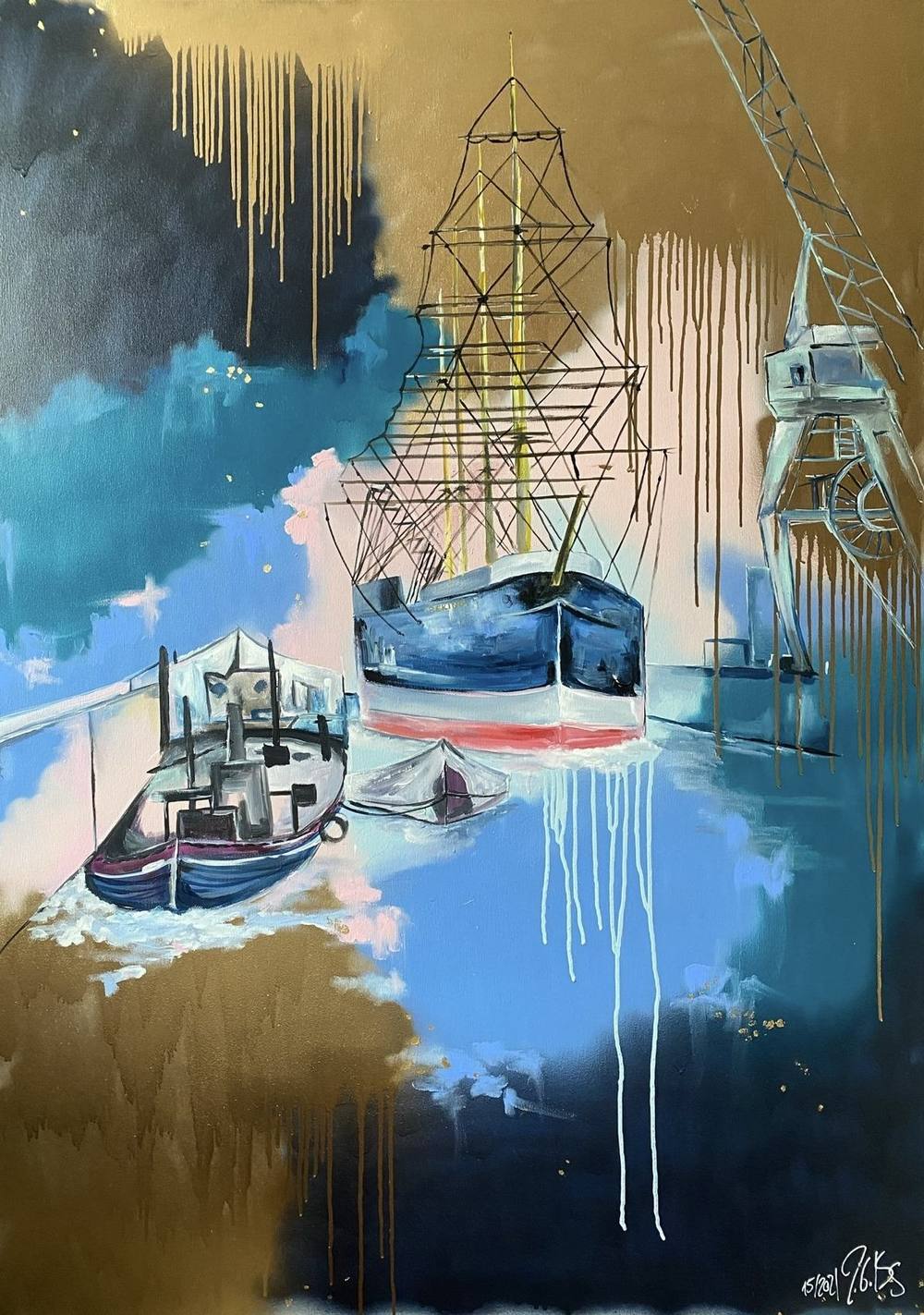
Closest to the Elbe is 15 | 2021 from Golden Things, a harbour in golden light with a tall ship, a rowing boat and a crane in fine lines. How this picture stands in the history of harbour painting is told in the article Harbour in painting. Since September 2025 Juliane Golbs has been artist in residence at the Louis C. Jacob on the Elbchaussee, upstream from Blankenese. There she also sketches the ships passing on the Elbe.
A walk to the two lights
To see both towers in one afternoon, start at the Blankenese pier. From there the bridge leads out to the platform at the front light, with a view across the river to the far bank. Upstream, the Elbe riverside path takes you to the Mühlenberg yacht harbour, where the rear light rises. On the way, Baurs Park lies on the slope with the Kanonenberg, where the old tower stood until 2020.
The walk is loveliest at dusk, when both lights begin to shine in the same rhythm. In winter the illuminated Pfahlewer boats hang in the trees of the village centre. What lies behind this emblem is told in the article on the Pfahlewer of Blankenese. If you are looking for a work for a room overlooking the water, you can filter the catalogue of works by colour or arrange a studio visit through the contact page.
Works from this article
Frequently asked questions
How tall is the Blankenese lighthouse?
Blankenese has two lighthouses. According to the Hamburg Port Authority, the rear light at the Mühlenberg yacht harbour is 62.25 metres tall, with its light about 65 metres above the water. The front light east of the Blankenese pier is just over 32 metres tall.
Since when have the present lighthouses stood in Blankenese?
The new towers have been in service since 26 October 2020. They replaced a range that went into service on 29 November 1984. The old towers were dismantled from November 2020.
What are front and rear range lights?
Together the two towers form a range. The lower front light stands by the water, the taller rear light behind it. When you see both lights exactly one above the other, you are on the defined line in the river.
Can you visit the Blankenese lighthouse?
A 22 metre bridge leads from the Elbe bank to a viewing platform at the new front light. The platform on the foundation of the old front light is also still accessible. The rear light can be seen from the Elbe riverside path at the Mühlenberg yacht harbour.
Are there works by Juliane Golbs showing a lighthouse?
The catalogue of works does not yet include a lighthouse. Water, night blue and light over the river run through several works, however, such as 28 | 2022, 508 | 2024 or the harbour painting 15 | 2021.
Sources
8 sources
- Hamburg Port Authority: New lighthouses for Blankenese
- Deutsche Leuchtfeuer: Richtfeuer Blankenese
- Baken-Net: Richtfeuer Hamburg Blankenese
- Der Heimatbote, Bürger- und Heimatverein Nienstedten, issue 8/2020 (Hamburg State and University Library)
- LISSMAC: Diamond tool cuts lighthouse into crane-ready segments (22.04.2021)
- National Galleries of Scotland: J. M. W. Turner, Bell Rock Lighthouse, 1819
- Kunstsammlung Nordrhein-Westfalen: Mondrian. Evolution, chapter on Zeeland
- The Metropolitan Museum of Art: Edward Hopper, The Lighthouse at Two Lights, 1929