Pfahlewer Blankenese: from fishing boat to a landmark of light
For centuries the fishermen of Blankenese sailed the Elbe and the North Sea in the Pfahlewer. Today its silhouette lights up the village’s trees every winter. On a ship, a symbol and a planned special edition.
Walk through Blankenese in November and you will see a ship that stopped fishing long ago. It hangs as a chain of lights in the trees along the main streets, glows from doorways and windows, and turns up on flags, jewellery and biscuit cutters. The Pfahlewer is the historic emblem of Blankenese, the old fishing village on Hamburg’s western edge. For centuries it was the working boat of the Blankenese fishermen, who sailed it out onto the Lower Elbe and far into the North Sea. This article explains how the Pfahlewer was built, how a fishing boat became a symbol, and why the Hamburg painter Juliane Golbs is naming a special edition after it.
What an Ewer is
Ewer is the name for the flat-bottomed sailing vessels that were at home on the Lower Elbe. The Arbeitskreis historischer Schiffbau, a German society for historic shipbuilding, describes them briefly as flat-bottomed craft with leeboards. Instead of a deep keel they have a flat floor, and the leeboards hang on either side of the hull.
Descended from a punt
The municipality of Oederquart, which today runs a replica, traces the ancestors of the Ewer back to Dutch settlers who came to the Elbe marshes at the end of the eleventh century. The Ewer probably developed from a boat built of three planks. That early form survived in the flat bottom and in the characteristic bottom plank, while the vessel above it grew ever larger. In various types, Ewer remained in use as fishing and cargo boats into the twentieth century.
A difficult river
The Lower Elbe demanded such a vessel. At the surface the fresh water of the river flows towards the North Sea, while beneath it the flood tide pushes salt water upstream. On the northern side the ebb can still be running when the flood has already begun on the southern side. Add storms and high water, and the channel can shift quickly. A shallow, nimble boat had the advantage here.
The Blankenese Ewer: a fishing boat with a pole mast
The Pfahlewer takes its name from its mast. The single-piece mast, as the Arbeitskreis historischer Schiffbau explains, is also called a Pfahlmast, a pole mast. Thanks to its sharp hull and its narrow, tall square sail, the Pfahlewer sailed very well and could hold a course close to the wind. For that reason it also served as a pilot boat on the Elbe.
For a Blankenese Pfahlewer of around 1800, the society gives an overall length of 13.6 metres and a beam of 4.1 metres. Its model is based on a construction plan published by the museum in Hamburg-Altona.
The Bünn: fish that arrive alive
According to the local paper Klönschnack, the most important feature on board was a Blankenese invention. Since there were no chilled holds, the Pfahlewer had a Bünn, a section of the hull connected to the water outside by holes in the planking. The catch stayed alive in it until it reached the market, and fresh fish earned the fishermen more.
Drift nets instead of the trawl
The fishing method also set the Blankenese men apart from their rivals. The Oederquart website quotes a report written in 1787 by Schrader, an advocate from Pinneberg. The Dutch, he wrote, fished with a trawl net, the Kurre, in which the fish were often injured. The Blankenese fishermen set drift nets that floated just above the seabed and left the fish undamaged. These nets cost more than ten times as much, but the reliability and quality of the catch made up for it. They caught flounder, plaice and sole at sea and smelt in the Elbe, selling in Hamburg and Altona and later on the Dutch coast. Many Ewer were built on Finkenwerder, whose boatbuilders had a reputation for reliability.
Blankenese: fishermen, pilots and captains
For a long time Blankenese was a poor village on a hillside. The Stiftung Historische Museen Hamburg, the foundation that runs the city’s history museums, dates its first documentary mention to 31 December 1301, in connection with the Elbe ferry. In 1535 the people of Blankenese were officially described as fishermen for the first time. From 1640, when the County of Pinneberg passed to Denmark, the fishery flourished and the village became one of the most profitable fishing communities in the county. In August 2026 Blankenese marked its 725th anniversary with a three-day festival.
According to the Hamburger Abendblatt, up to 140 Pfahlewer sailed from Blankenese under the Danish flag between 1640 and 1866. Towards the end of the eighteenth century the fishermen increasingly worked as pilots on the side. From 1795 they also used their Ewer to carry cargo, calling at Dutch and English ports. The fisherman was becoming a merchant skipper.
The Continental Blockade and the fruit schooners
High politics hit the village hard. With the Continental Blockade, trade with England was cut off from 1806, and until 1814/15 the Blankenese skippers were largely confined to trade with Denmark, with occasional smuggling. As Danish subjects they were harried by the English, and according to the Oederquart account they had to abandon fishing grounds. Fishermen from Finkenwerder gradually bought Blankenese Ewer and fished on where the Blankenese men had been forced to stop.
Seafaring continued. From 1830 Blankenese skippers sailed as Fruchtjager, fast fruit schooners carrying citrus from Sicily, Venice and Naples to Rotterdam, Hamburg, Bremen and St Petersburg. From 1849 they called at ever more distant ports, Latin America above all. On the Falkensteiner Ufer, Jochim Finck’s shipyard built vessels from around 1840 into the 1870s. By about 1920, according to the Oederquart account, Blankenese had no cargo ships left and its fishery was down to seven boats.
What remained were the people and their houses. Many captains and pilots spent their retirement in Blankenese, as hamburg.de notes. Intact fishermen’s cottages still stand at Am Hang 1 and at Bremers Weg 1 and 5a, all built around 1850, while the house at Op’n Kamp 9 dates back to 1786.
From working boat to emblem: the Pfahlewer Blankenese today
With the arrival of steam, traditional fishing came to a fairly swift end. The motif lived on. Klönschnack calls the Pfahlewer the historic emblem of Blankenese. It appears on flags, artworks, jewellery and souvenirs, and during Advent there are biscuits baked in its shape. The biscuit cutters and the lighting were introduced by the Blankenese Interessen-Gemeinschaft, a local association based on Blankeneser Bahnhofstraße.
The Ewer no longer sails the Elbe, as Klönschnack puts it. Anyone who wants to see a Pfahlewer under way needs a replica. The Oderik von Oederquart is, in the words of the Hamburger Abendblatt, a faithful reconstruction of a Pfahlewer, and the municipality of Oederquart in Nordkehdingen is responsible for it. She was launched in the harbour of Freiburg on the Elbe, exactly 130 years, the municipality says, after the last Pfahlewer went down the slipway. Her mast is 12.5 metres long. In June 2019, after the harbour festival in Wedel, the Oderik moored for a few hours at the Bulln jetty in Blankenese, a visit the Abendblatt described as a tradition of several years’ standing. The paper called the ship the floating calling card of the village.
So the Pfahlewer in Blankenese is not a fixed monument, a single vessel in a single place. It is a sign the village has given itself, and that is precisely why it is everywhere.
Blankenese at Christmas: when the Pfahlewer light up
Blankenese at Christmas is recognisable by its glowing ships. Since 2022 the Blankenese Interessen-Gemeinschaft has used its Pfahlewer light chains as winter lighting. They are installed at the beginning of November and not taken down until the end of January. The gate bearing the Christmas greeting in the centre, by contrast, is still only switched on after Totensonntag.
Where the lights hang
According to the association, the chains run from Richard-Dehmel-Straße to the junction with Schenefelder Landstraße and from the Strandweg by the river up to the station forecourt. There is also the Christmas gate on Probst-Paulsen-Straße. hamburg.de speaks of almost 300 illuminated Pfahlewer in the village centre and on nearly every road into Blankenese. Storage, repairs and installation cost just under 30,000 euros a year, met from membership fees and sponsorship.
From lamp post to tree
The present arrangement goes back to a decision taken in 2021. Until then, as Dorfstadt reported, the Christmas lighting had two elements: single Pfahlewer mounted on lamp posts and Pfahlewer chains in the trees. The lamp-post pieces had been put up and taken down by the volunteer fire brigade of Blankenese. They could only shine together with the street lamps, and having the circuits switched through the authorities was expensive. The association therefore gave them up in favour of chains in the trees. It offered the large used lamp-post Pfahlewer for sale in a strictly limited run, along with a small Pfahlewer for indoors.
In this way a fishing boat has become a light you can take into your own home. A vessel that once carried fish to market now stands in the window.
Christmas in Blankenese 2026: the market and the Advent calendar
This year the lights are joined by the market. According to hamburg.de, the Blankenese Winterfest takes place on Erik-Blumenfeld-Platz by the station from 23 November to 23 December 2026, daily from 1 pm to 9 pm. There are bratwurst, fried pastries, roasted almonds and mulled wine, with a mulled-wine hut at its heart. hamburg.de describes it as a small Christmas market away from the bustle of the city centre.
From 1 to 24 December the living Advent calendar opens a different door in Blankenese each day, with music, singing or something for children. Walk down from the market towards the river and the lights lead you to the Strandweg. According to hamburg.de, the Treppenviertel, the famous quarter of steps, stretches from the Strandweg up the slope to the Süllberg, and most of its houses can only be reached on foot via some 5,000 steps.
Art in Blankenese: a village of painters and poets
Art discovered Blankenese early. The journal of the Stiftung Historische Museen Hamburg shows a drawing by Johann Jacob Gensler from 1837, in pencil and watercolour, entitled Blankeneser Fischer. The foundation describes Blankenese as a place where fishing village, artists’ scene and high society form an alliance. The fisherman was a motif long before he became an emblem.
Richard and Ida Dehmel
In 1901 the poet Richard Dehmel and his wife Ida settled just outside Hamburg, first in a flat on Parkstraße in Blankenese. From 1912 they lived in their own house, which, according to the Dehmelhaus Stiftung, they shaped into a total work of art made up of poet’s house, furniture, artworks, archive and garden. It became a meeting place for artists from Germany and abroad. The Dehmels visited Max Liebermann in his studio, and Alfred Lichtwark valued Dehmel’s judgement on art. Richard Dehmel died in 1920. Ida Dehmel was ostracised as a Jew from 1933 and took her own life in 1942. That the house survives is above all thanks to their daughter Vera Tügel and her son Tim Tügel. In winter the Pfahlewer chains reach as far as the street that now bears the poet’s name.
In the Treppenviertel
The quarter of steps was home to the arts as well. hamburg.de names the artists Paul Kayser and Paul Friedrichsen and the writers Charitas Bischoff and Hans Leip among those who lived there. To this day artists, merchants and captains live side by side in the houses on the slope.
Eduard Bargheer
Eduard Bargheer was born in Hamburg in 1901 and grew up on Finkenwerder, the island whose yards once built Ewer for Blankenese. In 1939 he went to Italy, and from 1954 he spent his summers in Forio on Ischia. In the 1970s he withdrew to Blankenese, where he spent his last years until his death in 1979. hamburg.de calls his work Hamburg’s most important contribution to modern painting in the twentieth century. Since 2017 the Bargheer Museum in the Jenischpark has shown his work, with a view across the Elbe to Finkenwerder. His membership of the Hamburg Secession is covered in the article Painters in Hamburg.
From Blankenese to the Elbchaussee
One name links Blankenese with the place where Juliane Golbs works today. When the merchant Peter Godeffroy had the “White House” built in 1790/91 next to his brother’s estate in Dockenhuden, which has been part of Blankenese since 1919, the park was laid out by Daniel L. Jacob, as the Stiftung Historische Museen Hamburg records. A landscape gardener called Daniel Louis Jacob, who had come to the Elbe from France, opened a wine tavern in neighbouring Nienstedten in 1791. It grew into the Hotel Louis C. Jacob on the Elbchaussee.

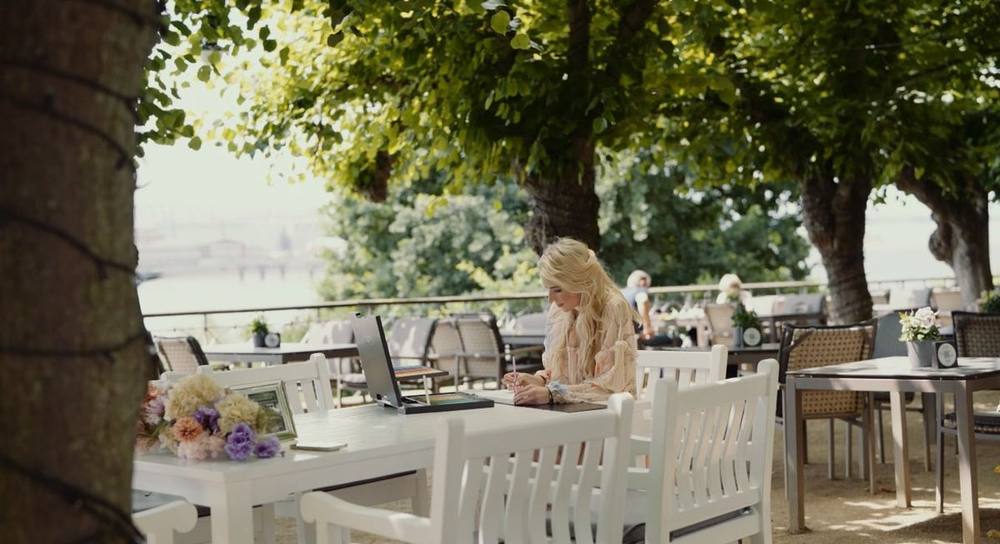
In 1902 Max Liebermann painted the hotel’s Lime Terrace with its view of the Elbe. Since September 2025 Juliane Golbs has been Artist-in-Residence at the Louis C. Jacob. She works in the house regularly, sketching and observing, the ships sailing in and out of Hamburg on the Elbe among them. What the residency involves is described in Artist-in-Residence at the Louis C. Jacob. Juliane Golbs was born in Schwerin and has lived in Hamburg since she was eighteen. More about her work in the city can be found in A female artist in Hamburg.
Ships and water in the work of Juliane Golbs
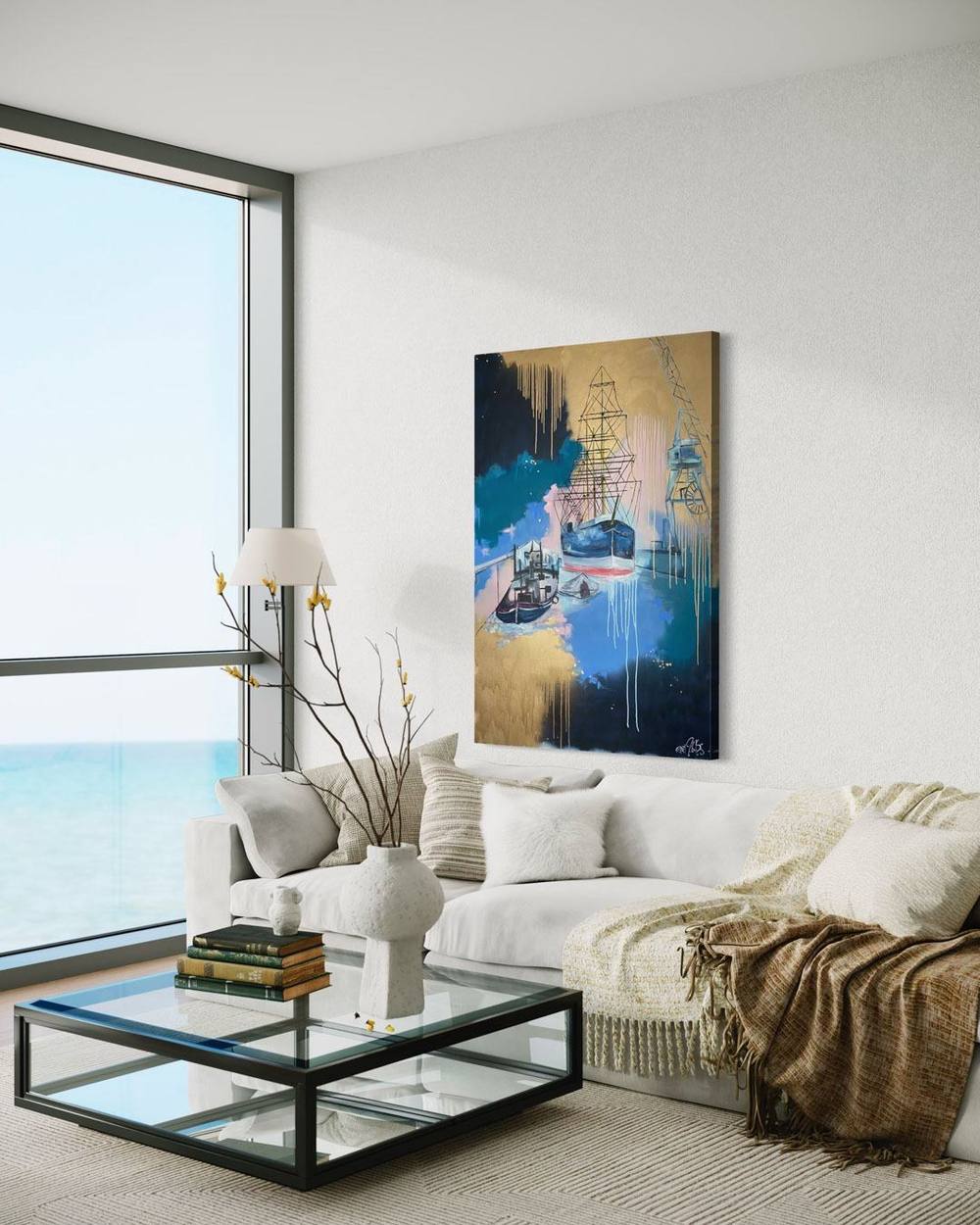
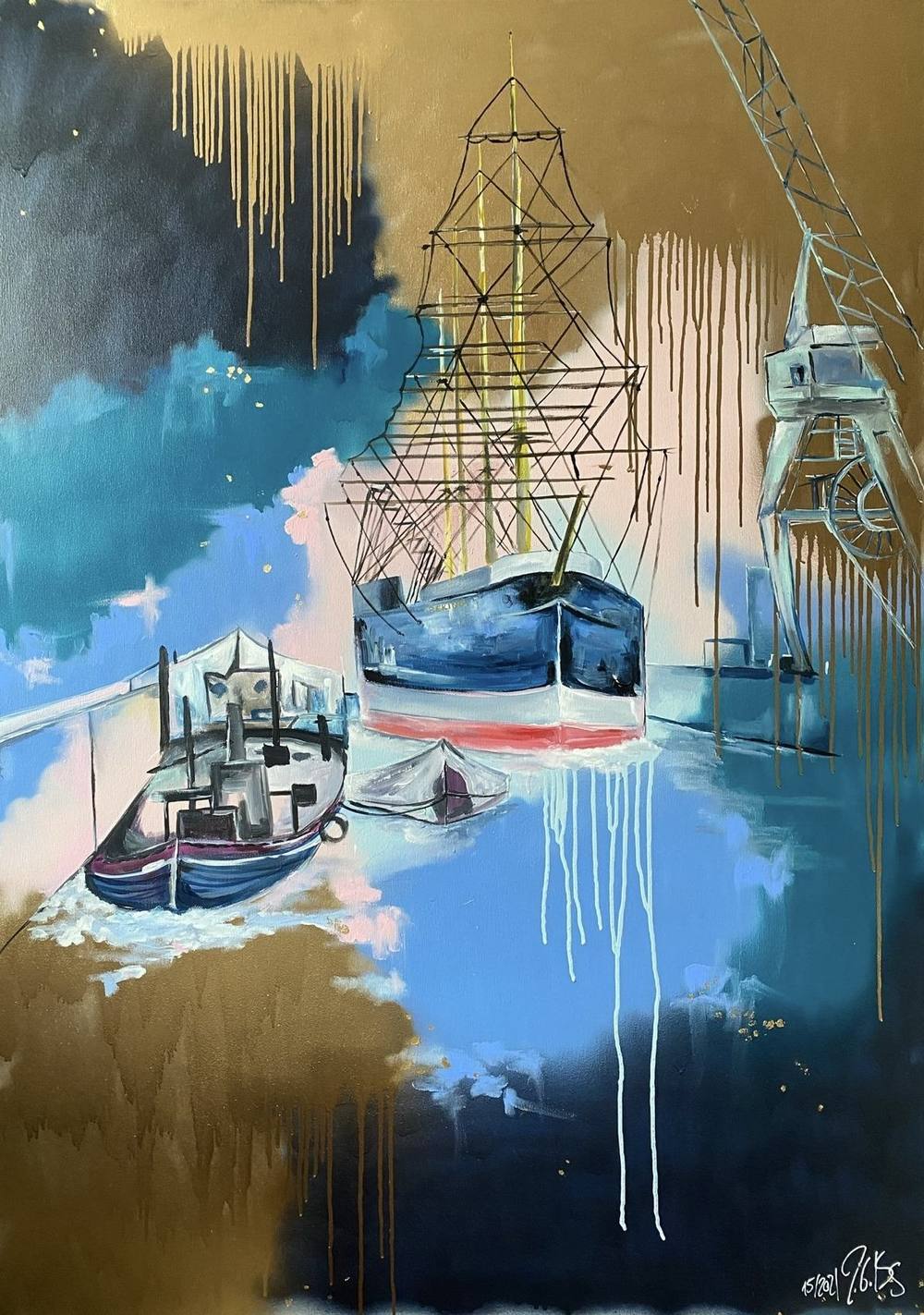
There is as yet no Pfahlewer in Juliane Golbs’s catalogue of works. The water of the Elbe and the ships upon it nonetheless run through several paintings. Most clearly in 15 | 2021 from the Golden Things series: a tall ship with finely drawn rigging lies at the centre, beside it a smaller vessel and a rowing boat, and at the right-hand edge a harbour crane sketched in line. Clouds of turquoise, sky blue and night blue surround the scene, framed by fields of gold. Acrylic and mixed media on canvas, 100 × 140 centimetres, available. Its place in the history of harbour painting is explored in Harbour paintings.

In 508 | 2024 from the Signature Collection the water itself is the subject. Over a moving sea in cobalt, petrol and turquoise lies a grid of golden signs: monogram, crown, hare and anchor. The tondo measures 80 centimetres across and is painted in acrylic, acrylic lacquers and gold lacquer. For a house on the Elbe it is perhaps the most direct answer to the view from the window.
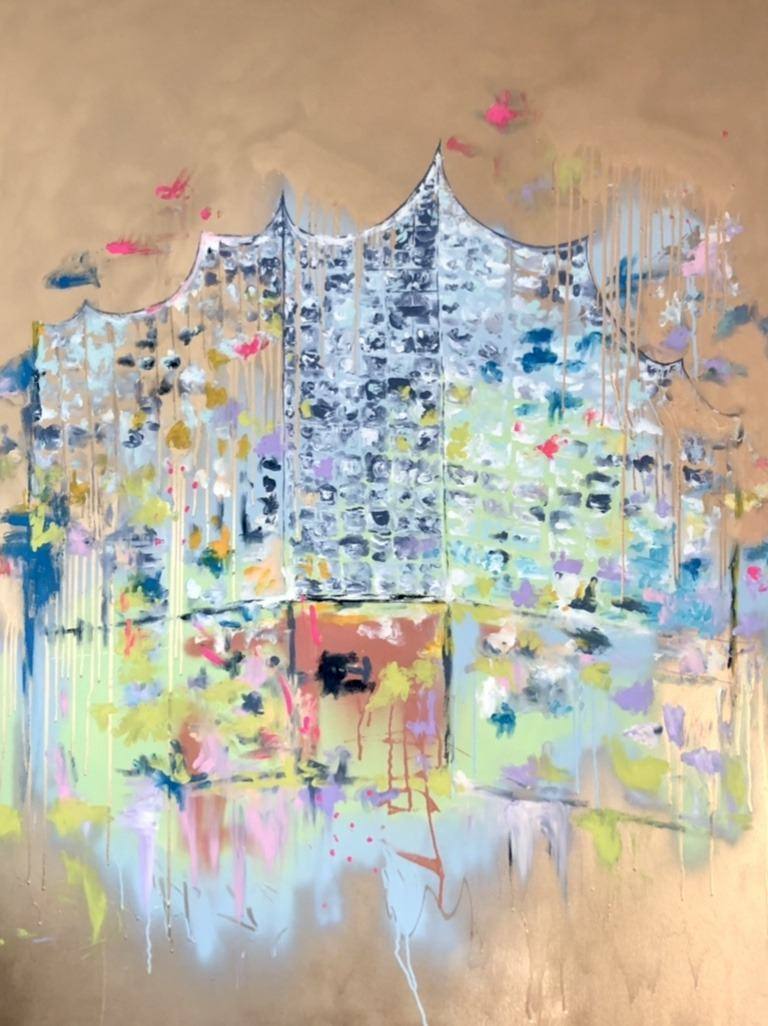
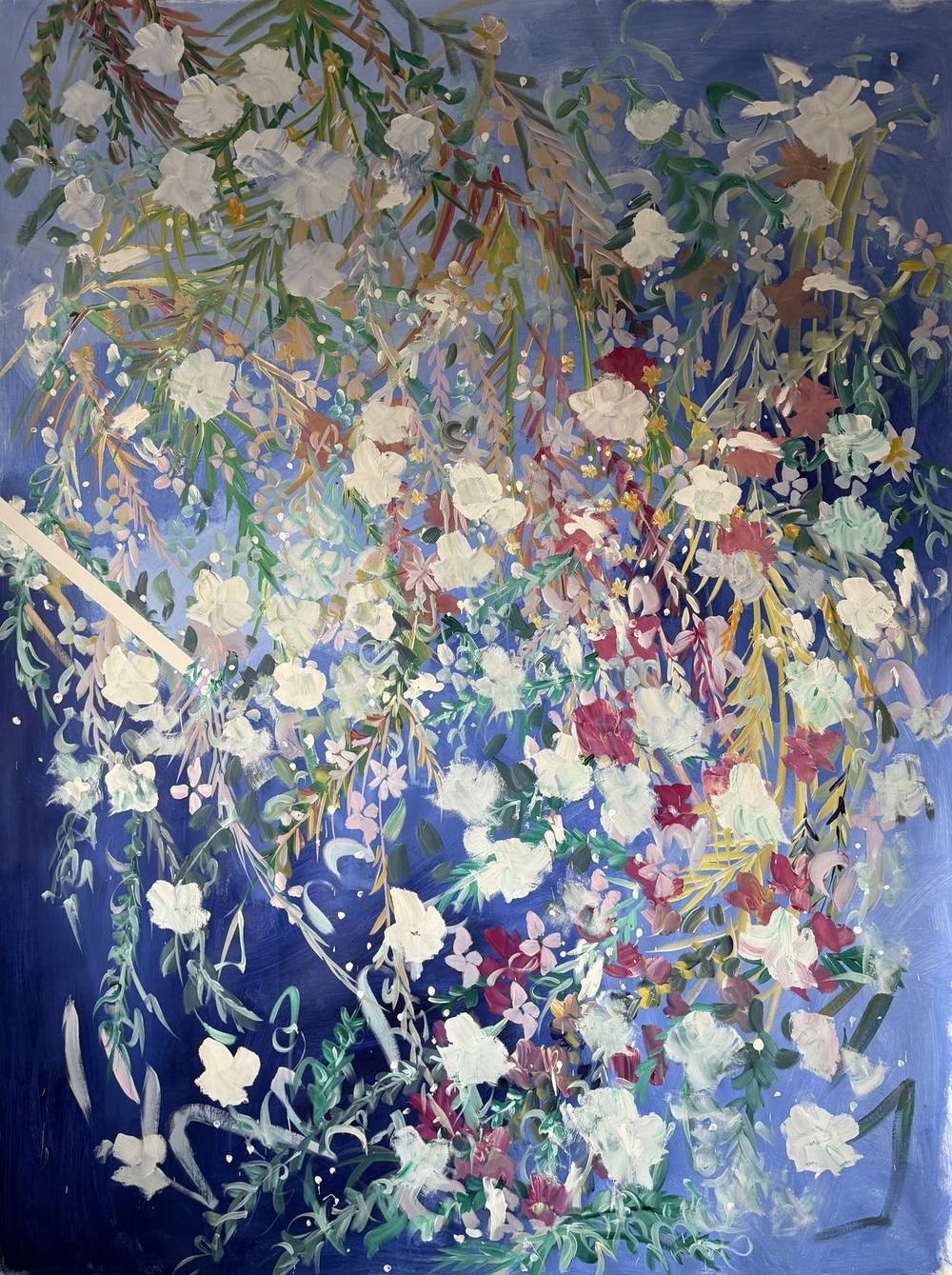
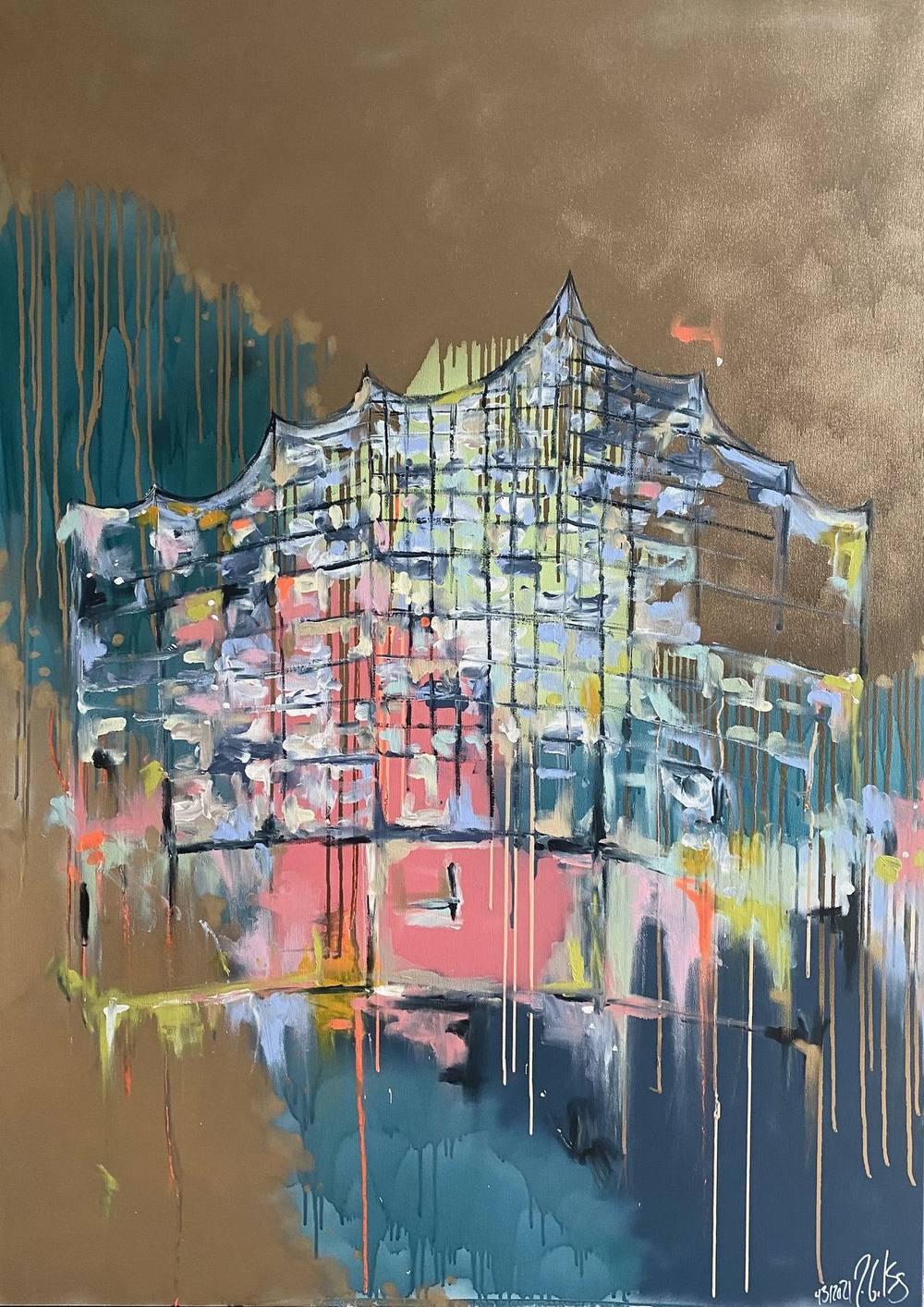
The Elbe as a city river appears in 43 | 2021, an Elbphilharmonie from Golden Things in acrylic and acrylic lacquers, 100 × 140 centimetres. At the bottom the building dissolves into petrol and night blue, with runs of paint trickling down like reflections in the water. A related work, Golden Elbphi of 2019, is in a private collection. Those looking for the wintry blue of the Elbe without architecture will find it in 02 | 2025 from Fifth Season #heaven can wait: a cascade of pale blossoms falling through a deep blue field, 150 × 200 centimetres.
The Pfahlewer special edition: art for a house on the Elbe
Juliane Golbs is planning a limited special edition called “Pfahlewer”. It will draw on three sources: existing works, newly handmade one-off pieces and commissions tailored precisely to the interior of each particular house. That is everything settled about the edition so far. No details on its size, formats or dates have been given yet, and as always the studio quotes prices only on request.
The name suits a place that carries its emblem not in stone but in light and everyday life. In Blankenese the Pfahlewer belongs to the windows, the trees and the houses. An edition conceived for particular homes follows the same logic. Which existing works it will include has not yet been published.
Limited, one-off, commission: what the terms mean for Juliane Golbs
The three building blocks of the special edition are not marketing words. They describe clearly distinct things, and anyone who collects should know the difference.
One-off
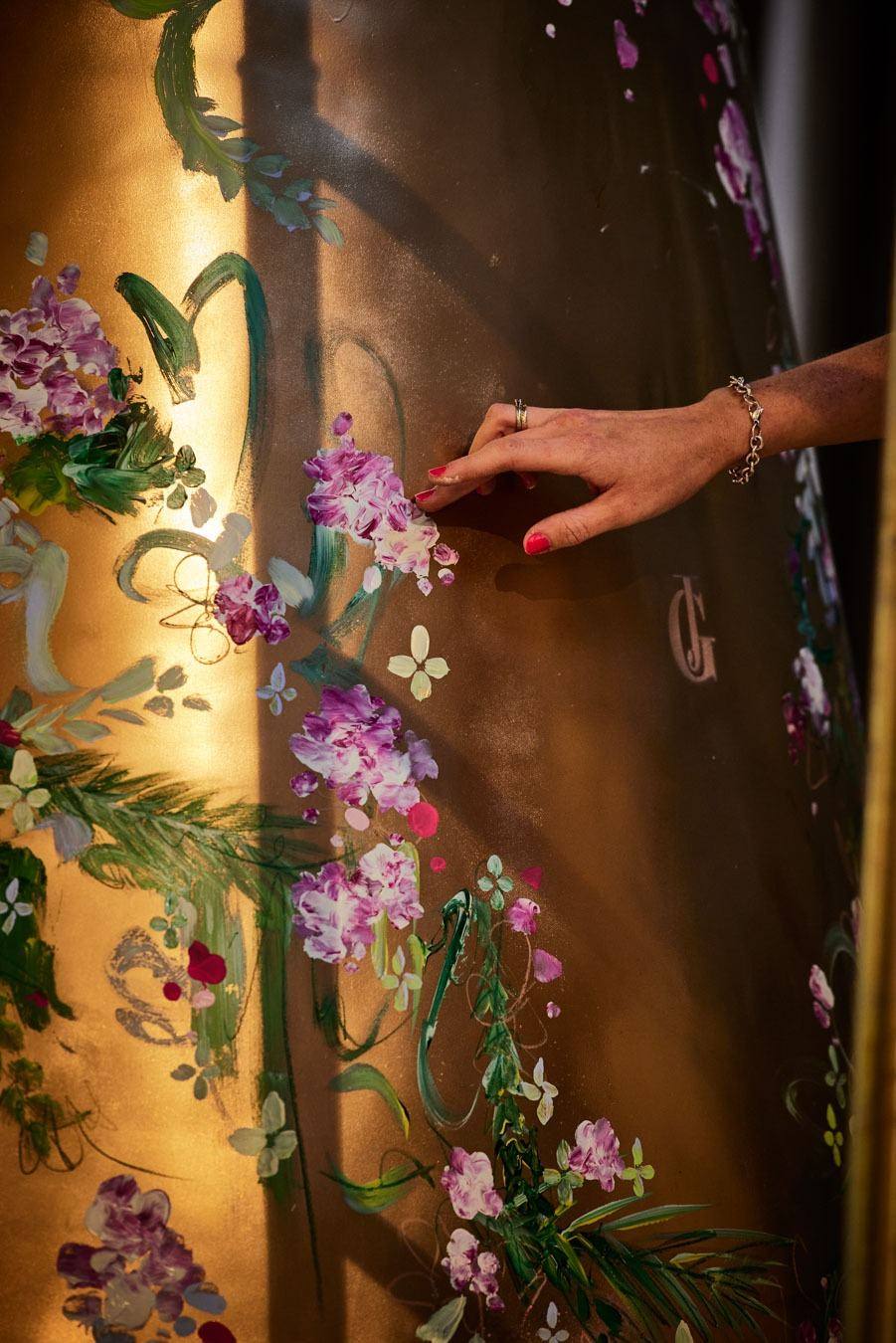
A one-off, or unique work, exists exactly once. Juliane Golbs’s paintings are hand-signed originals; she applies many of their layers with her fingers and often finishes a work with 24-carat gold leaf. The catalogue of works lists every painting with its title, year, technique and dimensions, so the details on a certificate can always be checked.
Limited
A limited edition is a fixed, numbered run, often of prints or objects. One example from her work is the Art Edition with the gin distillery Windspiel in 2021, limited to 999 bottles. For editions, the certificate also states the size of the run and the number of the individual copy. In a special edition made up of one-off pieces and commissions, the limit applies to the edition as a whole, since each work within it exists only once anyway.
Commission
A commission remains a free work in the artist’s own hand. It begins with a room rather than a blank canvas. The first conversation covers the wall’s dimensions, the light and the materials, and what the painting should evoke. Photographs of the room by day and in the evening are helpful. Because layers of paint and gold leaf need time to dry, a work takes shape over weeks. At the end comes the handover of the signed original with a certificate of authenticity, and on request the artist will also oversee the hanging. The whole process is described in Commissioning art.
Enquiries, studio visits and trial hanging
If the special edition interests you, the best way in is the contact form for commissions. A few sentences are enough: where the work is to hang, how large the wall is, which materials shape the room. The studio in Hamburg opens for private appointments by arrangement, including a first conversation in front of existing works.

Before deciding, it helps to look at scale. Every work page in the catalogue of works shows a scale size comparison with a door two metres high, a sideboard and an armchair. For a small fee an original can also be hung on trial, and if you decide to buy, the fee is credited in full. On the Elbe especially, where the water throws the light back, only your own wall shows how gold and blue behave in the morning and in the evening. The art advisor suggests suitable works by colour, format and mood.
For centuries the Pfahlewer fed Blankenese. Today it shines over the village streets through the short days between November and January, a reminder of fishermen, pilots and captains. An edition that bears its name brings this light into individual homes.
Works from this article
Frequently asked questions
What is a Pfahlewer?
An Ewer is a flat-bottomed sailing vessel with leeboards. The Pfahlewer takes its name from its single-piece mast, the Pfahlmast or pole mast. It was the typical boat of the Blankenese fishermen, who fished the Lower Elbe and the North Sea with it and brought their catch to market alive in a wet well known as the Bünn.
Why is the Pfahlewer the symbol of Blankenese?
Because around 1800 Blankenese was one of the most important fishing villages on the Lower Elbe, and the Pfahlewer was the boat that made this fishery possible. The fishing has gone, the motif has stayed: on flags, jewellery and souvenirs, and as an illuminated silhouette in winter.
When are the Pfahlewer lights on in Blankenese?
Since 2022 the Blankenese Interessen-Gemeinschaft has used its Pfahlewer light chains as winter lighting: they go up at the beginning of November and come down at the end of January. The gate with the Christmas greeting in the village centre is only switched on after Totensonntag, the Sunday before Advent.
When is the Blankenese Christmas market in 2026?
According to hamburg.de, the Blankenese Winterfest on Erik-Blumenfeld-Platz by the station runs from 23 November to 23 December 2026, daily from 1 pm to 9 pm.
Is there still a Pfahlewer under sail?
Yes, as a replica. The Oderik von Oederquart is a faithful reconstruction of a Pfahlewer, run under the responsibility of the municipality of Oederquart. The ship has visited Blankenese several times and moored at the Bulln jetty.
What is Juliane Golbs’s Pfahlewer special edition?
A planned limited special edition by the Hamburg painter. It will draw on existing works, newly handmade one-off pieces and commissions tailored to the interior of each particular house. Enquiries go to the studio via the contact form.
Can I see a work in my own room first?
Yes. Every work page shows a scale size comparison with a door, a sideboard and an armchair. For a small fee an original can also be hung on trial; if you buy it, the fee is credited in full.
Sources
12 sources
- Klönschnack: Wie der Pfahlewer zum Wahrzeichen Blankeneses wurde (11 August 2026)
- Hamburger Abendblatt: Der Pfahl-Ewer und seine verrückte Geschichte (18 June 2019)
- Arbeitskreis historischer Schiffbau: Der Blankeneser Pfahlewer (c. 1800)
- Municipality of Oederquart, Oderik von Oederquart: Pfahlewer
- Stiftung Historische Museen Hamburg, Journal: Blankenese. Nizza an der Elbe
- hamburg.de: Stadtteil Blankenese
- Blankenese Interessen-Gemeinschaft: Pfahlewer-Winterbeleuchtung
- Dorfstadt: Langfristige Ausrichtung der Blankeneser Weihnachtsbeleuchtung (23 April 2021)
- hamburg.de: Weihnachtsmarkt Winterfest Blankenese
- Blankenese Interessen-Gemeinschaft: Blankenese feiert 725 Jahre
- Dehmelhaus Stiftung: Richard und Ida Dehmel
- hamburg.de: Bargheer Museum