Cars in art: from Futurism to a roadster in gold
Since 1909 artists have argued over whether a racing car can be more beautiful than an ancient sculpture. A short history of cars in art, from Balla to a roadster in gold.
Cars in art have a precise birthday. On 20 February 1909 the Paris newspaper Le Figaro printed a manifesto on its front page that placed a machine above a sculpture of antiquity. Since then painters, sculptors and Pop artists have kept looking at the motor car afresh: as the embodiment of speed, as a surface to be painted, as an icon of consumer culture. At the end of this line stands a quiet picture in gold that tells of a car which is not moving.
1909: a racing car against the Victory
Filippo Tommaso Marinetti first published his manifesto on 5 February 1909 in the Italian newspaper Gazzetta dell’Emilia. It made its real mark fifteen days later in Paris. The Encyclopædia Britannica documents the text in English translation, including the sentence that opens the art history of the automobile: “A racing car whose hood is adorned with great pipes, like serpents of explosive breath … is more beautiful than the Victory of Samothrace.”
The provocation lay in the comparison. Against the ancient goddess of victory, an image of motion held in stone, Marinetti set actual motion: the noise and speed of a new technology. Anyone who painted a car after that never painted just a vehicle. They took a position on what might count as beautiful in the modern age.
Giacomo Balla paints speed
In Rome, Giacomo Balla turned this enthusiasm into painting. His Speeding Automobile of 1912, oil on wood and 55.6 × 68.9 centimetres, was bought by the Museum of Modern Art in New York directly from the artist in May 1948. The title alone makes velocity the true subject. The museum later showed the work in exhibitions with titles such as “Around the Automobile” (1965/66) and “Automania” (2021/22).
The Peggy Guggenheim Collection in Venice holds Velocità astratta + rumore (Abstract Speed + Sound) of 1913/14, oil on paperboard in a frame painted by the artist. The museum describes how Balla moved from depicting the splintering of light to exploring movement, more specifically the speed of racing cars. This led to a series of studies in 1913/14. Criss-cross motifs stand for sound. The painted frame continues the forms, so that the picture seems to reach out into the viewer’s own space.
The car as canvas: the BMW Art Cars
A good six decades after the manifesto, the direction reversed. The picture no longer showed the car; the car became the support for the picture. According to the BMW Group, the art auctioneer and motor racing enthusiast Hervé Poulain and Jochen Neerpasch invited the American sculptor Alexander Calder to paint a car. The result was a BMW 3.0 CSL that took part in the 24 Hours of Le Mans in 1975. The company regards it as the birth of its Art Car Collection.
In 1979 Andy Warhol followed with a BMW M1. Rather than working on a scale model, he painted directly onto the bodywork. According to the Le Mans organisers he needed 28 minutes and almost six kilograms of paint. “I have tried to show speed as a visual image,” they quote him as saying. The car, number 76, finished sixth overall.
Warhol’s Cars: one hundred years of the automobile
Seven years later Warhol returned to the car, this time on canvas. In 1986 Daimler-Benz commissioned him to produce a series of pictures for the centenary of the automobile. According to the Mercedes-Benz Art Collection, eighty pictures were planned, telling the history of the automobile from 1886 to the present through twenty selected models, among them the Daimler motor carriage and the Benz Patent Motor Car. When Warhol died in 1987, only part of it was complete. Cars became his last series.
One of the pictures shows the 1954 Mercedes-Benz 300 SL Coupé, painted from a photograph. Warhol was working from an existing image rather than from the car itself. It is the coolest position in this story: the car no longer appears in the rush of driving. It has long since become an icon to be quoted.
The sports car of the 1950s as a motif
The sports cars of the post-war years in particular have taken on this role. The Mercedes-Benz Group dates the presentation of the 300 SL and the 190 SL to the International Motor Sports Show in New York, held from 6 to 14 February 1954. The company had already shown the 300 SL as a racing prototype in 1952. As a motif, such cars carry an entire decade within them: chrome, open roads, summer light. Whoever paints an open sports car of those years today also paints an idea of freedom closely tied to that time.
For painting, the line matters more than the model. A wing, a windscreen, a round headlamp are enough to summon an era. Where the Futurists dissolved the car into motion, the present often dissolves it into memory.
07 | 2022: a roadster of line and gold
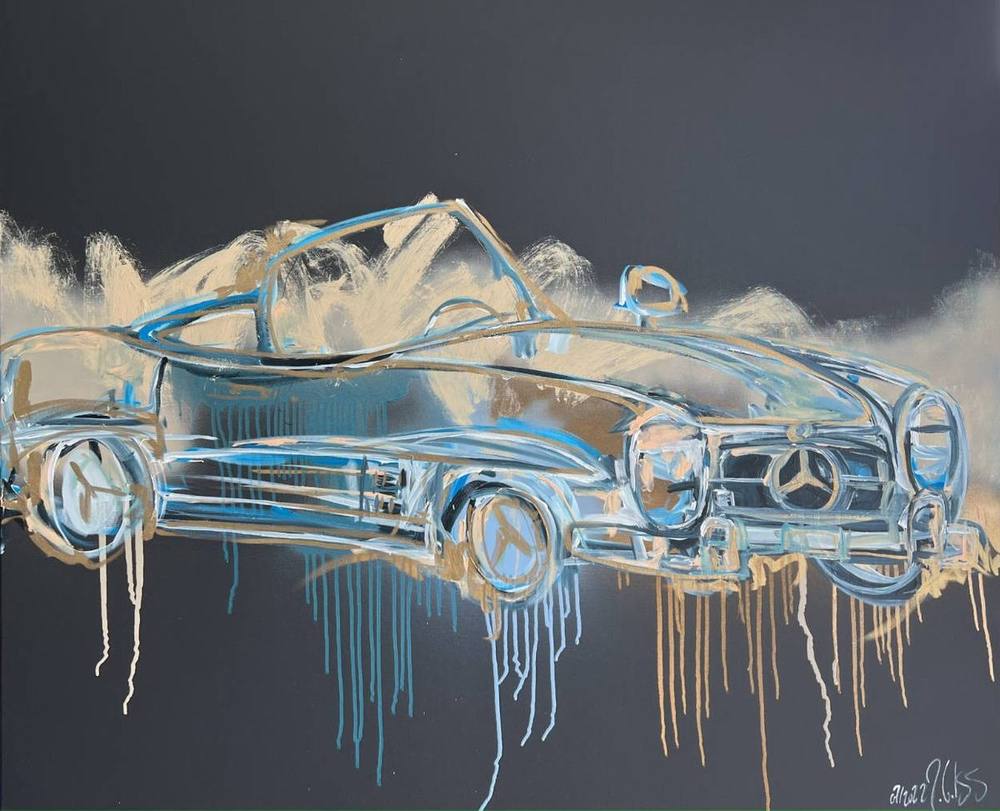
This is the thought that the painting 07 | 2022 by Juliane Golbs carries further. On a black canvas of 120 × 100 centimetres, painted in acrylic and gold lacquer, an open roadster stands in a three-quarter view from the front. The bodywork is left unfilled. Pale blue, white and a sandy gold outline it in quick, broad strokes: the long bonnet, the windscreen frame, the steering wheel, the round headlamps and a grille with a large star at its centre. The star recurs on the hubcaps and points to a Mercedes roadster of the 1950s, although the picture does not commit to a particular model.
Behind the car a cloud of gold and pale beige rises, as if dust were being thrown up or evening light were falling across a country road. Below, the paint runs down in long drips, blue beneath the tail and gold beneath the front. The car thus loses its footing. It hovers between drawing and dissolution, and that is the point of the picture: it does not show speed but the after-image of a drive.
The black ground strengthens this impression. The gold reflects the light of the room while the black absorbs it. Depending on the time of day, either the line or the golden cloud comes forward. The artist has signed the picture at the lower right.
The handling of the brush is striking. Juliane Golbs paints here almost as if with a drawing pencil, apparently in a single pass and without smoothing anything afterwards. Some contours are drawn twice; elsewhere the line breaks off and the black ground takes over the form. Up close you see the edges of the broad strokes and the small beads where the drips begin. From a distance the eye closes the gaps and sees a complete car.
Golden Things: gold for the fleeting hour
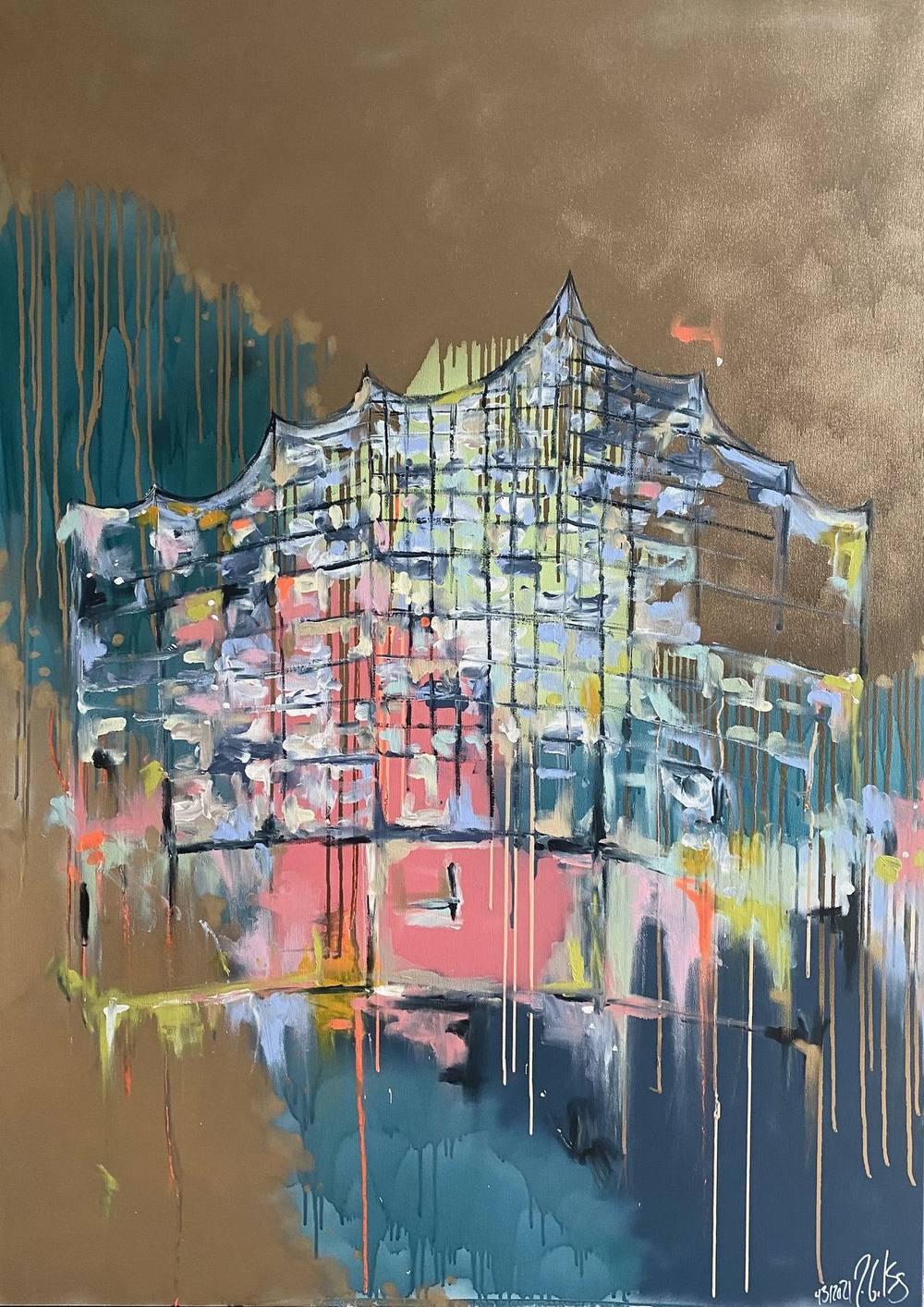
The painting belongs to the Golden Things series, a study of gold and light that sets out to hold on to the fleeting beauty of the golden hour. In this series Juliane Golbs often draws objects and places with a few lines and then lets them dissolve into colour and drips. In 15 | 2021 a tall ship and a harbour crane lie in golden light; in 43 | 2021 she breaks the Elbphilharmonie down into a grid and fields of colour.
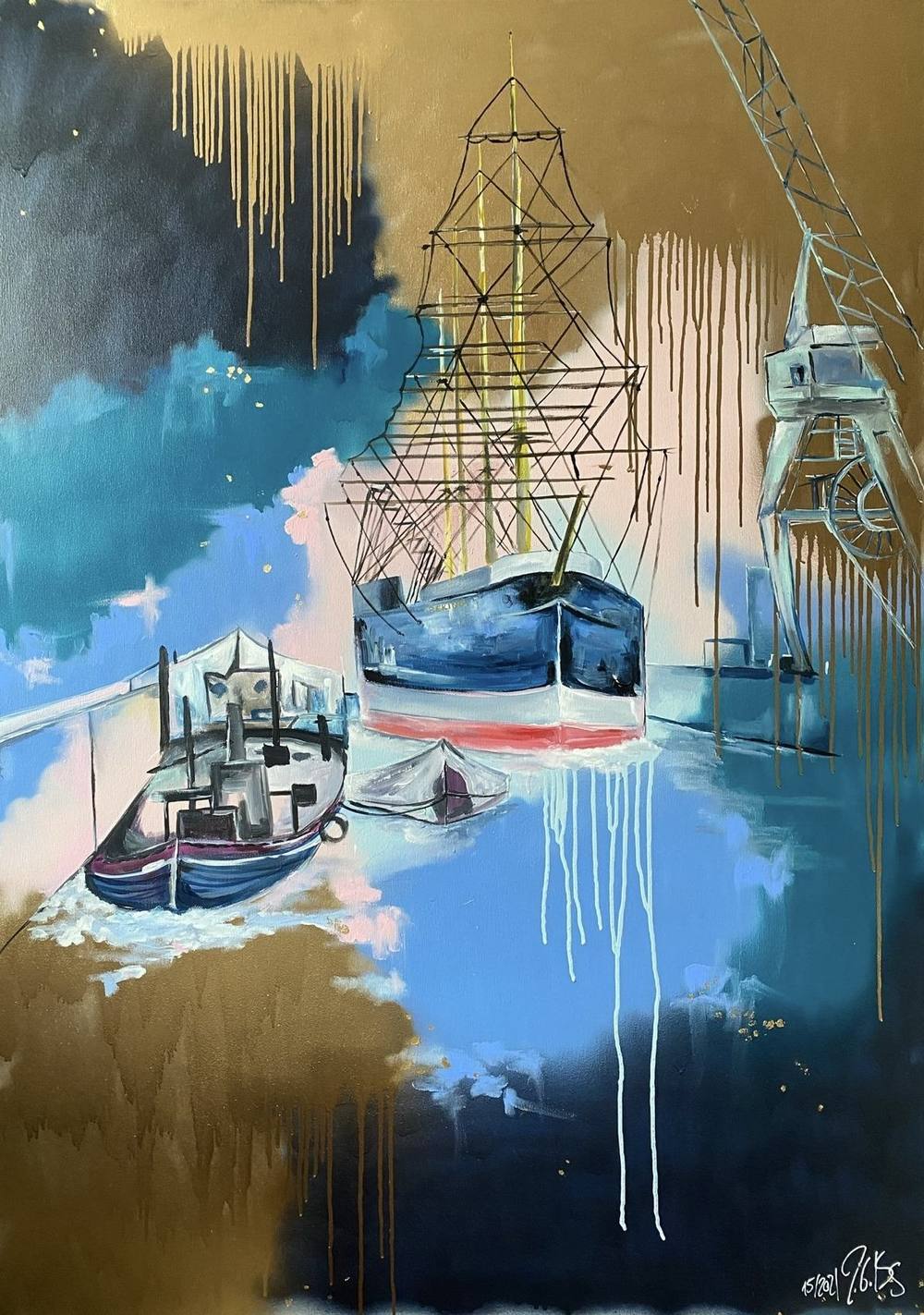
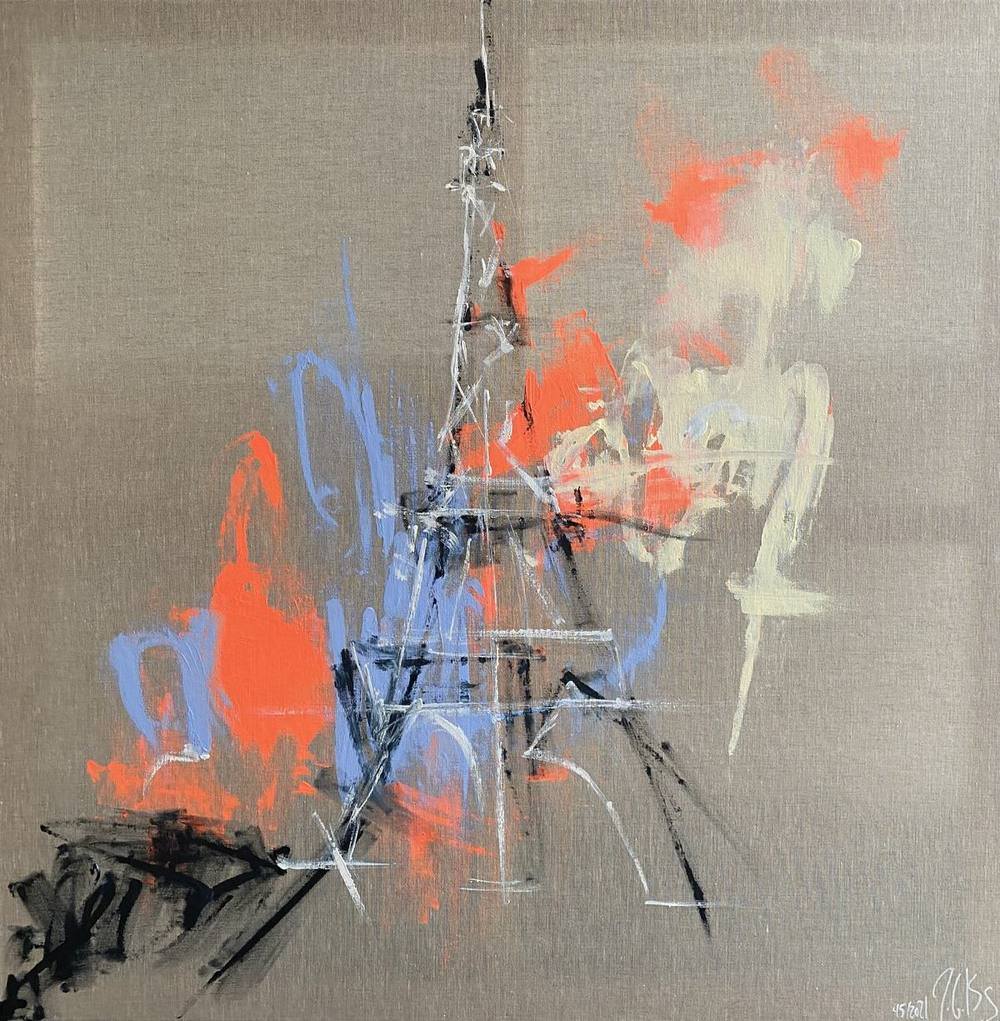
The kinship with the roadster is plain. The ship, too, is only contour, and here too gold and white run vertically across the surface. Technology, whether rigging, steel lattice or bodywork, becomes in Golbs’s hands the bearer of a memory. The same is true of 45 | 2021 from the Signature Collection, a tower structure on raw linen. The Parisian street view 51 | 2019, which is no longer available, belongs to the same line.
Cars in art today: memory rather than rapture
Marinetti wanted to leave the past behind. Today it is precisely the sports cars that once stood for departure that have become witnesses of a bygone time. The picture has changed with them. What was a battle cry in 1909 has become, in the twenty-first century, a motif of memory: of summers, of landscapes, of a particular way of being on the road.
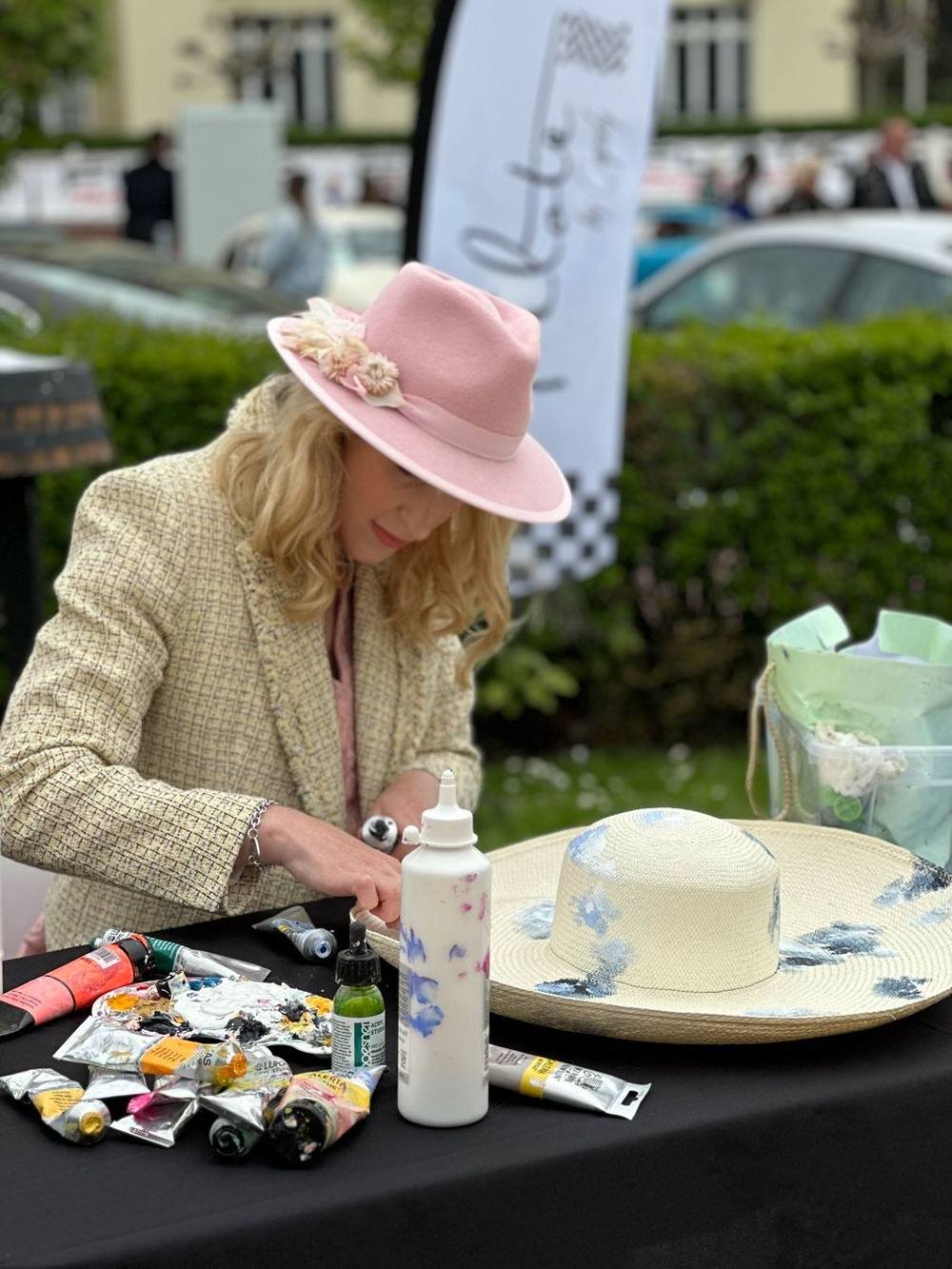
That the subject is not foreign to Juliane Golbs is also shown by an appearance in Deauville. In May and June 2023 she painted straw hats live there with Maison Laurette, surrounded by classic Porsche cars. Painting, fashion and the motor car met in a place where light and sea shape perception.
Whoever hangs a picture such as 07 | 2022 is choosing less a vehicle than a picture about time. The landscape format works especially well in clearly structured rooms: a study, a library or an entrance hall. In warm evening light the golden cloud begins to glow. Questions about the work, hanging and availability can be sent to the artist via the contact page. Further works can be found in the catalogue and through the art advisor.
Works from this article
Frequently asked questions
When did the car become a subject for art?
An early programmatic statement appears in Filippo Tommaso Marinetti’s Manifesto of Futurism, published on the front page of Le Figaro on 20 February 1909. It declares a racing car more beautiful than the Victory of Samothrace.
What are the BMW Art Cars?
Racing cars designed by artists. At the suggestion of the auctioneer Hervé Poulain, Alexander Calder painted a BMW 3.0 CSL in 1975, which raced at Le Mans. Andy Warhol followed in 1979 with a BMW M1.
What is Andy Warhol’s Cars series?
A series of pictures begun in 1986, commissioned by Daimler-Benz to mark one hundred years of the automobile. Eighty pictures were planned, but only part of the series was finished when Warhol died in 1987. It was his last series.
Which work by Juliane Golbs shows a car?
The painting 07 | 2022 from the Golden Things series shows an open roadster drawn in lines of pale blue, white and gold on black canvas. It measures 120 × 100 centimetres and is painted in acrylic and gold lacquer.
Sources
8 sources
- Encyclopædia Britannica: Filippo Tommaso Marinetti, Manifesto of Futurism
- The Museum of Modern Art: Giacomo Balla, Speeding Automobile (1912)
- Peggy Guggenheim Collection: Giacomo Balla, Abstract Speed + Sound (1913–14)
- BMW Group: Alexander Calder’s Art Car returns to Le Mans after 50 years
- 24 Heures du Mans: BMW M1 by Andy Warhol
- Mercedes-Benz Art Collection: Andy Warhol, Cars
- Mercedes-Benz: Mercedes-Benz and the art world
- Mercedes-Benz Group: Company history 1949 to 1960