When Time Becomes Precious: The Story Behind Fifth Season and Heaven Can’t Wait
Some pictures begin with an idea. These two series began with life itself – with fear, with time given back and with the decision to celebrate it.
Fifth Season and Heaven can’t wait are among the most personal works of the Hamburg artist Juliane Golbs. They speak of time that cannot be taken for granted, and of the decision to fill it with light.
This article tells the story of both series, places their motifs in context and shows how the pictures can be read: from a distance as a space of colour, up close as a web of traces.
Fifth Season: the season that does not exist
The title alludes to a fifth season. In German the expression already has a meaning: it is what people call Carnival, which begins on 11 November at 11:11 and ends on Ash Wednesday. For a few weeks different rules apply, everyday life steps back, life grows louder.
Juliane Golbs takes the word and shifts its meaning. Her fifth season is quiet. It is time received as a gift. The Fifth Season series grew out of an existential experience: fear for the life of her own daughter, and the unexpected extension of their time together.
The two meanings share only one thing: the fifth season stands outside the calendar. It does not follow the familiar course of spring, summer, autumn and winter. It is an exception, and that is precisely why it counts.
In this series, transience becomes the condition of closeness. What is finite becomes precious. What is precious demands attention. The light in these works is calm, the joy quiet.
One could put it this way: Fifth Season is an invitation to meet life with warmth, clarity and gratitude. Lightness becomes a conscious, almost ethical decision.
The 2024 exhibition and the second Windspiel edition
In 2024 Juliane Golbs presented the series in the exhibition “Fifth Season” in Hamburg, at MUMA Gallery in Hamburg-Eppendorf. It was also where the second limited gin edition from the Windspiel Manufaktur was introduced, for which she had designed the label: a Premium Dry Gin Pistacchio at 37.5 per cent, lighter than the first edition and intended for summer. The lettering on the label is embossed in gold.
The first collaboration in 2021 was limited to 999 bottles and sold out within a few days. That the distillery renewed the partnership says something about the effect of this visual language. Windspiel’s founder Sandra Wimmeler explicitly praised “the lightness and many layers of her work” at the time. Both describe Fifth Season rather precisely.
Heaven can’t wait: the concentration
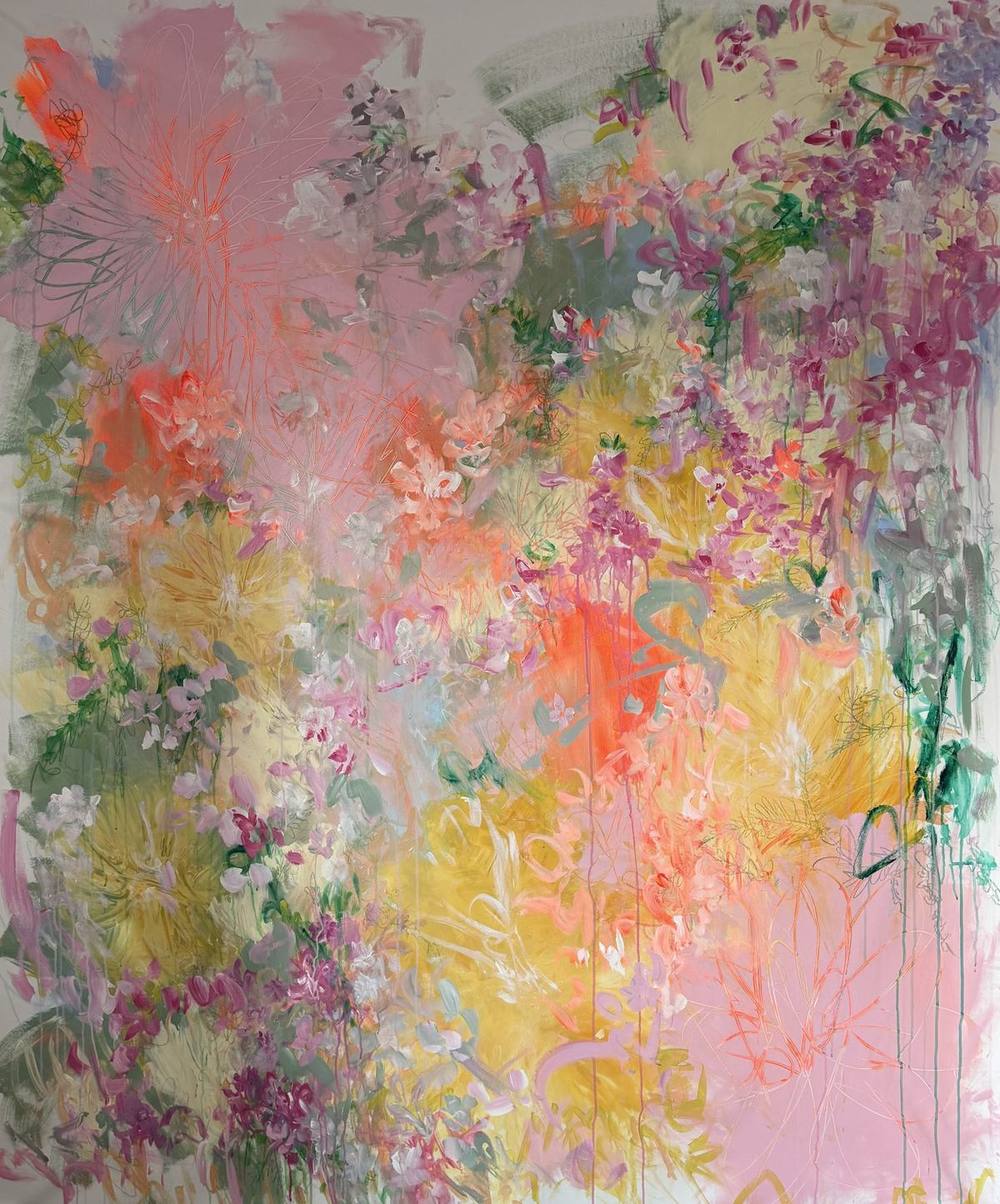
Heaven can’t wait is the continuation of Fifth Season and at the same time its concentration. The works are more complex and more layered. They are closer to drawing: lines, cracks, pencil marks and scratches come more clearly to the fore.
Some of these traces were made by her daughter. The pictures thus become shared works. They hold countless moments that two people have lived together. Every line is evidence of lived time that cannot be expressed in numbers.
The title is a statement. Heaven can’t wait – or, as the artist turns it around: heaven can wait. These pictures do not seek redemption. They bear witness to a happiness that is happening now.
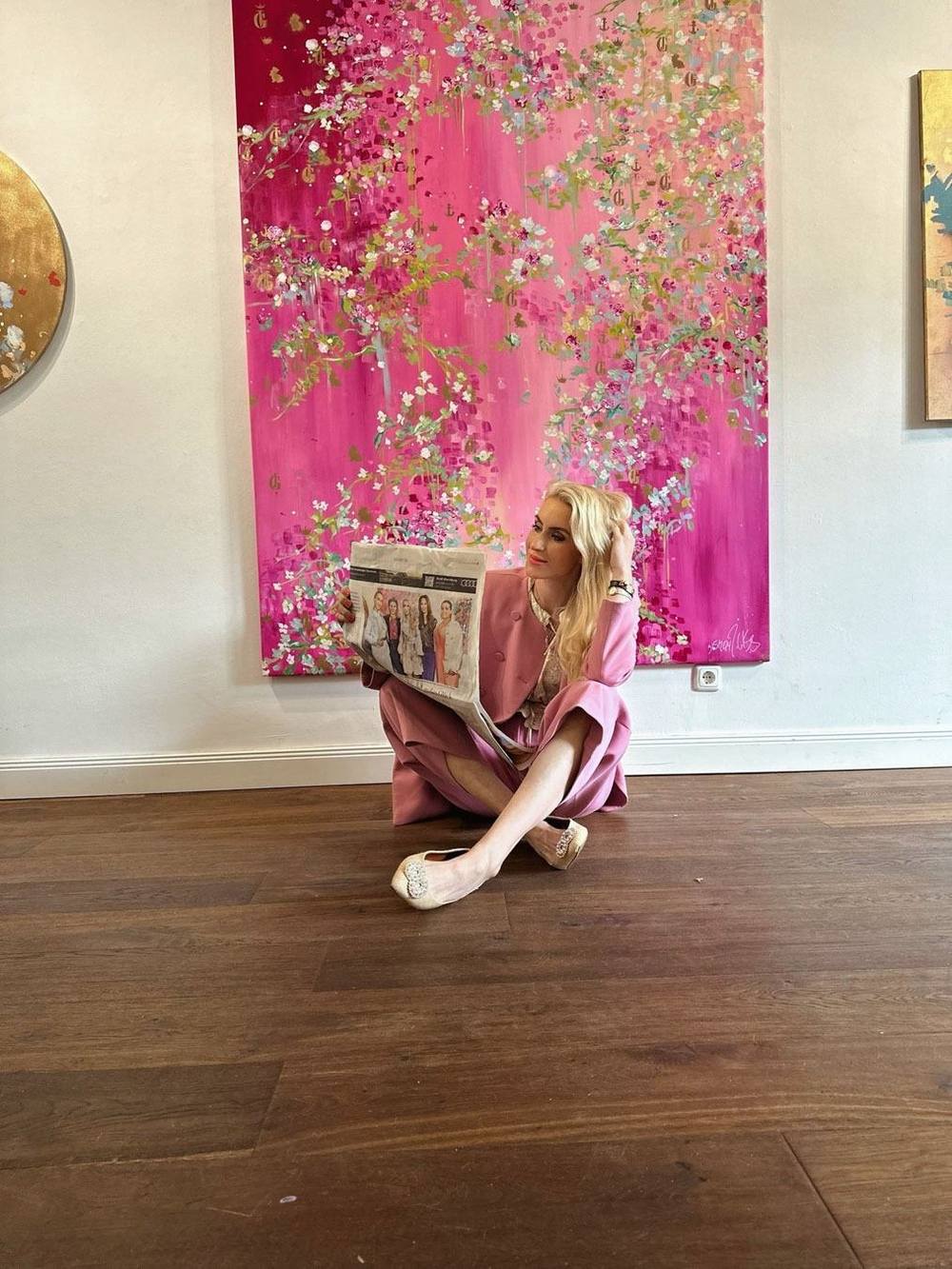
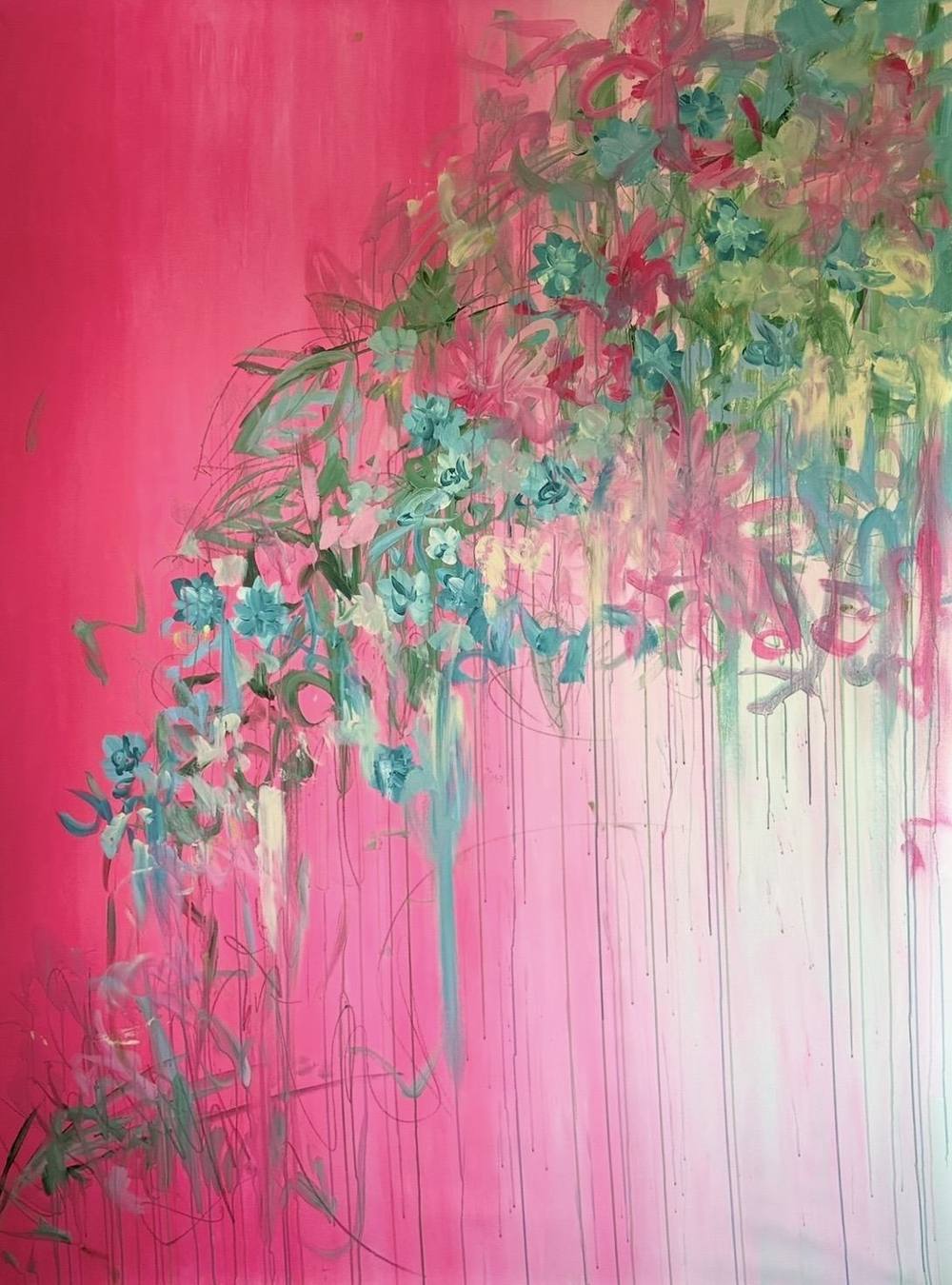
In the catalogue of works the continuation is listed as “Fifth Season #heaven can wait”. One example is the work 09 | 2026: acrylic and coloured pencil on canvas, 150 × 200 cm, in pink, turquoise, green and yellow. The work description speaks of a cascade of colour in which blossoms form and dissolve again. The coloured pencil is no marginal detail. It is the tool of childhood, and in a picture of this size every pencil line reads like handwriting no one wanted to paint over.
Blossoms against transience: an old idea
Blossoms in a picture about time given as a gift are no coincidence. Painting has long used flowers as a sign of transience. In seventeenth-century still lifes, blooms at different stages, from bud to wilting flower, stood for the fleeting nature of earthly things. Such pictures were called vanitas paintings.
At the same time, the painted bouquets contain a counter-thought. Using a bouquet by Jan Brueghel the Elder from around 1607 as an example, the Kunsthistorisches Museum in Vienna describes how painting seeks to create a form of eternity precisely in the image of the transient. The painted flower does not wilt.
Juliane Golbs does not paint still lifes, and her blossoms are not symbols to be decoded. But her pictures stand within this tension: they know of finitude and hold on to the blossoming all the same. The Everlasting Blossoms series carries this idea in its very name.
How to read the pictures
The works of both series ask for two distances.
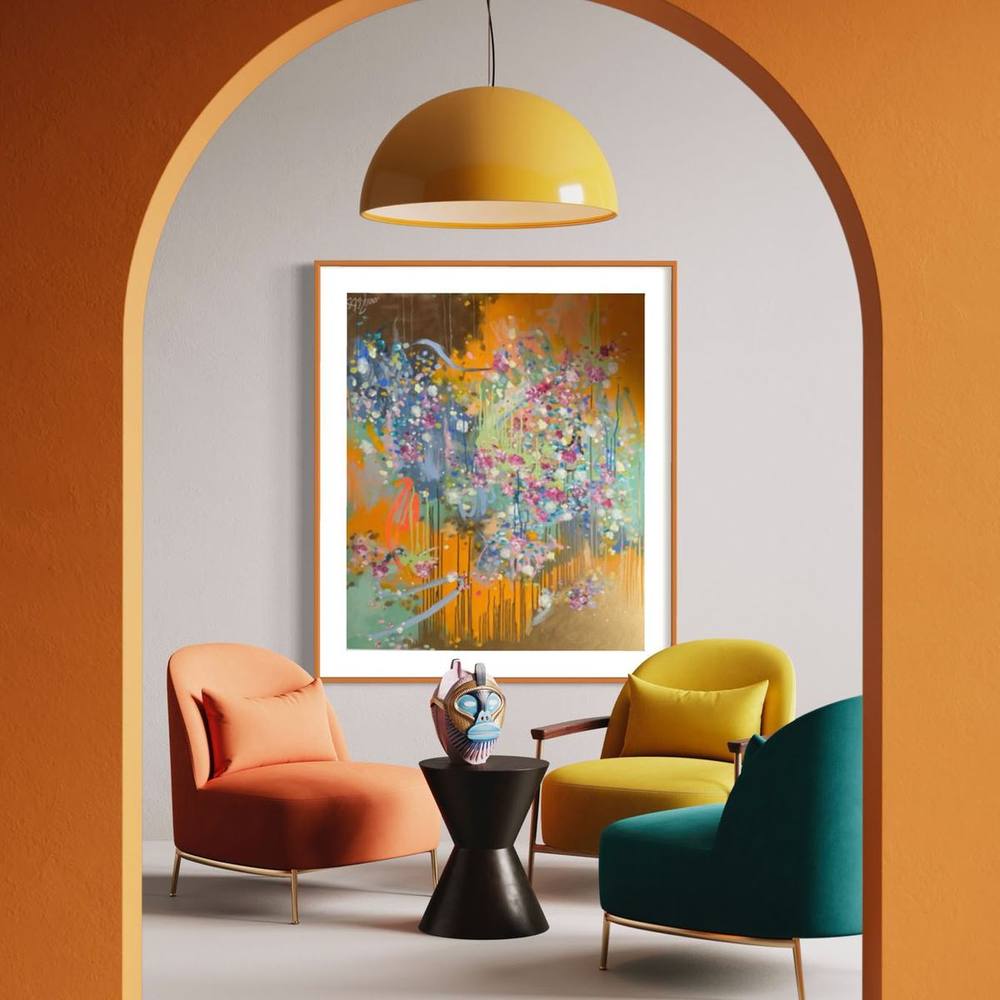
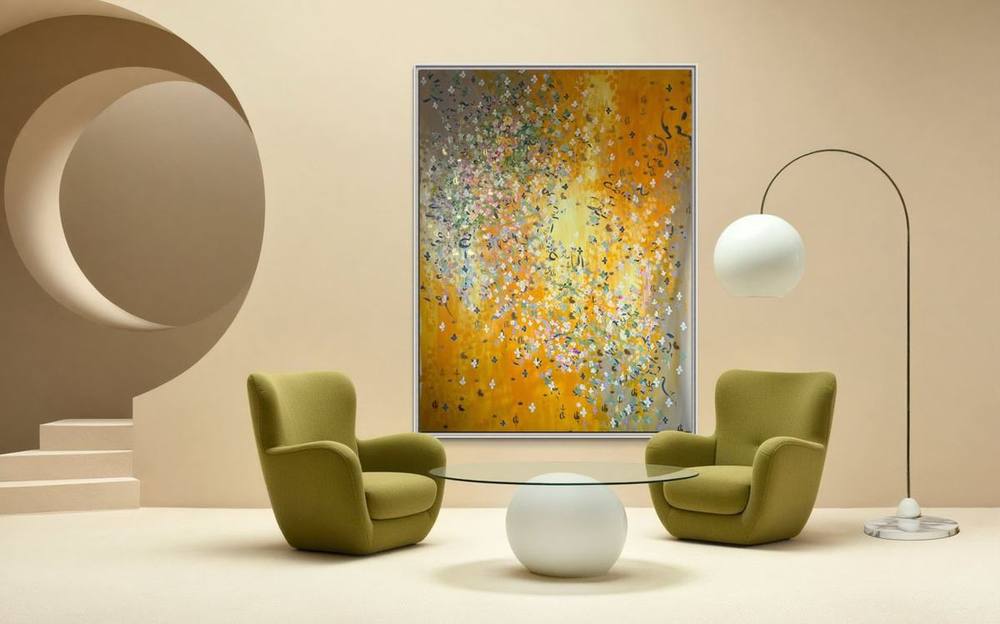
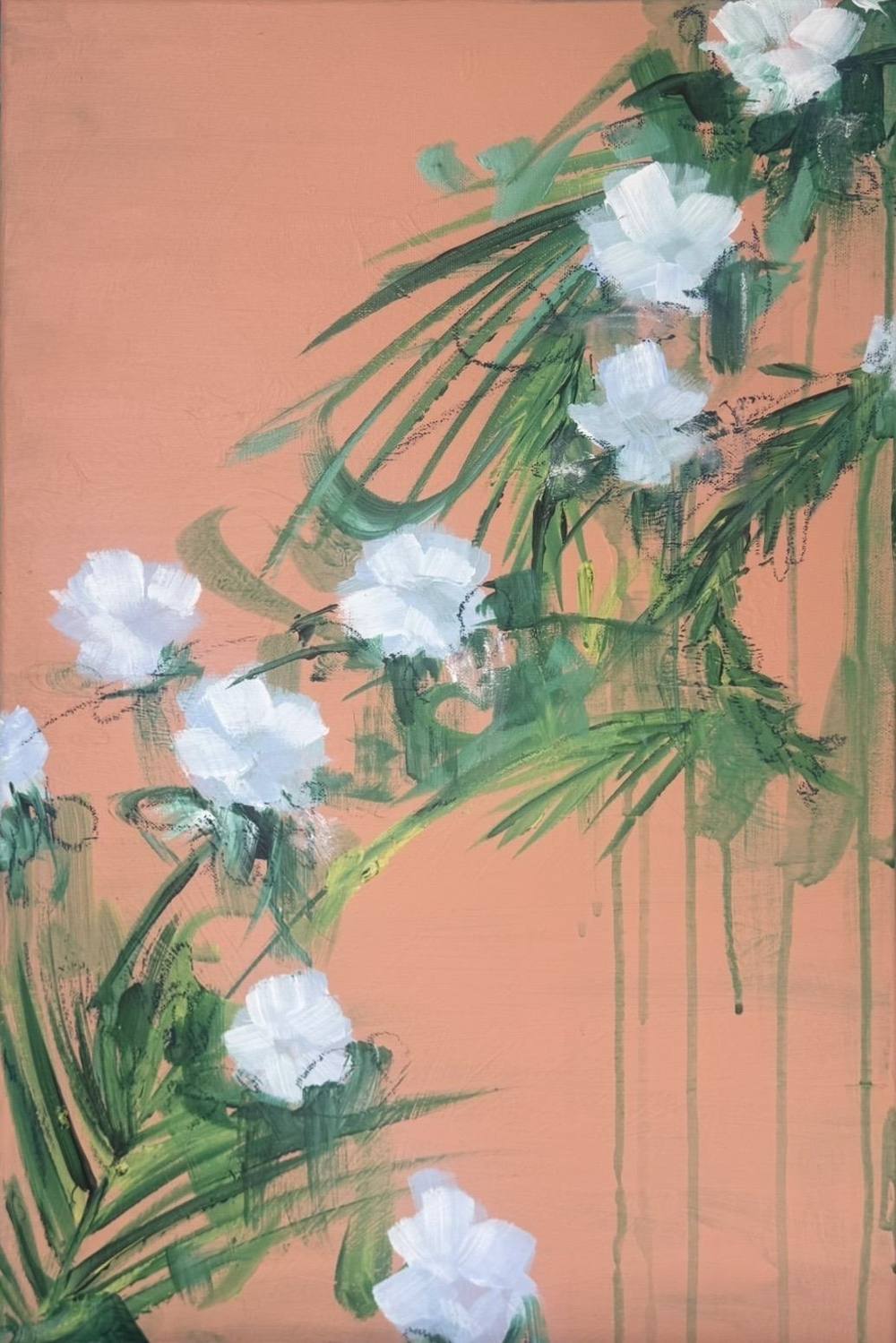
From afar you see a space of colour. A basic mood in pink, apricot, turquoise or green, shot through with light. The composition is open; there is no centre that holds the eye. The gaze wanders, as it wanders through a garden.
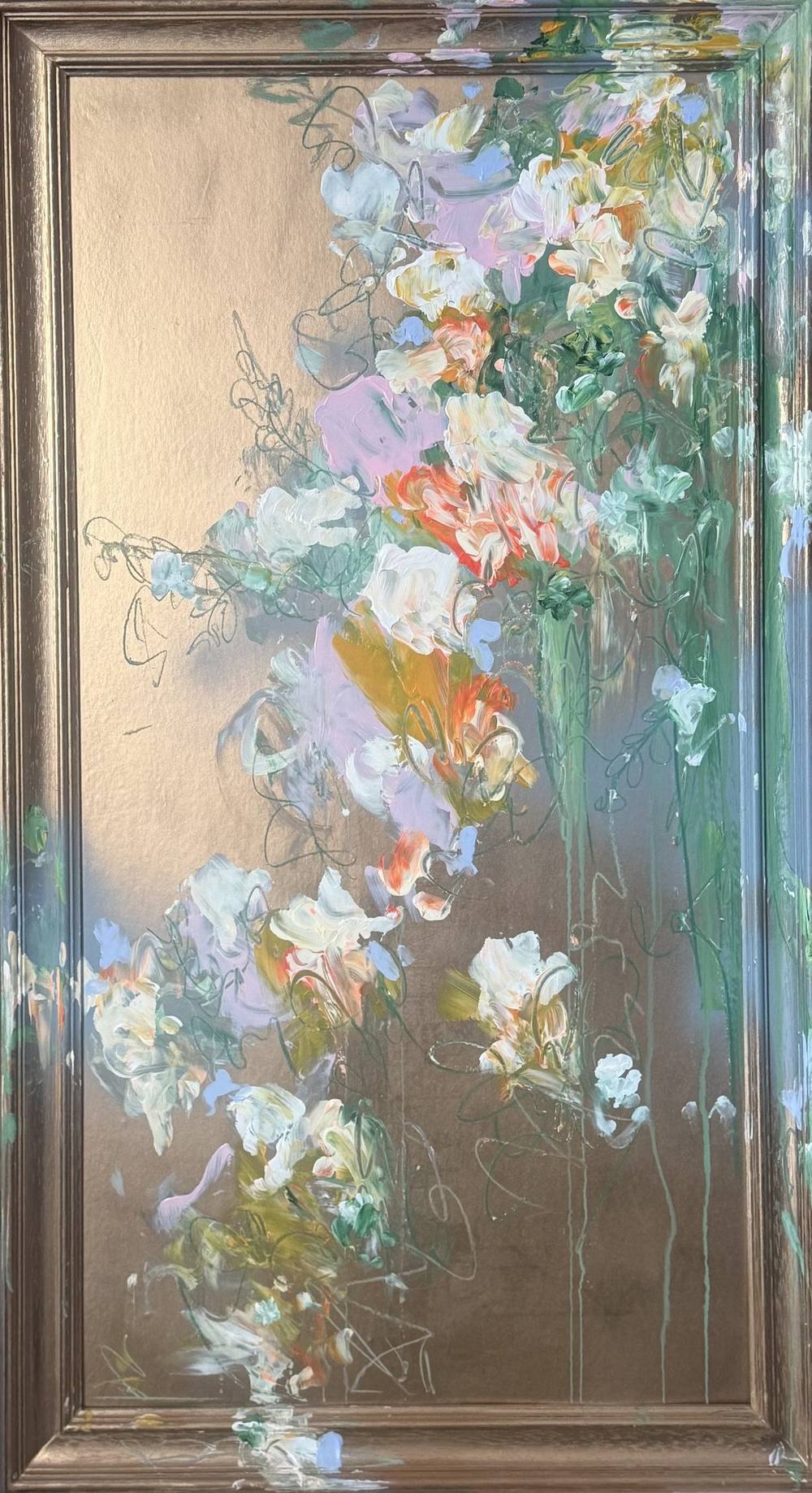
Up close the surface dissolves into traces. Paint applied with the fingers. Drips where wet paint ran downwards. Pencil lines, scratches, small islands of gold. In Heaven can’t wait there are more layers, and some lines belong to a second hand.
Over time the picture changes with the light. Gold lacquer and gold leaf respond to the angle of incidence. In the morning a work appears cooler, in the evening by candlelight warmer. Living with one of these pictures, you rarely see it the same way twice. That suits the subject: time given as a gift is not uniform either.
The colours of time given back
The palette of both series is light and warm. The same tones appear again and again in the work details of the catalogue: pink, apricot, turquoise, green, yellow, and gold.
Pink in these pictures is not a decorative colour. It is the colour of skin and blossom, of something living and vulnerable at once. In large areas it does not look sweet but intense, almost luminous.
Turquoise and green bring freshness and depth. They recall water and foliage, something that grows. Beside the pink, they ensure the pictures do not settle into a single mood.
Yellow and apricot are colours of light. They open the composition and let it breathe.
Gold, finally, lies over everything like a second source of light. It is the colour that does not fade, and in the history of painting the colour of the precious. That the artist uses it precisely in pictures about limited time is only consistent.
The fear from which the series arose is not in the foreground. It is the reason why the light carries so much weight.
How the works are made
Technically, both series combine what defines Juliane Golbs’s painting: highly pigmented acrylics, pastel and chalk, layers applied with the fingers and 24-carat gold leaf that takes in the light of the room. In Heaven can’t wait, coloured pencils and other drawing media are added, giving the pictures a new immediacy.
A work from Fifth Season such as 503 | 2024 shows the foundation: acrylic and gold lacquer on canvas, 80 × 80 cm, in green, apricot, blue and pink. The square format removes any direction from the picture. It is neither landscape nor portrait, but a section that seems to continue on every side.
Gold carries a particular meaning in both series. It stands for what remains. More about the technique in the article Gold leaf in painting.
Formats and rooms
The series span very different sizes, from square works around 80 × 80 cm to large canvases such as 150 × 200 cm. That has consequences for the room.
A square format needs little wall and plenty of calm around it. It works above a chest of drawers, in a hallway or as a pair side by side.
A large format changes a room. Above a sofa or a fireplace it becomes the centre to which furniture and light align. The rule of thumb many interior designers use – a picture should take up about two thirds of the width of the furniture beneath it – is a starting point. In the end, the feeling on site decides.
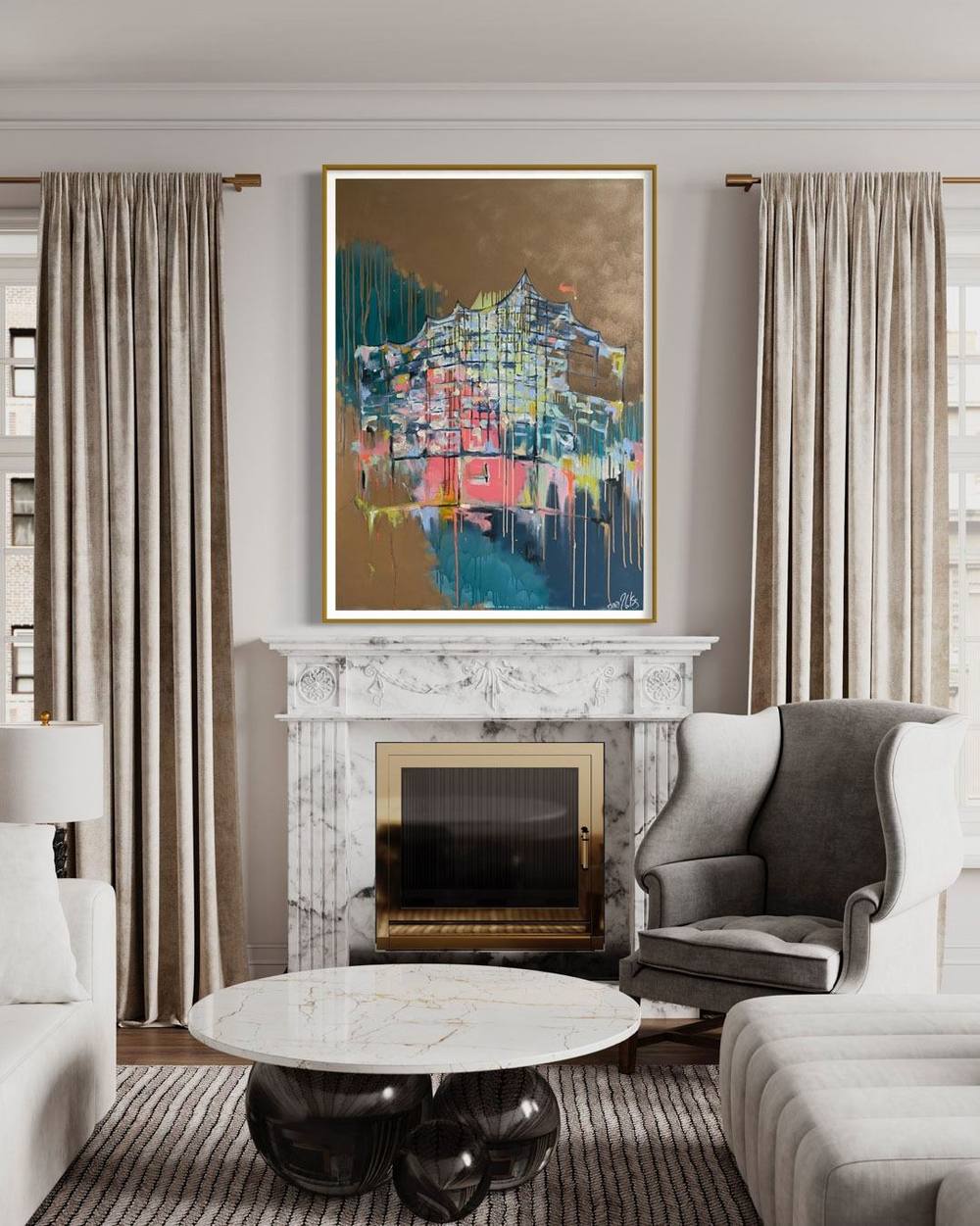
If you are unsure, a work can be hung on approval first. For a small surcharge the picture comes to your home; if you buy it, the amount is credited. More on this in the article Buying abstract art in Hamburg.
Why these pictures move so many people
Many people know such a fifth season from their own lives. Time with someone they nearly lost. Moments that only reveal their full weight in retrospect. The works of Fifth Season and Heaven can’t wait express this experience without spelling it out.
That is why they are especially suited to rooms that are lived in: a living room where the family gathers, a place where you drink the first coffee in the morning and come to rest in the evening.
The connection to the NCL Foundation
The experiences from which these series arose also explain the artist’s commitment to the NCL Foundation, which funds research into childhood dementia. The article Art that carries responsibility tells the story.
Seeing the works
Selected works from both series can be seen in the catalogue, with dimensions, technique and colours for every work. If you would like to experience an original up close, the studio in Hamburg can be visited by appointment. Enquiries about individual works go through the contact form.
Works from this article
Frequently asked questions
What does the title Fifth Season mean?
For Juliane Golbs, Fifth Season stands for time given as a gift: time one did not expect and which is therefore especially precious. The series arose from fear for her daughter’s life.
How does Heaven can’t wait differ from Fifth Season?
Heaven can’t wait is the continuation and concentration of Fifth Season. The works are more layered and more drawn, with lines, pencil marks and scratches, some of them made by her daughter.
Which formats are available in the series?
The series range from square formats such as 80 × 80 cm to large canvases such as 150 × 200 cm. Available works and dimensions are listed in the catalogue or given by the studio on request.
Sources
5 sources
- about-drinks: Windspiel präsentiert Art Edition mit Juliane Golbs (13.06.2024)
- Goethe-Institut: Karneval in Deutschland – die fünfte Jahreszeit
- Kunsthistorisches Museum Wien: Wider die Vergänglichkeit (Jan Brueghel d. Ä., Kleiner Blumenstrauß)
- Lernhelfer: Stilllebenmalerei im Barock
- Juliane Golbs, catalogue of works: Fifth Season series