Wassily Kandinsky: the path to abstraction and colour as sound
Kandinsky heard colours and painted sounds. How an evening concert in January 1911, a slim book and his years at the Bauhaus freed painting from the object.
Kandinsky is counted among the painters who freed the picture from the object. What he was looking for was a kind of painting that works as directly as music. Wassily Kandinsky heard sounds in colours, called his pictures Improvisations and Compositions and wrote a book on the spiritual in art. This article follows his path from Moscow lawyer to Bauhaus teacher and asks what his ideas on colour mean for looking at abstract painting today.
Wassily Kandinsky: from lawyer to painter
According to the Guggenheim, Kandinsky was born in Moscow on 16 December 1866. From 1886 to 1892 he studied law and economics at the University of Moscow, where he lectured after graduating. In 1896 he turned down a teaching position in order to study painting in Munich: first with Anton Ažbe from 1897 to 1899, then in 1900 at the Academy under Franz von Stuck. The Staatliche Kunsthalle Karlsruhe points out that Kandinsky had played the cello and the piano since childhood. Music was with him long before it became the key to his painting.
In Munich he co-founded the Phalanx group and taught at its art school. One of his students was Gabriele Münter, who remained his companion until 1914. In 1909 Kandinsky became president of the newly founded Neue Künstlervereinigung München. How he left that association in 1911 with Franz Marc and others to found the Blaue Reiter is told in the article on blue in art. This one is about the question that occupied him in those years: how much of an object does a picture need?
The Schoenberg concert and Impression III
On 2 January 1911 Kandinsky attended a concert of works by Arnold Schoenberg in Munich. The Museum of Modern Art records that he went with Gabriele Münter, Franz Marc, Alexej Jawlensky and Marianne Werefkin. Schoenberg’s music set aside the established rules of harmony. When the friends talked afterwards, the parallel was obvious: what Schoenberg was doing with sound, Kandinsky was attempting with colour. Within days of the concert he was sketching the performance.
From those sketches came the painting Impression III (Concert), oil on canvas, 78.4 × 100.6 centimetres, now in the Lenbachhaus. Gabriele Münter gave it to the museum in 1957. The Lenbachhaus describes how yellow and black dominate the picture. An irregular black triangle lies diagonally across the upper half, while beneath it yellow floods out in a sweeping gesture. Only on closer inspection do you make out the black grand piano and the leaning backs of the audience. The museum speaks of the “yellow sound” as the emanation of what was heard. Kandinsky had already drafted a stage work with music under that title in 1909, later published in the Almanac.
MoMA sees this evening as a turning point. Over the following months Kandinsky gradually removed every reference to the visible world from his pictures. The concert led to a correspondence, and according to the Lenbachhaus, Schoenberg took part in the Blaue Reiter exhibition at the end of 1911 with paintings of his own.
Concerning the Spiritual in Art and inner necessity
Kandinsky had already written down the thinking behind this step. MoMA dates the manuscript to 1909, and the Guggenheim gives December 1911 as the date of publication. It is not a manual of technique. Kandinsky asks what the content of art is and finds it within: a work, he says, is only well painted if its spiritual value is complete.
His measure for this is “inner necessity”. The term means the artist’s impulse towards spiritual expression and also that expression itself. Whoever follows it may use any form that the expression demands, whether it occurs in nature or not. Beautiful, for Kandinsky, is whatever arises from inner necessity, even if convention finds it ugly. Here lies the core of his case for abstraction: what gives a picture its meaning is not the motif but the truth of its colours and forms.
Where Kandinsky belongs in the wider history of abstraction, alongside Hilma af Klint, František Kupka, Malevich and Mondrian, is set out in the article on abstract paintings.
Colour as sound: Kandinsky’s theory of colour
The book’s best-known sentence comes from the chapter on the effect of colour: “Colour is the keyboard, the eyes are the hammers, the soul is the piano with many strings. The artist is the hand which plays, touching one key or another, to cause vibrations in the soul.” Painting becomes an instrument here. Colour does not work through an object it denotes. It works directly.
Kandinsky goes further and assigns sounds to individual colours. Light blue is like a flute, darker blue like a cello, darker still like a double bass, and the deepest blue of all like an organ. Absolute green corresponds to the placid middle notes of a violin. Light warm red sounds like trumpets, strong and ringing. He hears violet in the cor anglais or the deep notes of the bassoon, orange in the Angelus bell or an old violin. Yellow, as the Kunsthalle Karlsruhe puts it, hurts the ear like a trumpet.
He describes white and black with particular care. White affects him like a silence full of possibilities, like a pause in music after which a melody can begin afresh. Black, by contrast, he describes as something burnt out, motionless like a corpse. The Guggenheim thinks it possible that Kandinsky had a form of synaesthesia in which sounds call up colours. That is not certain. What is certain is that he himself spoke of colours he saw before his eyes while listening to music.
Impression, Improvisation, Composition
Kandinsky gave his pictures generic titles that could have come from music. In the closing chapter of the book he distinguishes three sources of inspiration. The Impression is a direct impression of outward nature, given purely artistic form. The Improvisation is a largely unconscious, spontaneous expression of inner character. The Composition, finally, expresses a slowly formed feeling in which reason, consciousness and purpose play the greatest part.
The Staatliche Kunsthalle Karlsruhe owns an early example of the second type: Improvisation 13 of 1910. The museum describes a picture full of interlocking areas of colour, round, pointed and curving forms, structured by heavy black lines. For all its movement it follows an order. Round forms adjoin angular ones, and the picture is deliberately built. It is exactly this tension between spontaneity and order that makes the three categories so useful, for other artists’ pictures too.
Composition 8: Kandinsky at the Bauhaus
With the outbreak of the First World War Kandinsky returned to Russia. From 1914 to 1921 he lived mainly in Moscow and held a post at the People’s Commissariat of Education. The Guggenheim describes how the geometric forms of the Russian avant-garde influenced him there, in artists such as Malevich, Rodchenko and Popova. He adopted clearly delineated shapes and overlapping planes. Yet his belief in the expressive content of abstract forms set him apart from most of his colleagues, who favoured more rational principles. In 1921 he returned to Germany.
In 1922 Kandinsky began teaching at the Bauhaus in Weimar. There he pursued his research into how colours and forms correspond and how they act on the mind. In July 1923 he painted Composition 8, oil on canvas, 140.3 × 200.7 centimetres, now in the Guggenheim collection. The museum describes a pulsating surface of coloured geometric forms, alternately dynamic and calm, aggressive and quiet. The circles in this picture anticipate the role the circle would play in the years that followed. Kandinsky called it the synthesis of the greatest oppositions.
Kandinsky moved with the Bauhaus to Dessau in 1925 and became a German citizen in 1928. After the Bauhaus closed in 1933 he settled in Neuilly-sur-Seine near Paris. In 1937 the National Socialists confiscated 57 of his works as “degenerate art”. Kandinsky died in Neuilly on 13 December 1944.
Hearing colour: the painting of Juliane Golbs
Kandinsky’s terms are a tool for seeing, even in front of pictures made a hundred years later. The texts on the gestural works of the Hamburg painter Juliane Golbs place them above all close to Art Informel and Action Painting. Still, they share one question with Kandinsky: how painting without a fixed object can nevertheless find an order.
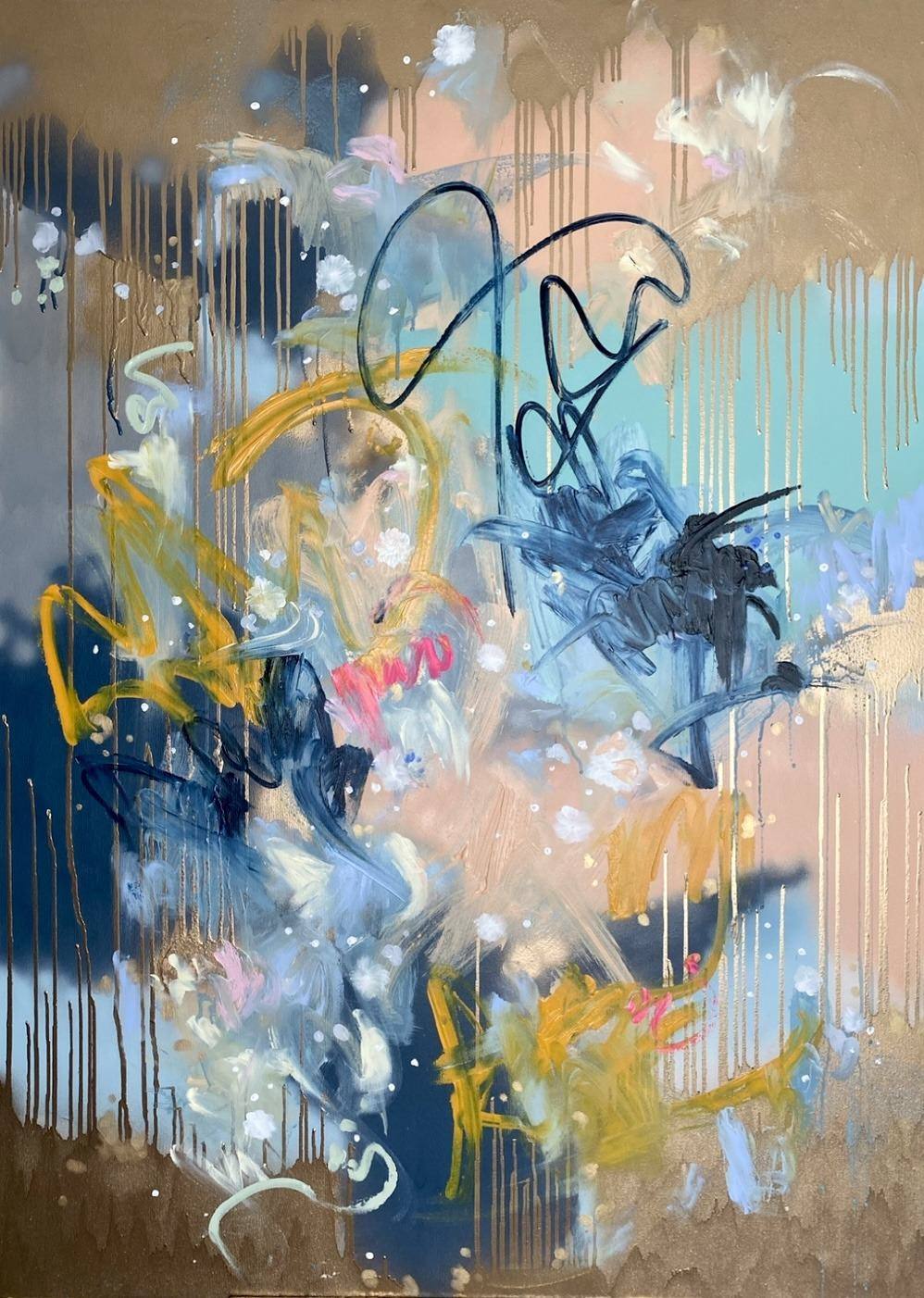
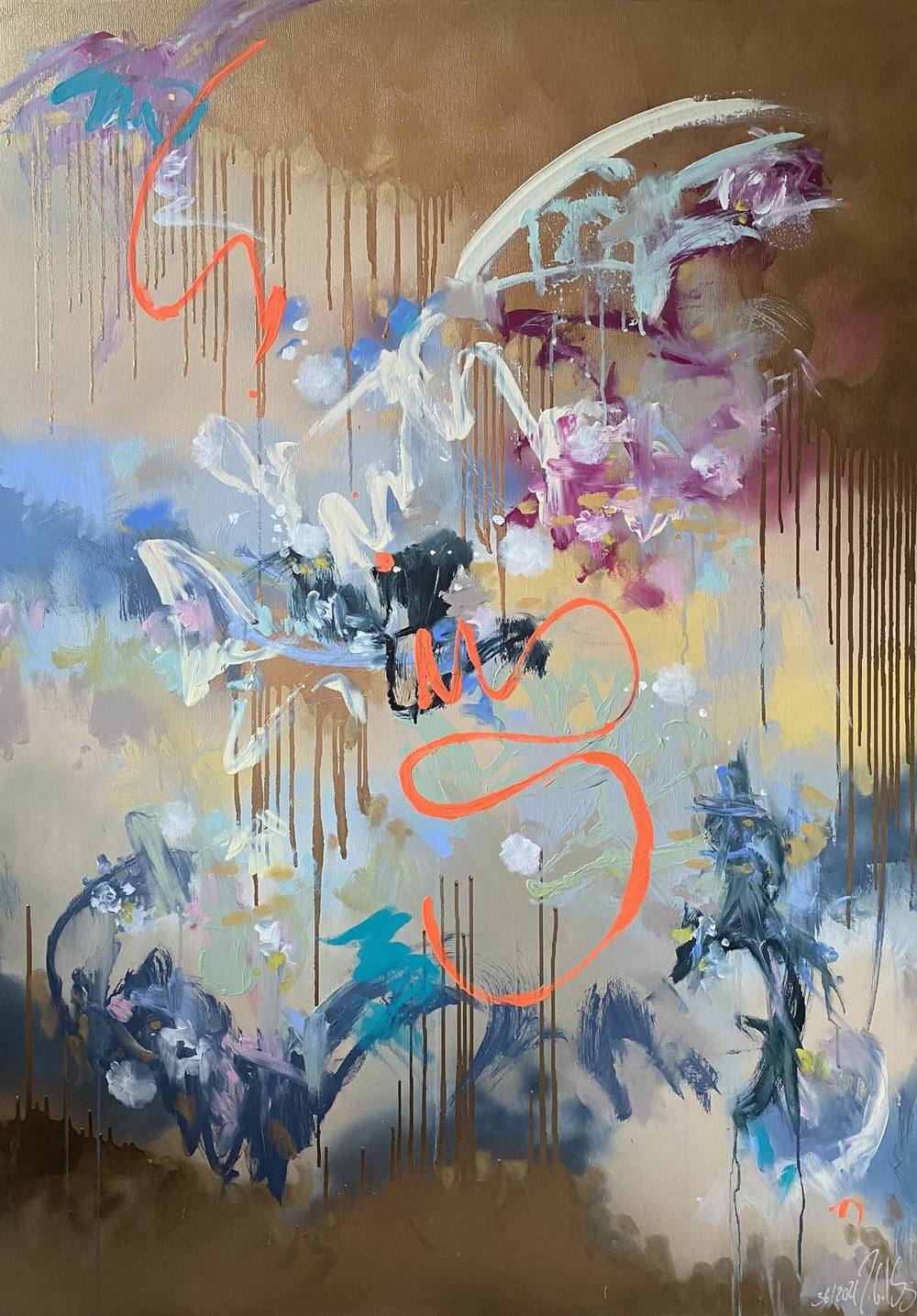
In the cover image of this article, 36 | 2021 from the series Golden Things, a bright orange stroke loops across brushwork in dove blue, white and violet. The text on the work notes that there is no motif here, only the trace of the arm and the rhythm of the paint. In Kandinsky’s vocabulary that would come close to an Improvisation. 38 | 2021 from the Signature Collection combines vertical drips in bronze and white, which according to its text give an almost curtain-like rhythm, with clouds of midnight blue and lines that wind across the surface like handwriting.
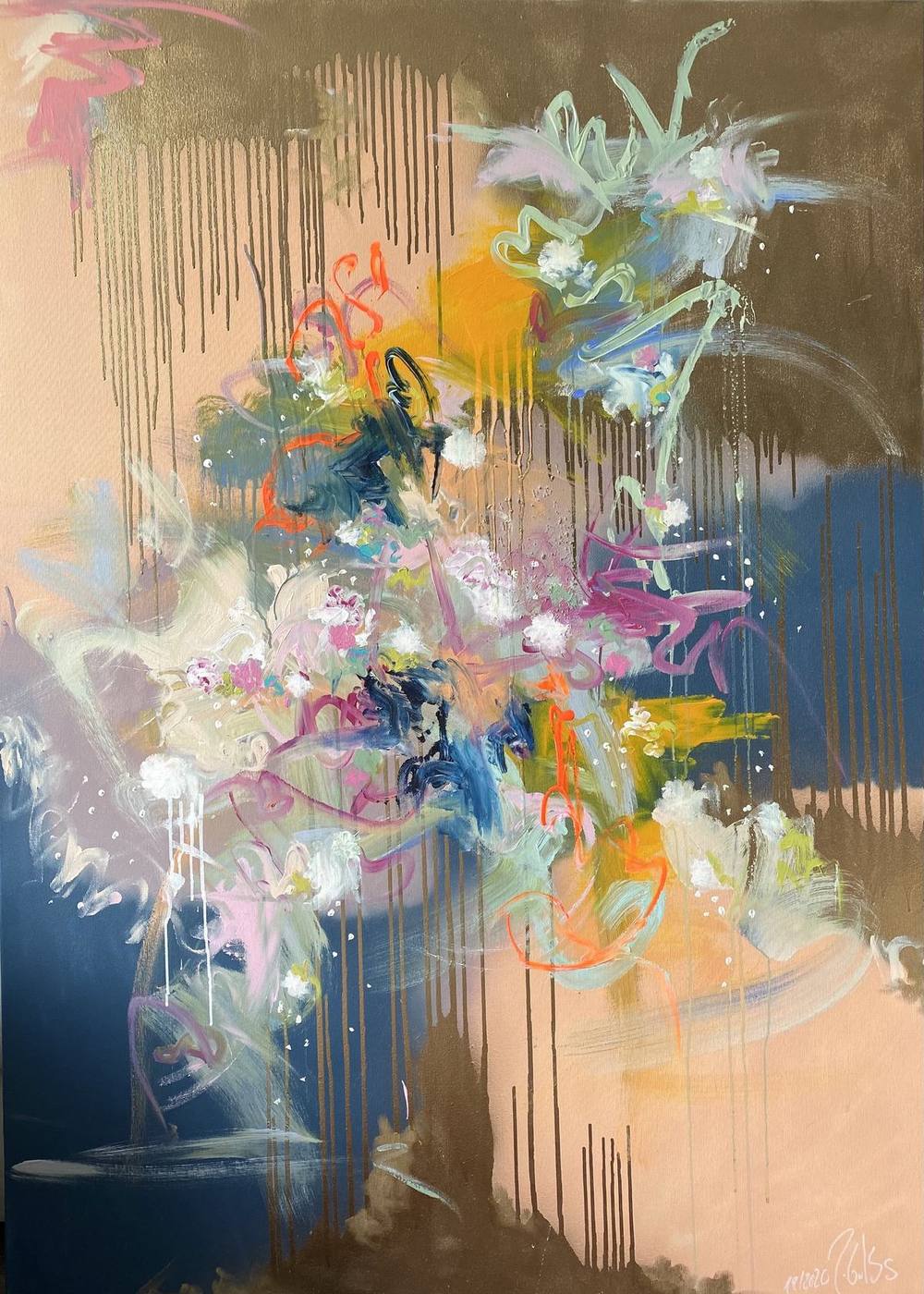
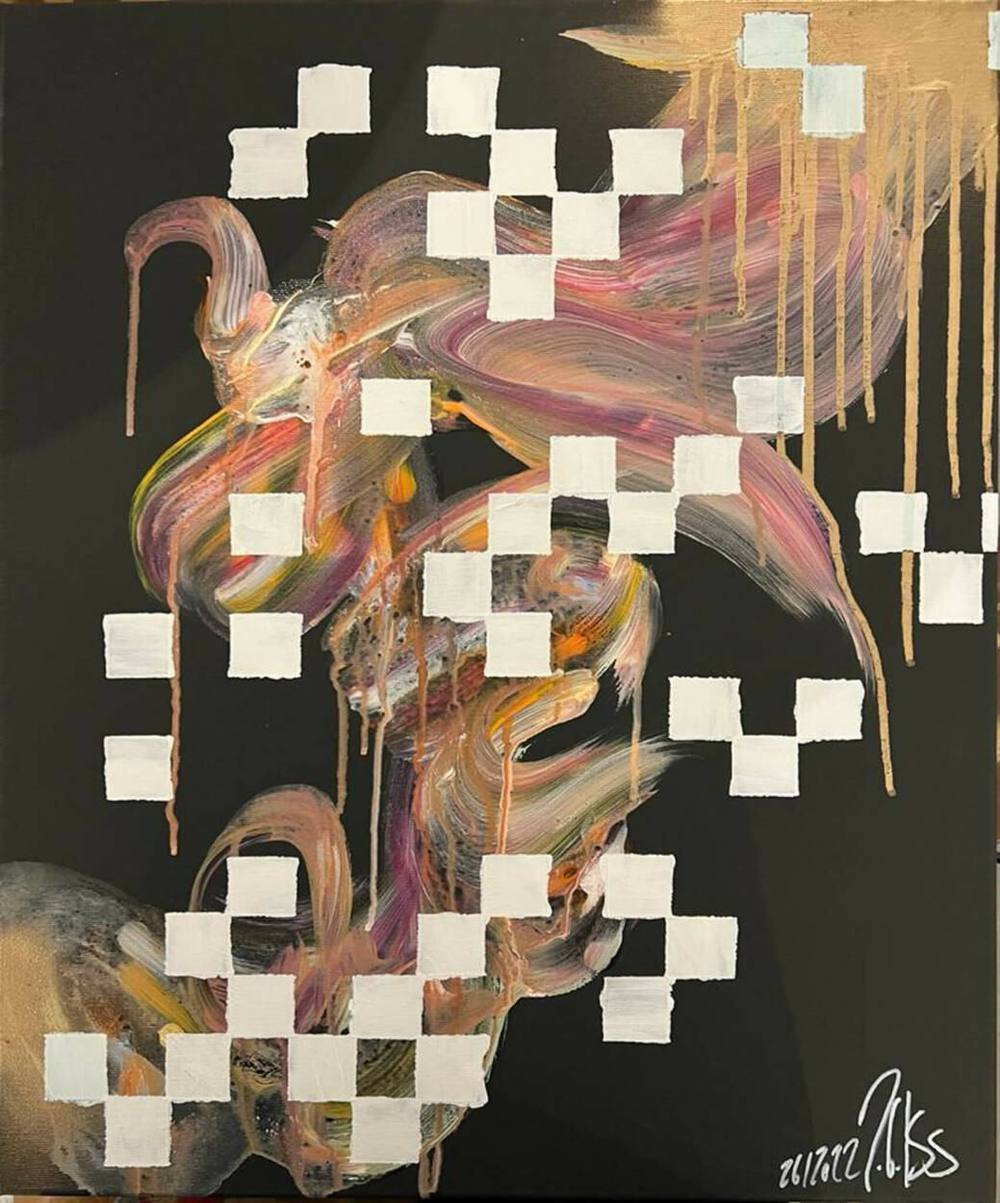
The relation between sound and pause that Kandinsky describes in white can be seen in 19 | 2020. At the centre, lines in mint, white, orange and midnight blue gather into a whirling core. Around it there is plenty of space, a ground of apricot and gold lacquer into which fine golden rivulets run. The text on the work speaks of a fragile balance between impulse and stillness. 26 | 2022 sets a single sweeping brushstroke in rosé and peach against a stepped pattern of white squares. Gesture and geometry stand side by side, much as they did in Kandinsky’s years between Improvisation and the Bauhaus.
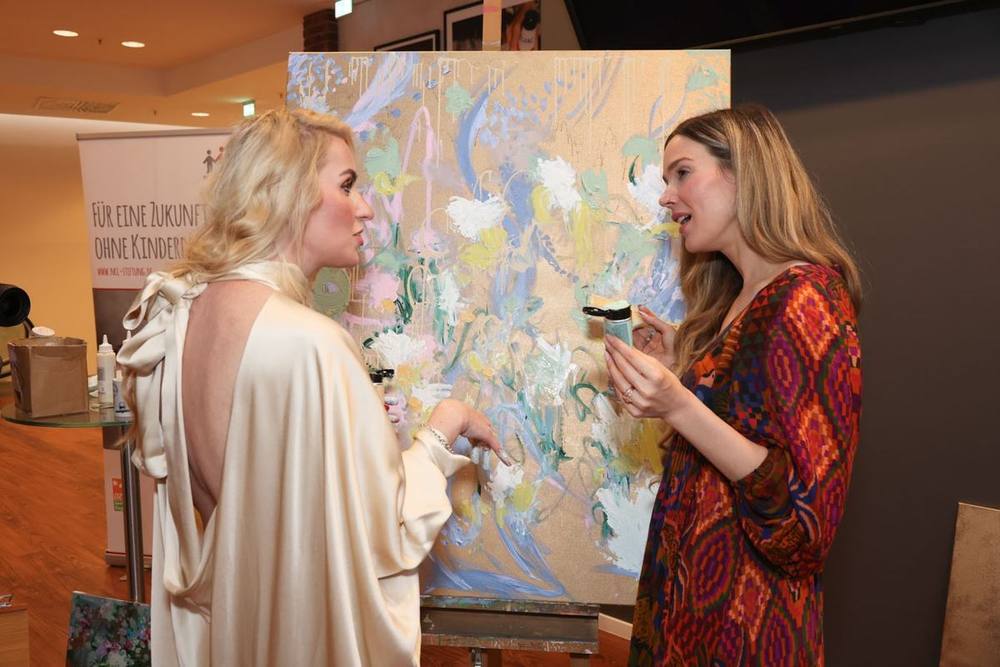
For Juliane Golbs, music also plays a very practical part. At the Elbjazz Festival 2026 she painted live in the Grand Hall of the Elbphilharmonie to the music of Joss Stone, and the picture came into being in the span of a concert. The article on the Elbphilharmonie in art tells more. The role her bare fingers play in her gestural painting is described in the article on painting with fingers.
Seeing Kandinsky paintings and looking at an original
Many people know Kandinsky paintings mainly as prints. The Kunsthalle Karlsruhe remarks with a wink that you meet them in hotels and doctors’ surgeries. Kandinsky himself held that the beauty of colour and form alone was not a sufficient aim for art. His theory of colour presupposes a viewer who stands in front of the picture and lets it work.
That still holds for abstract painting. Gloss and matt, the relief of the paint, gold that shifts with the light: all of this only shows itself in the room. In the catalogue of works Juliane Golbs’s paintings can be filtered by colour, and the art advisor leads through colour, format and mood to suitable originals. If you would like to see a work in the studio in Hamburg before buying, please get in touch through the contact form.
Works from this article
Frequently asked questions
What did Kandinsky mean by colour as sound?
In Concerning the Spiritual in Art, Kandinsky links colours to instruments and tones: light blue to the flute, darker blue to the cello, the deepest blue to the organ, white to a profound pause. Colour was meant to act on the soul as directly as music, without depicting an object.
When was Concerning the Spiritual in Art published?
According to the Guggenheim, in December 1911, shortly before the first Blaue Reiter exhibition. The Museum of Modern Art notes that the manuscript was essentially in place as early as 1909.
What is the difference between an Impression, an Improvisation and a Composition?
Impressions start from a direct impression of outward nature. Improvisations arise spontaneously and largely unconsciously from within. Compositions mature slowly, and reason and purpose play the greatest part in them.
Where is Kandinsky’s Composition 8?
Composition 8 of July 1923, oil on canvas, 140.3 × 200.7 centimetres, is in the Guggenheim collection. Impression III (Concert) of 1911 belongs to the Lenbachhaus in Munich, Improvisation 13 of 1910 to the Staatliche Kunsthalle Karlsruhe.
Did Kandinsky have synaesthesia?
That is not firmly established. The Guggenheim considers it possible that Kandinsky had a form of synaesthesia in which sounds call up colours. He himself described how music made colours and lines appear before his eyes.
Sources
7 sources
- The Guggenheim: Vasily Kandinsky (biography)
- The Guggenheim: Vasily Kandinsky, Composition 8 (1923)
- The Guggenheim: Synesthesia, a Visual Symphony
- The Museum of Modern Art: Inventing Abstraction, Vasily Kandinsky, Sketch for Impression III (Konzert)
- Lenbachhaus Munich: Wassily Kandinsky, Impression III (Konzert), 1911 (in German)
- Staatliche Kunsthalle Karlsruhe: Kunstsnack, Improvisation 13 by Wassily Kandinsky (in German)
- Wassily Kandinsky: Concerning the Spiritual in Art (English translation, full text)