Abstract paintings: history, movements and what makes an original
For little more than a century, artists have painted pictures that need not depict anything. A walk through the origins and movements of abstraction, and a guide to recognising a good original.
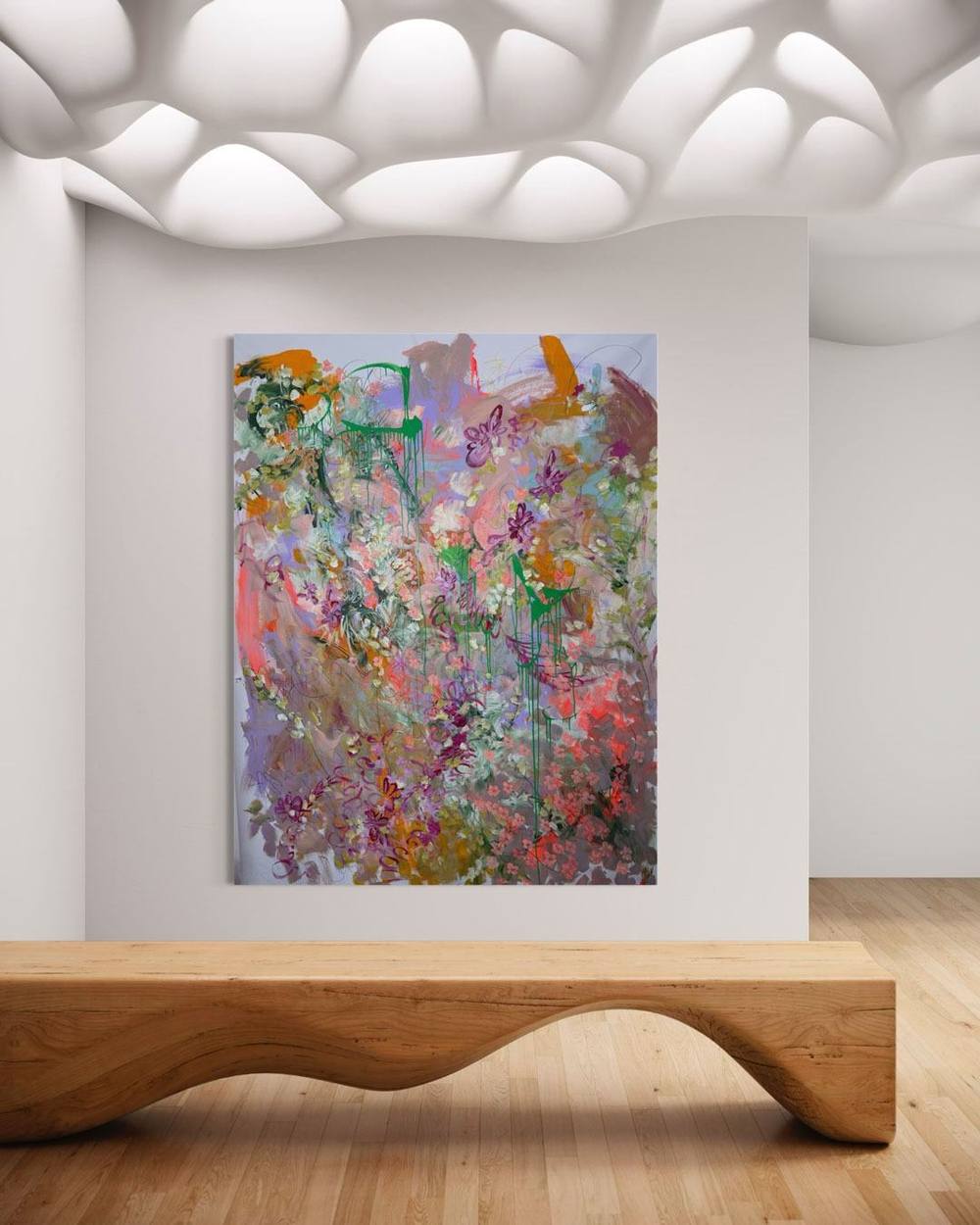
Abstract paintings have settled so naturally into museums and homes that it is easy to forget how young they are. A little over a century ago, a canvas without a recognisable subject was a provocation. Today abstraction is a language of its own, with dialects, schools and long-running disputes. This article sets it in order: what abstract painting is, how it began, which movements can be distinguished and how to recognise a good abstract original. It closes with the painting of Juliane Golbs, which has its own place in this story.
Abstract paintings: non-objective or abstracted
Tate defines abstract art as art that does not attempt to represent an accurate depiction of visual reality. It works instead with shapes, colours, forms and gestural marks. Within this broad field there is one distinction that helps a great deal in looking.
Abstracted pictures begin with something visible. A landscape, a figure or an object is simplified, broken down or dissolved into colour until only an echo remains. Non-objective pictures, by contrast, use forms with no source in the outside world: geometric planes, pure fields of colour, lines and gestures that refer only to themselves. Some artists preferred to call this concrete or non-objective art. Tate points out that the boundary between these terms is not always obvious.
For looking at a single painting the distinction is still useful. If you know a picture starts from a garden, you read its colours differently from a work concerned only with tension and balance. Many contemporary works deliberately move between the two poles: a motif can still be sensed, while the painting follows its own laws.
The beginnings: who painted the first abstract picture?
For a long time the answer seemed settled. Textbooks dated the birth of abstraction to the years 1910 to 1913 and linked it to Wassily Kandinsky. The question is more open today. It is better answered with several names than with one.
Hilma af Klint
According to the Centre Pompidou, the Swedish painter Hilma af Klint began making abstract pictures as early as 1906, at the age of 44. By 1915 she had completed the Paintings for the Temple, a cycle of 193 works. Af Klint stipulated that at least twenty years should pass after her death in 1944 before the works were shown. International recognition came late, not least through the exhibition The Spiritual in Art in Los Angeles in 1986.
Wassily Kandinsky
Kandinsky approached abstraction as both theorist and painter. His treatise Concerning the Spiritual in Art appeared in 1911. The Museum of Modern Art describes his Composition V of December 1911 as a radically new type of picture. In the years before the First World War, Kandinsky moved step by step away from the object. With his writing he also gave abstraction a reasoned foundation.
František Kupka
At almost the same moment František Kupka, born in what is now the Czech Republic, was working in Paris. MoMA counts him among the first artists to work in a fully abstract mode around 1910. He showed his painting Amorpha, Fugue in Two Colours at the Paris Salon d’Automne in 1912. It was among the first abstract paintings exhibited publicly in Paris. The public met it with consternation. Kupka reduced the picture to red and blue, interlacing like the voices of a fugue.
Anyone asking the pioneer question today reaches a sober conclusion. Between about 1906 and 1912, several artists in different places took the step into abstraction. Af Klint was early in time, Kandinsky and Kupka were early in public.
Malevich and Mondrian: pure form
Tate names Kazimir Malevich and Piet Mondrian as pioneers of “pure” abstraction from about 1910 to 1920. Neither was looking for nature dissolved any longer. Both sought a painting built from fundamental elements.
Malevich showed his Black Square in December 1915 in Petrograd, at The Last Futurist Exhibition of Painting 0.10. The first of four versions is dated 1913, though Tate considers 1915 the likely year it was painted. Malevich hung it high across the corner of the room, the place where an Orthodox icon would hang in a traditional Russian home. He called his approach Suprematism: the supremacy of colour and shape.
Mondrian called his painting Neo-plasticism. He limited himself to horizontal and vertical lines, to squares and rectangles, to primary colours and non-colours. He set out his theory in the journal De Stijl and belonged to the group until 1923. With Malevich and Mondrian the picture becomes an order that depicts nothing. They stand for the non-objective pole of abstraction.
After 1945: gesture, stain and improvisation
After the Second World War the emphasis shifted. In New York and Paris, almost simultaneously, a kind of painting emerged that relied less on order than on movement.
Abstract Expressionism
Tate uses the term Abstract Expressionism for the new forms of abstract art made by American painters such as Jackson Pollock, Mark Rothko and Willem de Kooning in the 1940s and 1950s. Since most of them worked in New York, the movement is also known as the New York School. Pollock and de Kooning represent action painting: spontaneous, improvised, often with large brushes. Pollock laid his canvases on the floor and poured paint onto them. The picture became the trace of a body moving around the surface.
Art Informel
In Europe, Art Informel arose at the same time. The French critic Michel Tapié used the term in 1952 in his book Un Art Autre. It describes improvised, highly gestural painting of the 1940s and 1950s. Wols, Jean Fautrier and Jean Dubuffet exhibited in Paris in 1952 in the exhibition Un Art Autre, while Hans Hartung and Pierre Soulages are counted among its other key figures. The term also covers Tachisme, the painting of the stain, as well as matter painting.
Lyrical abstraction
A related French tendency carries a more poetic name. The Musée Unterlinden describes how Georges Mathieu organised an exhibition at the Salon des Réalités Nouvelles in Paris in 1947 that he wanted to call “Towards Lyrical Abstraction”. The organisers rejected the title. The critic Jean-José Marchand nevertheless used the term in connection with the show. Among those exhibited were Wols, Hartung, Mathieu and Riopelle. Lyrical abstraction saw itself as the warm counterpart to geometric, “cold” abstraction.
Colour field painting: colour as space
Alongside the vehement gesture, New York also produced a quiet tendency. Tate describes colour field painting as abstract painting of the 1950s and 1960s with large areas of a more or less flat single colour. The term was first applied to Mark Rothko, Barnett Newman and Clyfford Still. Their pictures were meant to evoke a contemplative response.
Around 1960 a still purer form developed, for instance with Helen Frankenthaler, Morris Louis and Kenneth Noland. They set aside the mythic and religious content of Abstract Expressionism along with its personal, gestural handling. Colour field paintings work above all through scale and proximity: you stand before them as before a wall of light.
Modern abstract paintings today
Modern abstract paintings no longer have to belong to any of these schools. Many artists combine the gesture of Informel with the luminosity of colour field, the sign with the plane, the memory of an object with its dissolution. The old question of whether a picture is non-objective or abstracted remains a good key. It decides whether you may recognise something in a picture or whether you surrender entirely to the colour.
At the same time, abstract motifs are everywhere as decoration: as prints, posters and mass-produced wall art. That is exactly why it pays to look closely at what separates an original from a reproduction.
How to recognise a good abstract original
An abstract painting has no subject against which its quality could be measured. There are, however, criteria that can be tested on the picture itself.
Composition
A good composition holds even without a motif. You sense weight and counterweight, a direction, quiet zones beside dense passages. A useful test: step back a few metres. Does the picture hold as a whole, or does it fall apart into separate effects?
Layers
Good abstract painting has depth even when it shows no perspective. That depth comes from layers: glazed passages over opaque ones, a ground that shows through, marks painted over yet not entirely gone. Up close you can often read the order in which a picture was made.
Material
In abstraction, material is content. Matt and glossy areas, impasto and thin paint, chalk beside lacquer all change the way light lies on the surface. A good original uses its materials with intent and not as an effect.
The edge
How a painting ends at its edges reveals a great deal. Does the paint run over the sides of the stretcher, is the edge cleanly finished, does a frame belong to the work? In a carefully made original the edge is decided, not accidental.
Unique work, not print
A print reproduces the picture, a unique work is the picture. Relief, differences in sheen, runs of paint and fingerprints are lost in every reproduction. What edition, unique work and certificate of authenticity mean in detail is set out in the guide Buying abstract art in Hamburg.
Abstract paintings on canvas in the living room
Abstract paintings on canvas have one advantage at home: they tell no story you will eventually know by heart. Their effect changes with the light, with the time of day, with your own mood. A calm field of colour can gather a restless room, while a gestural work brings movement into a very ordered one.
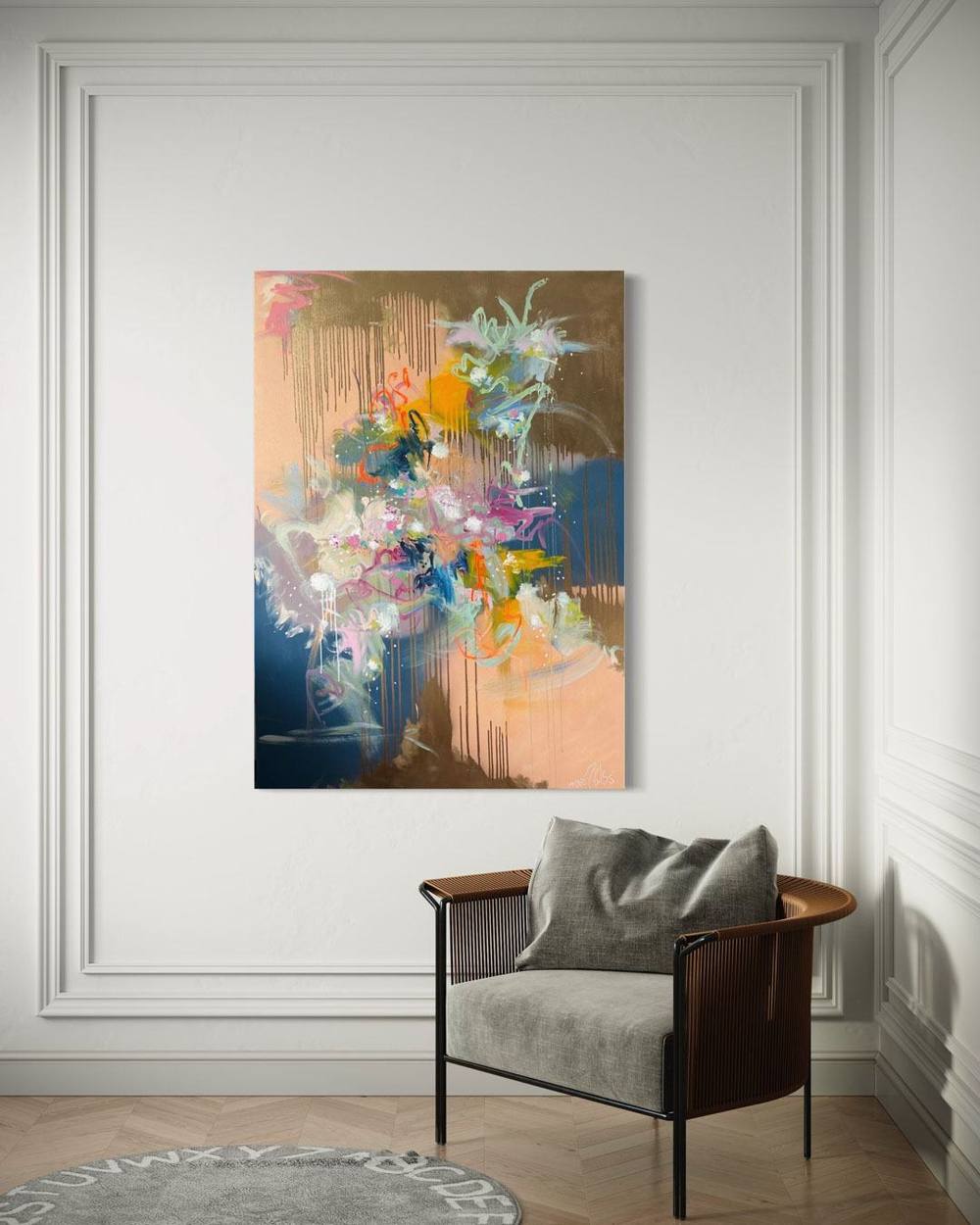
Questions of hanging height, light and grouping several pictures are covered in the article on living room art. If you are considering a statement format, the article on the large painting in the living room covers proportions and common mistakes.
Abstract paintings by Juliane Golbs
The Hamburg painter Juliane Golbs works with highly pigmented acrylics, with pastel and chalk, with lacquers and spray paint, with gold cream and 24-carat gold leaf. Much of it she applies with her bare fingers. Her pictures grow in layers that overlap and sometimes disappear again. In art-historical terms they stand closer to Informel and lyrical abstraction than to geometry.
Gold as order and light
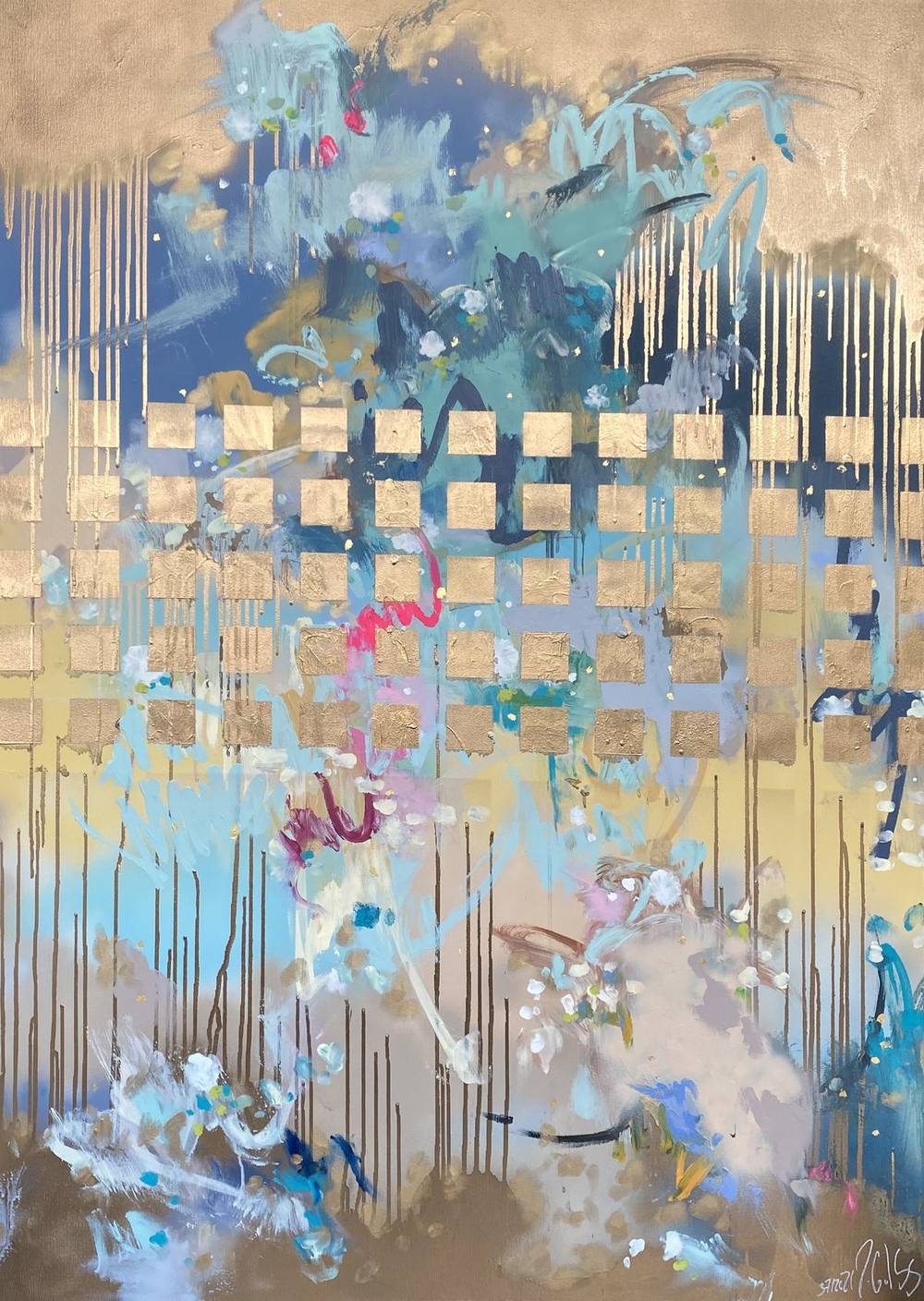
In 37 | 2021 from the Golden Things series, a grid of gold leaf lies over gesturally dissolved layers of blue, turquoise and sand. The picture is painted in acrylic, gold lacquers and gold leaf on canvas and measures 100 × 140 centimetres. Here the two poles of abstraction meet: the strict order of the squares and the free movement beneath.
Gesture on black
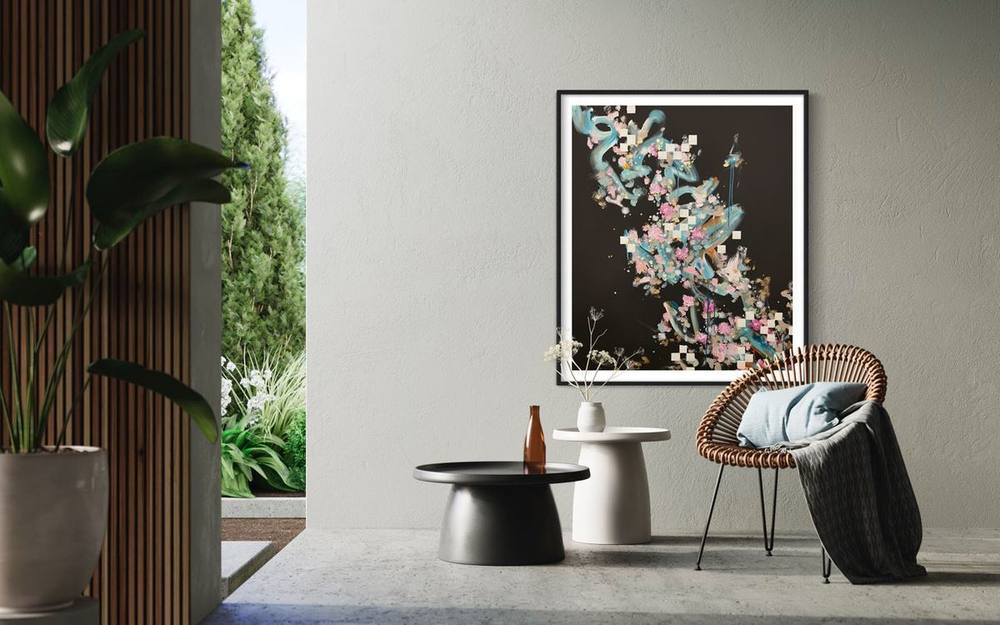
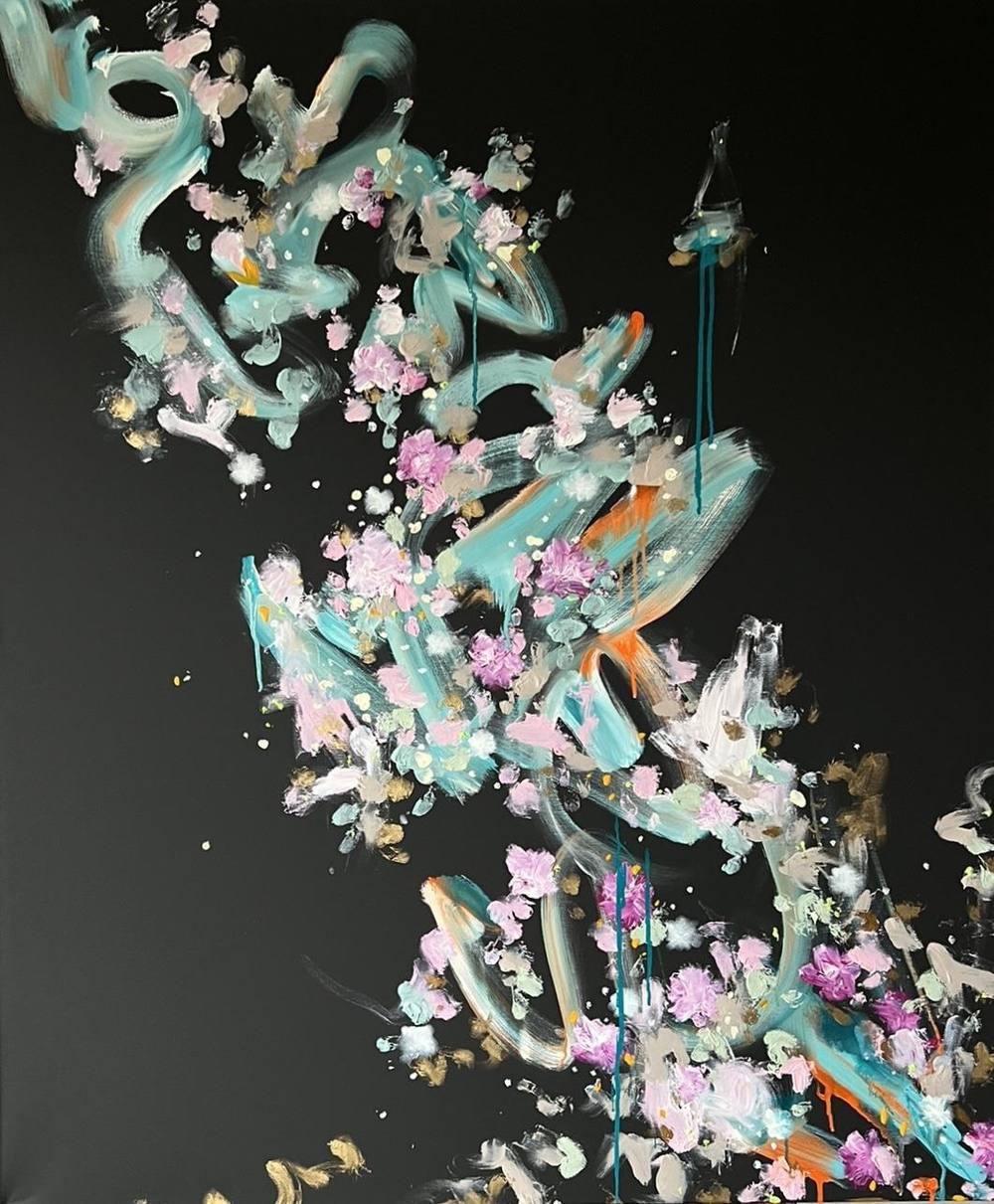
27 | 2022 from the Signature Collection shows a calligraphy of turquoise, white and pink breaking diagonally out of a black ground. The work measures 100 × 120 centimetres, acrylic on canvas. Its kinship with Informel is plain: the picture is the trace of a swift movement. A work such as 45 | 2021 on raw linen shows, by contrast, how close Golbs can stay to the object. An icon of the city is reduced to its skeleton, surrounded by bursts of coral and blue.
The garden dissolving
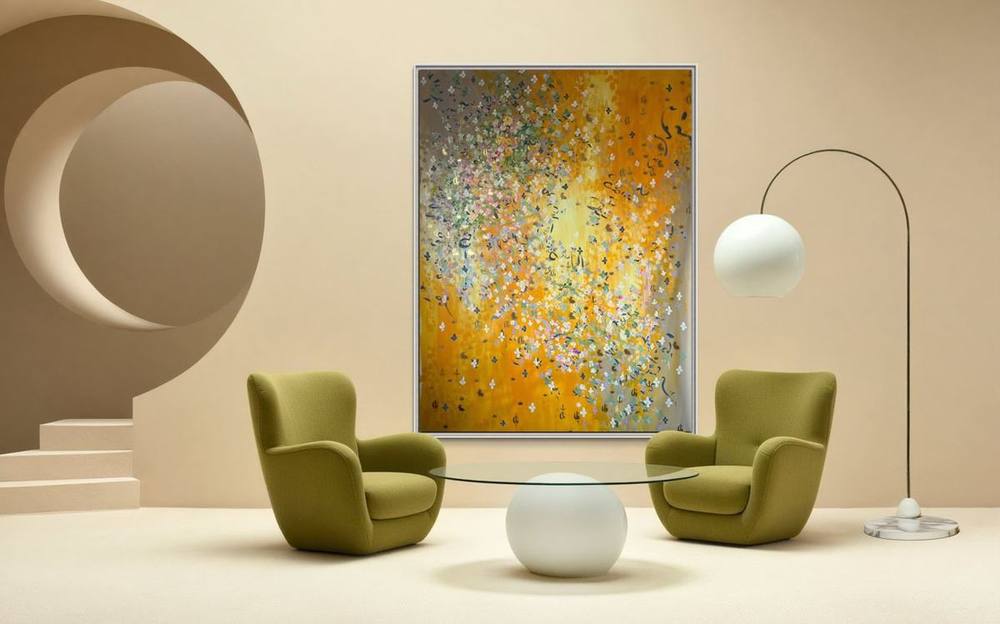
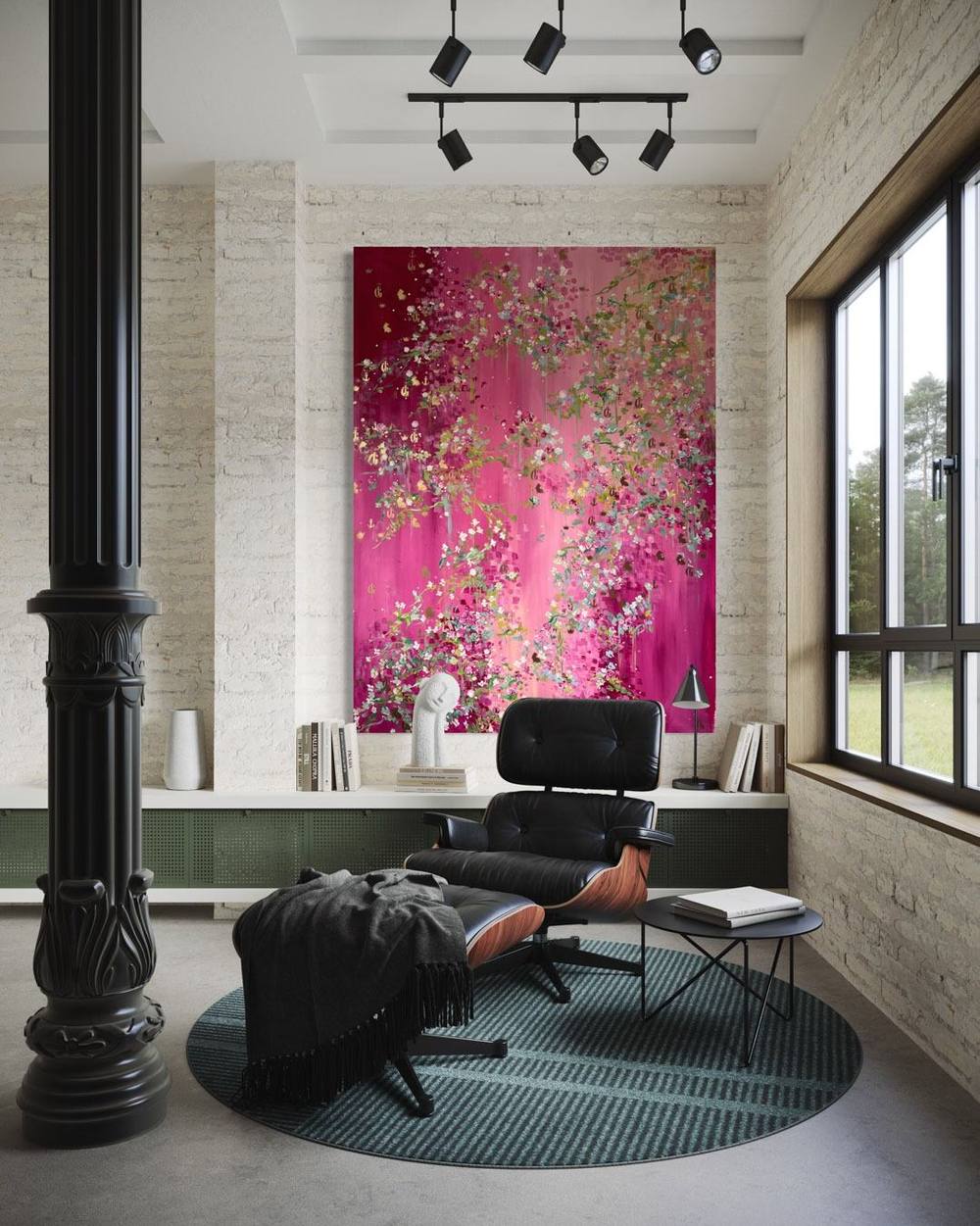
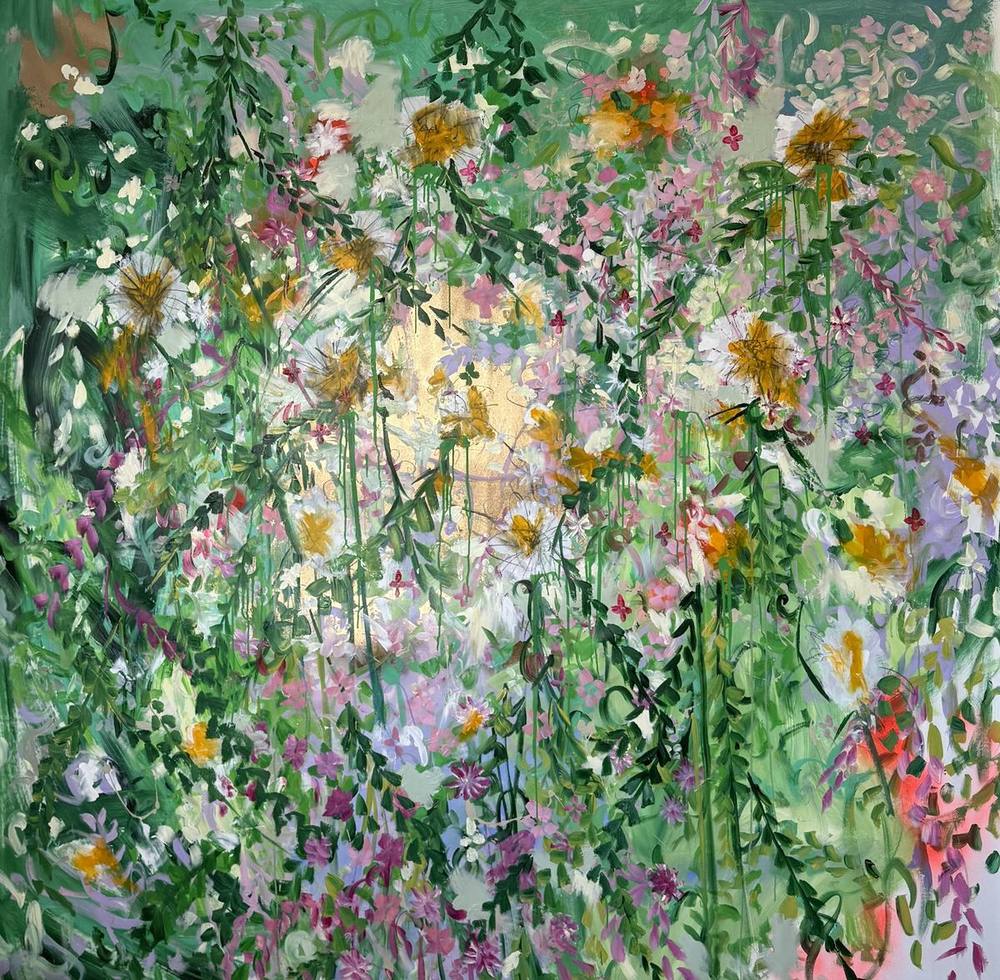
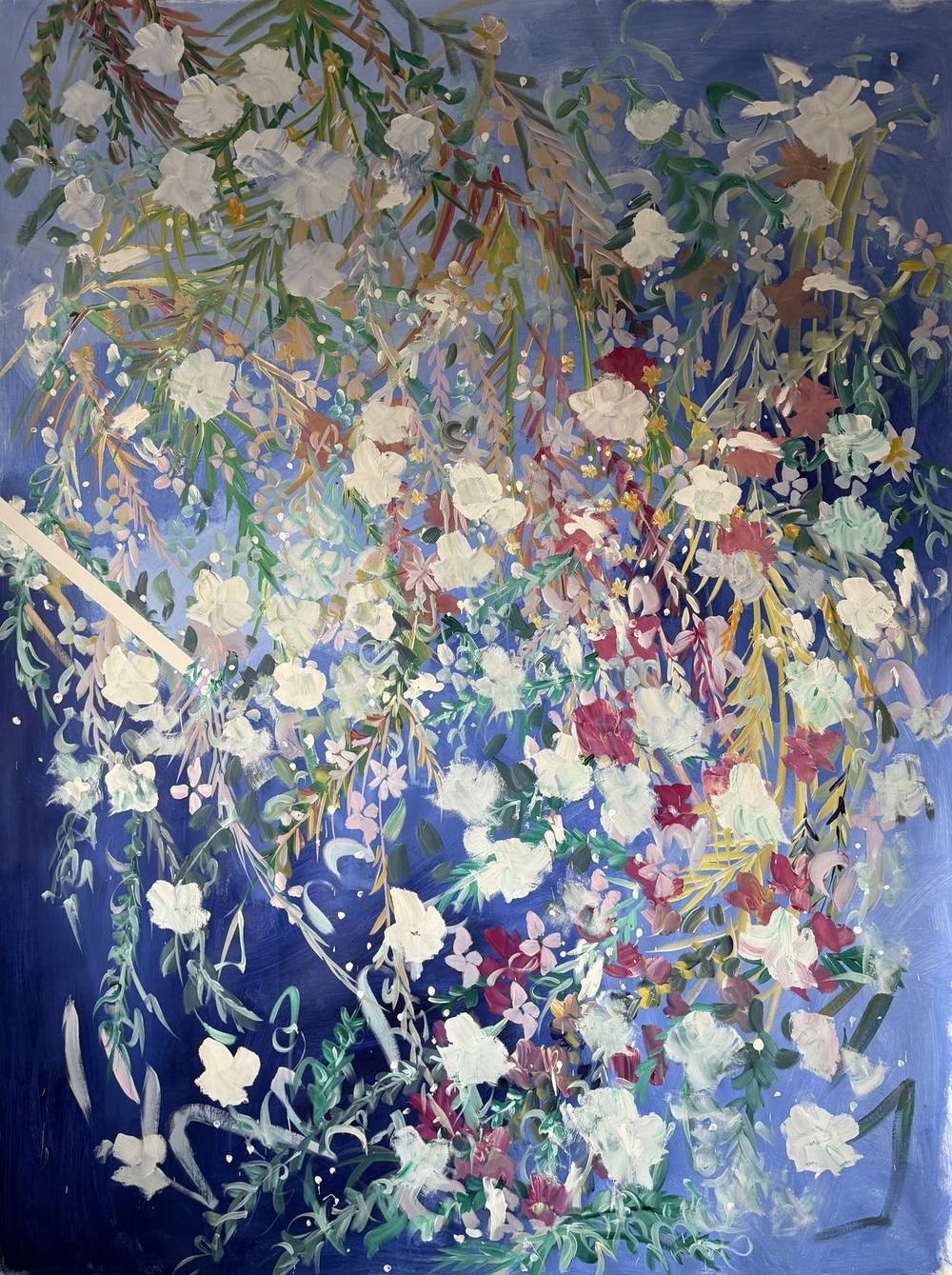
In the series Fifth Season and Fifth Season #heaven can wait, the starting point is often the blossom. 04 | 2025 is painted in acrylic, acrylic lacquers and gold lacquer on canvas, 200 × 200 centimetres. Gestural brushstrokes and flowing tendrils circle a luminous golden centre. 02 | 2025, at 150 × 200 centimetres, lets a cascade of pale blossoms fall through a blue depth. 515 | 2024 combines a deep magenta ground with accents of gold lacquer. These pictures are abstracted, not non-objective. How Golbs works with the floral motif, and the tradition it belongs to, is the subject of the article on abstract floral painting.
The edge in Juliane Golbs’s work
The criterion of the edge can also be observed in her paintings. Several works leave the conventional canvas behind. 12 | 2022 is painted on canvas over a frame, 01 | 2026 in acrylic and fabrics on a wooden panel over a frame. The transition between picture and border becomes part of the composition.
In other works the canvas itself remains visible. In 45 | 2021 the ground is raw linen, with the paint sitting on it like a drawing. Each of these works is unique, documented with dimensions, technique and series in the catalogue of works.
Seeing a painting before you decide
Abstract painting rarely reveals itself on a screen. Sheen, relief and the play of gold only show in a room, in changing light. In the catalogue the works can be filtered by colour, and the art advisor asks specifically about mood and format. For a small fee, credited against the purchase, any available work can be hung on trial. The studio in Hamburg opens by appointment via the contact form.
More than a hundred years after Kupka’s fugue in red and blue, abstraction is no longer a provocation. It is an invitation to look for longer.
Works from this article
Frequently asked questions
What is the difference between non-objective and abstracted painting?
Abstracted pictures start from something visible, such as a landscape or a figure, and simplify it. Non-objective pictures work with forms, colours and gestures that have no model in the outside world. In practice the boundary is often fluid.
Who painted the first abstract painting?
The question remains open. Wassily Kandinsky, around 1910 to 1913, was long regarded as the founder, while František Kupka was painting abstractly in Paris at the same time. The Swedish painter Hilma af Klint began her abstract works as early as 1906, yet they only became known decades after her death.
What is the difference between Art Informel and Abstract Expressionism?
Both emerged in the 1940s and 1950s and work in a gestural, improvised way. Art Informel refers mainly to the European tendency, with artists such as Wols, Jean Fautrier and Hans Hartung. Abstract Expressionism is the American movement rooted in New York, around Jackson Pollock, Willem de Kooning and Mark Rothko.
How do I recognise a good abstract original?
By a composition that holds, by visible layers, by materials used with intent and by edges that belong to the picture. Seen up close, a unique work shows traces that a print cannot reproduce: relief, differences in sheen, runs of paint.
Which abstract paintings suit a living room?
That depends on light, wall space and mood. Calm fields of colour settle a room, gestural works bring movement into it. The articles on living room art and on large paintings give guidance on format and hanging.
Are Juliane Golbs’s paintings non-objective?
Mostly not. Her works are abstracted: blossoms, gardens, signs or the silhouette of a city dissolve into colour, gesture and gold, yet often remain legible as a memory.
Sources
10 sources
- Tate: Abstract art (Art Term)
- Centre Pompidou: Hilma af Klint, the unsung pioneer of abstraction
- The Museum of Modern Art: Vasily Kandinsky
- The Museum of Modern Art: František Kupka, Amorpha: Fugue in Two Colors (1912)
- Tate: Five ways to look at Malevich’s Black Square
- Tate: Neo-plasticism (Art Term)
- Tate: Abstract expressionism (Art Term)
- Tate: Art informel (Art Term)
- Tate: Colour field painting (Art Term)
- Musée Unterlinden: Lyrical abstraction (gallery sheet)