Painting with fingers: from the cave wall to the present day
The hand was painting’s first tool, and it has never quite left it. A history of finger painting in art, from the cave wall to a studio in Hamburg.
Before there were brushes, there was the hand. Painting with fingers is the oldest way of bringing colour to a surface. It is also the most direct: no tool stands between body and picture. Art history has often consigned this closeness to the nursery. Yet it returns again and again wherever painters have wanted to close the last distance to the picture, on the cave wall as much as in Titian’s late work.
The first traces on the cave wall
In the cave of Rouffignac in the Dordogne, also known as the Cave of a Hundred Mammoths, people drew their fingers through the soft surface of walls and ceilings. The archaeologist Jess Cooney and Leslie Van Gelder of Walden University studied these so-called finger flutings. In 2011 the University of Cambridge reported that they are probably at least 13,000 years old and date from the same period as the painted and engraved animals. Many were left by children aged between three and seven, most of them by a girl of about five. One chamber is so densely marked by children that it may have been a space of their own. Whether it was used for play or for ritual cannot be said.
On the other side of the world, in the Cueva de las Manos in Argentine Patagonia, the second primal form appears. Here the hand itself served as a stencil, leaving its outline as a negative on the rock. UNESCO, which inscribed the site on the World Heritage List in 1999, describes the pigments: iron oxides, kaolin and manganese oxide, ground and mixed with a binder. The imprint of the hand is not a means to an image there. It is the image.
Titian: more with his fingers than with the brush
One of the best-known accounts of painting with the fingers in European art comes from Venice. In 1674 Marco Boschini published, in Le ricche minere della pittura veneziana, the account of the painter Palma il Giovane, who had seen Titian at work. According to it, Titian blended the transitions from highlights to half-tones with his fingers for the final touches. With a smear of his fingertip he set a dark accent in a corner, with a dab of red he enlivened a surface. The account closes, in essence, with the observation that in the final stages he painted more with his fingers than with the brush.
Many contemporaries thought the old painter no longer able to work because of his trembling hands, as Oskar Bätschmann notes in a research report for the National Gallery of Art in Washington. Palma’s account tells a different story: the hand kept working, simply more and more often without the brush. When Titian died on 27 August 1576, he left his Pietà unfinished. Palma il Giovane took the picture into his studio and added a Latin inscription: what Titian left unfinished, Palma reverently completed and dedicated to God.
Leonardo and the print in the portrait
Leonardo da Vinci, too, left marks of his hand that can still be seen. The National Gallery of Art in Washington, which acquired his portrait of Ginevra de’ Benci in 1967, points out that Leonardo blended parts of the painting with his hands. His fingerprints are visible in the paint. He painted the portrait around 1474 to 1478, in his early twenties.
For Leonardo the finger served blending, the soft transition between light and shadow. That his prints have survived in the paint gives the portrait today an added, almost private closeness to its painter.
Ruth Faison Shaw and finger paint
Finger painting became linked with school and childhood through an American educator. Ruth Faison Shaw ran her own school in Rome from 1922 to 1932. There, as the encyclopaedia NCpedia records, she discovered painting with the fingers as a means of expression and devised her own formula for finger paint. Her book Finger Painting: A Perfect Medium for Self-Expression appeared in 1934.
The title alone states the programme. Finger painting appears there as a medium of self-expression, a way into the picture with no tool between hand and surface. The idea reaches far beyond the classroom.
Chuck Close: the portrait made of fingerprints
In twentieth-century art the finger returned as a deliberate method. In the mid-1980s the American painter Chuck Close developed a technique in which he applied paint directly to the canvas with his fingertips. His painting Fanny/Fingerpainting of 1985, in the National Gallery of Art, measures about 259 × 213 centimetres. It shows his wife’s grandmother, in oil on gessoed canvas.
Close varied the amount of pigment and the pressure of his finger to build a whole scale of tones. From a distance the picture looks like a silvery photograph. Up close it breaks into individual fingerprints, whose abstract beauty the museum singles out. The face and the trace of the body that painted it lie on the same surface.
Painting with fingers in the work of Juliane Golbs
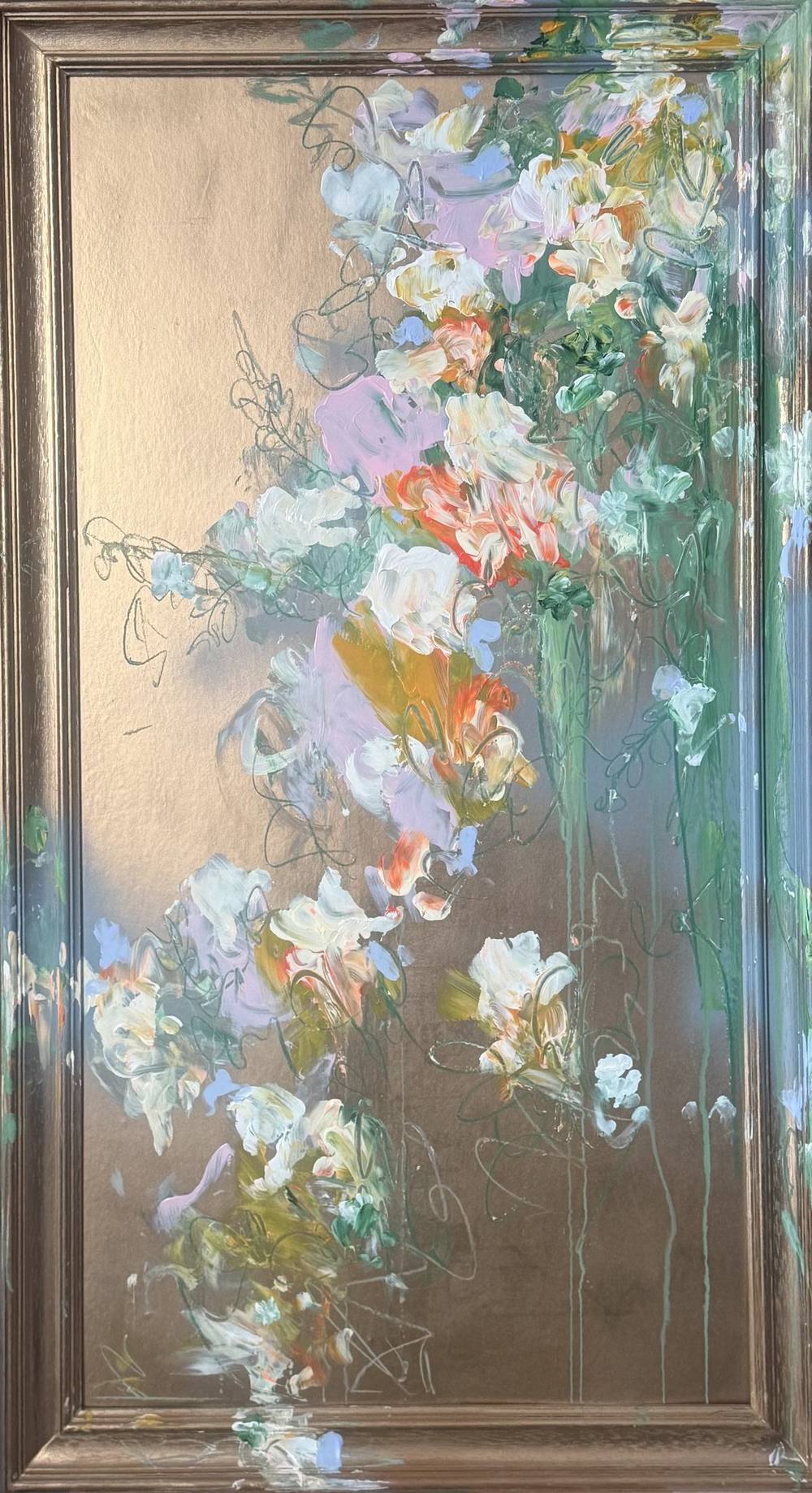
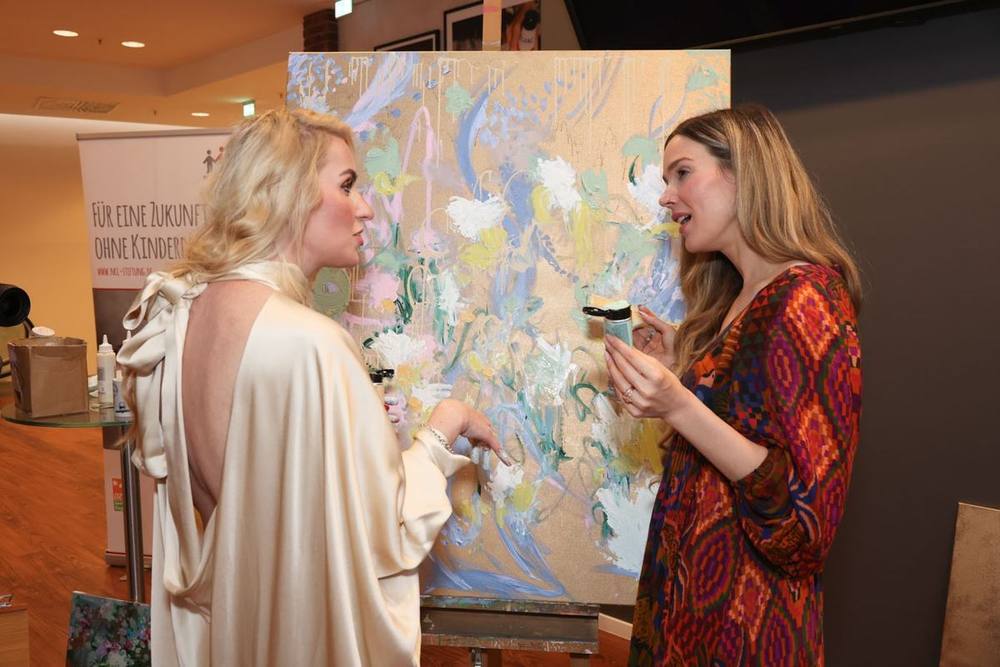
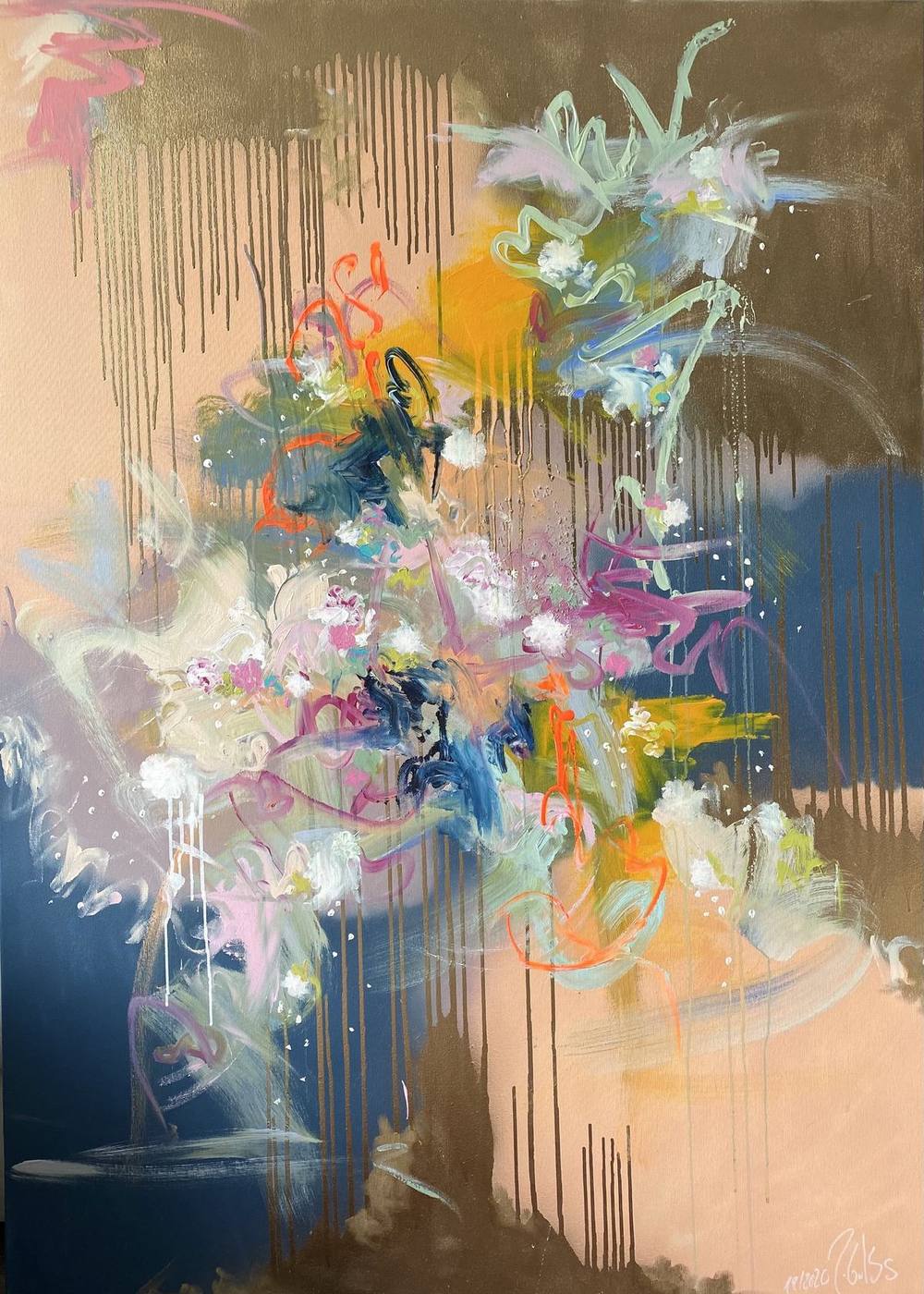
In the painting of Juliane Golbs the finger is not an exceptional tool. She works with highly pigmented acrylics, with pastel and chalk, with lacquers and spray paint. Much of it she applies with her bare fingers. How the material itself behaves is the subject of the article Acrylic on canvas.
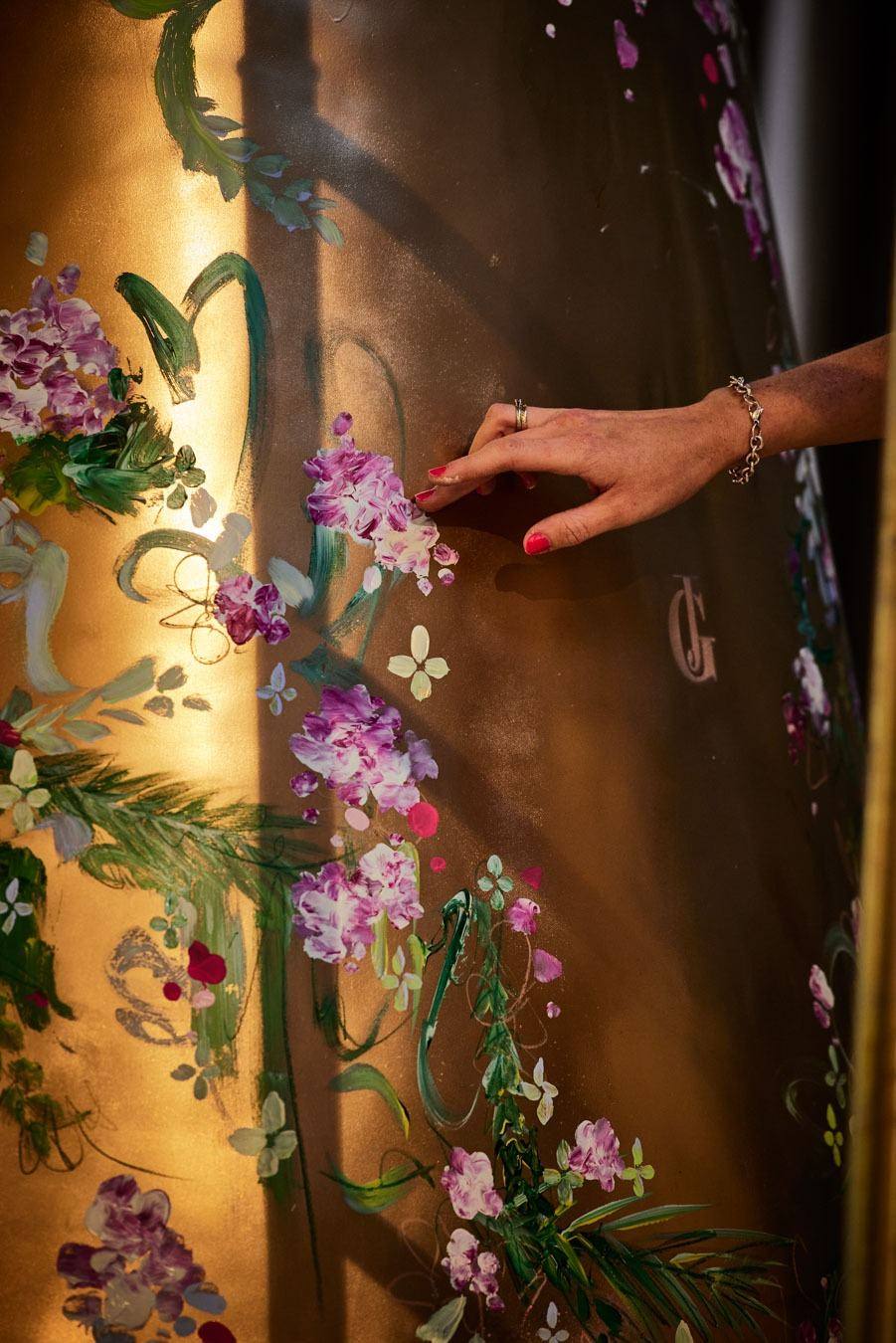
In the making of a picture there is a phase in which line and gesture arrive. Here Golbs works quickly and physically, with fingers, brush, chalk and spray can. Drips may remain where they give the picture depth. That this way of working is no studio ritual was shown at Venice Design Week 2025: on the opening evening she painted a hare sculpture some 3.5 metres tall in front of an audience, with brushes, spray paint, her bare fingers and fine detail. The guests could follow how colour, light and form came together layer by layer.
The hand stays involved in the works with 24-carat gold leaf and gold creams as well. Between the layers of gold lie acrylic, pastel, chalk and lacquer, and Golbs applies many of these layers with her fingers. How the gold is bound into the painting is described in the article Gold leaf in painting.
What the trace of a finger means
A brush mediates between hand and surface, taking up paint and spreading it evenly. The finger, by contrast, passes the pressure of the hand almost unfiltered to the surface. A layer of paint applied with the fingers therefore carries the speed and weight of a single movement that cannot be repeated. This is the difference between trace and gesture: the trace is the imprint, the gesture the movement that produced it.
The history of finger painting knows two directions. With Leonardo and in Titian’s final stages the finger smooths, joining light and shadow. With Chuck Close the print itself becomes the building block of the picture. Juliane Golbs moves between the two poles: some areas are calmed, while elsewhere the movement remains openly visible, as a dab, a drip, a stroke.
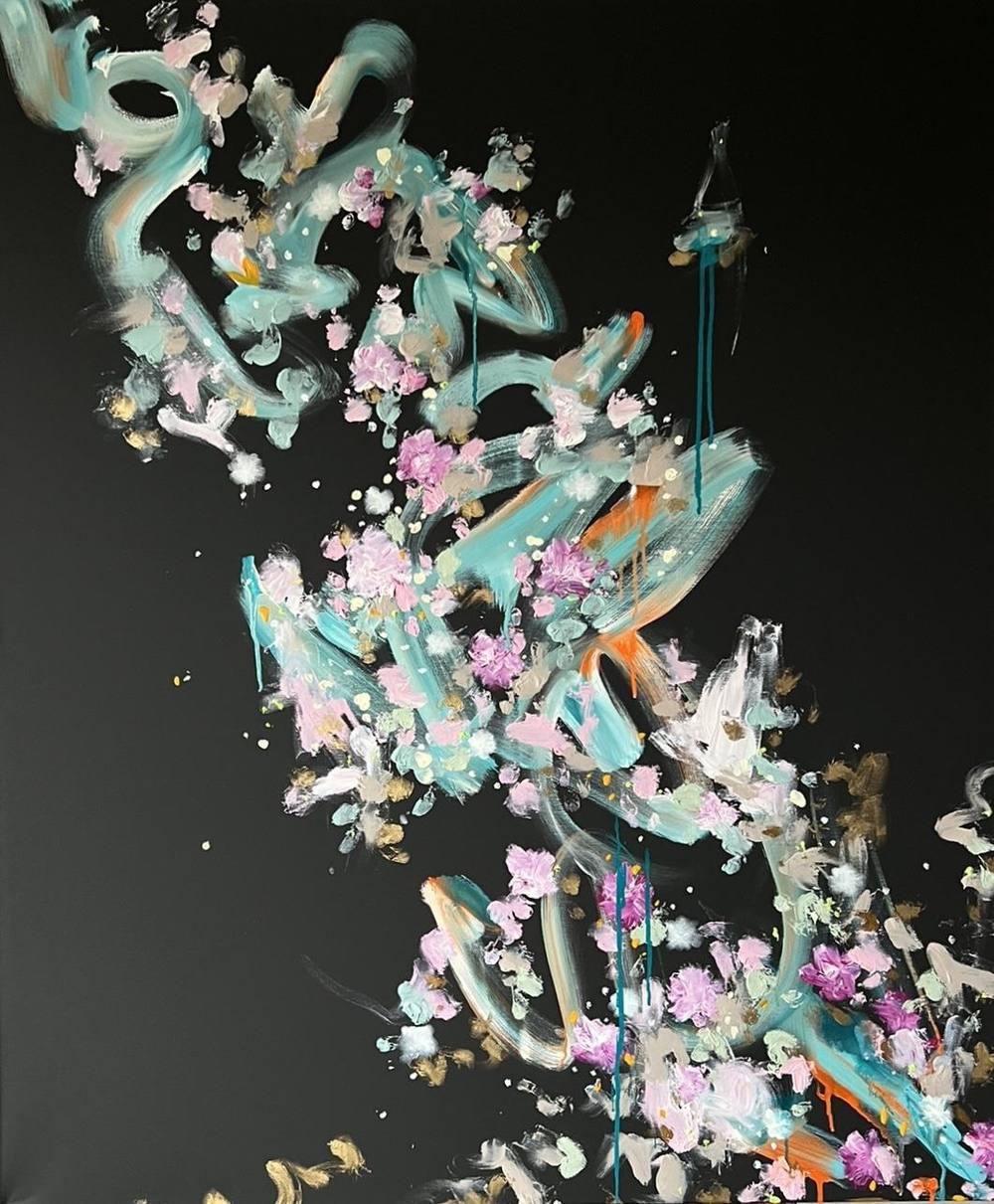
How strongly such a movement can carry a picture is shown by 27 | 2022 from The Signature Collection. A broad trail of turquoise and mint rises out of the black surface, twists and swings on like a piece of handwriting whose meaning stays open. The paint is applied thickly and stands in relief. In 19 | 2020 from the series Golden Things, gestural lines gather into a whirling centre, surrounded by a calm ground of apricot and gold lacquer. 36 | 2021, too, lives entirely from the trace of the arm and the rhythm of the paint.
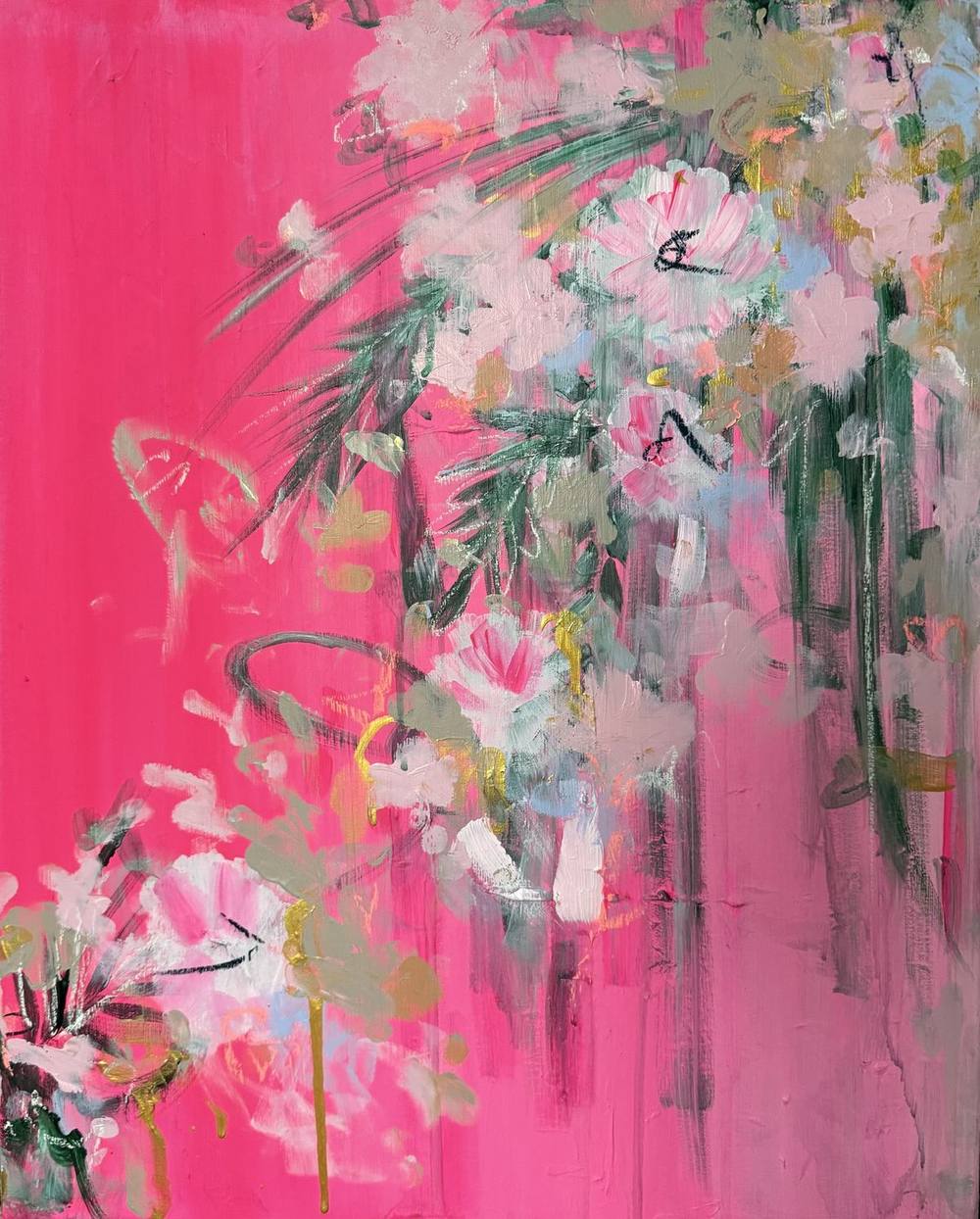
In the series Fifth Season #heaven can wait drawing comes to the fore. 05 | 2025 combines opaque blossoms with fleeting strokes and vertical drips, while the small 07 | 2026 sets white blossoms and a form drawn in chalk against a glowing pink. Up close, the pictures in this series dissolve into paint applied with the fingers, into drips, pencil lines and small islands of gold. Some lines there belong to a second hand: a number of the marks were made by the artist’s daughter. The personal story behind them is told in the article When time becomes precious.
Seeing the hand up close
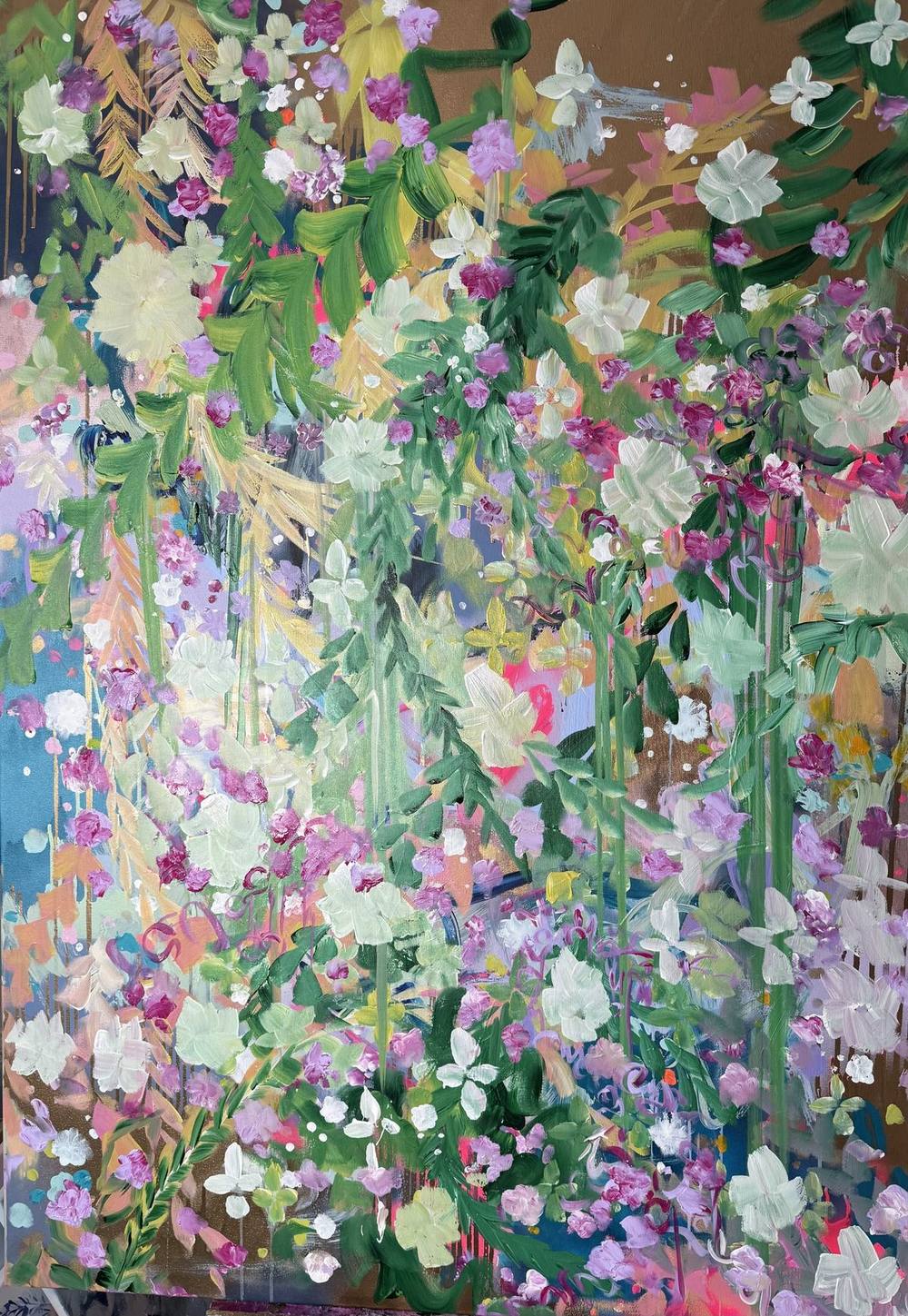
A picture in which the hand remains visible asks for two distances. From afar one sees blossom, garden and light, up close the relief of the layer, the direction of a smear and the point where a movement lifted off. Raking light from the side makes this structure especially clear. In the evening, under warm light, gold and lacquer come forward more strongly.
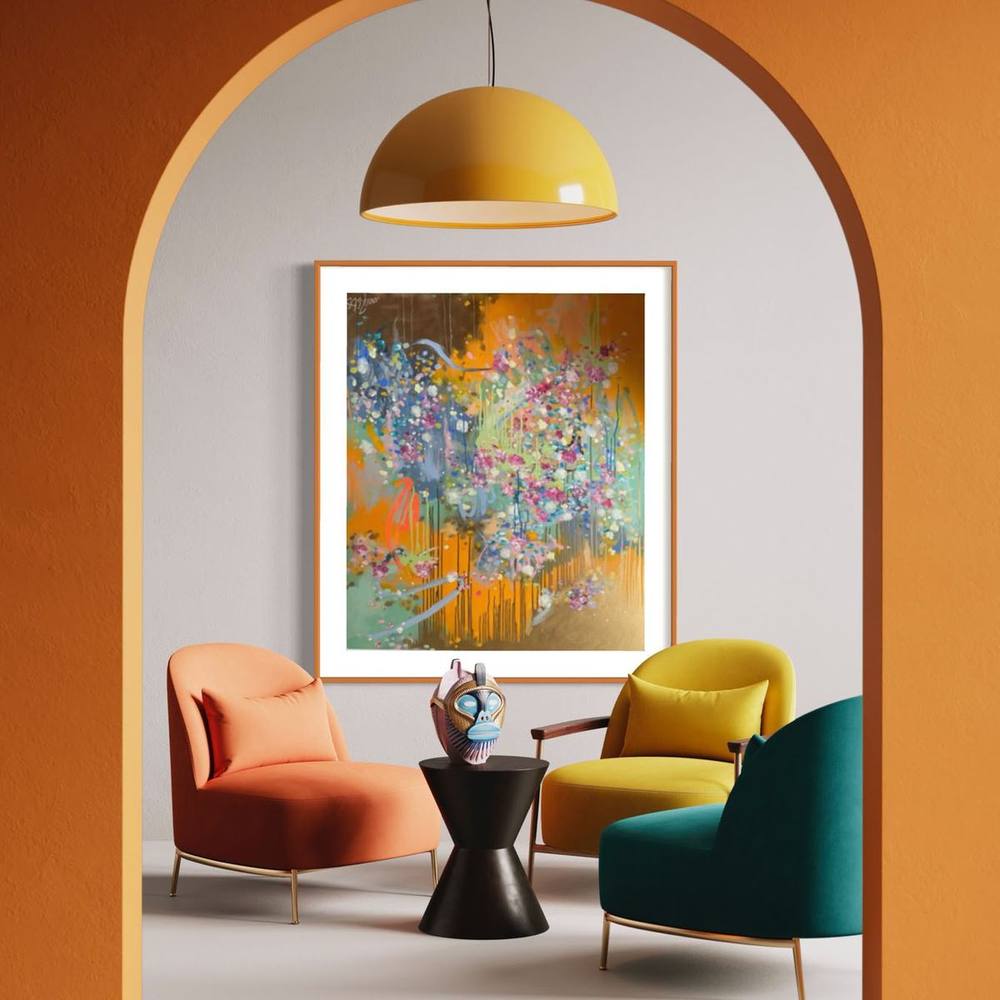
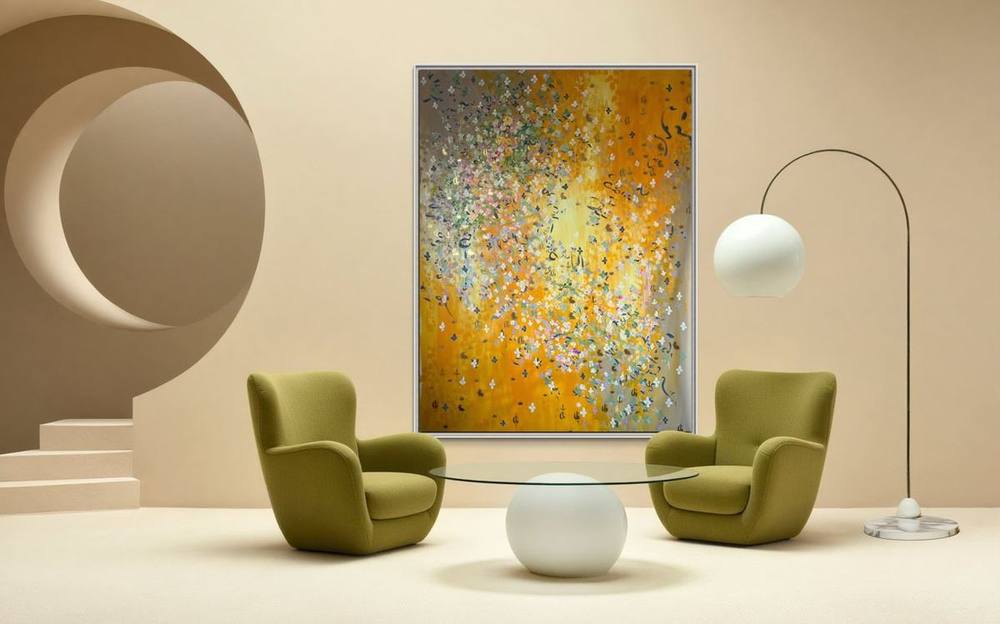
For collectors this way of working has a simple consequence. Every finger mark is singular, so every painting is a unique work that cannot be reproduced. The catalogue of works shows which pieces are available, with dimensions and technique. Anyone who would like to see an original up close in the studio can reach Juliane Golbs through the contact form.
From the finger flutings of Rouffignac to blossoms on a golden ground, finger painting in art rests on a single experience: the picture keeps the touch from which it was made.
Works from this article
Frequently asked questions
How long have people been painting with their fingers?
Since the Palaeolithic. In the cave of Rouffignac in the Dordogne, people drew their fingers through the soft surface of walls and ceilings. According to the University of Cambridge, these finger flutings are probably at least 13,000 years old, and some were made by children aged between three and seven.
Did Titian really paint with his fingers?
In 1674 the Venetian writer Marco Boschini recorded the account of Palma il Giovane. According to it, Titian blended transitions with his fingers in the final stages, set dark accents with a fingertip and in the end painted more with his fingers than with the brush.
Who developed finger paint?
The American educator Ruth Faison Shaw devised her own formula for finger paint while running a school in Rome between 1922 and 1932, where she discovered painting with the fingers as a means of expression. Her book on finger painting appeared in 1934.
Does Juliane Golbs paint with her fingers?
Yes. She applies many layers of paint with her bare fingers, alongside brushes, chalk, pencils and spray paint. The trace of the hand remains visible in the picture and makes every work unique.
Sources
8 sources
- University of Cambridge: Prehistoric pre-school (30.09.2011)
- UNESCO World Heritage Centre: Cueva de las Manos, Río Pinturas
- Sotheby’s: Tiziano Vecellio, called Titian (Important Old Master Paintings, 2011, Lot 156)
- Art-Test: A painting by Titian finally correctly attributed
- National Gallery of Art, CASVA: Oskar Bätschmann, Research Report 2012–2013
- National Gallery of Art: 10 Surprising Facts about Ginevra de’ Benci
- NCpedia: Shaw, Ruth Faison
- National Gallery of Art: Chuck Close, Fanny/Fingerpainting (1985)