Buying art online: what to look out for
A painting you know only from a screen deserves a closer look. What matters when you buy online, from the dimensions to the right of withdrawal.
Buying art online means deciding on a work you first know only as a field of light on a screen. A painting, however, is an object with weight, surface and dimensions, and these are exactly the qualities most easily lost on the way to the internet. This article gathers the questions worth asking before you buy from a distance: about size, about colour, about the kind of work, about condition and paperwork and about the right of withdrawal. The broader questions of buying art, of light, care and tax, are covered in the guide Buying abstract art in Hamburg. Here the focus is on what changes when you buy without standing in front of the picture.
Judging the dimensions realistically
The most common surprise with an online purchase is size. On a phone, a picture measuring 30 × 40 centimetres looks just as large as one measuring 200 × 200 centimetres. Read the dimensions first and transfer them to your own room. The simplest tool is masking tape: mark the outer edges of the picture on the wall, step back and look at the area from the distance at which you will later see the work. A rectangle of tape tells you more about the effect than any figure.
Pay attention to the order of the figures as well. In Juliane Golbs’s catalogue the dimensions are given as width × height, which elsewhere is not always clear. If in doubt, ask. A portrait and a landscape format with the same numbers call for entirely different walls.
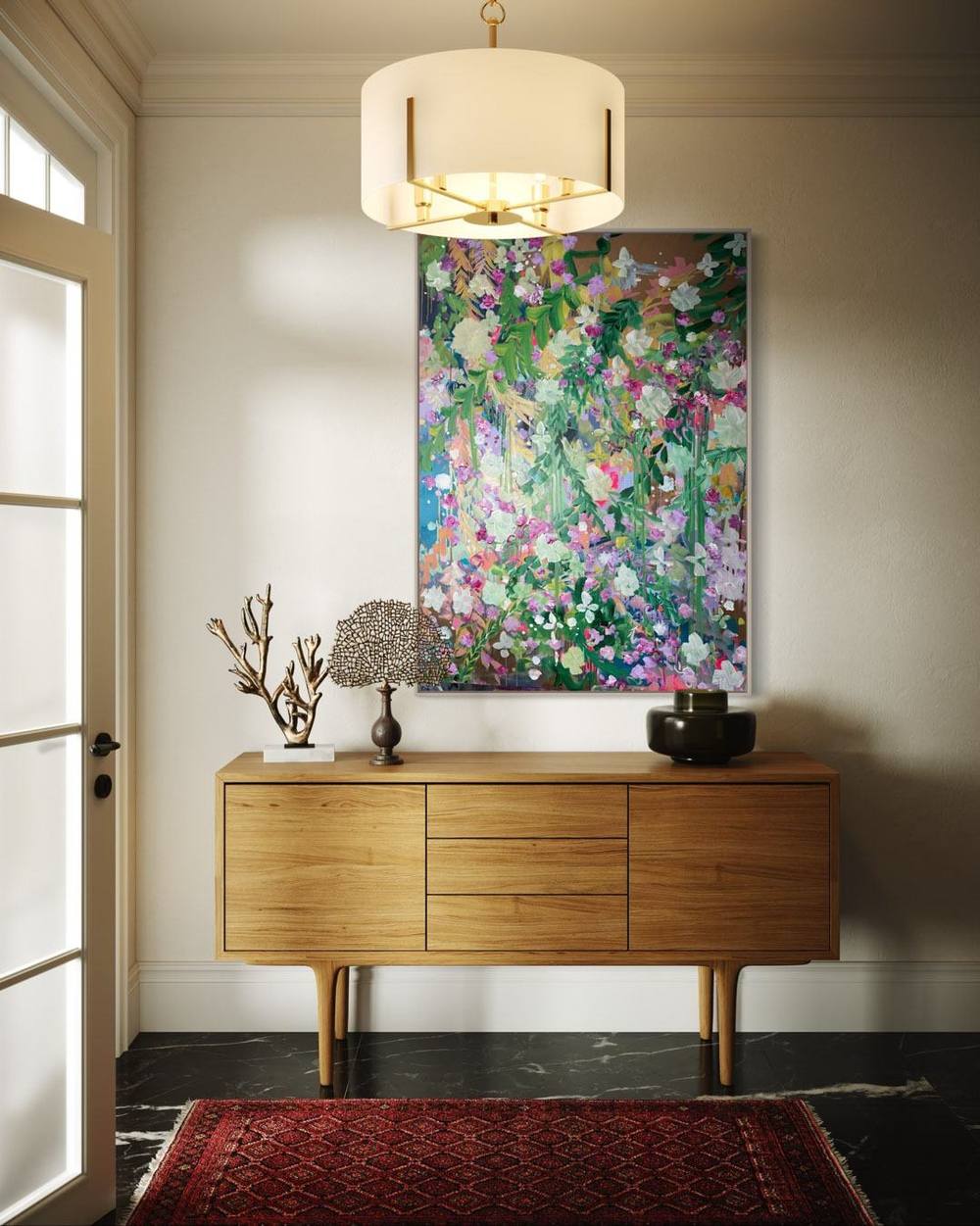
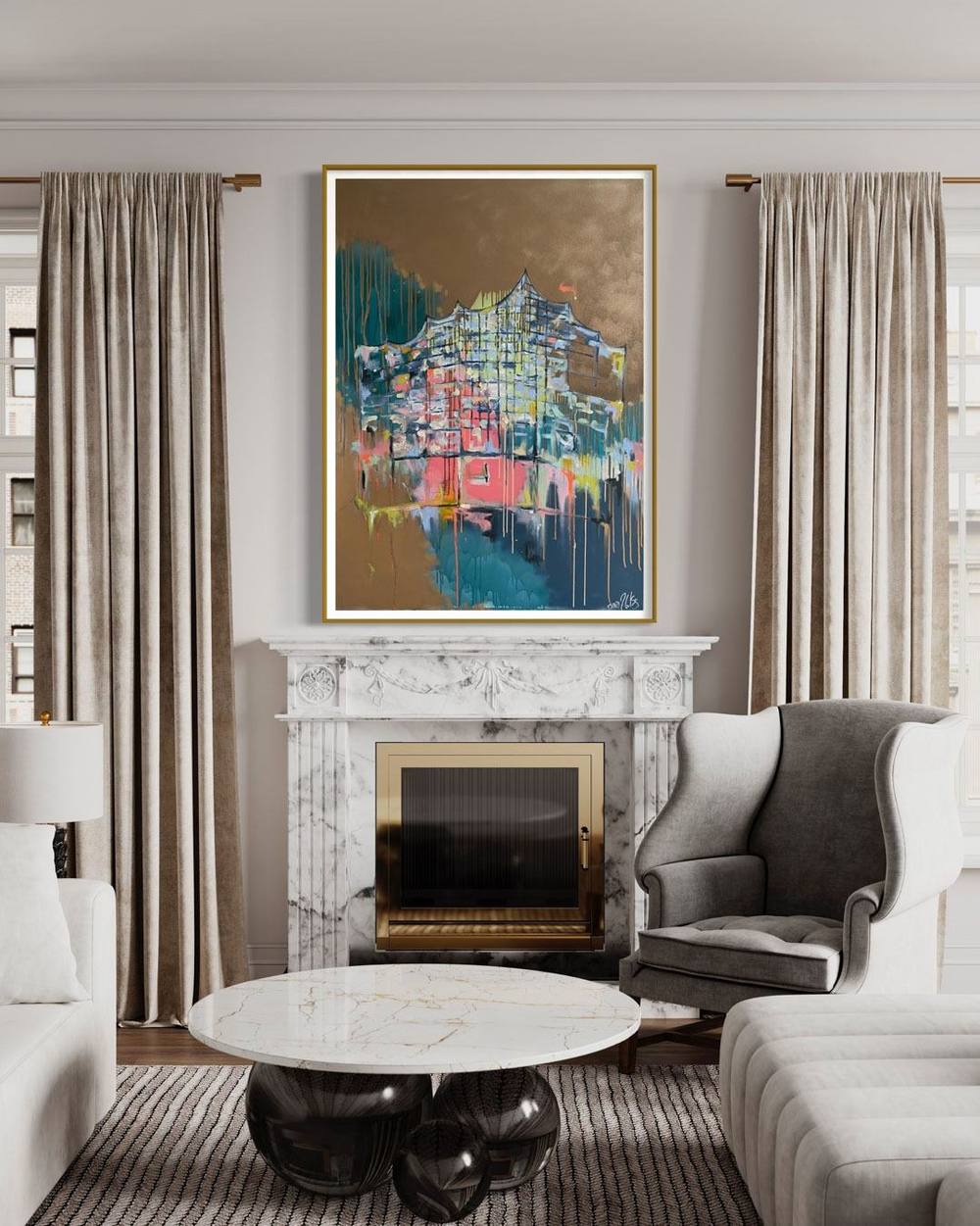
Every work page in the catalogue also offers an “In the room” view. It shows the work to scale beside a door of 200 × 80 centimetres, a sideboard of 120 × 45 centimetres and an armchair of 85 × 90 centimetres, with the centre of the picture at 150 centimetres, as is customary in museums. It makes plain that 07 | 2026, at 30 × 40 centimetres, is a picture for a chest of drawers or an alcove, while 04 | 2026, at 200 × 200 centimetres, reaches the height of a door.

Photographs and colour on screen
A photograph is a translation. Camera, lighting and editing decide how a picture appears online, and on top of that every screen renders colour slightly differently. Brightness, colour temperature and night mode shift the tones further. A cool petrol can look greenish on one device and almost blue on the next. Look at a work on more than one device, ideally by day and in the evening.
Reputable sellers show more than a single frontal shot. Detail photographs help, as do pictures in raking light and views of the edge and the back. They reveal whether the paint sits thickly or runs smoothly, whether the painting continues around the edge and how the stretcher is made. If a view is missing, ask for it.
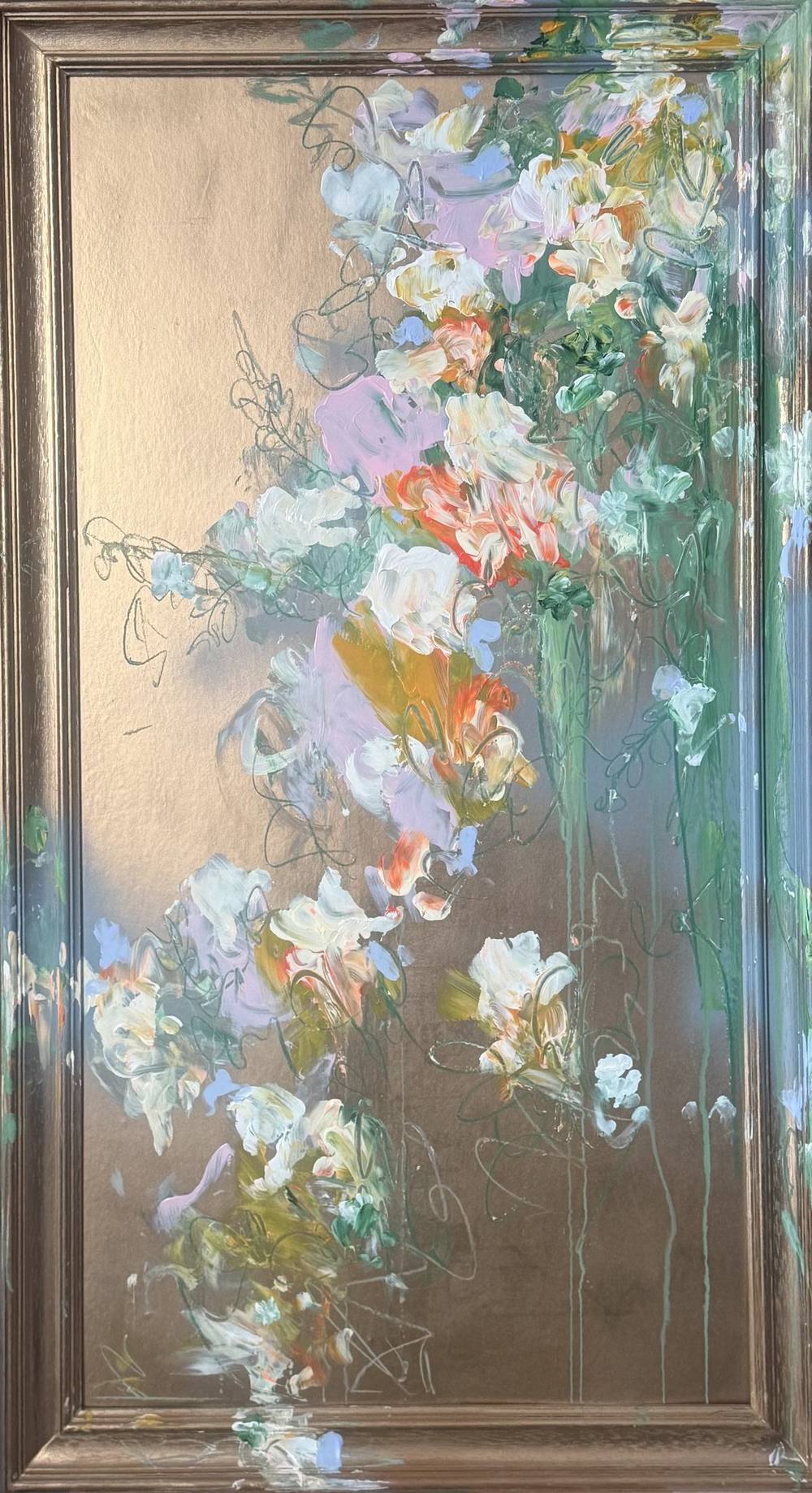
Metals and lacquers are particularly hard to photograph. Gold, bronze or glossy layers of lacquer change with the angle of view, and a photograph captures only one of them. In 01 | 2026, for instance, painted in acrylic and fabrics on a wooden panel set over a moulded frame, the ground shimmers in bronze and champagne. On screen it becomes a warm surface. In the room it is a sheen that moves with the light.
Original, edition or print
If you want to buy an original painting online, first make sure that it really is one. Online, unique works, numbered editions and open prints often sit side by side, with similar photographs and sometimes similar titles. A unique work exists exactly once, an edition appears in a fixed, numbered run, a print is a reproduction. Each has its place, but they are different things.
The description should say so plainly. If it does not, ask: is the work one of a kind? If it is an edition, how large is the run and which number will I receive? Is it signed by hand? Juliane Golbs’s paintings are hand-signed unique works, and she applies many of the layers with her fingers. How originals, editions and prints differ in price is explained in How much does a painting cost?.
Technique and condition
When buying online, the details of a work stand in for the close look you would take in the studio. Title, year, technique, dimensions and support should all be given. The technique tells you about the surface: “acrylic, gold lacquer on canvas”, as with 515 | 2024, means a matt ground with glossy accents, while “acrylic, gold leaf on canvas”, as with 42 | 2021, means a work with gold leaf that catches raking light. The support matters too. A canvas behaves differently from a painting board such as that of 501 | 2024, whose smooth surface lets the colours stand out with particular clarity.
Information on condition is often missing online. For older works or second-hand purchases, ask specifically: are there scratches, dents, cracks in the paint layer or discolouration? Has the work been restored? How is it framed? Is a hanging fixture fitted? Ask for photographs of any areas in question and keep the answers in writing.
Certificate of authenticity and paperwork
An original comes with documentation. The certificate of authenticity gives title, dimensions, technique and year of creation, alongside the signature on the work and an invoice. When buying from a distance these papers carry more weight, because they are the only thing you can check before delivery. Ask before you buy whether a certificate is included, who issues it and whether its details match the work page.
What a good certificate contains and how to keep it is described in the article on the certificate of authenticity for art. Keep the certificate, the invoice and a photograph of your own together.
Buying art online: the right of withdrawal in Germany
Anyone buying a painting online in Germany will want to know whether it can be returned. The German Civil Code answers this, and the answer depends on the kind of contract. Under § 312g(1) BGB, a consumer has a right of withdrawal under § 355 BGB for distance contracts. Under § 312c BGB, a distance contract is one between a trader and a consumer in which only means of distance communication, such as letters, telephone calls or emails, are used to negotiate and conclude it. If you buy from a private individual, this condition is not met.
Under § 355(2) BGB the withdrawal period is 14 days. For goods it usually begins, under § 356(2) BGB, once the consumer has received them. Under § 356(3) BGB, however, it does not begin before the trader has properly informed the consumer of the right of withdrawal. According to § 356(4) BGB the right expires at the latest twelve months and 14 days after receipt of the goods. No reason has to be given, and sending the withdrawal in time is enough to meet the deadline.
One exception matters particularly for art. Under § 312g(2) no. 1 BGB there is no right of withdrawal for contracts for goods that are not prefabricated and whose production depends on an individual choice or specification by the consumer, or that are clearly tailored to the consumer’s personal needs. This can apply to a commission created to your specifications for format or colour. The exception applies unless the parties agree otherwise. Whether, and how, a right of withdrawal applies to a particular purchase is therefore worth clarifying with the seller beforehand.
This section is general guidance and not legal advice. In an individual case, a lawyer can help.
Packaging and transport
A painting travels differently from a book. Ask before you buy how the work will be packed: are the corners and the surface protected, and will a large format travel in a crate or a sturdy box? With large canvases, take a look at your own staircase. A work of 200 × 200 centimetres has to fit through the door and the hallway.
The question of transport insurance matters just as much. Who bears the risk if the work is damaged in transit? Up to what value is the consignment covered? Ask for the answer in writing. When the work arrives, unpack it calmly and record its condition in photographs before you hang it.
Choose online, decide in the room
The internet is a good place to search. For the final decision it is a difficult one. Juliane Golbs’s website therefore offers several ways to narrow the choice. In Discover your taste you respond spontaneously to 8 to 16 works with “like”, “not for me” or “undecided”, and a personal selection from the catalogue emerges. The Art Advisor asks in four steps about colour, format, mood and budget. Prices are given personally by the studio, and the advisor only shows whether a work lies within your chosen range.
Works you want to remember go into your Favourites via “Save” on the work page. The list is stored only in your browser, without registration and without an account. From there you can enquire about all saved works at once. Every work page also leads via “Enquire about this work” straight to the contact form, with the work already selected.
At the end comes the step no screen can replace. Any available work can be hung on trial in your room for a small surcharge. If you decide on the picture, the surcharge is credited against the purchase price. Works can be viewed in the Hamburg studio by appointment. Starting online and seeing the original before deciding combines the breadth of the internet with the certainty of the room.
Works from this article

Frequently asked questions
How can I judge the size of a painting I have only seen online?
Mark the outer dimensions on the wall with masking tape and look at the area from the distance at which you will later see the picture. On Juliane Golbs’s work pages, a scale comparison also shows every work next to a two-metre door, a sideboard and an armchair.
Do I have a right of withdrawal when buying art online in Germany?
If a consumer buys from a trader under a distance contract, § 312g(1) of the German Civil Code (BGB) grants a right of withdrawal. Under § 355 BGB the period is 14 days and, for goods, usually begins on receipt. There is a statutory exception for goods made to the buyer’s individual specifications. This is not legal advice.
Does the right of withdrawal apply to a commissioned work?
Under § 312g(2) no. 1 BGB there is no right of withdrawal for goods that are not prefabricated and whose production depends on an individual choice or specification by the consumer, unless the parties agree otherwise. Whether a commission falls under this depends on the individual case.
How can I tell whether a picture is an original?
From a clear statement of whether it is a unique work, an edition or a print, from the signature and from a certificate of authenticity giving title, dimensions, technique and year. Juliane Golbs’s paintings are hand-signed unique works.