The crown in art: from the Imperial Crown to Basquiat
A gold circlet from the tenth century, a painted coronation from Florence, three points on a New York canvas. How the crown turned from an emblem of rule into a painter’s sign.
Few signs are understood as quickly as the crown. A circlet with points is enough: anyone looking at it reads rank, dignity, distinction. The crown in art runs from a gold emblem of rule in a Viennese display case, through the painted coronations of the Middle Ages and the coronets of heraldry, to the scrawled three-pointed crown on the canvases of Jean-Michel Basquiat. In the work of Juliane Golbs it has become a small, recurring sign, often found only on a second look.
The Imperial Crown in the Vienna Treasury
This story begins with an object that is a work of art in its own right. The Imperial Crown of the Holy Roman Empire is kept today in the Imperial Treasury of the Kunsthistorisches Museum Vienna. The museum dates it to the second half of the tenth century and attributes it to western Germany. The cross on the front was added in the early eleventh century. Gold, cloisonné enamel, precious stones and pearls form an octagonal body of eight plates joined by hinges. The museum gives its overall height as 28.6 centimetres.
What stands out is how candidly the museum treats that date. In describing its research project CROWN, which ran from 2022 to 2024, it notes that scholars still disagree about when and where the crown was made, and calls the debate over its origin “highly controversial”. Inscriptions, technical analysis and comparison with other goldsmiths’ work of the tenth and eleventh centuries are meant to help settle the question.
The crown is also a programme of images. Four smaller plates carry Old Testament scenes in enamel, among them the kings David and Solomon, standing for justice and wisdom. Four larger plates are set only with stones and pearls. The museum reads the twelve stones of the brow plate as the twelve Apostles. A heart-shaped sapphire that once topped the arch above the brow plate is last recorded in 1550 and has since disappeared. One inscription names an emperor called CHVONRADVS. This is an object that was added to, altered and diminished over generations.
Gold and lapis lazuli: the Coronation of the Virgin
Alongside the real crown, the Middle Ages produced the painted one. One of the great subjects of European painting is the Coronation of the Virgin, in which Christ places a crown on his mother’s head in heaven. The National Gallery in London holds one of the finest versions. Lorenzo Monaco painted the central panel of his Coronation of the Virgin between 1407 and 1409 in egg tempera on wood, probably poplar. It measures 220.5 × 115.2 centimetres.
The gallery describes Christ setting a jewelled, gilded crown on Mary’s head as she crosses her hands on her chest in a gesture of acceptance. For a painter who works with gold leaf, the craft repays attention. The gilding of the background and haloes was laid first, before any paint. The haloes were burnished and then stamped with different punches. For Christ’s mantle Lorenzo Monaco used lapis lazuli, a pigment the National Gallery describes as more expensive than gold.
One detail makes the panel especially moving today. Mary’s robe has faded almost entirely to white. The crown has weathered the centuries better than the colour beneath it.
Crowns in heraldry
A third path led the crown into the world of signs. In heraldry it sits above the shield and announces the rank of its bearer. The Austrian encyclopaedia AEIOU explains that a crown above a coat of arms was at first used only by kings. Later every rank of the nobility took up the motif, yet each noble was entitled only to the coronet that matched his title.
A further remark is telling. Heralds invented stylised crowns that existed mostly in the depiction of arms and not in reality, and the drawing of these coronets followed national conventions. Here the crown detaches itself from any object. It becomes pure form, something drawn, repeated and recognised by its silhouette. That quality is exactly what makes it so useful to contemporary painting.
How closely crown and initials sit together in court tradition is the subject of the article on monogram art.
Basquiat and the three-pointed crown
In early 1980s New York the crown took on a new meaning. Jean-Michel Basquiat placed it on his pictures so often that it became a kind of signature. The Brooklyn Museum, which showed his notebooks in 2015, notes that crowns already appeared in the SAMO© street writings Basquiat had made across the city. Through repetition the three-pointed crown became closely tied to his name. It stood for nobility, heroism and high status, and it appears on figures, on objects or entirely on its own, as in Untitled (Crown).
Whom the crown honours was the theme of a section of Now’s the Time at the Guggenheim Museum Bilbao in 2015. Basquiat celebrated Black athletes, musicians and writers as kings and saints. The museum quotes the painter Francesco Clemente: “Jean-Michel’s crown has three peaks, for his three royal lineages: the poet, the musician, the great boxing champion.” In Basquiat’s hands the crown can also turn into a halo or a crown of thorns. By an unexpected route, it returns to the coronation pictures of the Middle Ages.
The crown in art as a personal sign
With Basquiat the crown is no longer an emblem one inherits. The artist bestows it himself, on whomever he chooses. As a symbol it has been set free. In popular culture it has since become a quick, almost offhand sign of excellence. For painting, something else matters: a crown no longer bound to an office can become a personal sign.
This is where the work of Juliane Golbs begins. She has created her own small repertoire of signs: the JG monogram, the crown, the hare and the anchor. In the studio’s curated texts on the works, the crown stands for sovereignty, the anchor for Hanseatic constancy, the hare for alertness. The repertoire comes from heraldry, but its tone is different. The crown does not sit above a shield. It lies among blossoms, in rows, as a stencil or as a tiny silhouette. How Joseph Beuys turned a crown into a hare is told in the article on the hare in art.
Arms above the sea: 508 | 2024
The heraldic origin is clearest in the round painting 508 | 2024 from the Signature Collection, 80 centimetres in diameter. Above a sea of cobalt, petrol blue and turquoise, gold signs lie in strict rows. One row alternates crown and monogram, the next hare and anchor. The crowns are broad, open circlets with pointed tips, each ending in a small dot like a pearl. Because the gold floats over the current, the crowns look embroidered on a cloth suspended above the water.

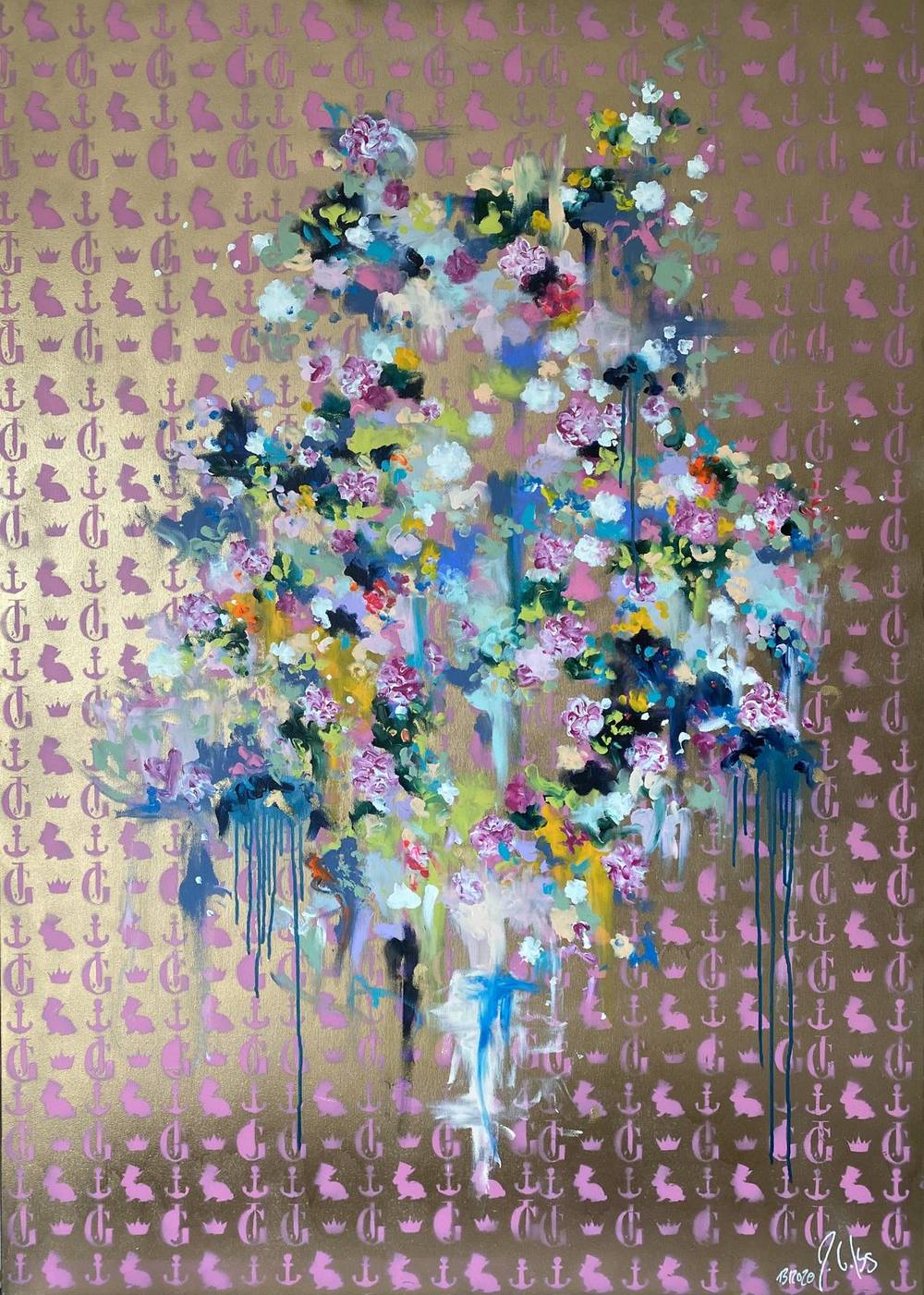
Juliane Golbs had already tried out this pattern in 2020 in the Monogram series. In 13 | 2020, a portrait format of 100 × 140 centimetres, the signs are sprayed in lilac onto a gold ground. The crowns are smaller than in 508 | 2024 and stand in regular rows among monograms, hares and anchors, like a wallpaper. In front of them a bouquet bursts out in pink, white, turquoise, mustard yellow and midnight blue, its paint running in long blue streaks over the pattern. Order and painting face each other like a heraldic cloth and a garden.
Crowns in the garden: Fifth Season and heaven can wait
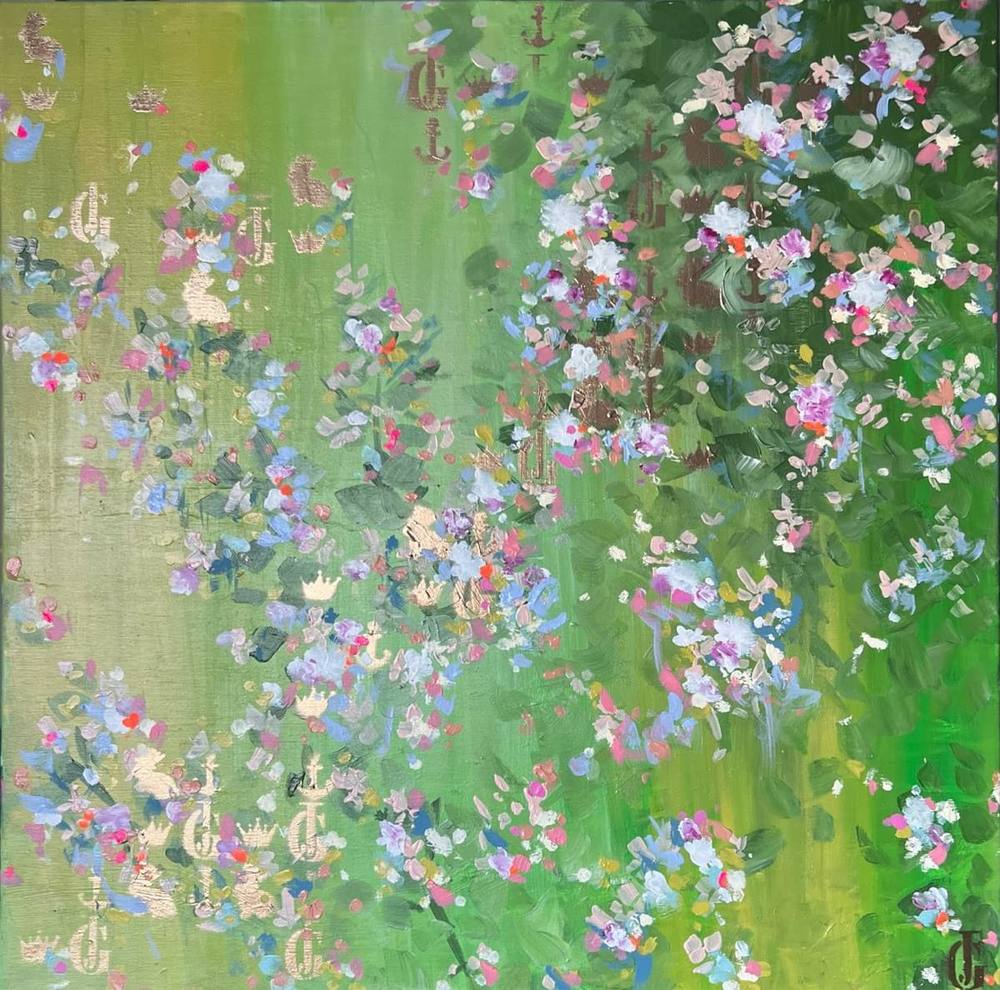
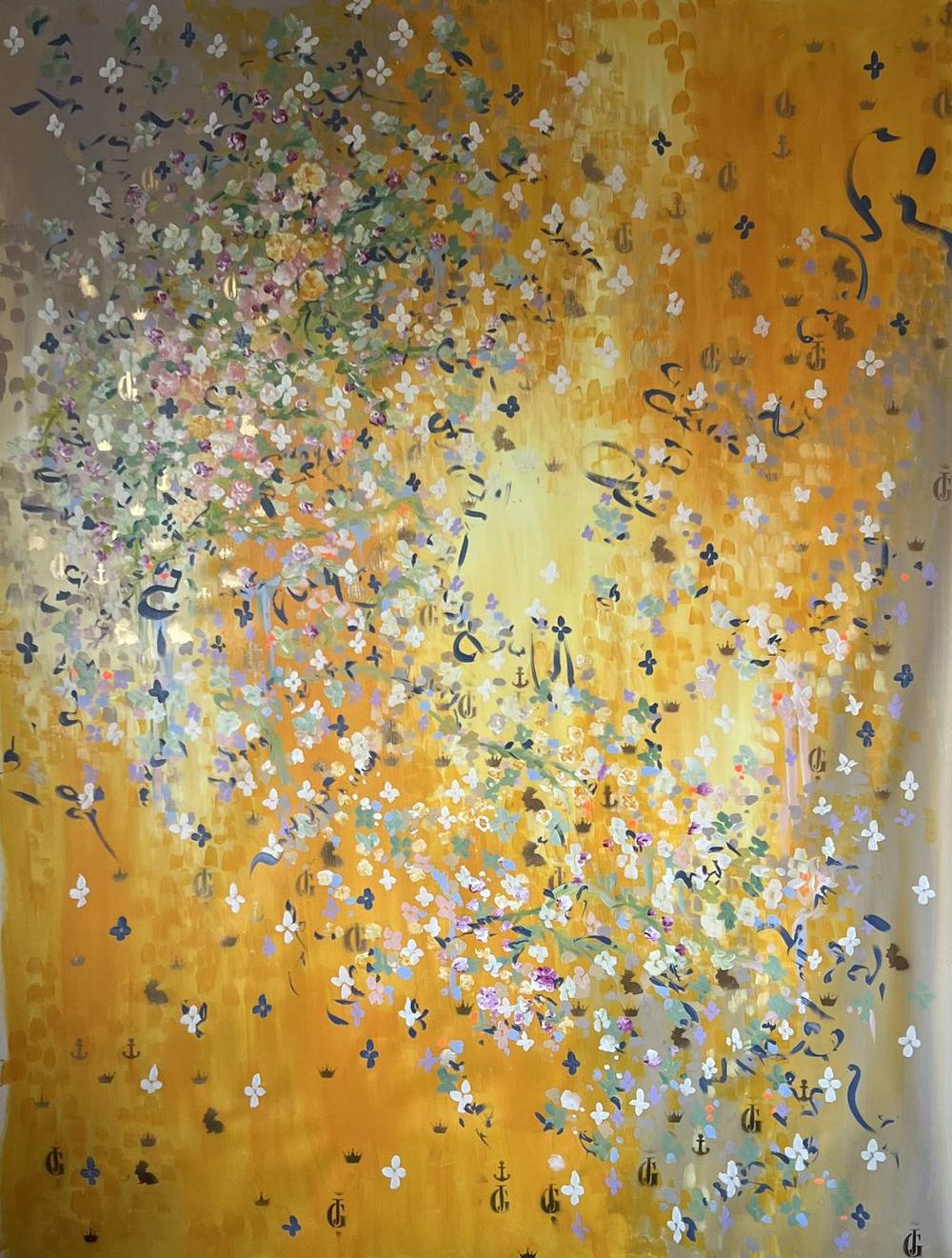
In the later series the crown grows quieter. In the cover image of this article, 503 | 2024 from the Fifth Season series, small crowns in gold lacquer glimmer among blossoms in lilac, pink and white. They gather in the paler left half above the yellow-green, while the meadow green thickens to the right. Depending on the light they come forward or almost vanish, like watermarks in paper.
In the large format 516 | 2024, 150 × 200 centimetres, the crowns are dabbed in midnight blue and grey. They stand in loose rows above the honey-gold ground, especially in the lower third, among monograms, anchors and small hares. Here the signs look like blossoms that have fallen from the swarm above.
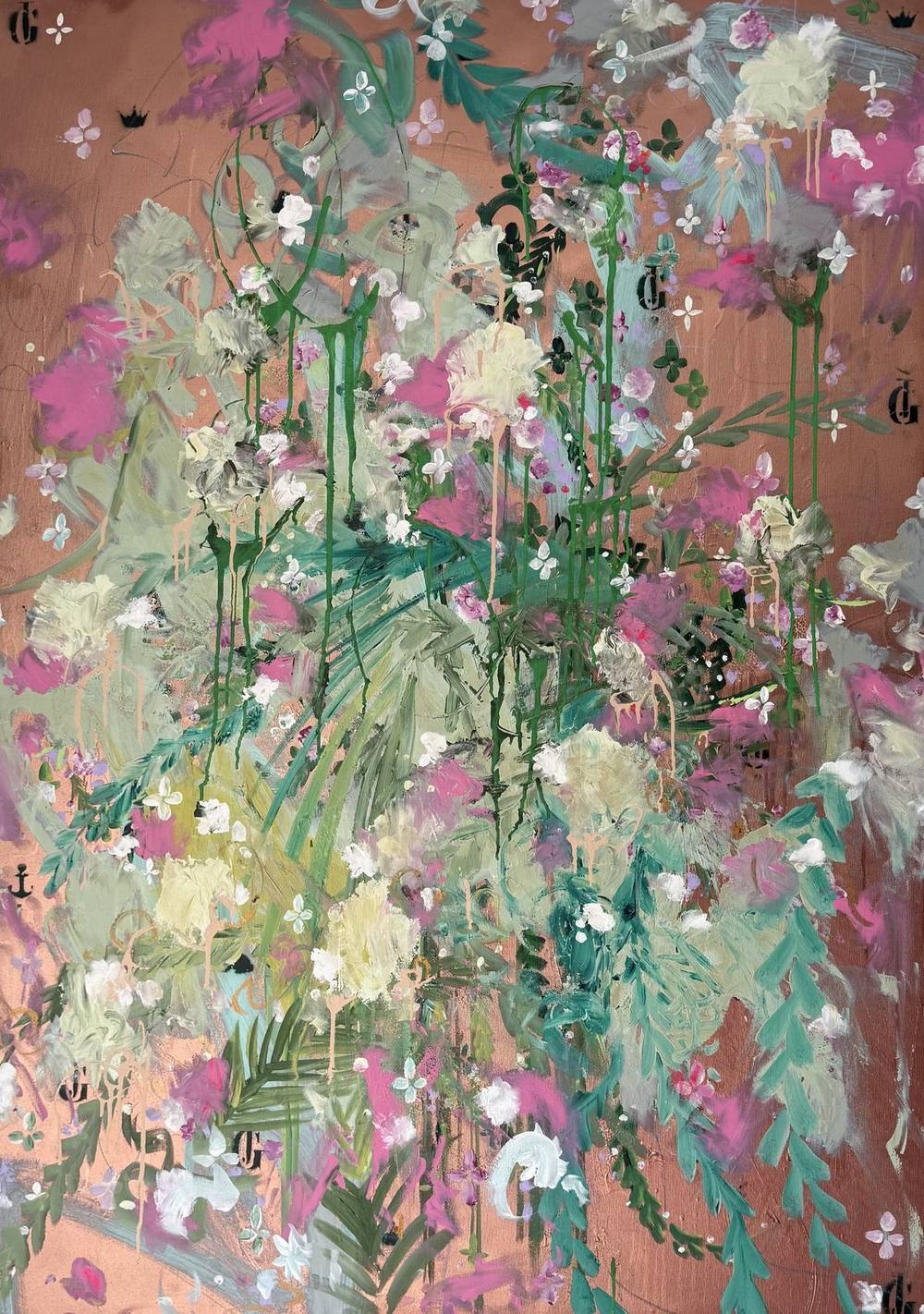
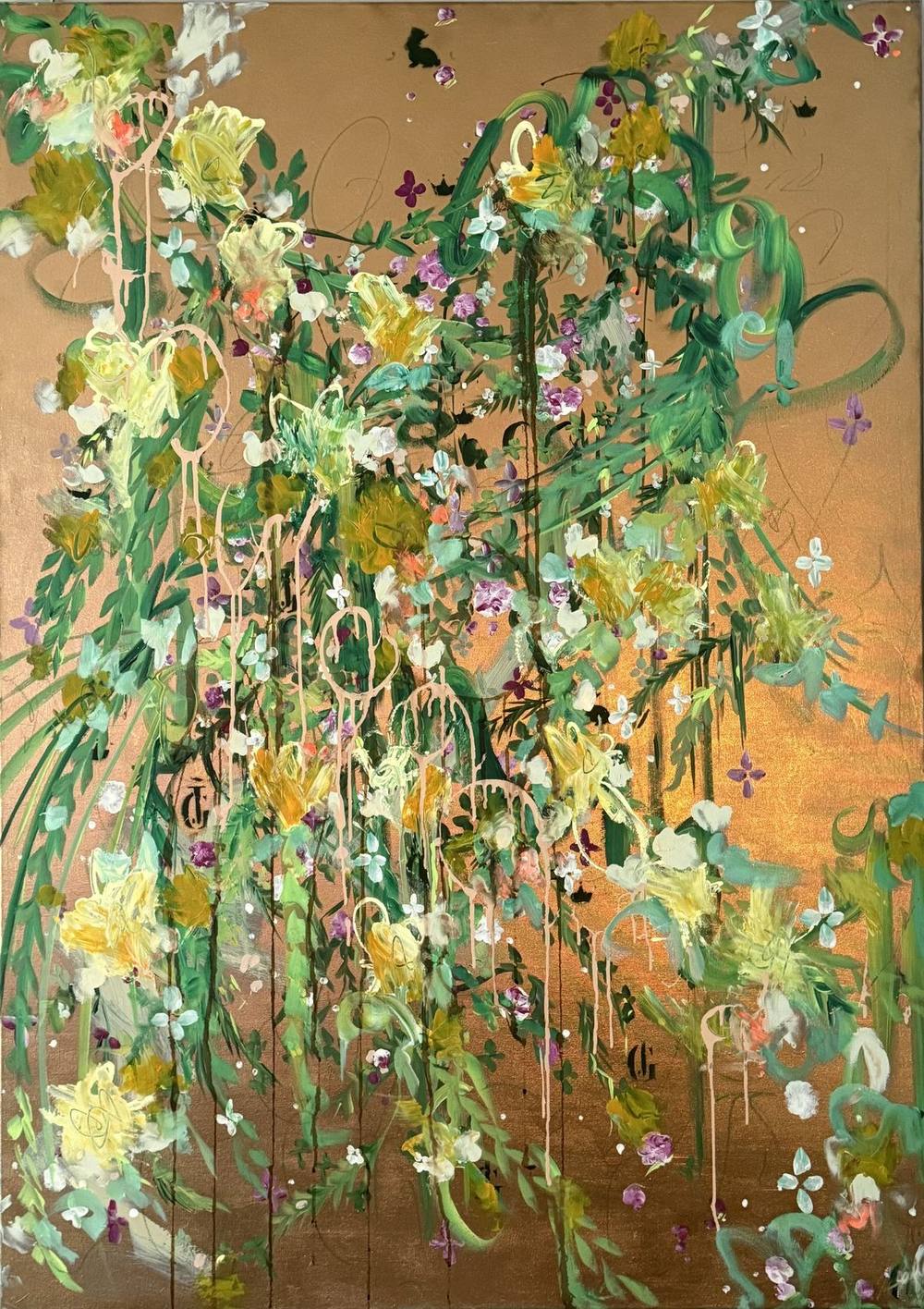
The crowns are more reticent still in the Fifth Season #heaven can wait series. In 06 | 2025, 100 × 140 centimetres in bronze lacquer and acrylic on canvas, tiny black crowns sit in the upper corners near the black stamped monograms. Below them a garden of sage green, magenta and cream spreads out, its paint trickling downwards. In 07 | 2025, the same format on gold lacquer and a warm copper tone, dark crowns appear at the upper right among green tendrils and yellow blossoms, not far from a small hare silhouette. You have to look for them. That is their charm: the crown no longer marks rank. It marks the hand that painted the picture.
Finding a crown
From the circlet of the Imperial Crown to a black silhouette on bronze lacquer, the crown has changed its form many times. It has been regalia, a subject for painting, a sign of rank and, with Basquiat, an honour the artist conferred himself. For Juliane Golbs it is part of her handwriting, related to the monogram and the hare, with which it almost always appears.
If you would like to search for the crowns yourself, you will find them in the catalogue of works and in the Signature Collection. The art advisor helps you choose by format and mood. For a work with your own signs or initials, a commission is the right place to start. For questions about individual paintings, you can reach the artist through the contact form.
Works from this article
Frequently asked questions
How old is the Imperial Crown in Vienna?
The Kunsthistorisches Museum Vienna dates it to the second half of the tenth century, with the cross added in the early eleventh century. The museum itself stresses that scholars still disagree about when and where it was made.
What does the Coronation of the Virgin show?
Christ placing a crown on the head of his mother Mary in heaven. A well-known example is the panel Lorenzo Monaco painted between 1407 and 1409, now in the National Gallery, London.
What does Jean-Michel Basquiat’s three-pointed crown mean?
According to the Brooklyn Museum, it signified nobility, heroism and high status. The Guggenheim Bilbao quotes the painter Francesco Clemente, for whom the three points stood for three royal lineages: the poet, the musician and the great boxing champion.
What role does the crown play in the work of Juliane Golbs?
It belongs, alongside the JG monogram, the hare and the anchor, to her personal repertoire of signs and stands for sovereignty. It is clearest in 508 | 2024 from the Signature Collection, but crowns also appear in works from the Fifth Season and Fifth Season #heaven can wait series.
Sources
6 sources
- Kunsthistorisches Museum Vienna, Imperial Treasury: The Imperial Crown (WS XIII 1)
- Kunsthistorisches Museum Vienna: Research project CROWN. The Imperial Crown in Vienna
- The National Gallery, London: Lorenzo Monaco, The Coronation of the Virgin (NG1897)
- Austria-Forum, AEIOU Austrian encyclopaedia: Heraldik
- Brooklyn Museum: Basquiat. The Unknown Notebooks (2015)
- Guggenheim Museum Bilbao: Jean-Michel Basquiat. Now’s the Time, Heroes and Saints