Black in art: from the cave wall to the black canvas
Black was the first colour of painting and became its most radical in the twentieth century. A short history of black, leading to Juliane Golbs’s paintings on black grounds.
Black in art is two things at once: the oldest colour in painting and one of its most recent provocations. As early as the Palaeolithic, people drew on rock walls with charcoal. In the twentieth century a black square became the starting point of abstraction. Later, a French painter found in black a source of light. Standing before a painting on black canvas today, you are looking at a colour with a long and remarkably changeable history.
Charcoal, bone and manganese
The black drawings in the Chauvet Cave in the Ardèche were made with charcoal. According to the cave, it came mainly from Scots pine. To obtain good charcoal, the people of the Aurignacian had already mastered the controlled burning of wood. Chauvet also revealed a technique that had not been identified before the cave was discovered: a charcoal line is applied, applied again and spread with a finger or a tool, giving the figures volume and relief.
At Lascaux the palette was different. The French Ministry of Culture describes it as limited: black alongside a few warm tones of dark brown, red and yellow. In that region the blacks are always based on manganese oxide. Elsewhere, in the Lot, the Ardèche and the Ariège, charcoal from wood or bone was mostly used instead. The two great families of black are thus already present in the Palaeolithic: charred organic matter and the black mineral.
Caravaggio: light out of darkness
How much a painter can say with darkness is shown by Caravaggio’s Supper at Emmaus of 1601 in the National Gallery, London. The museum explains that Caravaggio uses contrasts of light and shade, chiaroscuro, to heighten the drama. A strong light from the left falls on the faces of Christ and of the disciple on the right, often identified as Saint Peter.
The innkeeper, by contrast, stands outside the event with his face in shadow. The National Gallery reads this as a sign that he has not yet seen the light, a metaphor for spiritual understanding. Here the darkness is no empty background. It separates those who recognise from those who remain unmoved. In 1839 the painting became the first work by Caravaggio to enter the National Gallery’s collection.
Goya’s Black Paintings at the Quinta del Sordo
A little over two centuries later, Francisco de Goya painted a group of pictures directly onto the walls of his house in Madrid, the Quinta del Sordo. According to the Museo del Prado, they are known as the Black Paintings because he used so many dark pigments and blacks in them. Their sombre subjects contributed to the name as well. Chemical analysis reveals oil in the paint layers, so Goya must have worked in a mixed technique.
Baron Émile d’Erlanger acquired the house in 1873 and had the murals transferred to canvas, a process in which much paint was lost. He later donated the paintings to the Spanish state, and they have been on view at the Prado since 1889. Among them is Saturn, dated 1820 to 1823 and measuring 143.5 × 81.4 centimetres. What had decorated private rooms became a principal work of a public museum.
Malevich and the Black Square
In December 1915, at the Last Futurist Exhibition of Painting 0.10 in Petrograd, Kazimir Malevich showed a black square on a white ground. Tate describes how he hung it high across the corner of the room, the place an icon occupied in a Russian home. For Malevich the picture marked the beginning of Suprematism, a painting of pure shapes and colours that was no longer meant to depict anything.
The first version is now in the State Tretyakov Gallery in Moscow. It is dated 1913, but Tate considers it was probably painted in 1915. X-rays show a multicoloured Suprematist composition beneath the black. Malevich painted four versions in all. After his death in 1935 his work disappeared from public view, and the Black Square was not exhibited again until the 1980s.
Ad Reinhardt: three blacks in one painting
Ad Reinhardt took black further still. In the last ten years of his life, according to the Museum of Modern Art, he painted only square black paintings. His Abstract Painting of 1963 at first looks monochrome, yet it is a grid of three by three squares. The corners are a reddish black, while the cross between them is bluish in its vertical bar and greenish in its horizontal one.
Reinhardt mixed black oil paint with small amounts of red, green or blue and left it to stand for weeks so that pigment and solvent separated. The surface was to be matte and not reflect its surroundings. MoMA quotes him: “There is a black which is old and a black which is fresh. Lustrous black and dull black, black in sunlight and black in shadow.” When the black paintings were first shown at MoMA in 1963, at least one visitor cancelled their membership in protest.
Pierre Soulages and Outrenoir
Pierre Soulages went the opposite way. Reinhardt wanted a black without gloss, whereas Soulages let light work on the black. In 1979, after more than thirty years of painting, he began a new phase that he called Outrenoir, literally “beyond black”, according to the Centre Pompidou. The beginning is told there like this: after a fruitless day’s work the canvas was saturated with black. The next morning his wife remarked that he had opened a new path.
Painting 202 × 452 cm, 29 June 1979 shows how it works: one colour, one tool, one type of movement, one consistency of paint. The grooves the brush draws at different depths produce endless variations. In later works such as Painting 300 × 235 cm, 9 July 2000, incident light on the grooves creates shades of grey. Soulages himself said that black “never exists in the absolute”. Its intensity changes with the size of the surface, its form and its texture. His paintings carry no titles, only their dimensions and date.
Vantablack: a black under licence
In the twenty-first century black came out of the laboratory. The British company Surrey NanoSystems originally developed Vantablack for technical uses, among them satellites. In February 2016 The Guardian described it as a material that reflects almost no light. The paper also reported that Surrey NanoSystems had confirmed that the artist Anish Kapoor alone could paint with it. Kapoor had been working with Vantablack since 2014.
Other artists were keen to use the material too, The Guardian noted, and the exclusive licence remained contested. For the history of the colour the case is revealing. With Reinhardt, black was to reflect nothing. With Soulages, it returns light in gradations. Vantablack, by contrast, reflects almost nothing at all.
Black in art: the work of Juliane Golbs
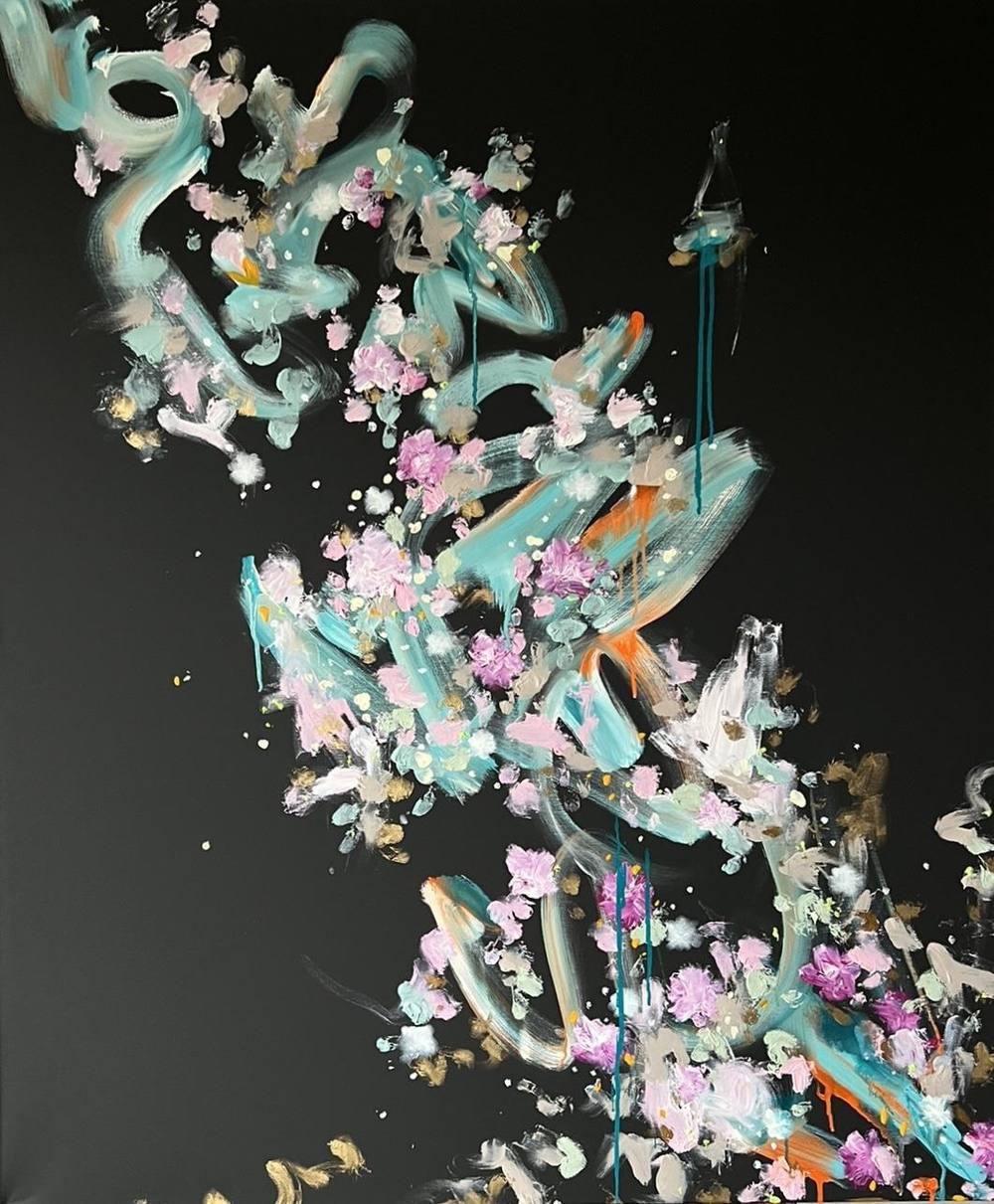
In the work of the Hamburg painter Juliane Golbs, black is rarely the motif but often the ground. According to her catalogue of works, several paintings are made on black canvas. Here the black acts like a night sky against which the colours stand. Soulages had this contrast in mind when he spoke of black on the ground as a stronger contrast than any other colour for illuminating the light parts. A black background in painting heightens the light and glossy colours in Juliane Golbs’s work too.
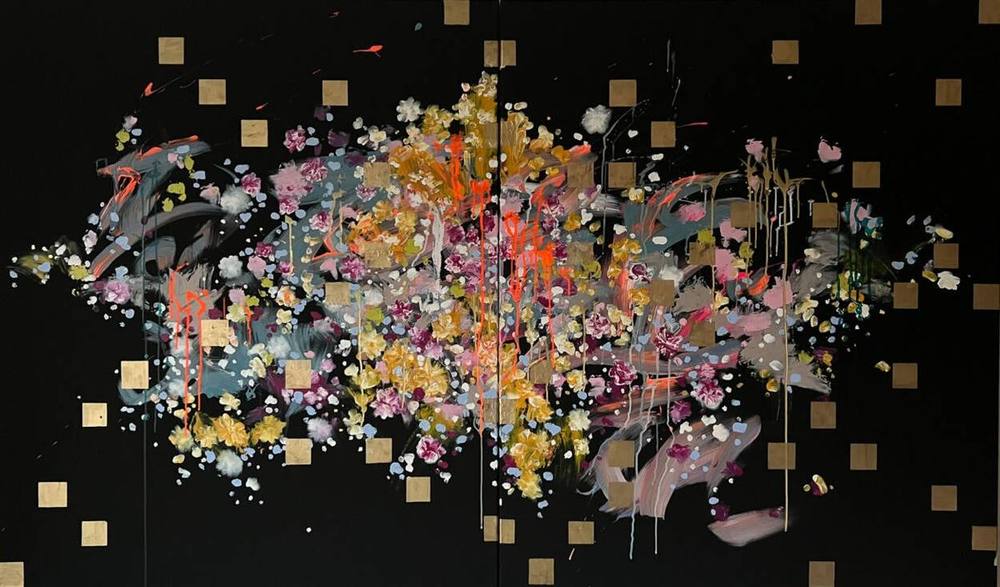
The landscape format 02 | 2023 from the Everlasting Blossoms series measures 200 × 120 centimetres. At its centre spreads a dense cloud of blossoms, splashes and lines, gold and ochre at the core, surrounded by pink, coral, white and the occasional turquoise. Small gold squares are scattered loosely around it. Acrylic, acrylic lacquers and gold lacquer sit on the matte black and shine there like points of light. Part of the proceeds from the series goes to the NCL Foundation.
In 27 | 2022 from the Signature Collection a single broad stroke of turquoise and mint rises diagonally out of the black. Dabs of rosé, lilac and white bloom along its path. The smaller 26 | 2022, at 50 × 60 centimetres, sets a stepped pattern of white squares against a swirling stroke of rosé, peach and mother-of-pearl, while threads of gold lacquer run down from the top edge.
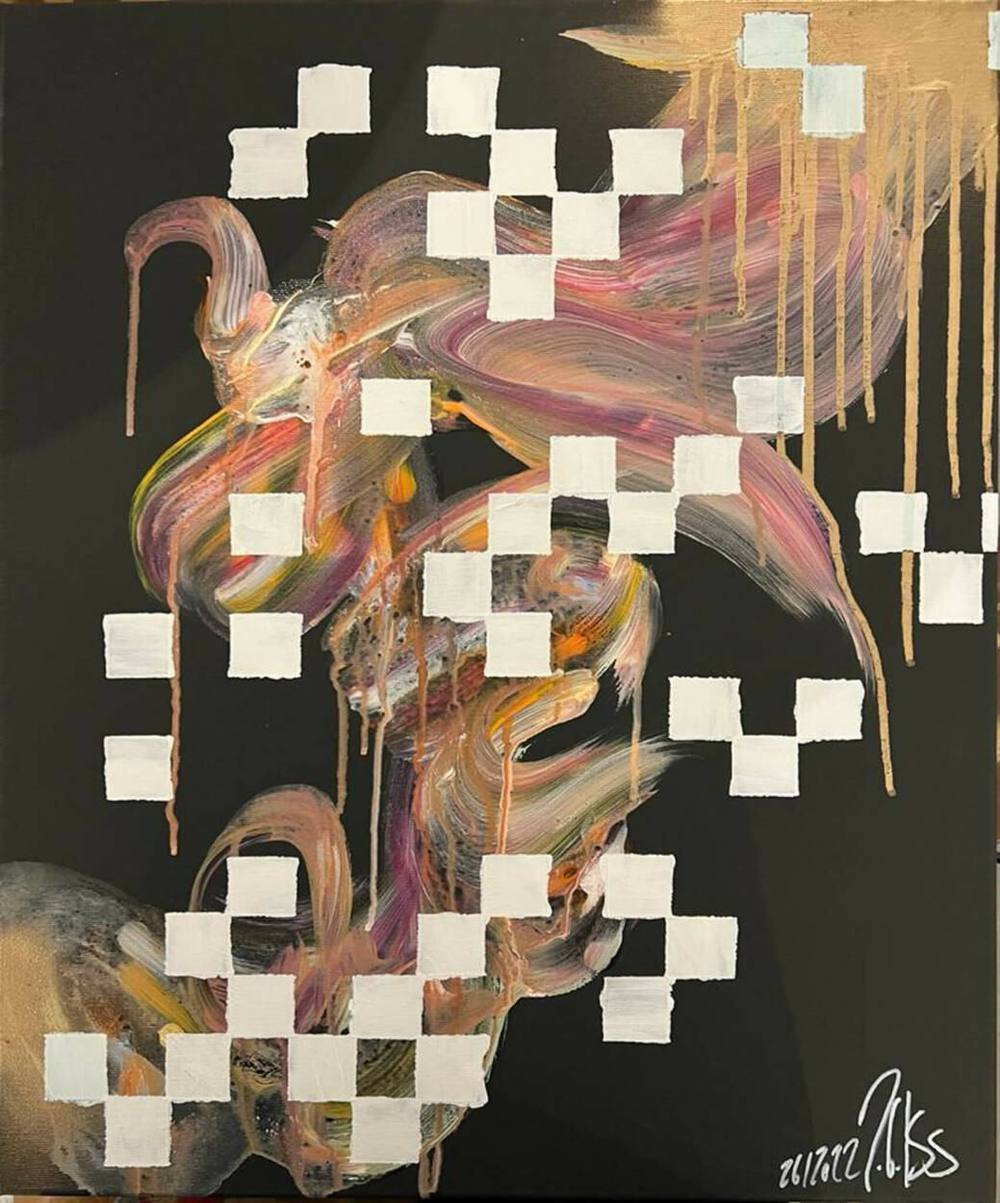
On this ground gold behaves differently from the pigment colours. Gold lacquer reflects light, while the matte black absorbs it. In 02 | 2023 this creates an alternation of glossy and dull zones that shifts as the viewer moves.
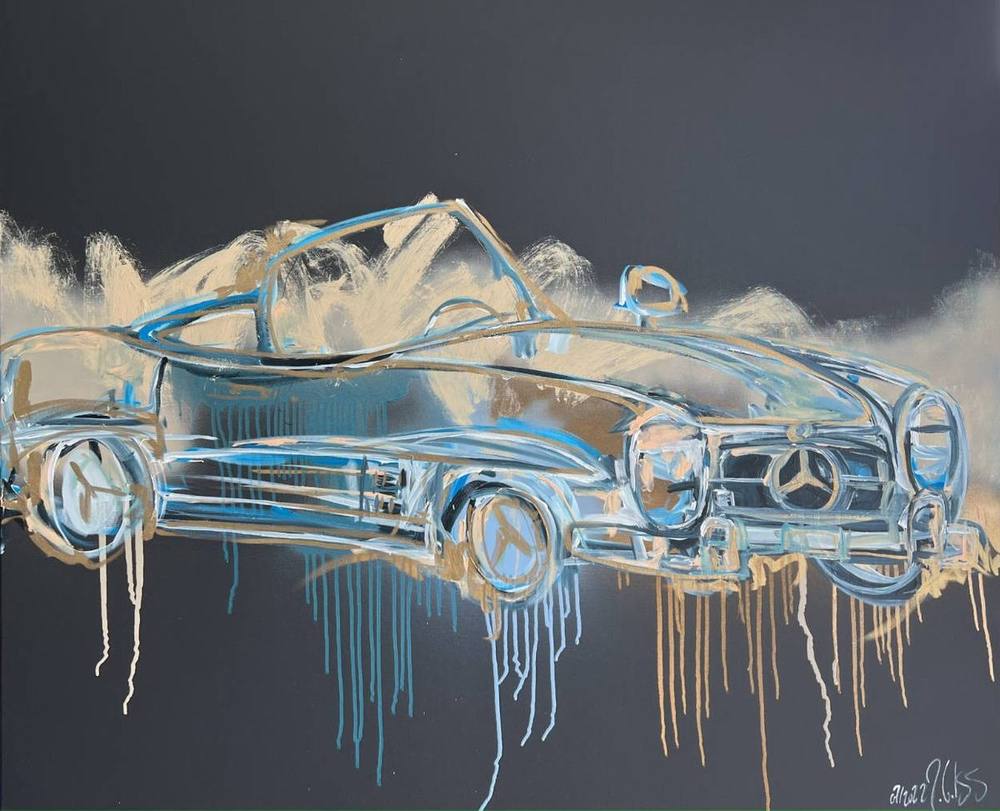
How well a dark ground carries line is shown by 07 | 2022 from the Golden Things series. Against a graphite surface primed in black, a classic roadster appears, drawn only in lines of pale blue, ice blue and sandy gold. A golden cloud rises behind the car, and below it the paint runs down in long drips. Two works built in a similar way are no longer available: the three-part frieze 01 | 2023, three metres wide, and 29 | 2022 with its mint-green squares on black.
Black also appears in Juliane Golbs’s work as a sign. In 06 | 2025 and 07 | 2025 from Fifth Season #heaven can wait, small black monograms and crowns lie over gardens on bronze and gold grounds, like handwriting in a margin. There black is the colour of script. On the black canvas it is the colour of space.
Choosing a painting on a black ground
A painting on black canvas needs light. Under warm, raking light the gold lacquer and acrylic lacquer come forward, while in flat daylight the black appears calmer and deeper. A pale wall gives the dark picture a clear edge, and wood and stone pick up the warm tones of gold and ochre. A large format such as 02 | 2023 can hold a long wall, while a small one such as 26 | 2022 creates a deliberate contrast.
The catalogue of works can be filtered by colour, and the art advisor asks about mood and format. How the gold finds its way into these paintings is explained in the article on gold leaf in painting. What lies behind the monogram is shown in the article on the Signature Collection. To see a work on a black ground in the original, you can reach the studio through the contact form.
Works from this article
Frequently asked questions
What did Palaeolithic artists use to paint black?
Charcoal and mineral pigments. According to the cave itself, the black drawings at Chauvet were made with charcoal, mainly from Scots pine. At Lascaux, the French Ministry of Culture notes that the blacks are based on manganese oxide, while in other regions charcoal from wood or bone was mostly used.
Why are Goya’s Black Paintings called that?
According to the Museo del Prado, because he used so many dark pigments and blacks in them, and because of their sombre subjects. Goya painted them directly onto the walls of his house, the Quinta del Sordo. They have been on view at the Prado since 1889.
What does Outrenoir mean?
Outrenoir is the name Pierre Soulages gave to the phase of his work that began in 1979. The canvas is covered entirely in black, and light arises from the texture of the paint, which reflects incident light differently depending on its grooves and surface.
Can any artist use Vantablack?
According to reports in 2016, the manufacturer Surrey NanoSystems confirmed that Anish Kapoor alone could paint with Vantablack. The Guardian reported that Kapoor had been working with the material since 2014.
Which works by Juliane Golbs are painted on black canvas?
Among others 02 | 2023 from Everlasting Blossoms, 27 | 2022 and 26 | 2022 from the Signature Collection, and 07 | 2022 from Golden Things. The catalogue of works can be filtered by colour.
Sources
8 sources
- Ministère de la Culture: Lascaux, The raw materials
- Grotte Chauvet (Google Arts & Culture): The Drawings of the Chauvet Cave
- The National Gallery, London: Caravaggio, The Supper at Emmaus (1601)
- Museo Nacional del Prado: Francisco de Goya, Saturn (1820–1823)
- Tate: Five ways to look at Malevich’s Black Square
- The Museum of Modern Art: Ad Reinhardt, Abstract Painting (1963)
- Centre Pompidou: Pierre Soulages, Teaching pack
- The Guardian: Can an artist ever really own a colour? (2016)