The Golden Things series by Juliane Golbs: between gold ground and the present
Thirteen paintings made between 2017 and 2025, in which gold becomes sky, ground and time of day. A walk through the Golden Things series and the history behind it.
In the catalogue of Juliane Golbs, a group of thirteen paintings carries the name Golden Things. They were made between 2017 and 2025. In almost all of them gold takes on a role beyond decoration: it becomes sky, ground, cloud or grid. The studio describes the series as “a study in reflection”. This article introduces the works of the Golden Things series one by one, sets out their formats and techniques, and shows the long pictorial tradition in which golden paintings stand.
The Golden Things series: thirteen works, one light
The earliest work in the series is ein Adler from 2017, the most recent 10 | 2025. Between them lies a clear centre of gravity: five of the thirteen paintings date from 2021 and three from 2022.
What connects the pictures is less a subject than a way of building them. Almost always a quickly drawn line stands against a fluid, warm field of gold or bronze. Golden, white or coloured runs drip into the picture from above and loosen firm shapes. A ship, a building, a face remains recognisable while it begins to dissolve. The series description speaks of the “golden hour”, whose fleeting beauty the paintings set out to hold. In many of the works this can be taken literally: the gold stands for a time of day.
Formats: the portrait canvas as the standard
Eight of the thirteen works measure 100 × 140 centimetres in portrait format. This is the real standard of the series, from the harbour scene 15 | 2021 to the still life “1756 | 2022”. Slightly squatter is the figure painting “01 | 2021” at 100 × 120 centimetres. The tall format gives room to the runs of paint that fall from the top edge in nearly every picture.
The exceptions are all the more telling. The Paris street view “51 | 2019” is square, 100 × 100 centimetres. The only landscape format is 07 | 2022 at 120 × 100 centimetres, painted for a subject that stretches sideways. The largest picture, “Golden Elbphi” from 2019, measures 120 × 160 centimetres. At the other end stands 10 | 2025 at just 40 × 60 centimetres, a painting meant to be seen from close by.
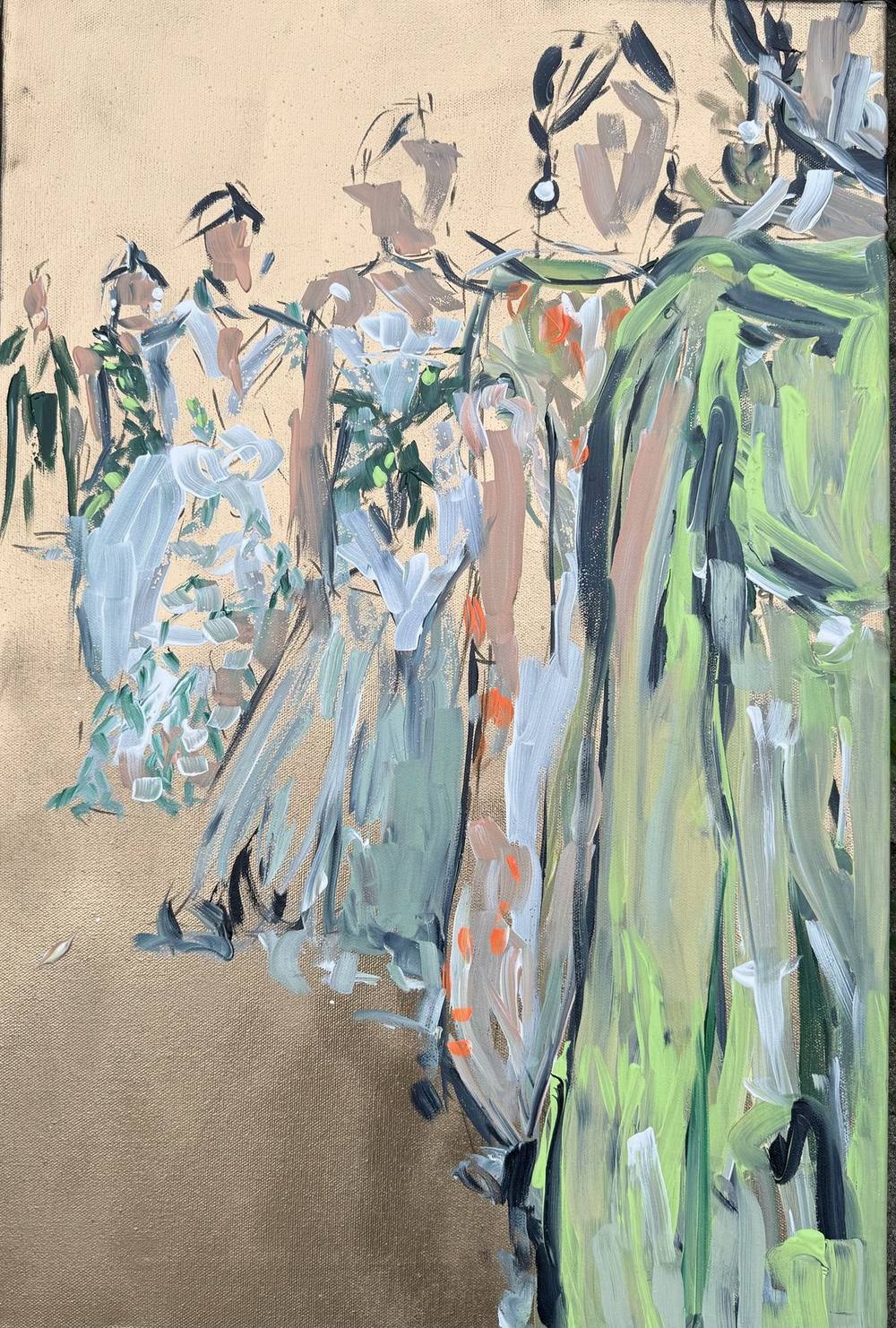
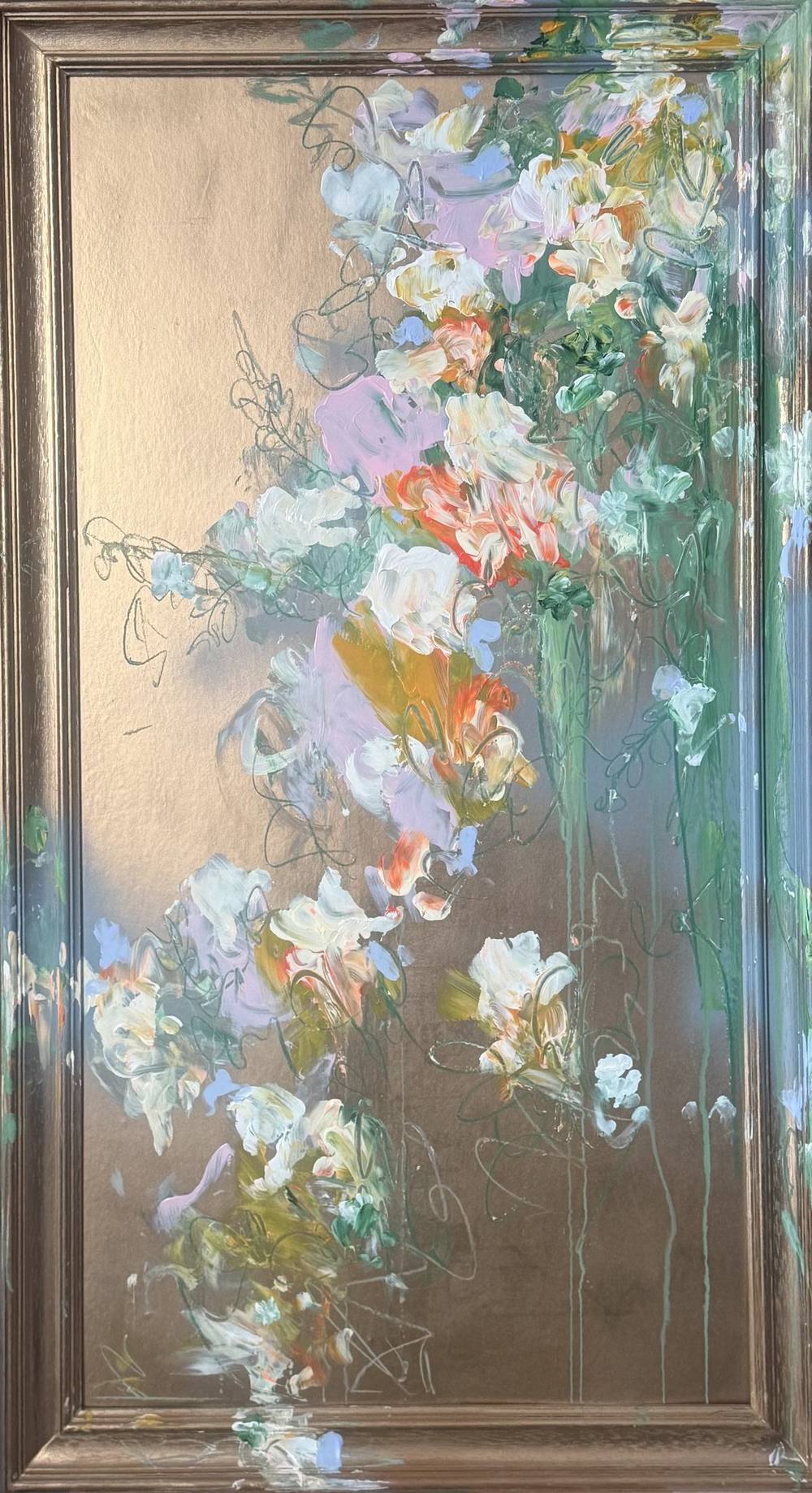
In 10 | 2025 a group of figures, suggested rather than described, gathers on a warm gold tone. Sage green, dove blue and broken white form their clothes, a few orange-red dabs add accents, the faces stay open. Here the golden ground does much of the picture’s work and reads like the light of a summer evening.
Gold lacquer, acrylic lacquer, gold leaf: what the work details show
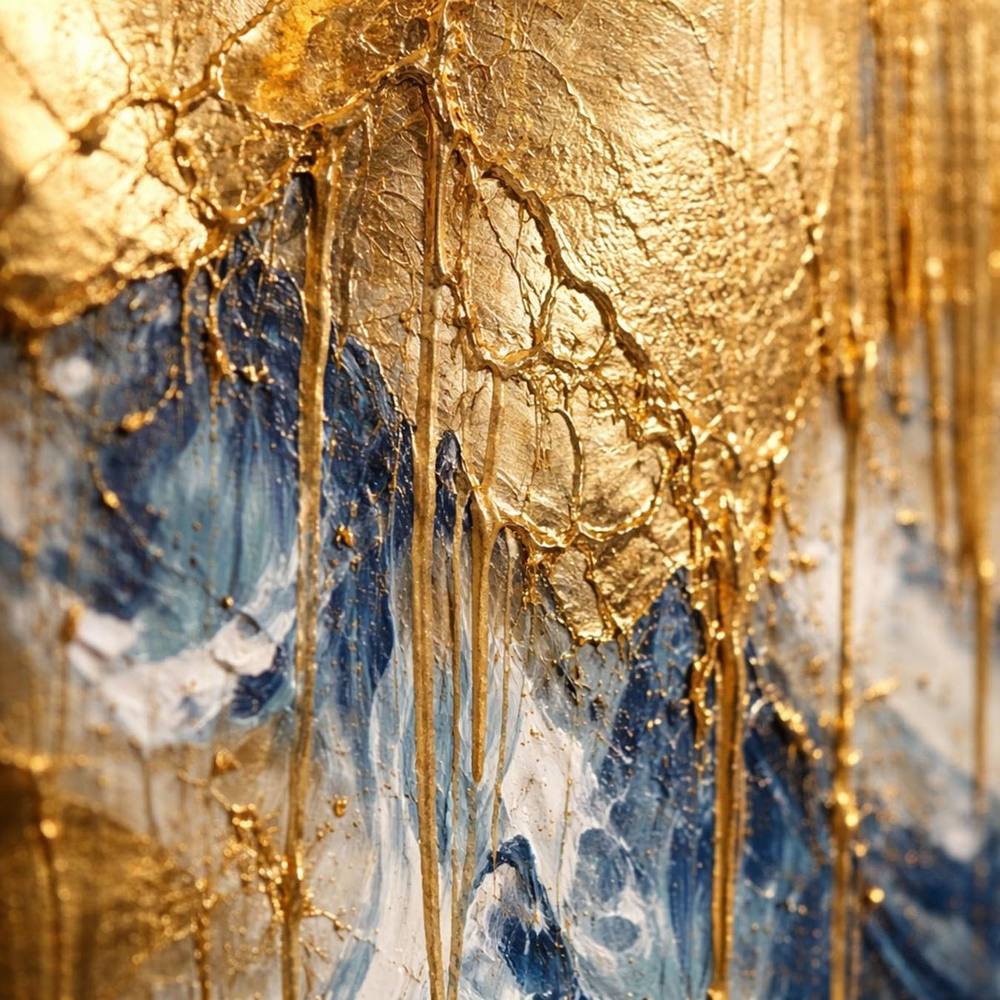
The series description names 24-carat gold leaf and gold creams as its materials. A look at the individual work details shows how differently the gold enters each picture. Seven works list gold lacquer, usually together with acrylic and acrylic lacquers. Gold leaf is named explicitly only for 37 | 2021: “acrylic, gold lacquers and gold leaf on canvas”. Other works create their golden effect with acrylic and lacquer, with ink on a golden ground or with mixed media.
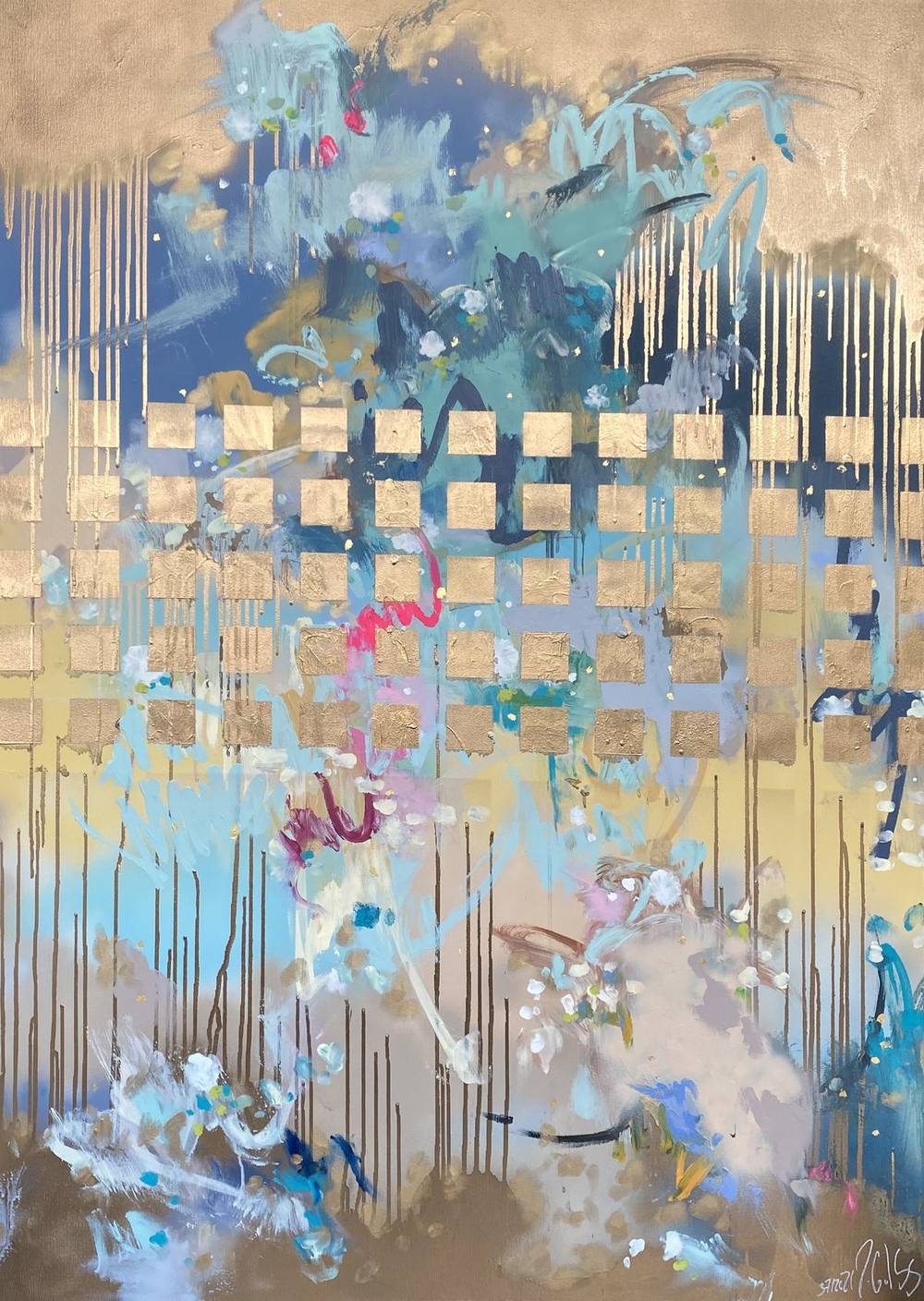
In 37 | 2021 the difference between the materials is plain to see. A grid of square gold-leaf fields runs across the portrait canvas, while above and below it the painting moves freely in ice blue, midnight blue, white and turquoise. The gold leaf reflects sharply, the lacquers more softly, and the acrylic stays matt. How gold leaf is laid and why it changes with daylight is described in detail in the article on gold leaf in painting.
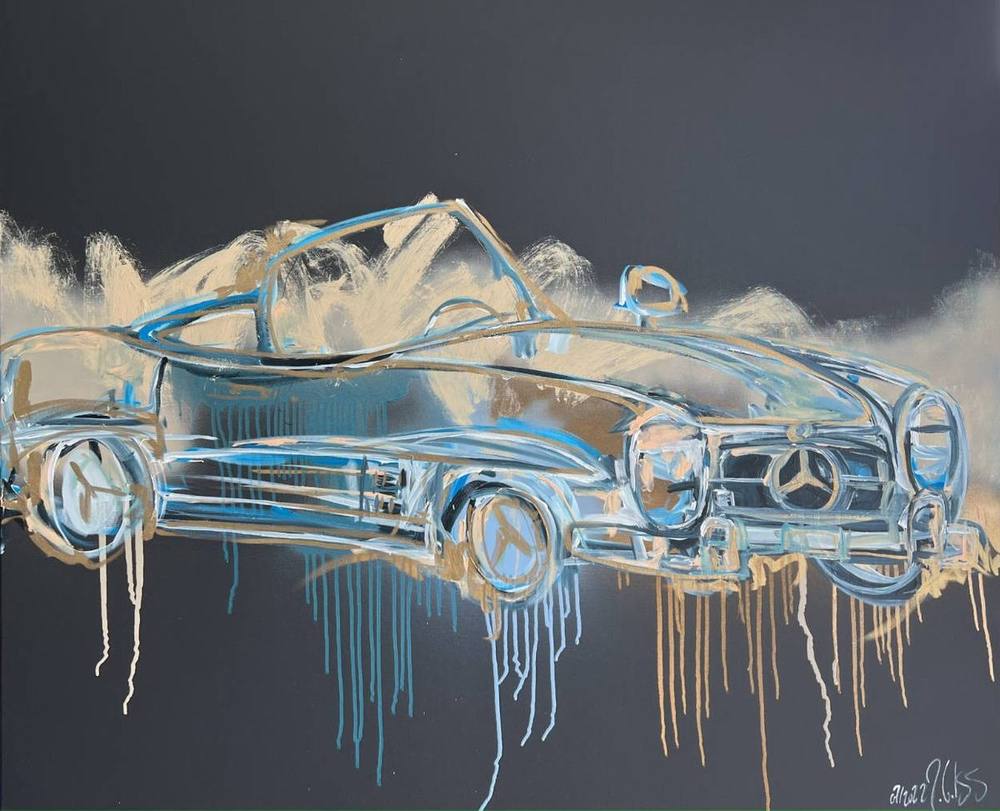
07 | 2022, painted in acrylic and gold lacquer on black canvas, holds a position of its own. A classic roadster is drawn in line alone, in pale blue, ice blue and a sandy gold. Behind the car a golden cloud rises, and long runs drip from its lower contour. The black swallows the light; the gold lacquer throws it back.
Places: Paris, the harbour, the Elbphilharmonie
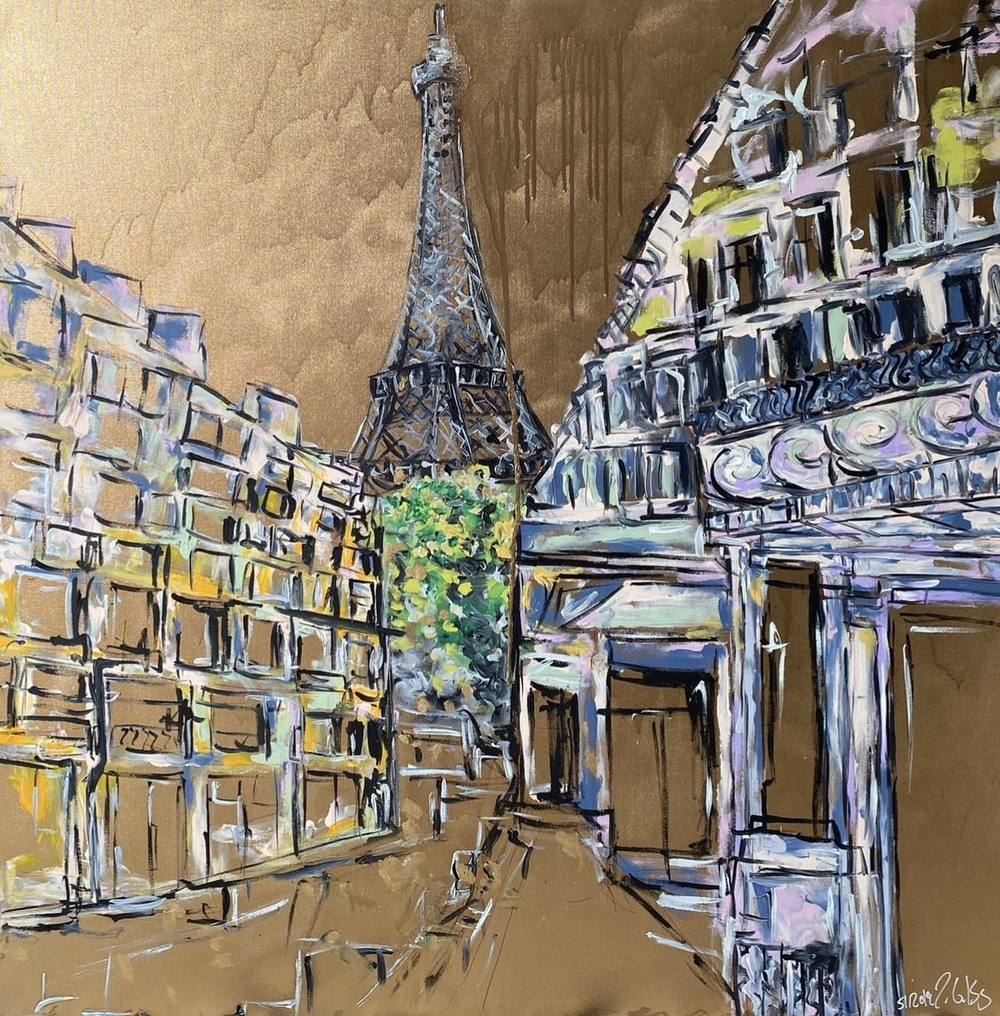
Several works in the series depict places. In “51 | 2019” a Parisian street with tall façades and balconies leads towards the Eiffel Tower, which rises slender against a golden sky. The architecture is drawn in quick lines of ink and brush, with lavender, lemon yellow and the green of a tree glowing between them. It is one of the earliest works in the series and is in a private collection.
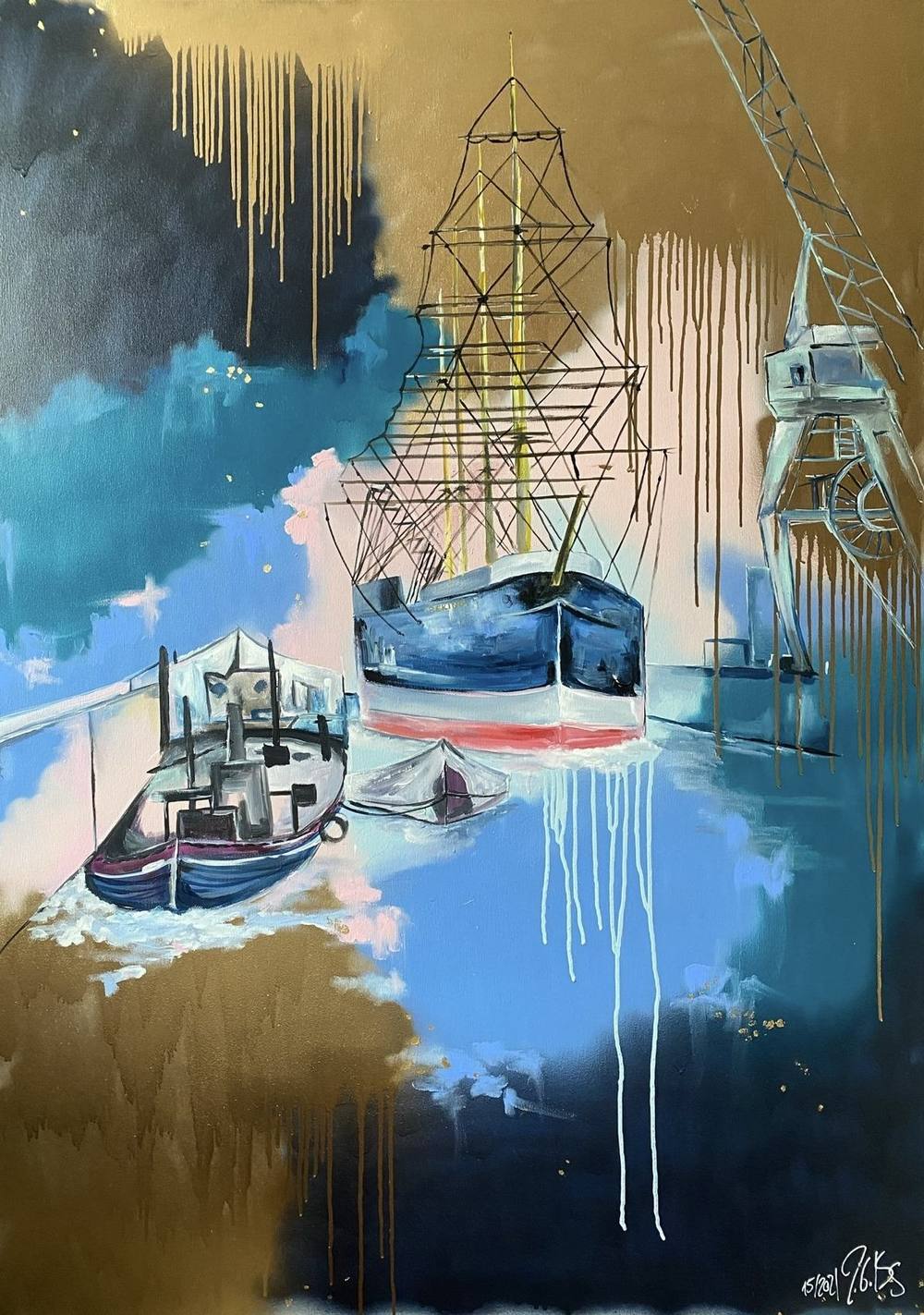
Hamburg appears twice, with the same building. “Golden Elbphi” from 2019 paints the glass façade of the Elbphilharmonie as a grid of blue, grey and white dabs over a copper-gold ground; the picture is now in a private collection. Two years later came 43 | 2021, in which the curving roofline sits beneath a calm sky of bronze and gold while the building below melts into petrol and midnight blue. The harbour appears in 15 | 2021: a tall ship with delicate rigging, a rowing boat and a crane, surrounded by turquoise and midnight blue and framed by a broad field of gold.
The Elbphilharmonie remained a subject of the series. At the Elbjazz Festival 2026, Juliane Golbs painted live in the Grand Hall to the music of Joss Stone, creating a large picture of the building as a unique work from Golden Things. It was auctioned in support of the NCL Foundation.
Figures, animals and objects
A second strand of the series is figurative. The earliest picture, ein Adler, shows an eagle’s head with a sharply outlined yellow eye and a crest of feathers in orange, pink and black, behind which broad bands of gold lacquer run. In “01 | 2021” a man in a dark suit raises a trumpet to his lips. The artist links the picture to a memory of her father playing the trumpet on New Year’s Eve. The work is currently not available.
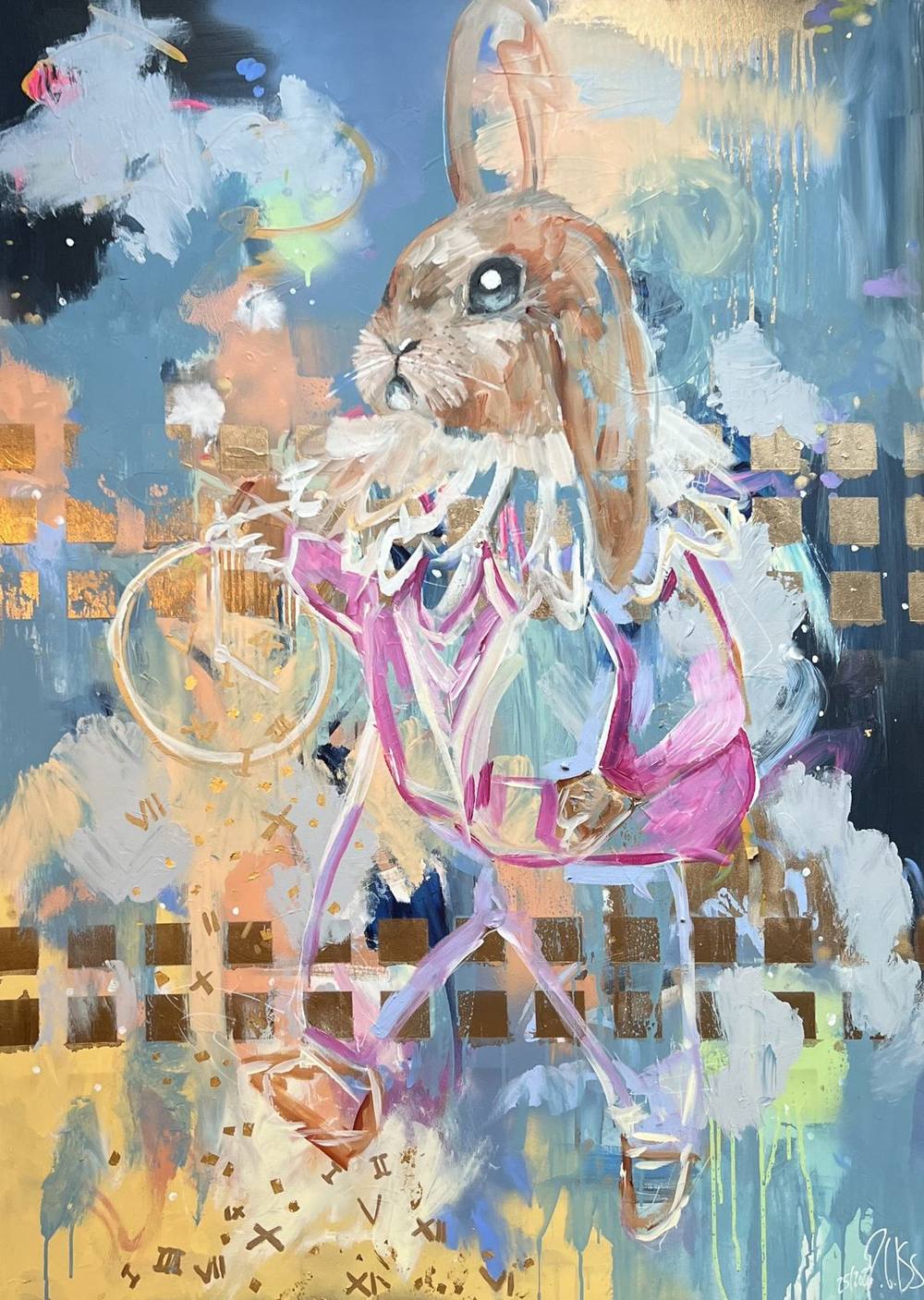
The hare, a recurring figure in the work of Juliane Golbs, appears in 25 | 2022 wearing a ruff and a pink garment, surrounded by clouds, a ring and Roman numerals like those of a dissolving clock face. Two bands of square gold fields divide the picture horizontally. The article on the hare in art tells more about this motif. Finally, “1756 | 2022” is a still life: a wine glass and a curving carafe before clouds of coral, midnight blue and gold lacquer. This work is no longer available.
Gold as gesture: the abstract works
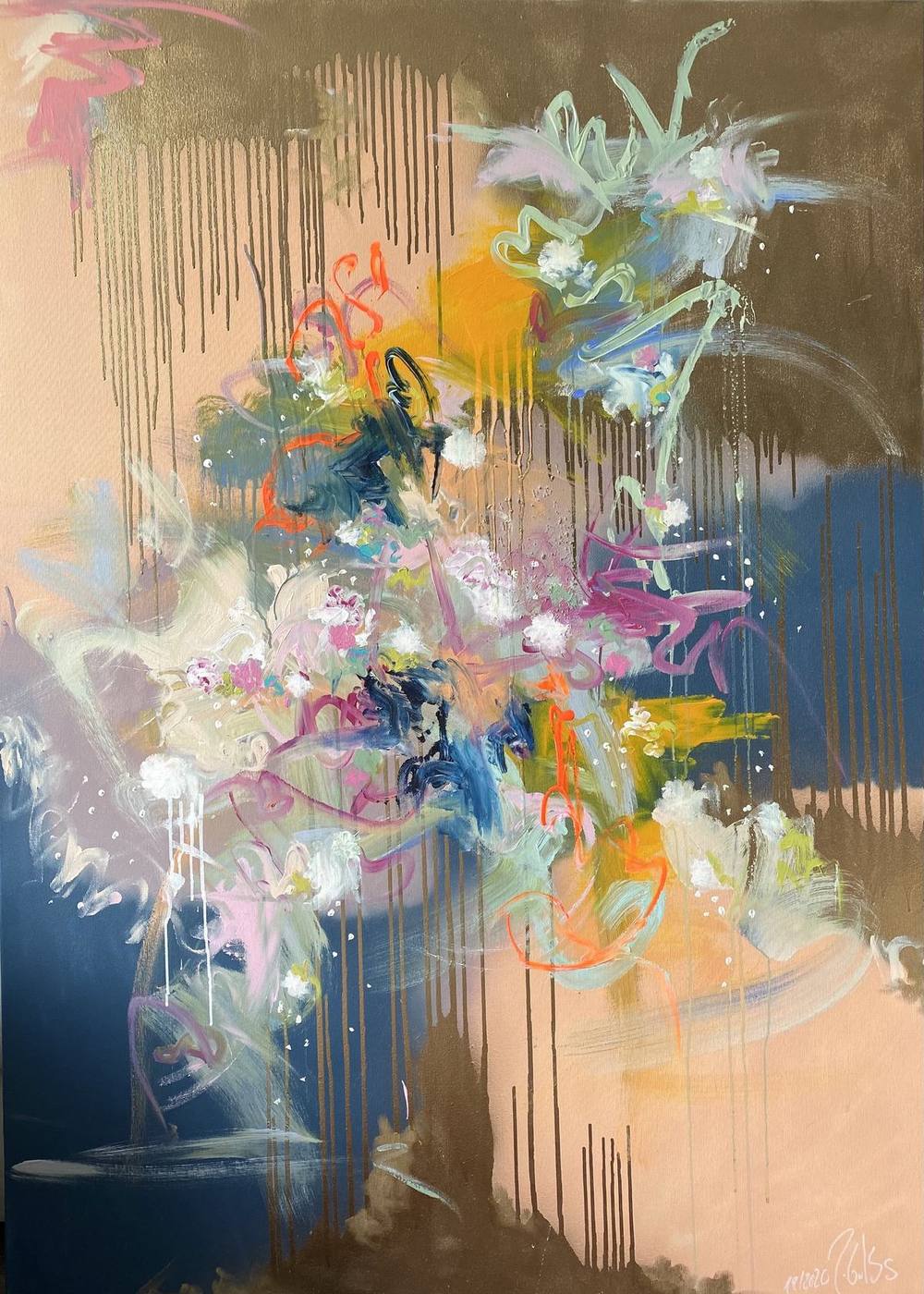
Three works do without an object. In 19 | 2020 gestural lines in mint, white, orange and midnight blue gather into a swirling centre, surrounded by a wide ground of apricot and gold lacquer. Fine golden trickles run down from the top, while a deep block of Prussian blue sits in the lower left. Here the gold does not fall evenly; it drips and pools.
36 | 2021 is built around a single bright orange stroke that loops across the surface like a signature written large. The ground is bronze and sand, applied in acrylic and acrylic lacquers in glossy and matt passages. Together with the gold-leaf grid of 37 | 2021, these pictures show the series at its freest: gold here is neither sky nor place, but movement and structure.
The gold ground: gold as sacred space
Gold as a pictorial ground has a long history. Byzantine and Russian icon painting kept the gold ground, and in Italy it remained almost the only convention for images of saints until towards the end of the fifteenth century. A well-known example hangs in the Uffizi in Florence: the Annunciation signed by Simone Martini and Lippo Memmi in 1333. The panel measures 184 × 168 centimetres, is painted in tempera on wood with a gold ground and was made for the altar of St Ansanus in Siena Cathedral.
The angel’s greeting, “AVE GRATIA PLENA DOMINUS TECUM”, stands as a raised inscription on the gold and issues from Gabriel’s mouth. The gold shows no earthly space. Smarthistory describes the ground as representing the spiritual light of heaven. It is precisely this absence of landscape and perspective that makes the gold ground so particular: the figures stand within a light, not in a place.
Gold in modernism: Klimt’s Golden Period
In early twentieth-century Vienna, gold took on a secular role in painting. The Belvedere calls Gustav Klimt’s “The Kiss (Lovers)” the most important work of his so-called Golden Period. Klimt showed the picture in the summer of 1908 under the title “Lovers” at the Kunstschau. While the exhibition was still running, it was bought by the Ministry of Education. The collection dates it to 1908, completed in 1909.
The painting measures 180 × 180 centimetres. According to the Belvedere, Klimt used gold leaf, silver leaf, platinum leaf and oil-resin paints on primed canvas in the figurative area, while the background is brass metal leaf, glazed over and strewn with flakes of leaf metal. Gold becomes ornament and surface at once. Together, the two examples mark two historical roles for gold in painting: as sacred space and as the ornament of modernism. Golden Things can be seen against this background without being absorbed into either role.
Choosing a work from Golden Things
Nine of the thirteen works are currently available, among them 15 | 2021, 19 | 2020, 37 | 2021 and 07 | 2022. If you are looking for a work from the series, consider first the balance between gold and colour. Cool pictures such as 37 | 2021, with plenty of blue, suit light rooms with clear architecture; warm ones such as 19 | 2020, with apricot and gold lacquer, suit rooms with wood and softer light. Because gold and lacquer reflect, these paintings come most alive on a wall that people walk past.
The Golden Things page shows every work in the series, and the catalogue of works shows the rest. The art advisor asks about mood and format directly. The studio gives prices on request via the contact page. For a small fee, credited against the purchase price, any available work can be hung on trial.
Works from this article
Frequently asked questions
How many works belong to the Golden Things series?
The catalogue lists 13 paintings from 2017 to 2025. The earliest is “ein Adler” from 2017, the most recent “10 | 2025”.
Is real gold leaf used in Golden Things?
The series description names 24-carat gold leaf and gold creams. In the individual work details, gold leaf is listed explicitly for “37 | 2021”; most of the other works name gold lacquer or acrylic lacquers alongside acrylic.
What formats does the series include?
Eight of the thirteen works measure 100 × 140 cm in portrait format. There is also one landscape format of 120 × 100 cm, a square of 100 × 100 cm, the large “Golden Elbphi” at 120 × 160 cm and the small “10 | 2025” at 40 × 60 cm.
Are works from Golden Things available?
Yes, nine of the thirteen works are currently available. The studio gives prices on request; for a small fee, credited against the purchase price, a work can be hung on trial.